VA Effective Dates: When Your Disability Pay Starts
The effective date is when your VA disability compensation legally begins, the date back pay is calculated from. The rules live in 38 USC § 5110 and 38 CFR § 3.400, written in plain English below.

The General Rule
The default effective date is the later of two dates:
- The date VA received your claim, or
- The date entitlement arose (the date the disability actually began or worsened to the claimed level).
This rule comes from 38 CFR § 3.400. In practice, for most veterans the date VA received the claim is what matters, because the disability already exists by the time you file. The "date entitlement arose" only beats the receipt date when something is filed before the condition is service-connectable (rare).
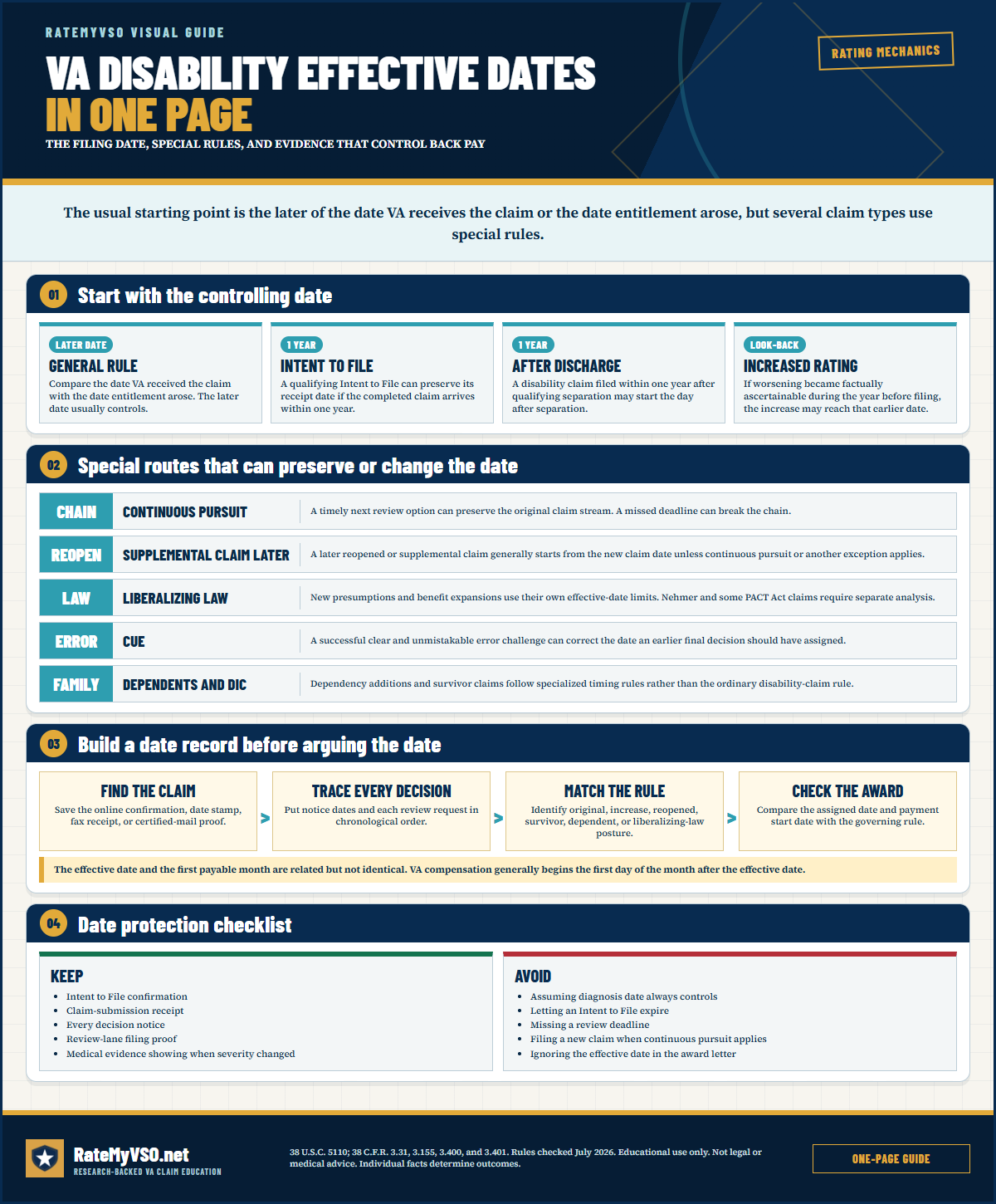 One-page guide: VA Disability Effective Dates In One Page
See the general rule, Intent to File, post-discharge, increase, continuous-pursuit, and CUE date paths in one chart. Opens the full-size chart, free to save or print.
One-page guide: VA Disability Effective Dates In One Page
See the general rule, Intent to File, post-discharge, increase, continuous-pursuit, and CUE date paths in one chart. Opens the full-size chart, free to save or print.
Intent to File (ITF)
An Intent to File is a notice to the VA that you plan to file a disability compensation claim. Filing an ITF locks in an effective date for up to one year while you gather your evidence and complete the formal claim. The governing regulation is 38 CFR 3.155.
How the Date Works
Once VA records your ITF, the date it receives the ITF becomes the controlling effective date for your claim, provided you file the complete claim within one year of that date. If the formal claim arrives within the one-year window and is approved, your compensation back-dates to the ITF date, not to when you submitted the completed claim.
Three Ways to Submit
- Online: VA.gov allows you to submit an Intent to File through the online disability application portal. The submission is logged immediately and you receive a confirmation with a timestamp.
- Paper (VA Form 21-0966): Download and mail or fax VA Form 21-0966 to the VA Evidence Intake Center. The recorded date is when VA receives it, not when you mailed it.
- By phone: Call the VA (1-800-827-1000) and verbally state your intent to file. VA records the call date. Ask the representative to confirm the date recorded before you hang up.
Filing the Full Claim the Same Day Collapses the Window
The ITF is most useful when filed before you complete the formal claim. If you submit both the ITF and the complete claim on the same day, VA treats the date as the effective date of the formal claim and the ITF provides no additional protection going forward. The one-year window is only meaningful if you actually need time to gather evidence after the ITF date is set.
What an ITF Covers
An ITF covers compensation claims (disability ratings). It does not preserve an effective date for a pension claim or a DIC claim on its own. If you are filing for pension, a separate ITF for pension (also on VA Form 21-0966) is needed. The online portal asks which benefit type you are filing for.
Source: 38 CFR 3.155 • VA Form 21-0966
1-Year Post-Discharge Rule
If you file your claim within 1 year of separating from active duty, the effective date is the day after discharge, not the date VA received the claim. See 38 CFR § 3.400(b)(2)(i).
Example: discharge date is 2025-06-15. You file 2026-03-01. Effective date = 2025-06-16. Eight and a half months of back pay.
Miss the 1-year window by even a day, and the effective date drops back to the receipt date of the claim, often a costly distinction.
Reopened Claims
If your original claim was denied and you reopen it later with new evidence, the effective date is the date of the new claim, not the original. See 38 CFR § 3.400(r).
This is one of the most painful rules in VA law. A veteran denied in 2010 who finally gets the right evidence and wins on a 2024 reopened claim does not get 14 years of back pay, only back pay to 2024.
Two routes can restore the original date instead: continuous pursuit, or CUE.
Continuous Pursuit: Keeping the Chain Alive
Continuous pursuit means filing each next review step, a Notice of Disagreement, a Supplemental Claim, a Higher-Level Review request, or a Board appeal, within the deadline that runs from the decision before it. Each timely filing keeps the claim open instead of closed, and an unbroken sequence of timely filings forms a chain that can reach back to the original filing date.
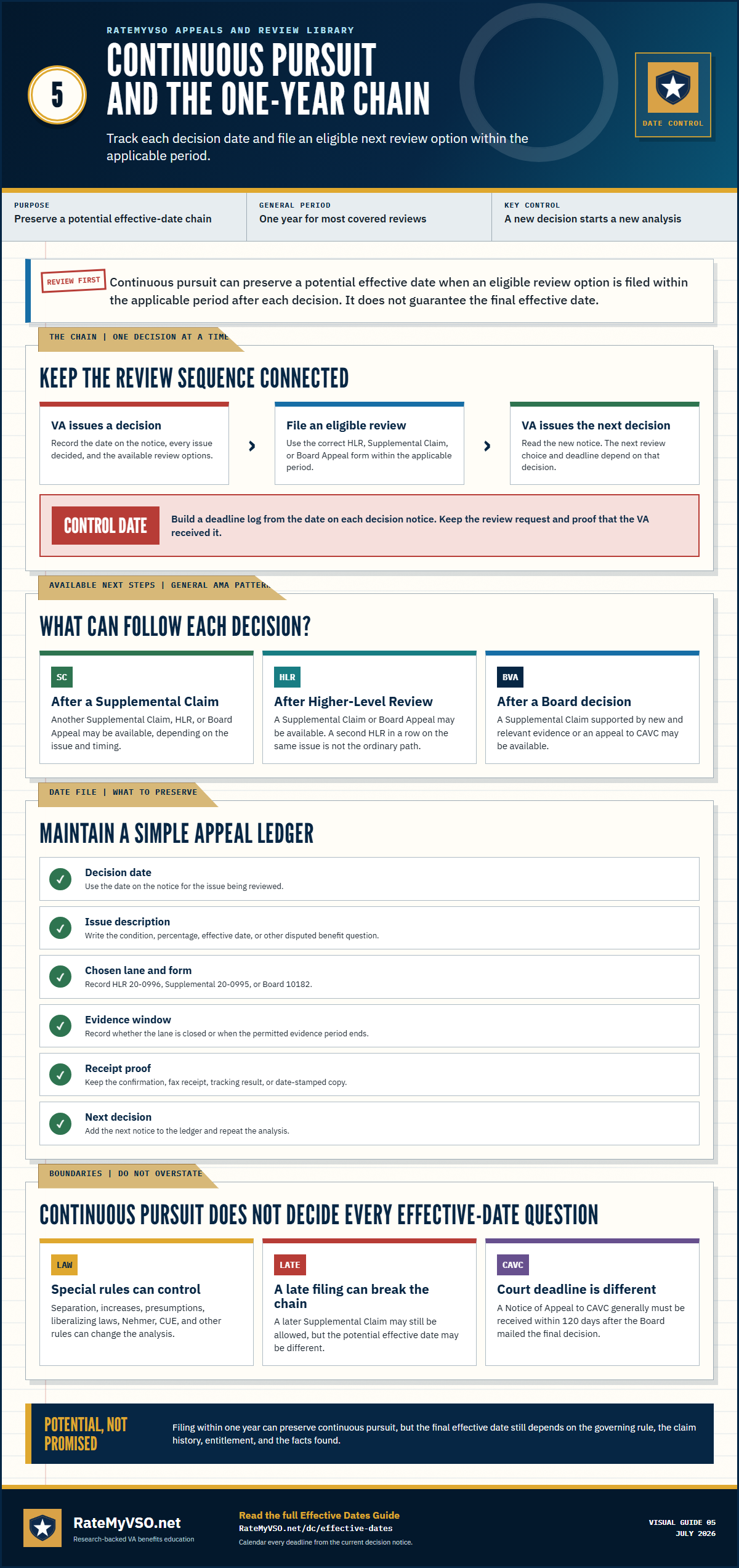
Under the Appeals Modernization Act (AMA, in effect since 2019-02-19), filing a Supplemental Claim, Higher-Level Review, or Board appeal within 1 year of a denial is what keeps the chain unbroken. Outside that window, the claim closes and a later filing reopens it at a new date.
The second route, unrelated to the filing chain, is CUE: if the original denial itself was a clear and unmistakable error, the original date can be restored regardless of what was filed afterward. See the CUE section below.
Withdrawal is the other way to lose your effective date. Withdrawing a pending claim or appeal generally surrenders the effective date and the back pay tied to it. See the withdrawing a claim or appeal guide before calling the 800 number.
Increased Ratings
For a claim asking VA to increase a rating you already have, the effective date follows a different rule. 38 CFR § 3.400(o):
- Default: the date of the increased-rating claim, OR the date VA receives medical evidence showing the increase, whichever is later.
- One-year look-back exception: if VA determines the disability actually worsened within the 1 year before you filed the increase claim, the effective date can be set as far back as the factually-ascertainable date of worsening.
Example: you file an increase claim on 2026-04-01 for a knee that has been getting worse. Treatment records show the knee deteriorated to the new rating level on 2025-08-15. Effective date can be 2025-08-15. About 7 months of additional back pay.
Dependents and DIC
Adding a dependent (spouse, child, dependent parent) to your award has its own rule under 38 CFR § 3.401: file the dependency claim within 1 year of the qualifying event (marriage, birth, adoption) and the effective date is the date of the event. File later, and it's the date VA received the dependency claim.
DIC (Dependency and Indemnity Compensation) for surviving spouses, children, and dependent parents follows 38 CFR § 3.400(c): if filed within 1 year of the veteran's death, effective date = the first day of the month of death. Filed later, effective date = the date VA received the claim.
Liberalizing Law, Nehmer, PACT Act
When Congress or VA expands a benefit, "liberalizing law" rules under 38 CFR § 3.114 control how far back the new benefit reaches.
General Liberalizing Law (38 CFR § 3.114)
If a veteran files within 1 year of a new law's effective date, the effective date is the new law's effective date. File later, and the effective date is the date the new claim was received.
Nehmer (Vietnam Agent Orange)
Nehmer class members get special treatment. For Agent Orange presumptive conditions, the effective date can reach back to the date of the original (sometimes denied) claim under the Nehmer Court Order. See 38 CFR § 3.816. Many Vietnam veterans denied for ischemic heart disease, B-cell leukemias, or Parkinson's before those became presumptive in 2010 are owed years of retroactive pay under Nehmer.
PACT Act (Honoring our PACT Act of 2022)
The PACT Act became law on 2022-08-10. For PACT Act presumptive conditions:
- Claims filed between 2022-08-10 and 2023-08-09 use 2022-08-10 as the effective date.
- Claims filed after 2023-08-09 use the regular receipt-date rule.
Veterans who filed within that 1-year PACT window are entitled to back pay to August 2022 even if the claim was decided years later. See VA's PACT Act page for the conditions list.
CUE (Clear and Unmistakable Error)
Clear and Unmistakable Error is a way to attack a final VA decision and recover the original effective date even decades later. Standards are in 38 CFR § 3.105(a). Three requirements:
- The error must be in a final VA decision (not under appeal).
- It must be the kind of error where, if corrected, the outcome would have been manifestly different.
- The error must be based on the law and evidence as it existed at the time of the original decision, not new evidence or new law.
What counts as CUE: VA misapplied a regulation that was in effect, ignored a record actually in the file, or made a math error on a clearly-set rating schedule. What does NOT count as CUE: a different doctor today reaches a different conclusion, or new evidence emerges, or the law has since changed.
If a CUE motion succeeds, the effective date is the date the original (defective) decision should have used, often decades back. Some CUE awards exceed $500,000 in back pay.
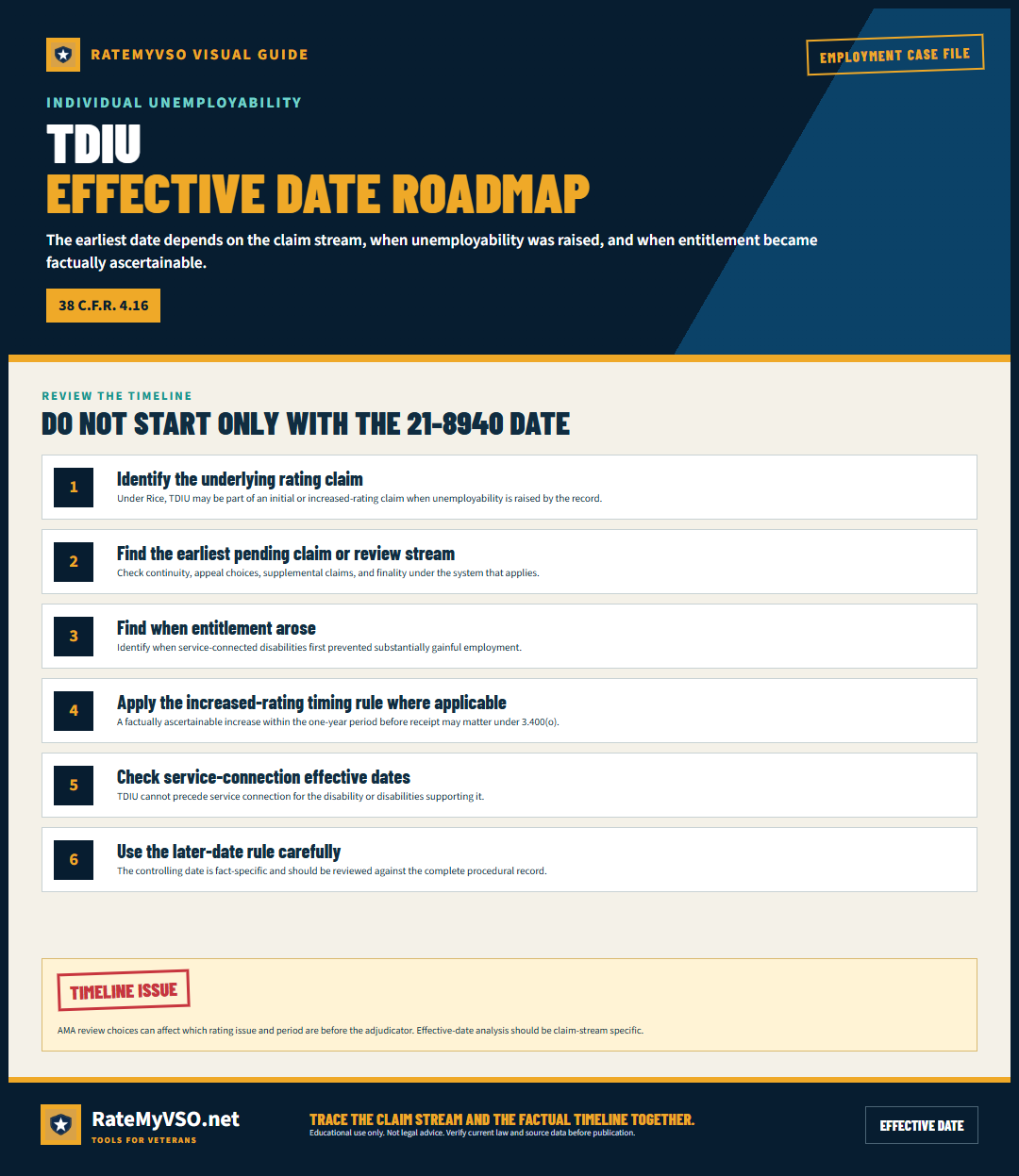
Earlier Effective Date (EED) Theories
"Earlier Effective Date" is the umbrella term for any argument that pushes your effective date back further than what VA initially assigned. Common EED theories:
| Theory | Argument | Effect |
|---|---|---|
| Pending unadjudicated claim | An earlier claim was filed but never formally decided (no rating decision, no denial letter). | Effective date = date of original unadjudicated filing. |
| Implicit denial (Deshotel doctrine) | An earlier claim was denied without explicit acknowledgment, but the issue was raised in the record. | Push back to the implicit-denial date. |
| 1-year look-back on increase | Medical evidence shows worsening within 1 year before the increase claim. | Effective date moves to factual worsening date. § 3.400(o)(2). |
| Continuous prosecution | The original claim was kept alive through timely appeals. | Original receipt date preserved. |
| CUE | Final decision contained a clear and unmistakable error. | Restores the date the original decision should have used. § 3.105(a). |
| Liberalizing law (Nehmer / PACT) | New law expanded a benefit and the original claim falls within the look-back window. | Effective date = new law's effective date or original claim date (per program). |
How Back Pay Is Calculated
Once an effective date is set, back pay equals the monthly compensation rate for each month between the effective date and the date of the rating decision, summed.
Compensation rates change with the annual COLA (cost-of-living adjustment) on December 1 each year, so back pay across multiple years pays at multiple rates.
Use the RateMyVSO Back Pay Estimator to model your actual back pay using historical rates.
Common Mistakes
- Letting an Intent to File expire. An ITF (Form 21-0966) preserves your effective date for 1 year. File the formal claim before it expires or you lose the date.
- Not checking the effective date on the decision letter. When a rating decision arrives, verify the effective date matches the date you filed or the date of your Intent to File. A date recorded incorrectly is a common, and correctable, reason veterans lose back pay.
- Letting the 1-year review window close. Under AMA you have 1 year from the decision date to file a Higher-Level Review or a Notice of Disagreement to the Board. A Supplemental Claim has no deadline and can be filed at any time, but one filed after that year no longer holds your original effective date, so a later grant pays from the newer date.
- Filing a "new" claim instead of a Supplemental Claim. A new claim resets the effective date. A Supplemental Claim within 1 year preserves it. Use the right form.
- Missing the PACT Act 1-year window. Veterans with PACT Act presumptive conditions who didn't file by 2023-08-09 can still file, but they lose the back-date to August 2022.
- Not knowing about Nehmer. Vietnam-era veterans previously denied for now-presumptive conditions (ischemic heart disease, Parkinson's, certain leukemias) often have substantial Nehmer back pay sitting unclaimed.
- Ignoring the 1-year look-back on increase claims. If your condition worsened in the past year, attach the medical evidence to the increase claim and explicitly cite § 3.400(o)(2) in your statement.
Claim Quest: Quick Check
Five questions based only on this guide.
This checks what you understood from this guide. It is not a claim-readiness score, a prediction, an official test, or a record on your account.
Related Tools and Guides
This page is educational and is not legal advice. For help applying these rules to a specific claim, work with a VA-accredited representative.