Your conditions. Your work. Your claim.
VA TDIU: Total Disability Based on Individual Unemployability
This guide explains how the VA can pay you at the 100 percent rate even when your combined rating is below 100 percent. You will learn how TDIU works under 38 CFR § 4.16, the eligibility for schedular and extraschedular consideration, and how the VA decides whether your service-connected conditions prevent "substantially gainful employment." It covers marginal employment, sheltered work environments, and how the VA weighs medical and vocational evidence. You will also find the qualification thresholds, the forms you need like VA Form 21-8940, and the common mistakes that delay or sink a claim. Whether you cannot hold steady work or are preparing evidence to file, this guide shows you how TDIU is evaluated and what it takes to qualify.
Start with what you need
Find your way through TDIU.

Understand TDIU
What it is, the rating thresholds, and the two paths to consideration.
Explore eligibility
When work gets complicated
Marginal employment, earnings, and protected work environments.
Read the work rules
Put your record together
The forms, work history, medical evidence, and supporting statements.
See what to gather
Explain the impact on work
Functional limitations, practical examples, and what to bring.
Open exam preparationThe visual guides, gathered in one place.
Thresholds, employment, evidence and the examination. Open a chart at full size to save or print.
The complete guide
A clearer path through the details.
Choose a chapter. Your place in the guide stays within reach.
01What Is TDIU?
The benefit and why it exists.
TDIU stands for Total Disability Individual Unemployability. It's a VA benefit that pays you at the 100% disability rate even though your actual combined rating is less than 100%.
The idea is simple: if your service-connected disabilities are so severe that you can't maintain substantially gainful employment, you should be compensated as though you're totally disabled, because functionally, you are.
02Eligibility Requirements
Percentage thresholds and the work-capacity question.
There are two paths to TDIU: schedular (meets the rating thresholds) and extraschedular (doesn't meet thresholds but can't work anyway).
Schedular TDIU (38 CFR § 4.16(a))
You meet the rating thresholds if:
- One disability rated at 60% or higher, OR
- Two or more disabilities with a combined rating of 70% or higher, where at least one disability is rated at 40% or higher.
AND your service-connected disabilities prevent you from securing or following a substantially gainful occupation.
Extraschedular TDIU (38 CFR § 4.16(b))
If you don't meet the rating thresholds but your service-connected disabilities still prevent you from working, you can still get TDIU, but the process is different:
- The regional office can't grant it directly.
- Your case gets referred to the Director of Compensation Service for extraschedular consideration.
- This path takes longer but is absolutely available.
03Schedular vs Extraschedular
Two routes, with an important distinction.
Schedular TDIU
- Meets 60% single / 70% combined threshold
- Regional office can grant directly
- Faster processing
- More straightforward to prove
- Most TDIU grants are schedular
Extraschedular TDIU
- Below rating thresholds
- Must be referred to Director of Compensation
- Slower, adds referral step
- Need stronger evidence of unemployability
- Still absolutely possible and granted regularly
04Marginal Employment Rules
Earnings, accommodations, and protected employment.
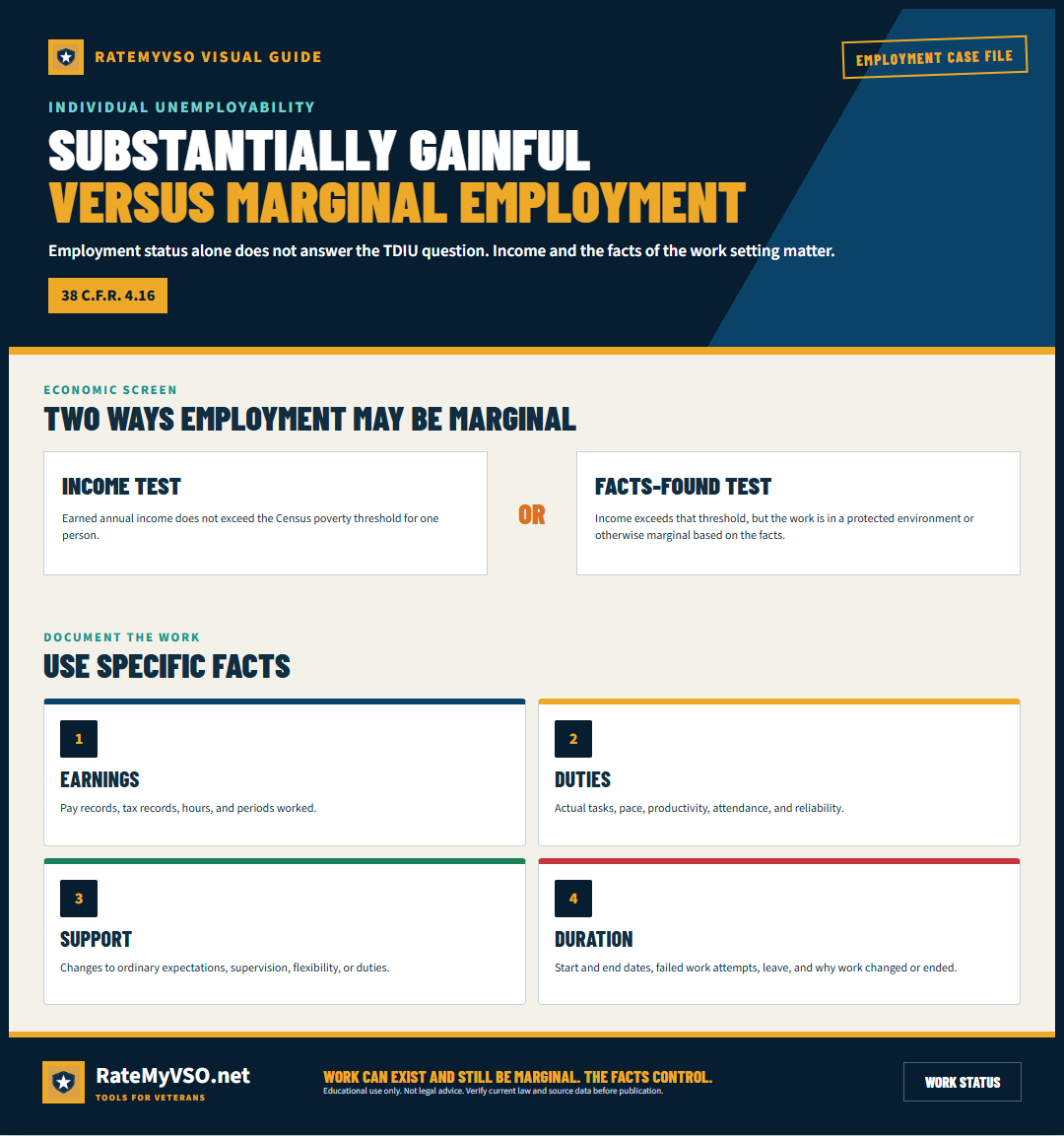
Having a job doesn't automatically disqualify you from TDIU. The standard is substantially gainful occupation, not "any work at all."
What Counts as Marginal (Still Eligible)
- Income below the poverty threshold - if you earn less than the Census Bureau poverty threshold for one person ($16,749 for 2025, or $15,440 if you are 65 or older), your employment is generally considered "marginal" and won't disqualify you. VA uses the Census threshold named in 38 CFR 4.16(a), not the HHS "federal poverty level" figure you may see quoted elsewhere, and the number changes every year.
- Sheltered work environment - working for a family business, a sympathetic employer who accommodates your disabilities, or in a protected workshop. The key question: could you get and keep this job on the open competitive market?
- Part-time or sporadic work - occasional odd jobs or very limited hours generally don't disqualify you.
What Disqualifies You
- Earning above the poverty threshold in a competitive work environment.
- Full-time employment in the open market (with some exceptions for sheltered environments).
05How to File for TDIU
Forms, employment history, and supporting evidence.
- File VA Form 21-8940 (Veteran's Application for Increased Compensation Based on Unemployability). This is the primary TDIU application form.
- File VA Form 21-4192 (Request for Employment Information in Connection with Claim for Disability Benefits). This goes to your former employers. The VA uses it to verify your employment history.
- Submit supporting evidence:
- Medical opinion (nexus letter) explaining how your service-connected disabilities prevent employment
- Employment history showing job losses or inability to maintain work
- Buddy statements from former supervisors, coworkers, or family about your work limitations
- Vocational assessment from a vocational expert (very helpful but not required)
06Common Mistakes
Common gaps that can delay a claim.
- Saying "I can't work because of my age." Age is explicitly excluded from TDIU consideration. Focus only on how your service-connected conditions prevent work.
- Listing non-service-connected conditions. TDIU is about your service-connected disabilities only. Even if your non-SC conditions contribute, don't lead with them.
- Not describing functional limitations. Don't just say "I have PTSD." Explain: "I can't concentrate for more than 20 minutes, I have panic attacks in crowds, I can't handle criticism from supervisors without emotional outbursts."
- Not claiming when employed in a sheltered environment. If your spouse employs you, or your employer makes massive accommodations, you may still qualify.
- Waiting until you're already unemployed. You can file while still working if you believe you'll soon be unable to continue.
07TDIU vs Schedular 100%
Work restrictions, payment, and reduction protection.
Both pay the same monthly rate, but there are important differences:
TDIU
- Same monthly pay as 100%
- Can be reduced, but only under TDIU's own standard, not the schedular 100% rule
- Does NOT automatically qualify for SMC-S (housebound)
- May require periodic employment verification
- Dependents' education benefits (Chapter 35) available if permanent
Schedular 100%
- Same monthly pay
- Can work without affecting rating
- CAN qualify for SMC-S if additional 60%+ disabilities
- No employment restrictions
- Chapter 35 available if permanent
How a TDIU reduction actually works
TDIU has its own reduction standard under 38 CFR § 4.16, separate from the continuance rule that protects a schedular 100 percent rating under 38 CFR § 3.343(a). Do not confuse the two.
- Actual employability must be shown, not just a return to some work. The VA must establish, by clear and convincing evidence, that you are actually able to secure and follow a substantially gainful occupation before it can reduce TDIU.
- Substantially gainful employment alone does not support a reduction unless it was maintained for 12 consecutive months. Short, temporary interruptions in that employment are disregarded.
- The 60-day notice and predetermination hearing rules still apply. See the Proposed Rating Reduction guide for the process.
08Tips for TDIU Claims
Practical guidance for your record.
- Be brutally honest on Form 21-8940. Describe your worst days, not your best. The VA needs to understand what prevents you from maintaining employment.
- Get a vocational expert opinion if your case is borderline or has been denied before.
- Document everything. Missed work, workplace incidents, disciplinary actions, accommodations your employer made, all of this supports your claim.
- Consider filing with an increase claim. If you're at 50% and file for an increase that might get you to 70%, file the TDIU application at the same time.
- Don't forget about protected work. Earning some income doesn't mean you're "employable" in the VA's eyes if you're in a sheltered work setting.
09C&P Exam Preparation for TDIU Claims
Work functions, examples, evidence, and examiner pitfalls.
TDIU does not have a single dedicated "TDIU exam." Instead, VA orders a per-condition Disability Benefits Questionnaire (DBQ) for each service-connected disability and asks the examiner to complete the Functional Impact section on every one. The rater reads those Functional Impact answers, your VA Form 21-8940 (Veteran's Application for Increased Compensation Based on Unemployability), your employer responses on VA Form 21-4192, and your education and work history, then decides under 38 CFR § 4.16 whether your service-connected disabilities alone preclude substantially gainful employment.
Examiners do not decide TDIU. They describe symptoms and functional impact. The rater applies the law. That split matters: your job at the exam is to give the examiner the specific, concrete observations that a rater can later quote.
What examiners actually ask
The Functional Impact section of every DBQ asks one core question, copied verbatim from VA's standardized template:
"Does the Veteran's [condition] impact his or her ability to work? If yes, describe the impact, providing one or more examples."
Around that anchor question, examiners also probe these areas (the exact wording varies by DBQ, but the topics are stable):
- Activities of daily living (ADLs): bathing, dressing, grooming, eating, toileting, transferring (getting in and out of bed or a chair), continence. Inability to perform ADLs independently is the strongest functional evidence.
- Instrumental ADLs (IADLs): cooking, cleaning, laundry, shopping, driving, managing medications, managing finances, using a phone. Loss of IADLs maps directly to lost workplace capacity.
- Sitting, standing, walking tolerance: "How long can you sit before pain forces you to get up?" "How far can you walk before stopping?" These directly bear on sedentary-work analysis.
- Lifting and carrying: pounds, frequency, duration. Examiner may ask you to demonstrate range of motion or grip strength.
- Concentration, persistence, and pace (CPP): the heart of mental-health TDIU. "Can you follow a TV show for an hour?" "Can you read a paragraph and remember what it said?" "Can you maintain attention through a 4-hour task?"
- Social functioning: "Can you interact with coworkers, supervisors, customers, the public?" Panic attacks, irritability, isolation, paranoia all matter here.
- Reliability: "How many days in the last month did you skip planned activities because of your symptoms?" Absenteeism above two to three days per month is industry-recognized as fatal to competitive employment.
- Pain intensity, flare frequency, flare duration: for orthopedic, neurological, and migraine claims. Sharp v. Shulkin, 29 Vet. App. 26 (2017) requires examiners to address flares even when the exam is not during a flare.
- Medication side effects: sedation, cognitive fog, GI symptoms, dizziness. Many veterans become unemployable not from the condition itself but from the side effects of treatment.
- Sleep: hours, fragmentation, daytime hypersomnolence. Common bridge between sleep apnea, PTSD, depression, chronic pain.
Document how your conditions prevent sedentary work, not just physical labor
This is the single most-misunderstood part of TDIU. Under Beaty v. Brown, 6 Vet. App. 532 (1994), VA cannot deny TDIU by simply asserting "the veteran could do sedentary work" without analyzing whether the veteran's service-connected disabilities actually allow sedentary employment. But the burden of producing concrete sedentary-work limitations falls on the veteran. If your symptoms only prevent physical labor, your claim will probably fail.
Common sedentary-work barriers veterans should be ready to articulate by example:
- Sitting tolerance. "I cannot sit at a desk for more than 20 to 30 minutes before back pain forces me to stand and walk for 10 minutes." A typist or coder needs sustained sitting. Describe what breaks that.
- Hand and arm use. "I cannot grip a pen or use a keyboard for more than 15 minutes without numbness and dropping objects." Carpal tunnel, cervical radiculopathy, peripheral neuropathy, or rated DC 5215 to 5228 hand/wrist conditions.
- Concentration in a quiet office. "I lose track mid-sentence three or four times an hour. I have to re-read paragraphs." PTSD, depression, TBI residuals, sleep deprivation. Tie to 38 CFR § 4.130 language: "occupational and social impairment with reduced reliability and productivity" (50%) or "deficiencies in most areas" (70%).
- Tolerating fluorescent lighting, computer screens, or background noise. Migraine (DC 8100), TBI (DC 8045), photophobia. A sedentary office is full of these triggers.
- Maintaining a schedule. "On bad days I cannot get out of bed. I cannot predict which days those will be. In the last 30 days I had nine of them." Maps to Faust v. West, 13 Vet. App. 342 (2001) recognition that unpredictable absenteeism defeats competitive employment.
- Tolerating supervision and interaction. "I have panic attacks when a supervisor approaches my desk." "I cannot answer the phone." PTSD, social phobia, paranoid features.
- Medication side effects in a workplace. "My pain medication makes me too drowsy to drive. I cannot operate machinery or focus on detailed work after I take it." Sedation, cognitive impairment, GI urgency that requires unscheduled bathroom access.
- Bathroom access. "I have IBS flares that require unscheduled bathroom access two to four times a morning, lasting 15 to 30 minutes each." Few employers tolerate that. DC 7319 / 7332 / 7336 claims.
- Sleep apnea and CPAP-dependence with daytime symptoms. "Even with CPAP I have daytime hypersomnolence. I fell asleep in three meetings last month." DC 6847.
How to articulate symptom impact during the exam
The examiner has 15 to 30 minutes per condition. The temptation to say "I'm fine, I'm tough" must be resisted. Practical guidance based on what wins:
- Describe your worst day in the last 30 days, not your average. The rating schedule reads "frequency, severity, and duration" and the rater needs the upper bound. "Last Tuesday I could not get out of bed because of a migraine and lost the entire day." Tell that story.
- Use numbers wherever possible. "Three flares per week, each four to six hours." "Eight to ten missed days per month over the past year." "Can sit no longer than 20 minutes." Examiners record what you say. Vague statements get translated into vague Functional Impact write-ups.
- Tie symptoms to specific work tasks you can or cannot do. "I cannot stand for the cashier shift my last job required. I cannot type for the data-entry job I tried two years ago. I cannot drive to a job site because of vision issues during a flare."
- Bring a written symptom diary. Hand it to the examiner. A two-week journal with dates, pain scores, missed activities, and triggers is far harder to discount than a verbal recollection. Examiner is required to consider lay evidence under Buchanan v. Nicholson, 451 F.3d 1331 (Fed. Cir. 2006).
- List your current medications and side effects. Many veterans forget to mention drug-induced sedation or cognitive fog. The examiner will not ask if you do not raise it.
- Explain what your last job ended over. Were you fired for absenteeism? Did you reduce hours to part-time? Did your employer make accommodations? Each maps to the Geib v. Shinseki, 733 F.3d 1350 (Fed. Cir. 2013) requirement that the rater consider real-world employment history.
- Describe what you have tried and why it did not work. "I tried part-time security work in 2024 and quit after six weeks because I could not stand the full shift." That is direct evidence of unemployability under 38 CFR § 4.18.
- Never overstate. If you can drive ten miles to the grocery store once a week, say so. Inconsistencies between your statements and your medical records get flagged in the rating decision and used against you.
What to bring to the exam
- A typed one-page summary listing every service-connected disability and how each one limits work tasks. Hand it to the examiner. Ask them to attach it.
- A two- to four-week symptom diary with dates, pain scores, flare frequency, and missed activities.
- A list of current medications with side effects you experience.
- A copy of your VA Form 21-8940 employment-history section so your testimony matches what you wrote.
- Lay statements from family or former coworkers describing observable limitations. Buchanan makes these competent evidence of symptoms.
- A list of accommodations your last employer made (reduced hours, schedule flexibility, light-duty restrictions, frequent breaks).
Diagnostic codes most often involved in TDIU and the occupational impact framing for each
Different conditions map to different parts of the Functional Impact analysis. Brief framing guidance:
- Mental health (DCs 9201-9440): Rated entirely by occupational and social impairment under 38 CFR § 4.130. The 70% level explicitly contemplates "inability to establish and maintain effective relationships", a documented inability to work with supervisors or coworkers is the rating. See the Mental Health Rating Formula guide and the PTSD Claims Guide.
- Spine and orthopedic (DCs 5235-5243, 5260-5263, 5200-5215): Range of motion drives the schedular rating, but TDIU turns on sitting tolerance, lifting limits, painful motion under 38 CFR § 4.59, and flare frequency under Sharp v. Shulkin. The examiner must address flares.
- Migraine (DC 8100): Rated by "prostrating attack" frequency. A prostrating attack means stopping all activity and lying down. The 50% level requires "very frequent completely prostrating and prolonged attacks productive of severe economic inadaptability", language written directly for TDIU.
- Sleep apnea (DC 6847): CPAP-dependence sets 50%. TDIU turns on residual daytime hypersomnolence, cognitive impairment, and reliability. Document fall-asleep-at-work episodes specifically.
- TBI (DC 8045): Rated across ten facets (memory, judgment, social interaction, orientation, motor activity, visual spatial orientation, subjective symptoms, neurobehavioral effects, communication, consciousness). Each facet is a TDIU evidence point. See Rating TBI.
- Cardiac (DCs 7000-7019): METs (metabolic equivalents) drive the rating. A 3 METs limit (the 100% threshold) effectively means no employment is sustainable. Below that, the question becomes whether the METs-permitted tasks exist in your real labor market.
- Hearing loss and tinnitus (DCs 6100, 6260): Schedular ratings are notoriously low. TDIU often turns on the combination with mental-health symptoms or on documented job loss from communication failure.
- Diabetes and its complications (DC 7913 + secondaries): Insulin-dependent diabetes with regulation of activities, plus secondary peripheral neuropathy (DC 8520) or retinopathy, can reach TDIU through cumulative functional limitation rather than any single condition.
- Digestive (DCs 7319, 7323, 7332, 7336): IBS, ulcerative colitis, hemorrhoids, fistula. Functional impact framing: unscheduled and unpredictable bathroom access, fecal urgency, abdominal pain forcing schedule disruption.
- Genitourinary (DCs 7507-7542): Urinary frequency, incontinence, dialysis schedule. Same workplace-disruption logic as digestive.
What the rater is required to consider beyond the exam
Per 38 CFR § 4.16(a) and the M21-1 procedural rules at Part IV, Subpart ii, Chapter 2, Section F, the rater must consider:
- Your education level and training.
- Your full employment history (the last five years are on the 21-8940 form. The rater can request earlier).
- Whether prior employment was substantially gainful or marginal under the poverty-threshold test.
- Whether the conditions preclude both physical and sedentary work, per Beaty v. Brown.
- Not your age. Hatlestad v. Brown, 5 Vet. App. 524 (1993) bars VA from denying TDIU based on age.
- Not non-service-connected conditions. The rater must isolate the impact of service-connected disabilities alone.
If the rating decision relies on any of the prohibited factors, that is a specific ground for Higher-Level Review or Supplemental Claim.
Common C&P exam pitfalls that sink TDIU claims
- "Mild" or "no impact on employment" boilerplate. Some contract examiners default to this. If the Functional Impact section says "mild" but your record shows missed work, fired-for-absenteeism, or accommodations, you have a Stefl v. Nicholson, 21 Vet. App. 120 (2007) inadequate-exam argument. See Bad C&P Examiner and How VA Raters Weigh Medical Opinions.
- Examiner not addressing flares. Sharp v. Shulkin requires it. Absence of flare analysis on an orthopedic, migraine, or mental-health exam is an inadequate exam.
- Examiner conflating "able to perform ADLs" with "able to work." Doing dishes is not the same as holding a 40-hour job. If the Functional Impact write-up only addresses ADLs without addressing IADLs and work tasks, that is incomplete.
- Examiner answering "no" to functional impact because the veteran is currently working. Marginal employment, sheltered work, and protected work (family business, accommodated job) are not substantially gainful. The Functional Impact section must reflect that. Be ready to describe accommodations.
- Examiner relying on a single best-day snapshot. Bring the symptom diary specifically to counter this.
See the connections
Visual references for your next step.
Every chart linked from this guide, grouped by purpose. Full-size charts open separately; your place here stays put.
Understand the routes
5 charts ·
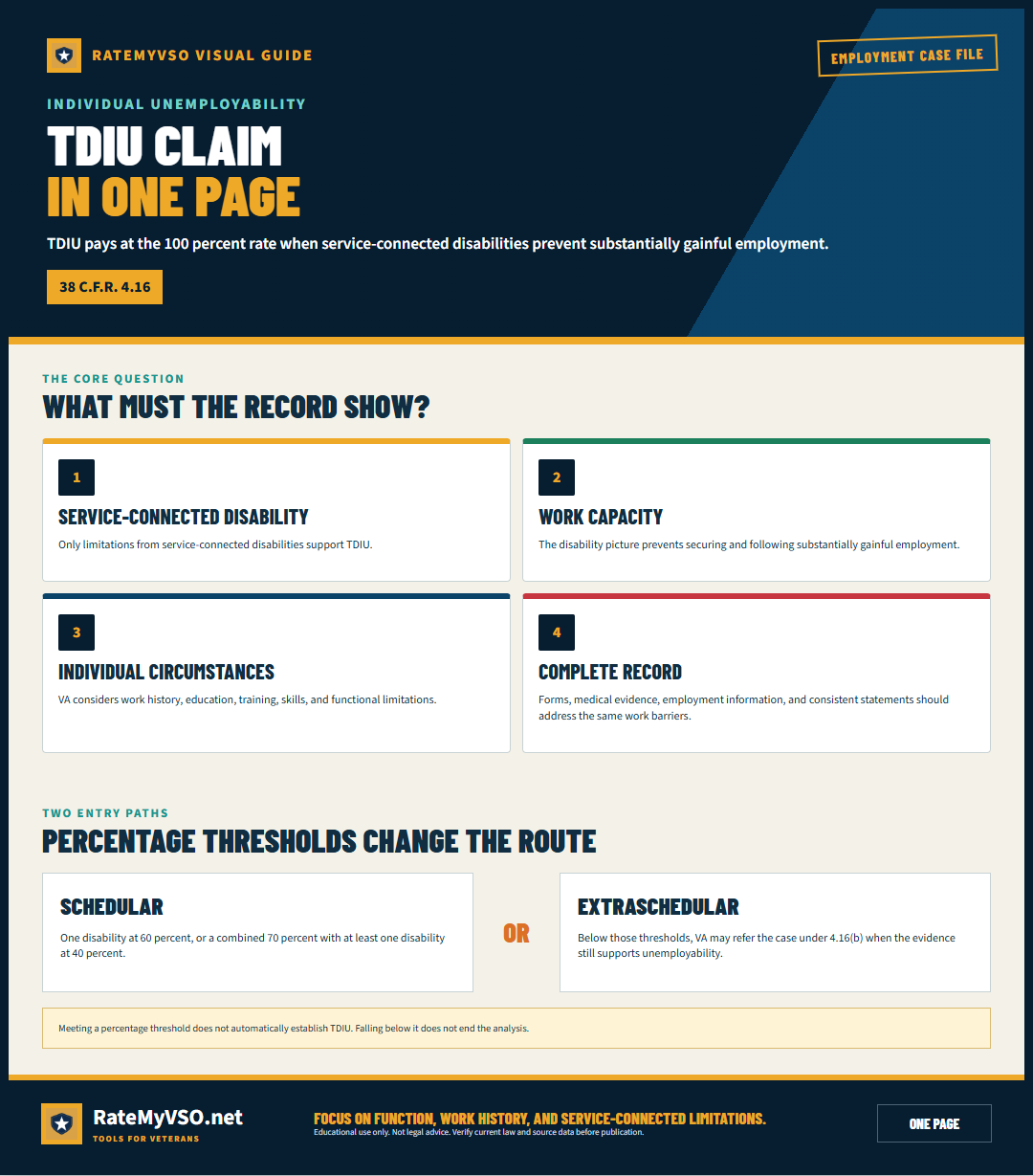 One-page guide: TDIU Claim in One Page
Five-part visual guide to TDIU covering service-connected work limitations, schedular and extraschedular routes, marginal employment, employment and medical evidence, work-capacity questions, and a filing checklist. Opens the full-size chart, free to save or print.
One-page guide: TDIU Claim in One Page
Five-part visual guide to TDIU covering service-connected work limitations, schedular and extraschedular routes, marginal employment, employment and medical evidence, work-capacity questions, and a filing checklist. Opens the full-size chart, free to save or print.
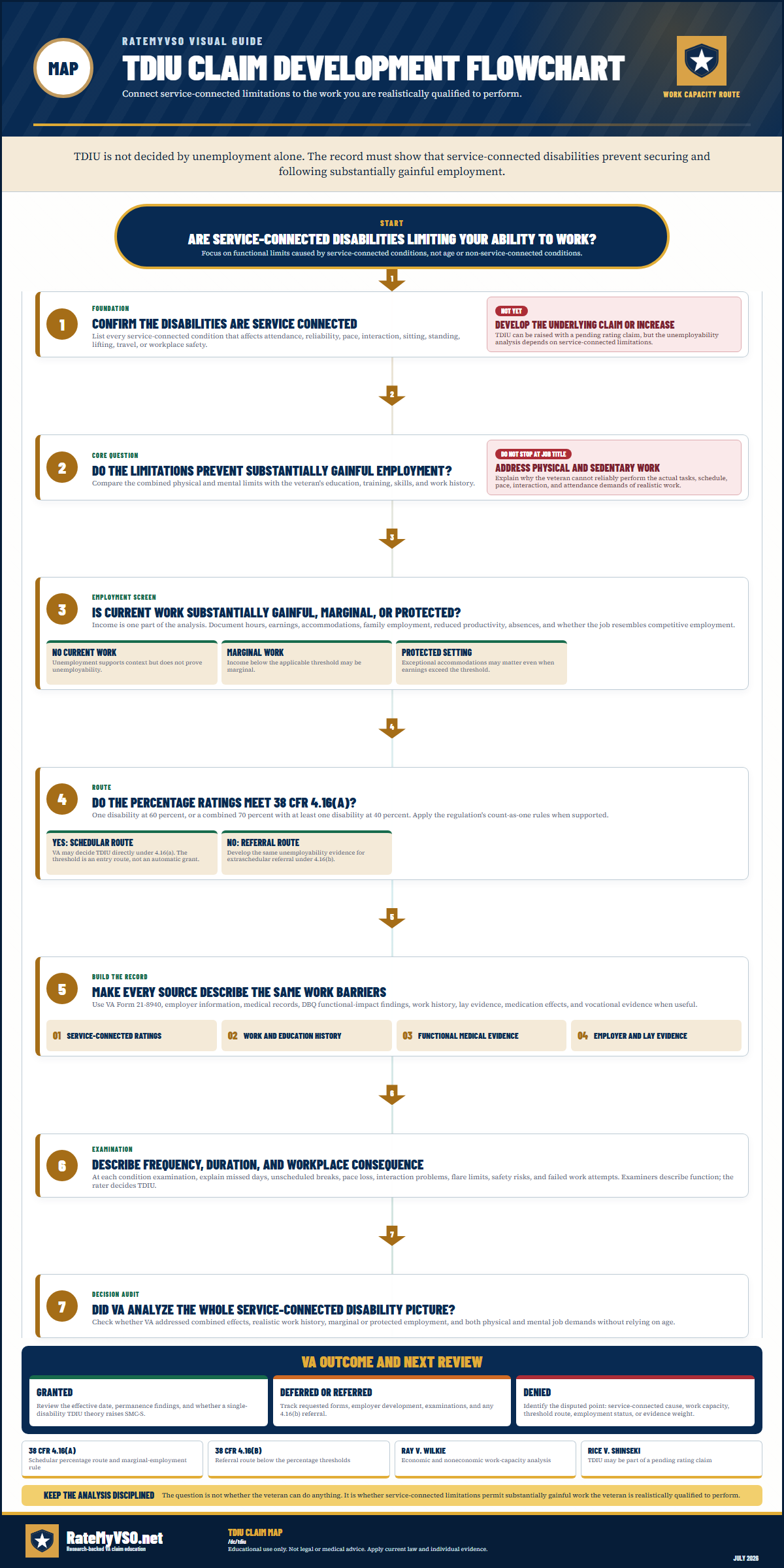
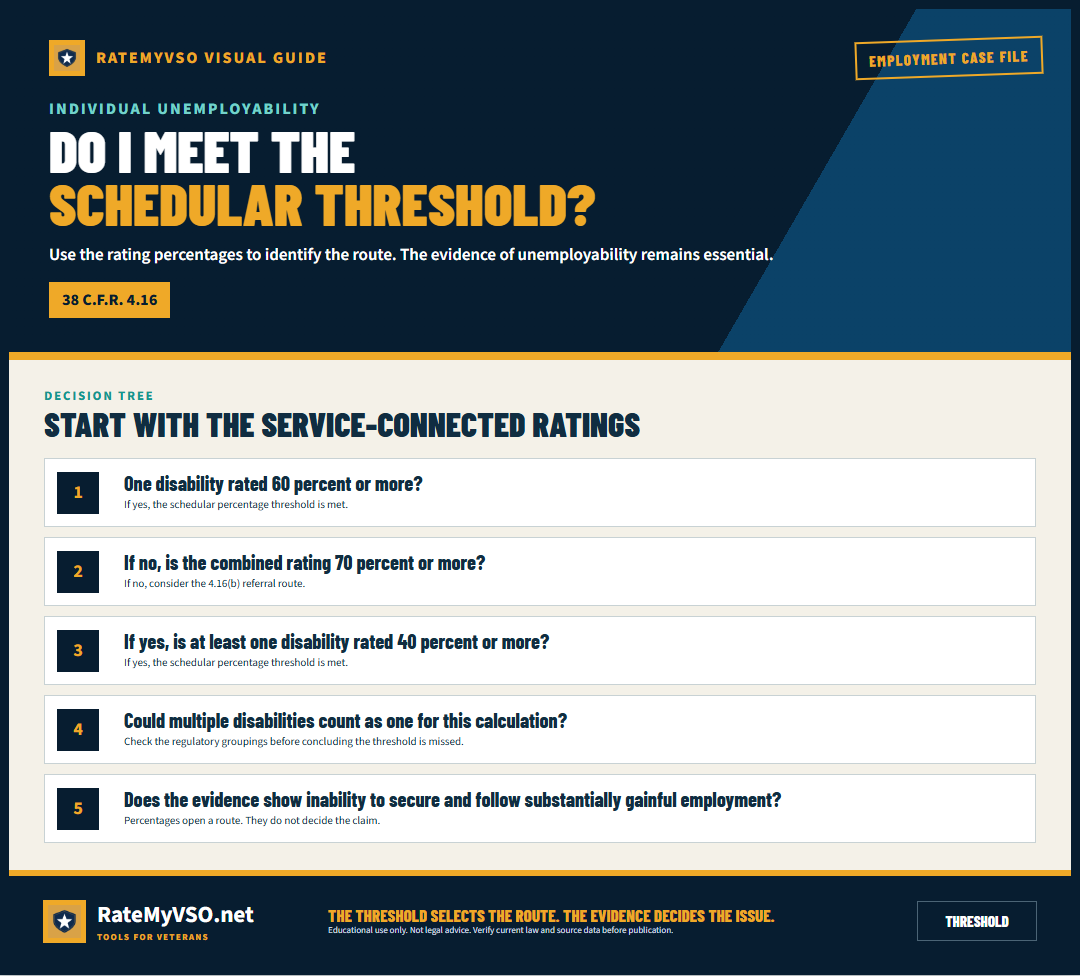
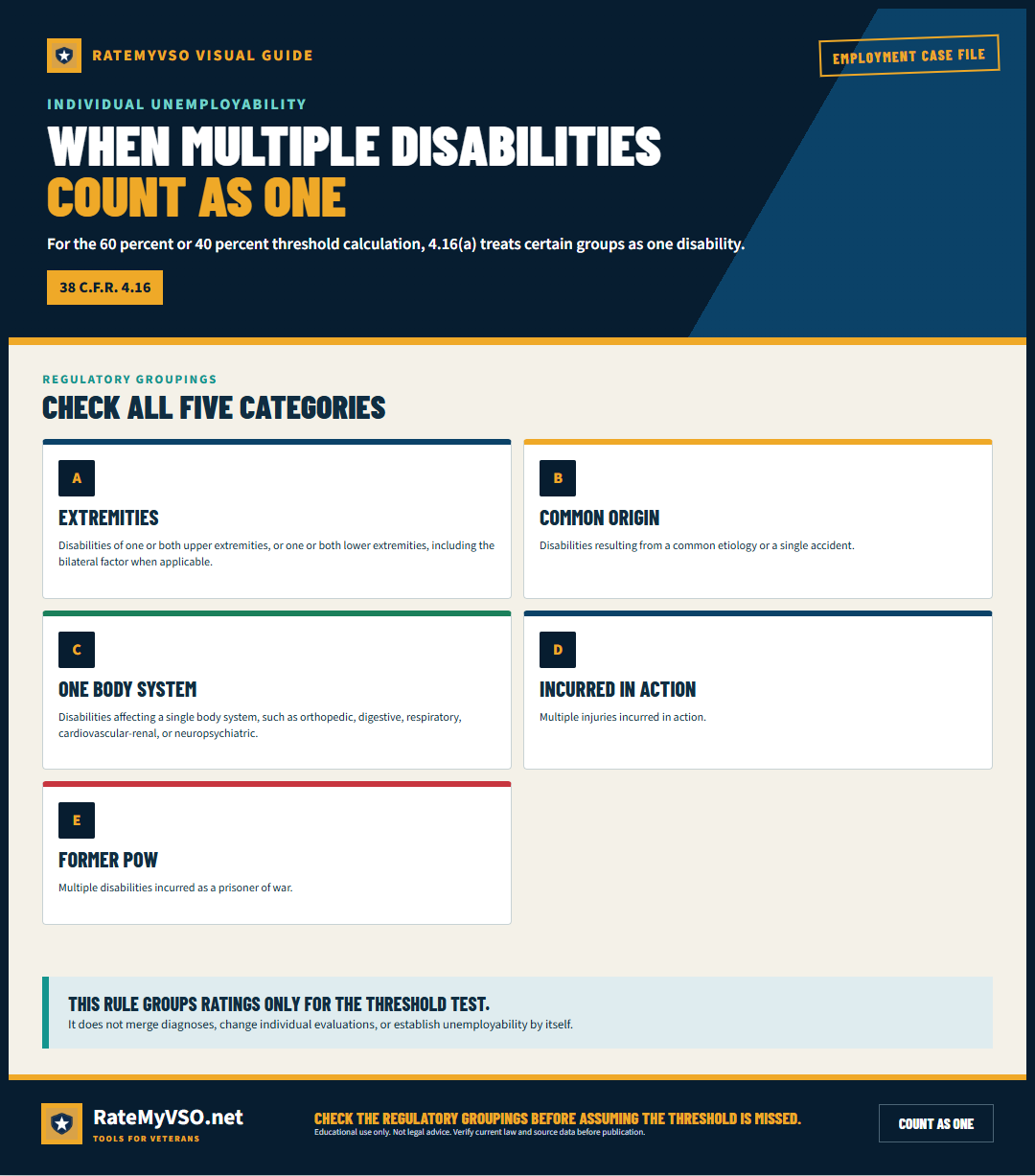 One-page guide: When TDIU Disabilities Count as One
Five regulatory groupings that may count as one disability for the TDIU percentage threshold. Opens the full-size chart, free to save or print.
One-page guide: When TDIU Disabilities Count as One
Five regulatory groupings that may count as one disability for the TDIU percentage threshold. Opens the full-size chart, free to save or print.
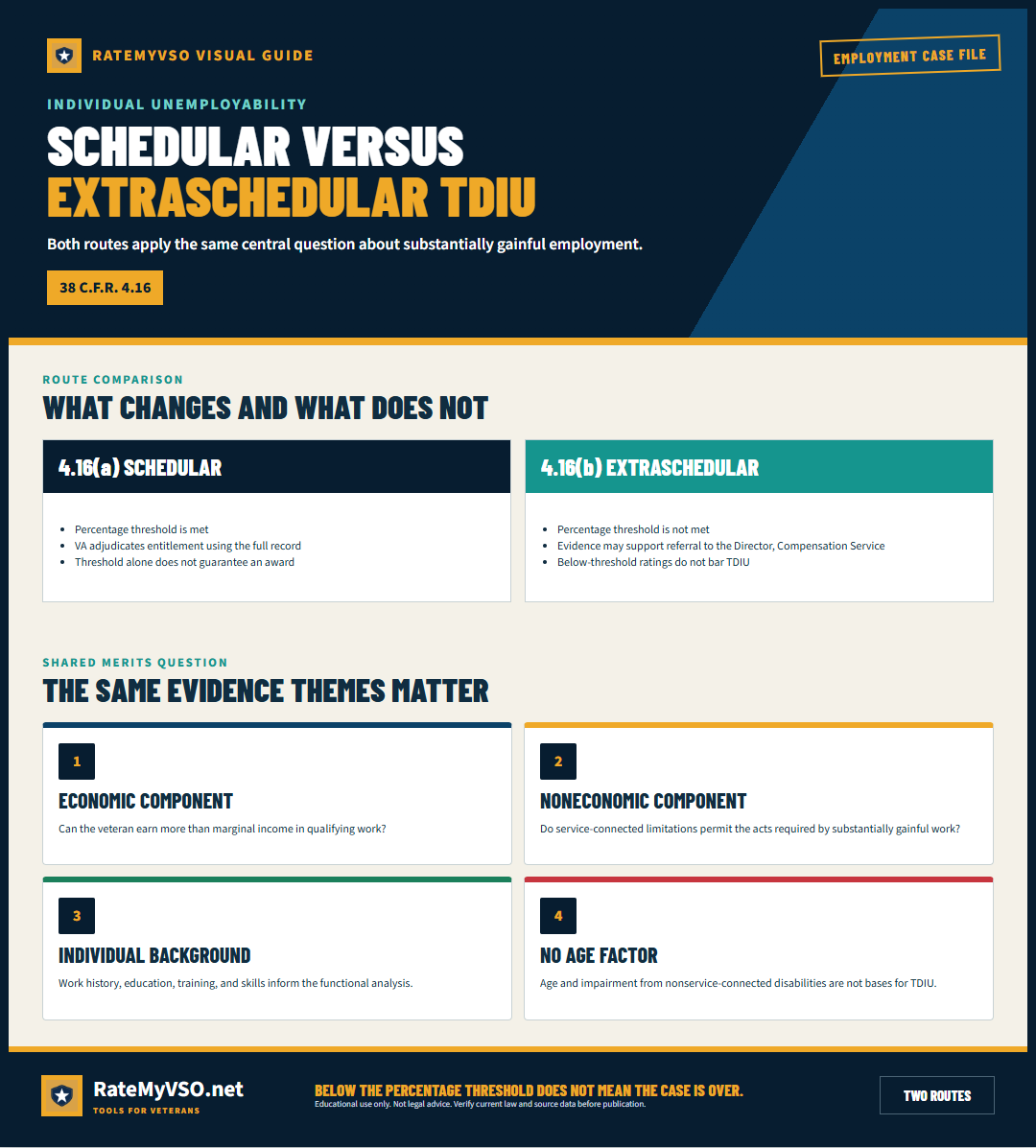 One-page guide: Schedular vs Extraschedular TDIU
Comparison of the schedular and extraschedular TDIU routes. Opens the full-size chart, free to save or print.
One-page guide: Schedular vs Extraschedular TDIU
Comparison of the schedular and extraschedular TDIU routes. Opens the full-size chart, free to save or print.
Work, income & protection
4 charts ·
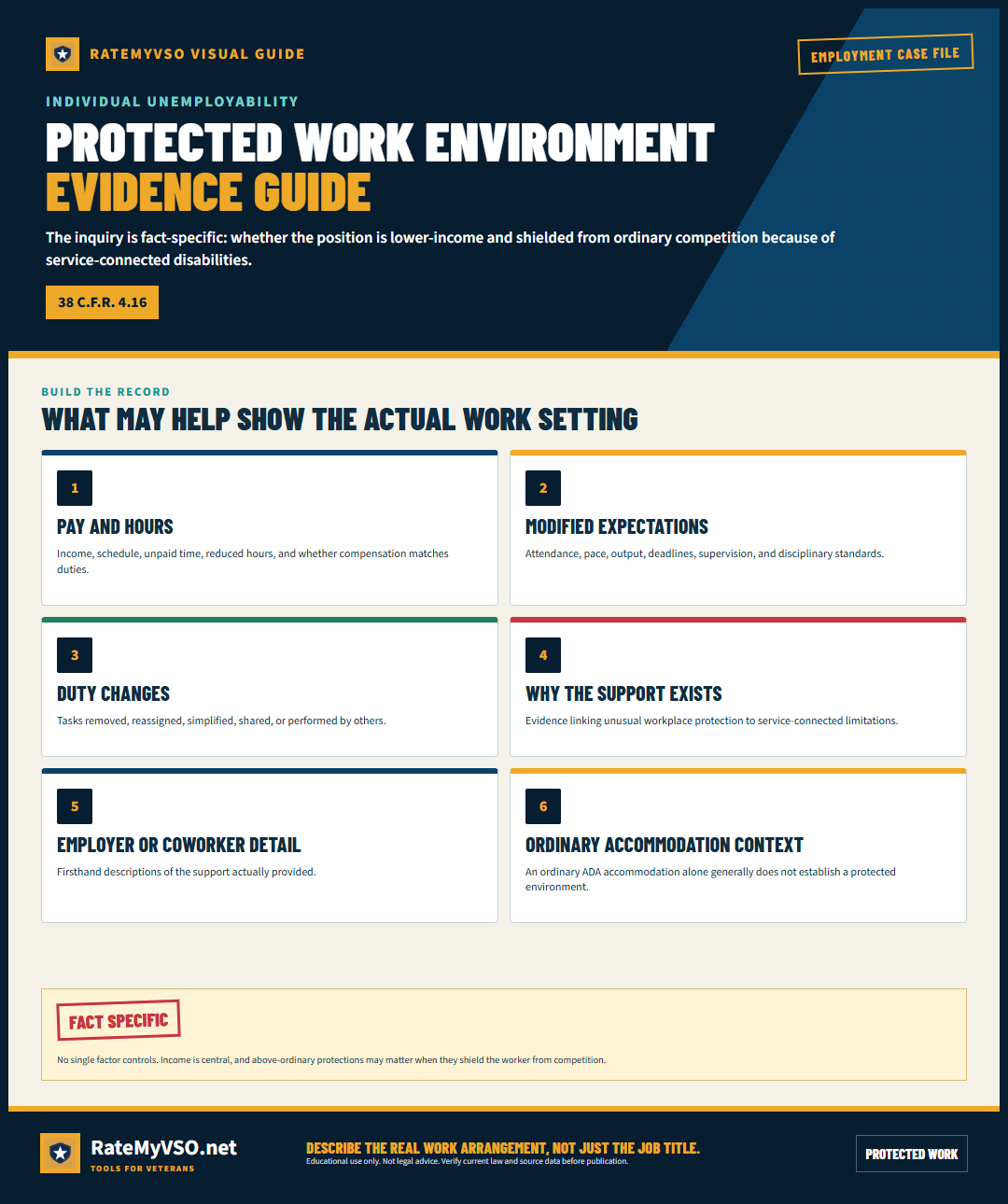 One-page guide: Protected Work Environment Evidence
Evidence guide for documenting a protected work environment in a TDIU claim. Opens the full-size chart, free to save or print.
One-page guide: Protected Work Environment Evidence
Evidence guide for documenting a protected work environment in a TDIU claim. Opens the full-size chart, free to save or print.
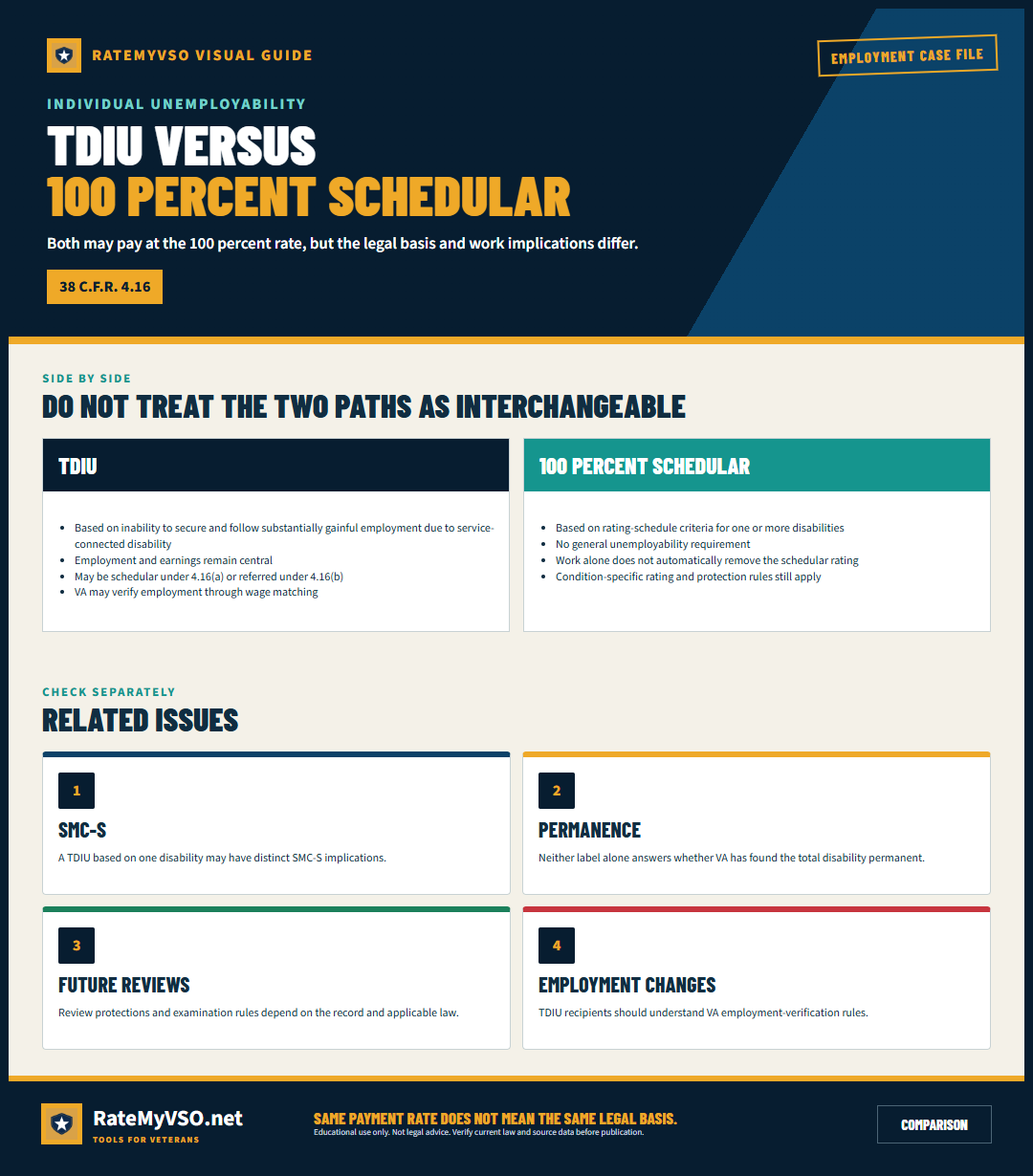 One-page guide: TDIU vs 100 Percent Schedular
Comparison of TDIU and a 100 percent schedular disability rating. Opens the full-size chart, free to save or print.
One-page guide: TDIU vs 100 Percent Schedular
Comparison of TDIU and a 100 percent schedular disability rating. Opens the full-size chart, free to save or print.
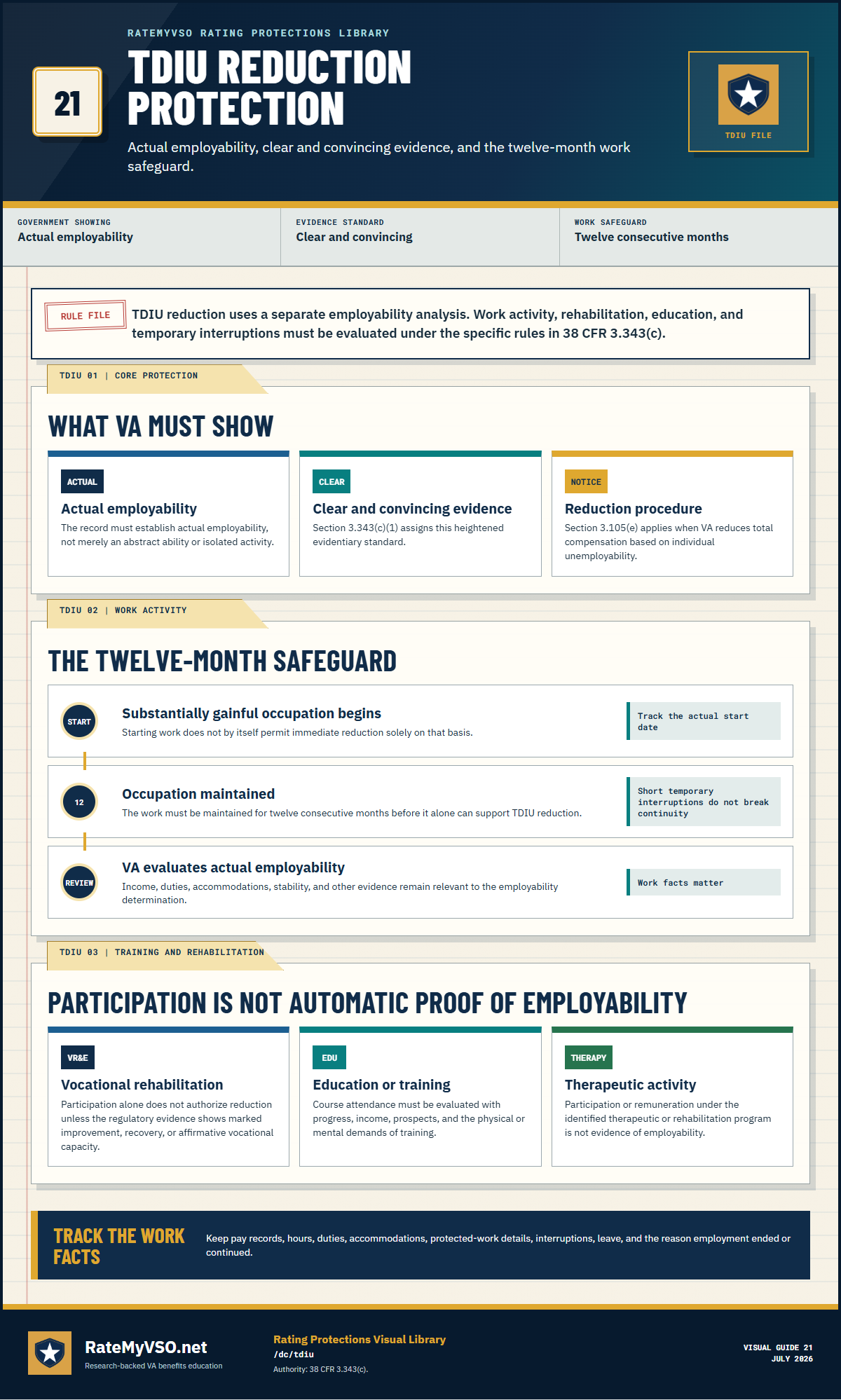 One-page guide: TDIU Reduction Protection
TDIU reduction guide covering actual employability, clear and convincing evidence, twelve consecutive months of work, rehabilitation, education, and therapeutic activity. Opens the full-size chart, free to save or print.
One-page guide: TDIU Reduction Protection
TDIU reduction guide covering actual employability, clear and convincing evidence, twelve consecutive months of work, rehabilitation, education, and therapeutic activity. Opens the full-size chart, free to save or print.
Evidence & filing
6 charts ·
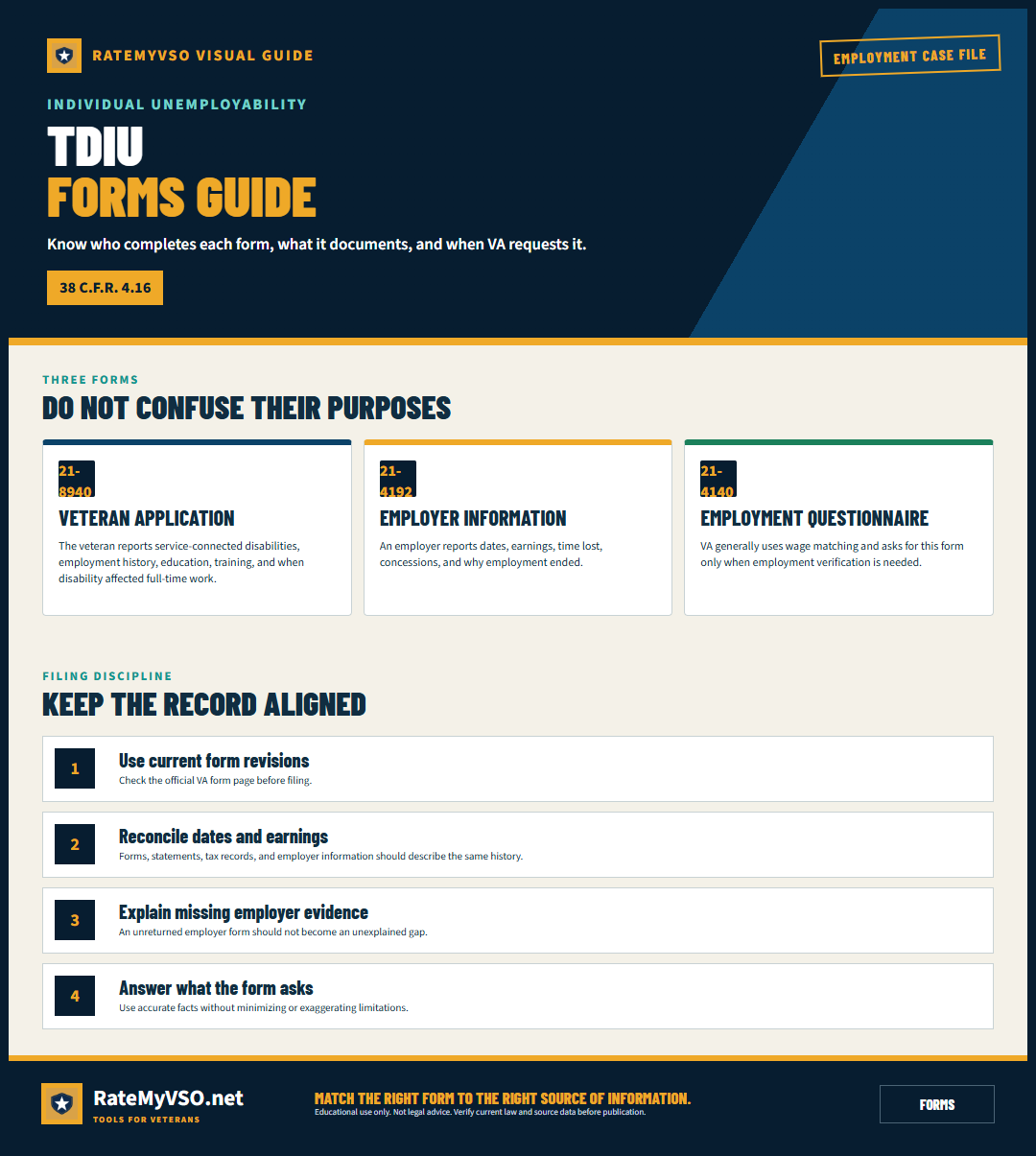 One-page guide: TDIU Forms Guide
Guide to VA Forms 21-8940, 21-4192, and 21-4140. Opens the full-size chart, free to save or print.
One-page guide: TDIU Forms Guide
Guide to VA Forms 21-8940, 21-4192, and 21-4140. Opens the full-size chart, free to save or print.
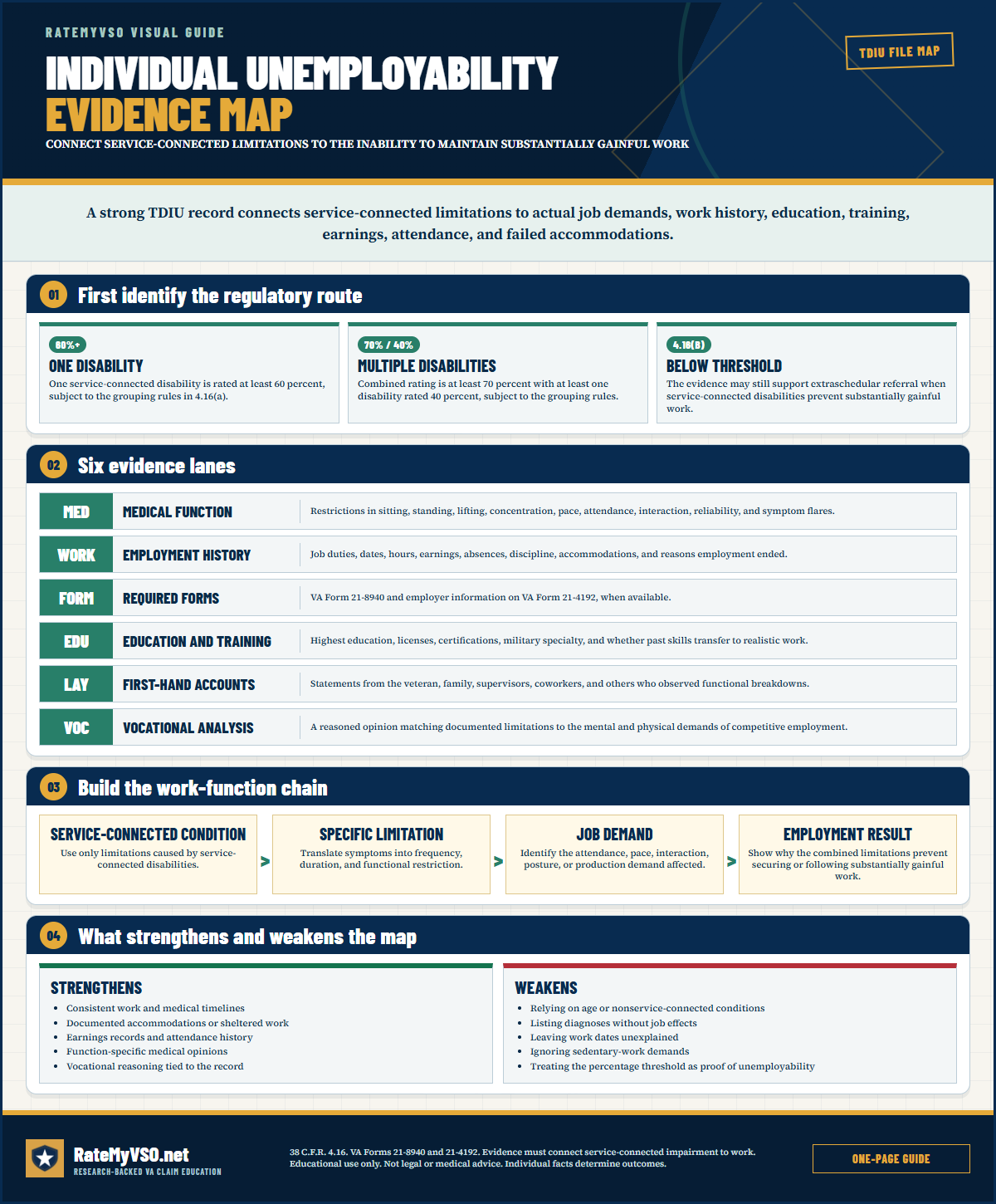 One-page guide: Individual Unemployability Evidence Map
Map medical, work, earnings, education, lay, and vocational evidence to the work-function question. Opens the full-size chart, free to save or print.
One-page guide: Individual Unemployability Evidence Map
Map medical, work, earnings, education, lay, and vocational evidence to the work-function question. Opens the full-size chart, free to save or print.
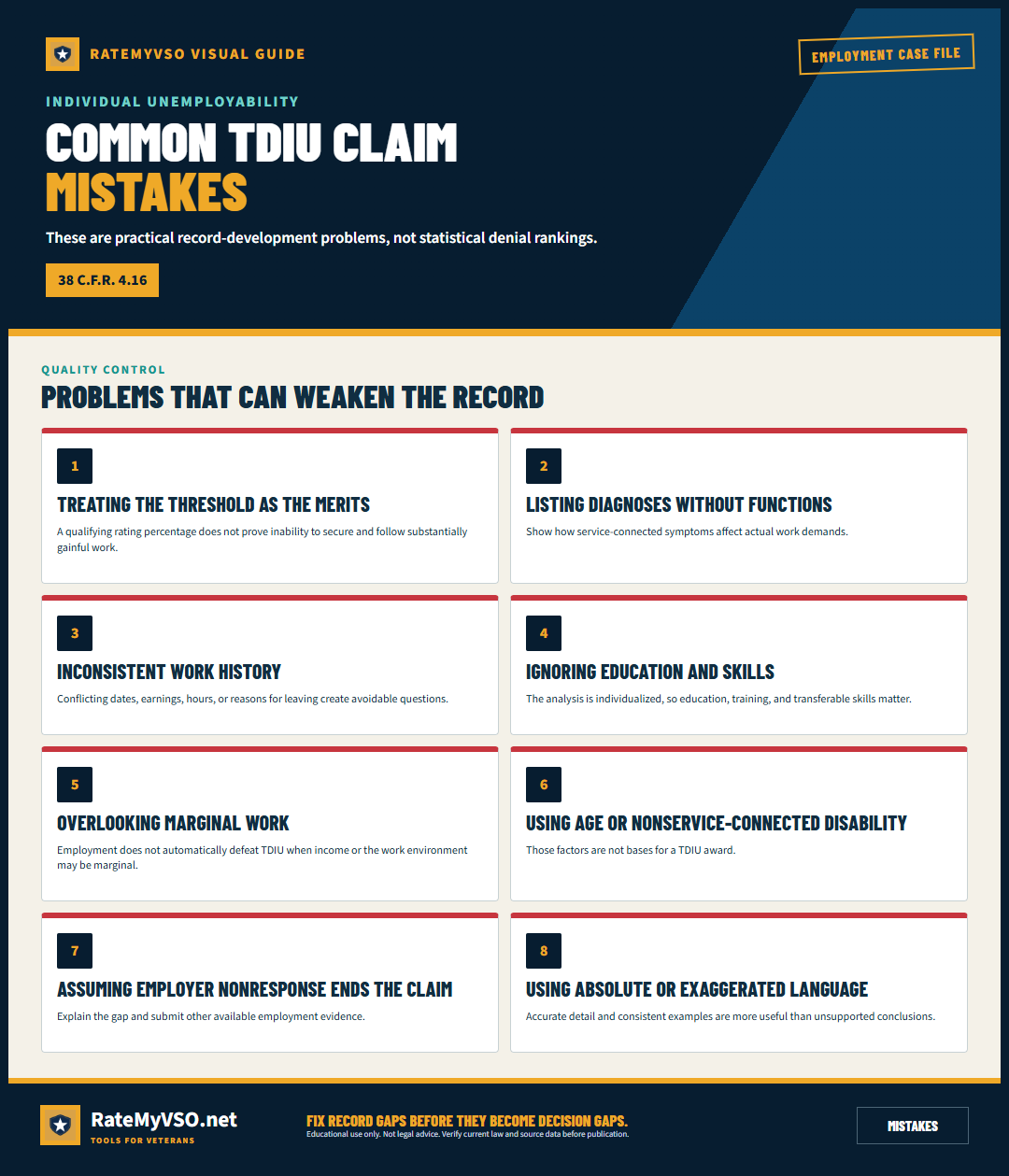 One-page guide: Common TDIU Claim Mistakes
Eight common record-development mistakes in TDIU claims. Opens the full-size chart, free to save or print.
One-page guide: Common TDIU Claim Mistakes
Eight common record-development mistakes in TDIU claims. Opens the full-size chart, free to save or print.
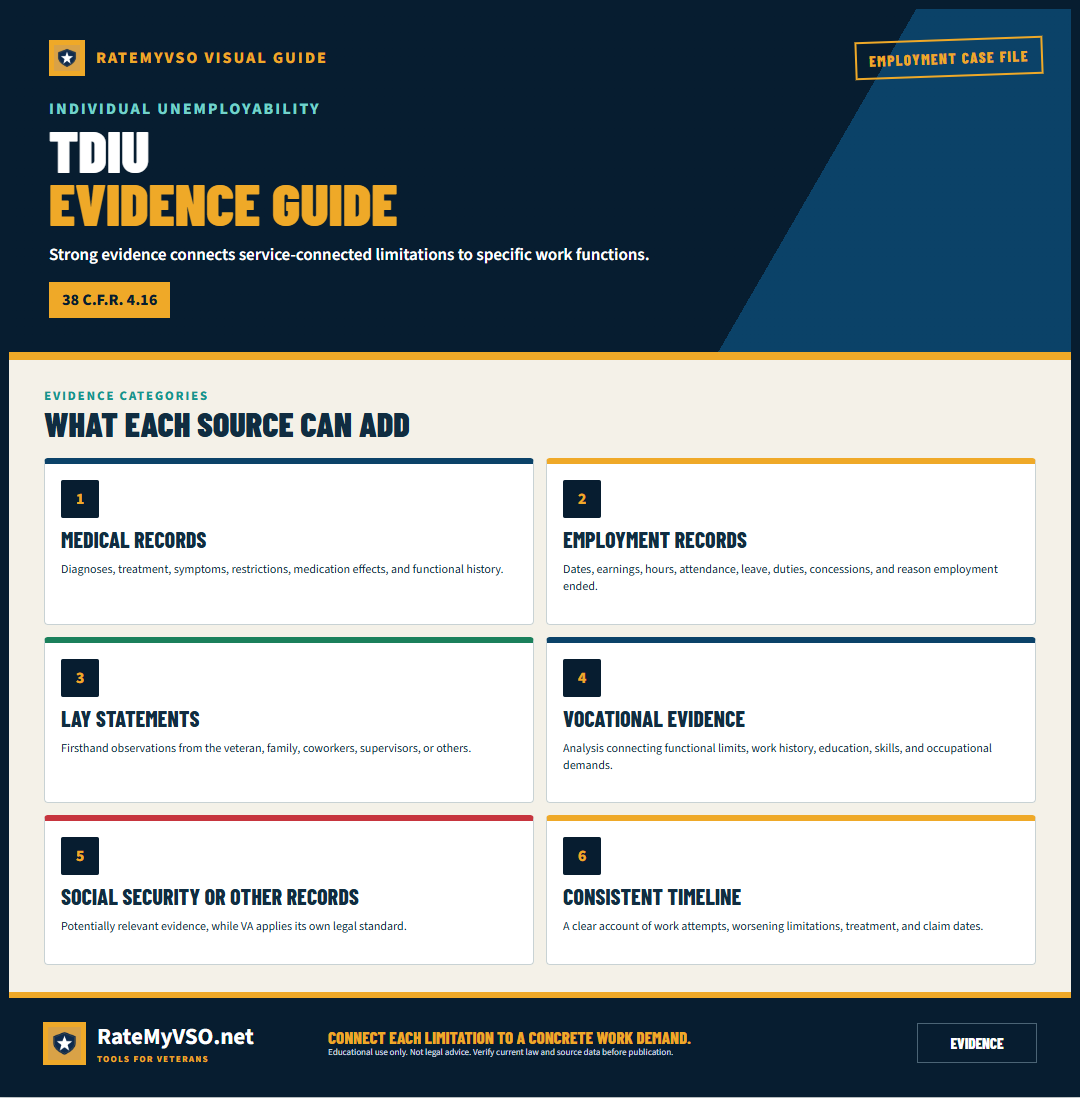 One-page guide: TDIU Evidence Guide
Six evidence categories that may document service-connected work limitations. Opens the full-size chart, free to save or print.
One-page guide: TDIU Evidence Guide
Six evidence categories that may document service-connected work limitations. Opens the full-size chart, free to save or print.
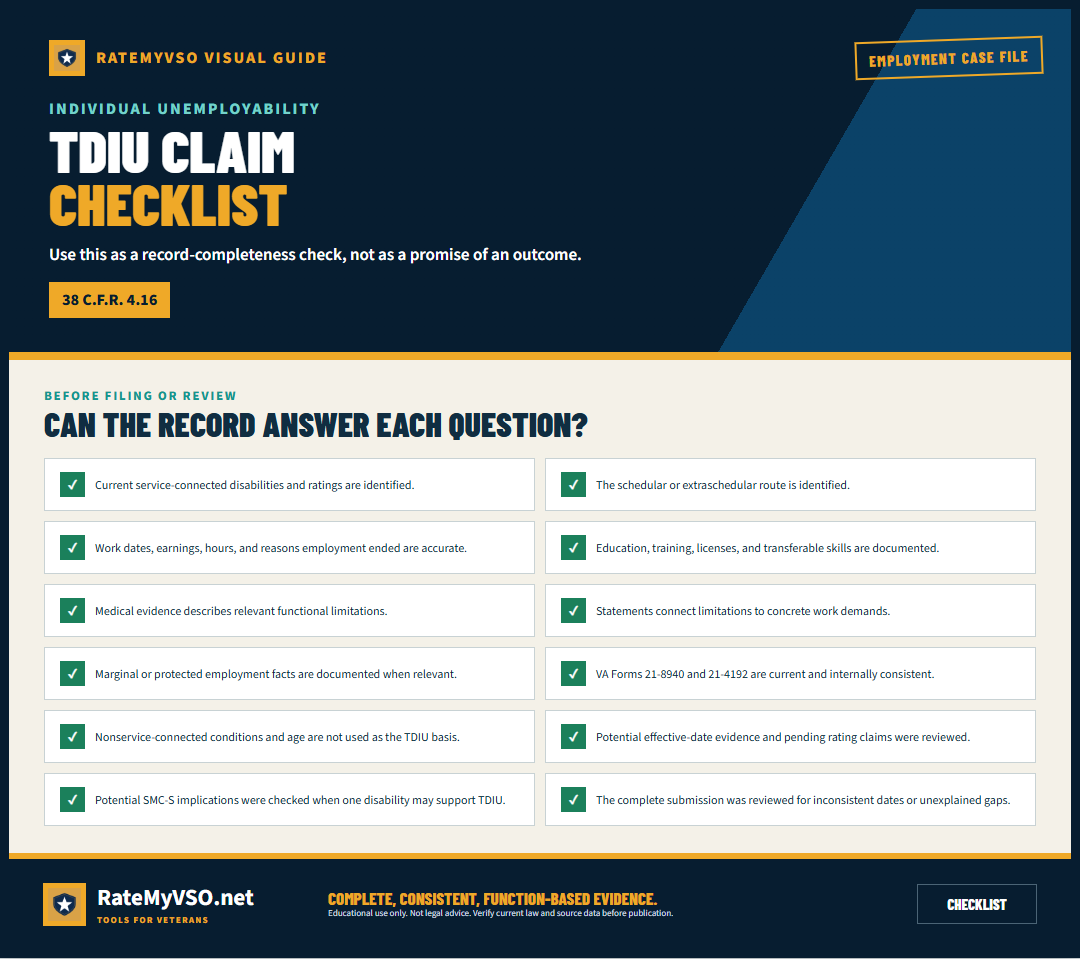 One-page guide: TDIU Claim Checklist
Twelve-item completeness checklist for a TDIU claim record. Opens the full-size chart, free to save or print.
One-page guide: TDIU Claim Checklist
Twelve-item completeness checklist for a TDIU claim record. Opens the full-size chart, free to save or print.
Prepare for the examination
2 charts ·
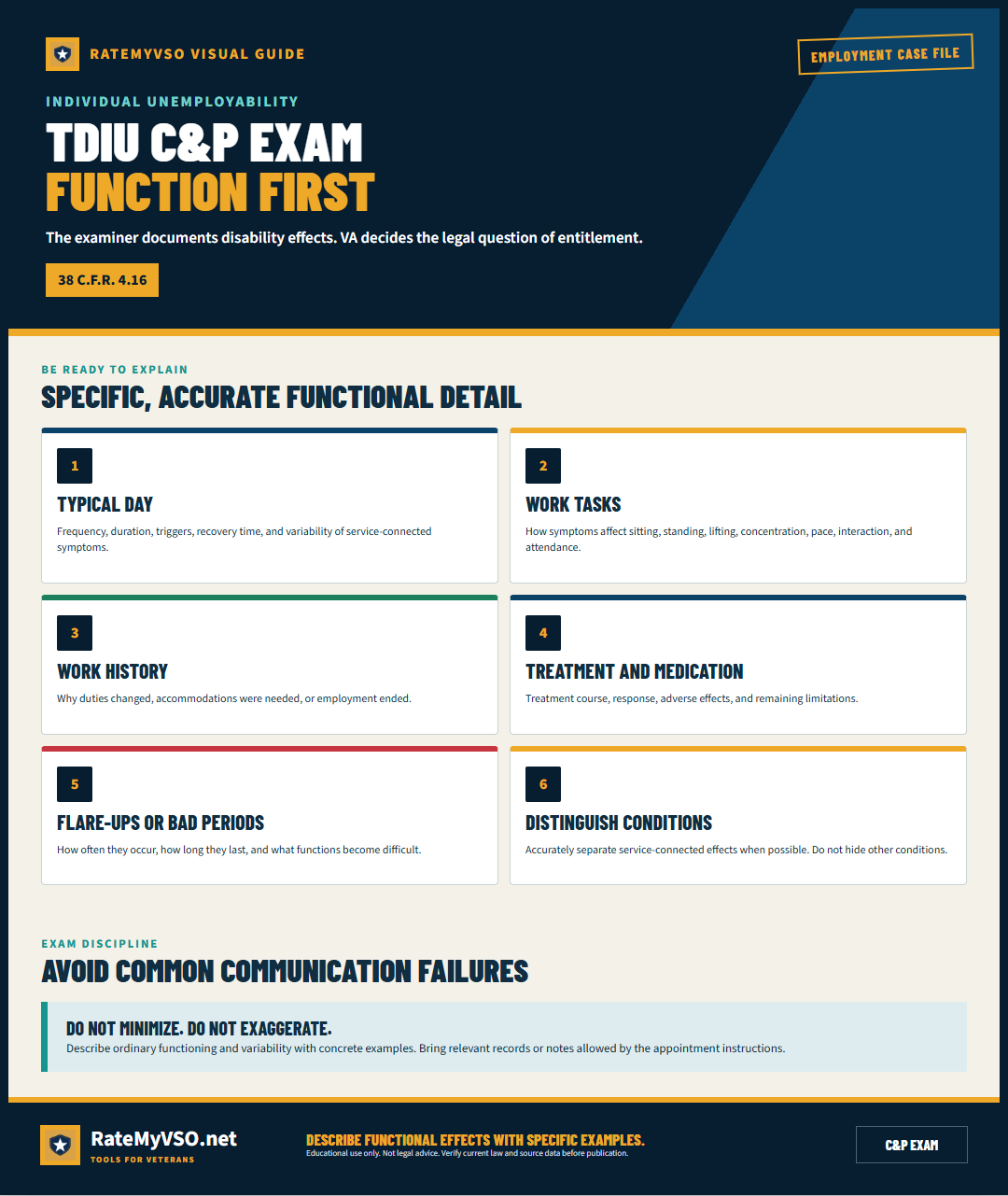 One-page guide: TDIU C&P Exam Guide
Guide for accurately describing functional effects during a TDIU examination. Opens the full-size chart, free to save or print.
One-page guide: TDIU C&P Exam Guide
Guide for accurately describing functional effects during a TDIU examination. Opens the full-size chart, free to save or print.
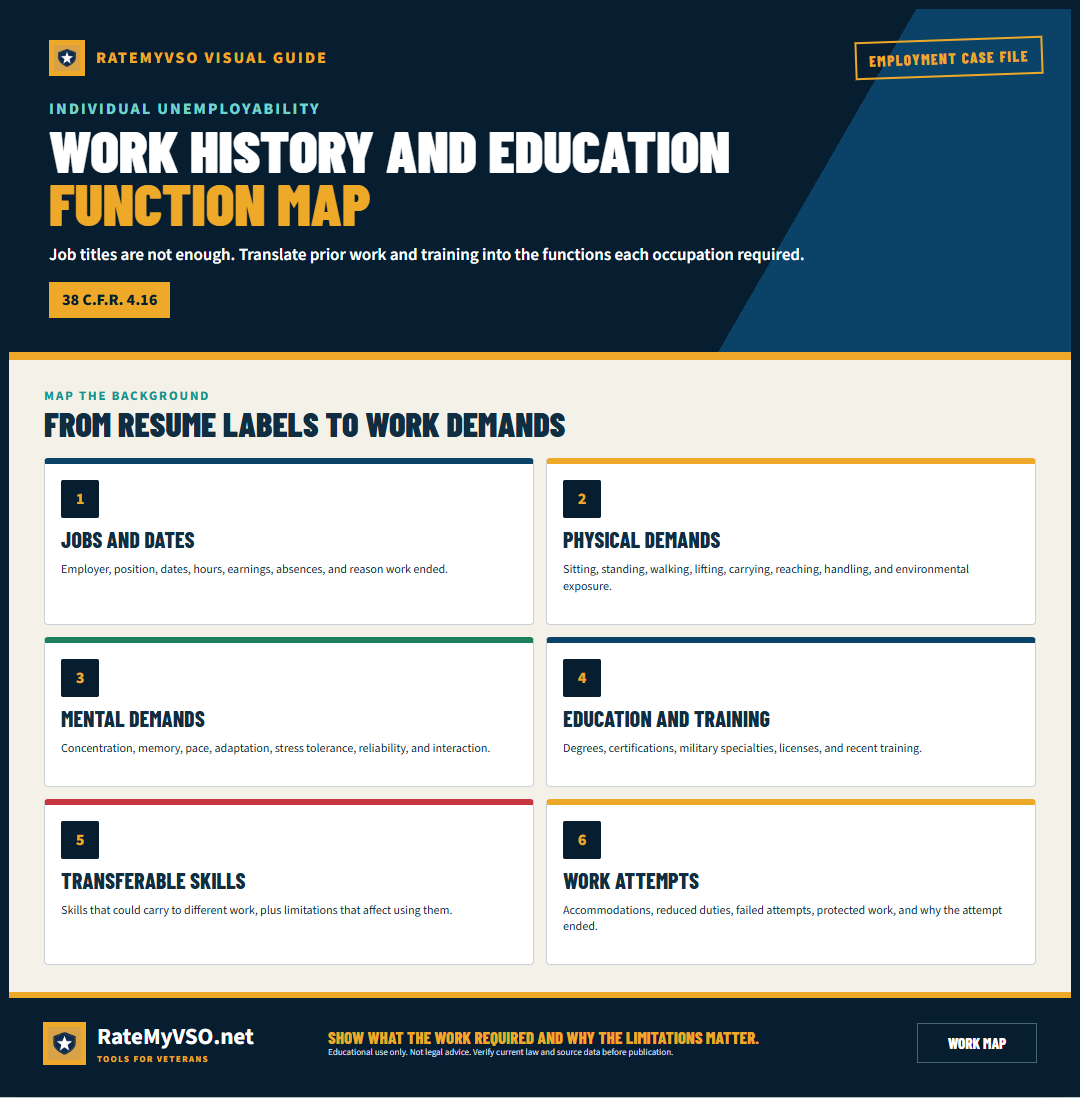
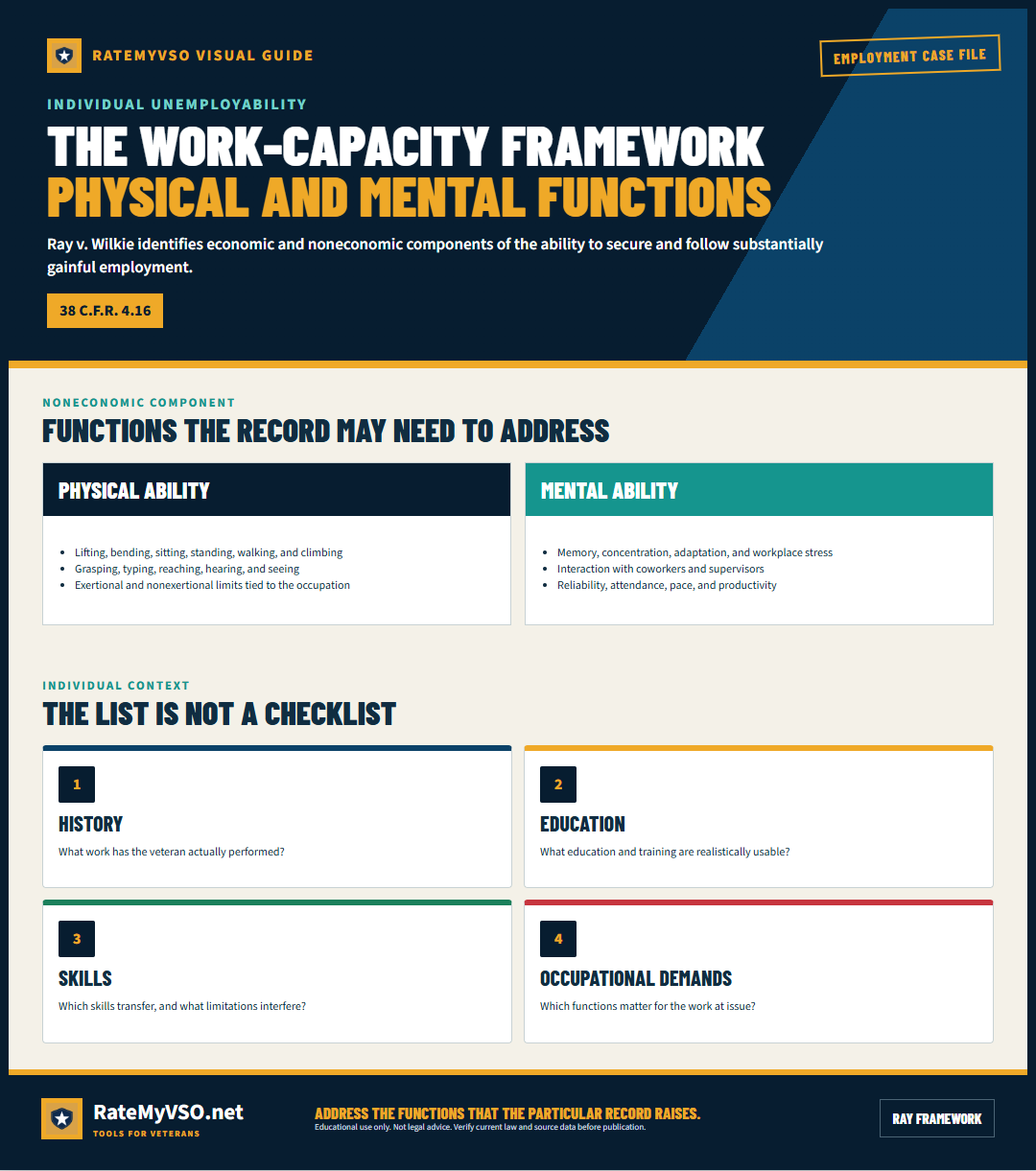 One-page guide: TDIU Physical and Mental Work Functions
Physical and mental work functions identified in the Ray v. Wilkie framework. Opens the full-size chart, free to save or print.
One-page guide: TDIU Physical and Mental Work Functions
Physical and mental work functions identified in the Ray v. Wilkie framework. Opens the full-size chart, free to save or print.
The published Board record
2 charts ·
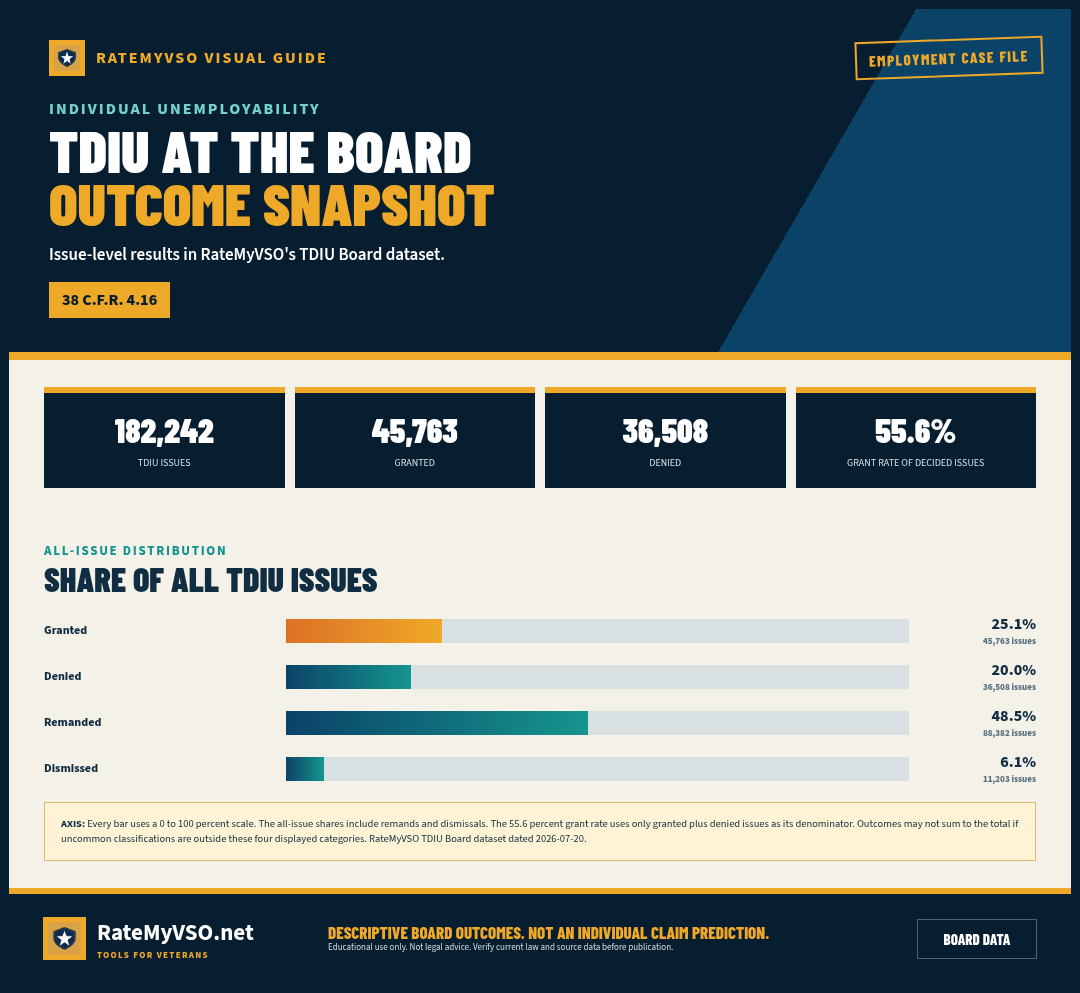 One-page guide: TDIU Board Outcomes
Issue-level TDIU Board outcome distribution across 184,401 issues, with the decided-issue grant rate. Opens the full-size chart, free to save or print.
One-page guide: TDIU Board Outcomes
Issue-level TDIU Board outcome distribution across 184,401 issues, with the decided-issue grant rate. Opens the full-size chart, free to save or print.
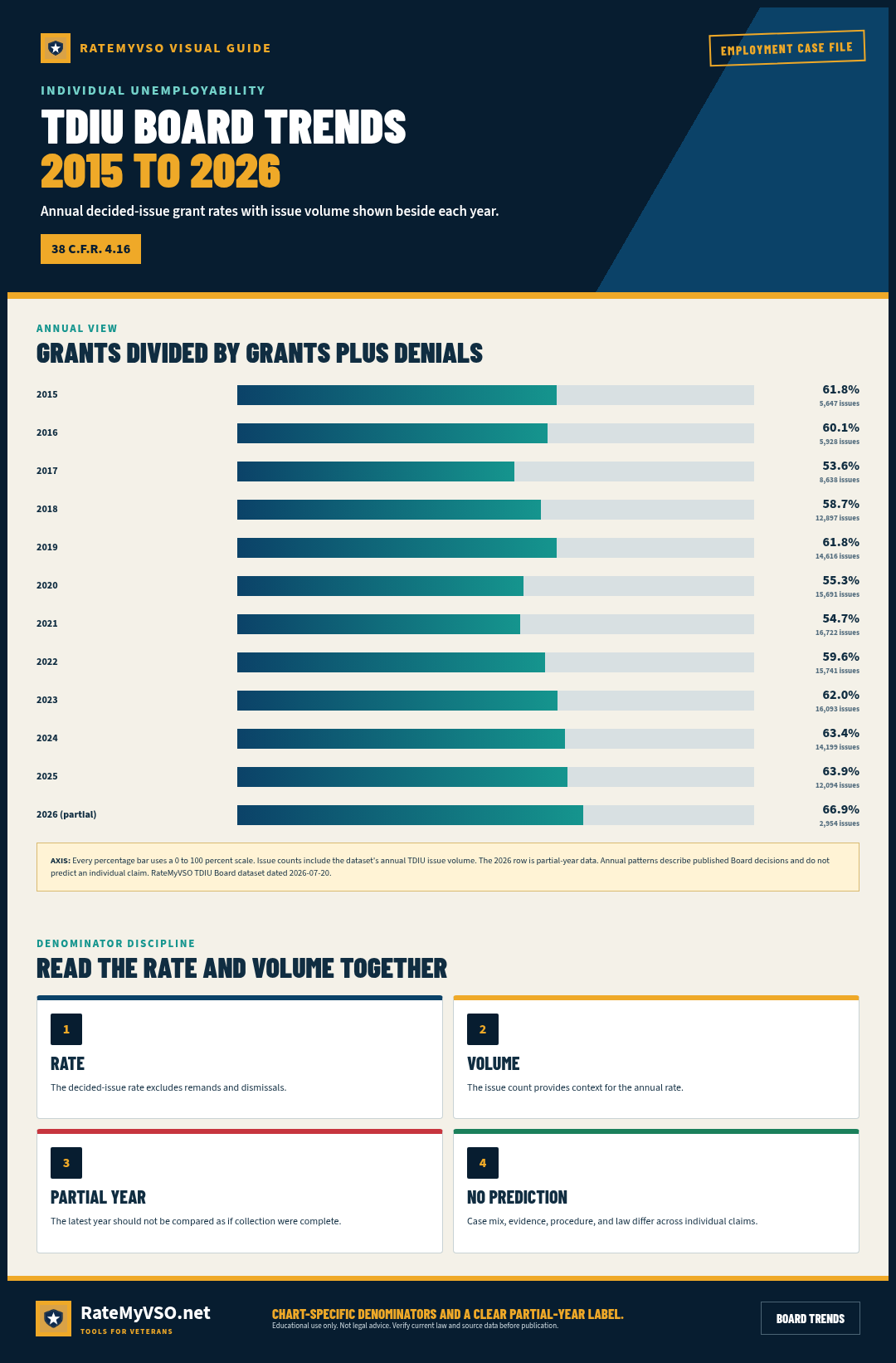 One-page guide: TDIU Board Trends
Annual TDIU decided-issue grant rates from 2015 through partial-year 2026 data. Opens the full-size chart, free to save or print.
One-page guide: TDIU Board Trends
Annual TDIU decided-issue grant rates from 2015 through partial-year 2026 data. Opens the full-size chart, free to save or print.

The published record
TDIU at the Board of Veterans' Appeals
Understand the outcomes in published Board decisions, not the odds for an individual claim.
Put the guide to work
Claim Quest: Quick Check
Five questions based only on this guide.
This checks what you understood from this guide. It is not a claim-readiness score, a prediction, an official test, or a record on your account.
This guide is for educational purposes only and is not legal advice. TDIU rules and rates change. For current rates, check the VA compensation rates page. For help filing, find a VSO representative. Last reviewed: 2026-04-14.