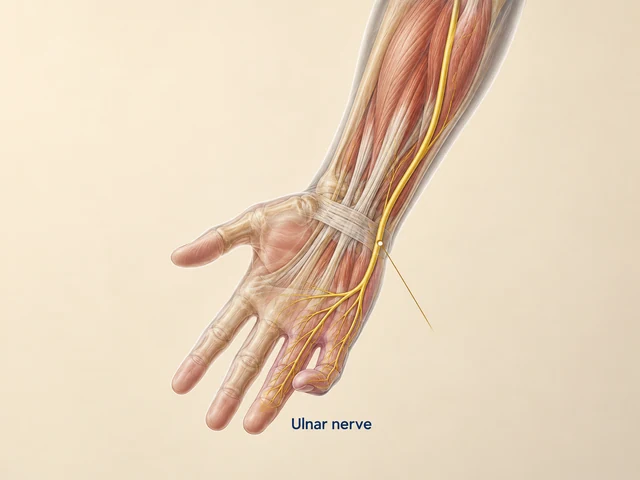
VA Disability Rating for Paralysis of ulnar nerve (DC 8516)
Body system: Neurological Conditions and Convulsive DisordersRegulation: 38 CFR § 4.124aDBQ: DBQ NEURO Peripheral Nerves
DC 8516, paralysis of ulnar nerve, is rated by the level below that matches your condition; the dominant (major) arm is rated higher than the non-dominant (minor) arm at the upper levels. The levels: Complete; the "griffin claw" deformity, due to flexor contraction of ring and little fingers, atrophy very marked in dorsal interspace and thenar and hypothenar eminences; loss of extension of ring and little fingers cannot spread the fingers (or reverse), cannot adduct the thumb; flexion of wrist weakened: 60% for the dominant arm, 50% for the non-dominant arm. Incomplete, severe: 40% for the dominant arm, 30% for the non-dominant arm. Incomplete, moderate: 30% for the dominant arm, 20% for the non-dominant arm. Incomplete, mild: 10% for either arm.
Rating levels
60% — Complete paralysis of the ulnar nerve causes a "griffin claw" hand deformity where your ring and little fingers are permanently bent and contracted inward. You'll have severe muscle wasting (atrophy) in the spaces between your fingers and in the muscle areas of your palm and pinky side of your hand, cannot straighten your ring and little fingers, cannot spread your fingers apart or bring them together, cannot move your thumb toward your palm, and have weakened ability to bend your wrist.
50% — Complete paralysis of the ulnar nerve causes a "griffin claw" hand deformity where your ring and little fingers are permanently bent and contracted. You'll have severe muscle wasting (atrophy) in the spaces between your fingers and in the palm muscles, cannot straighten your ring and little fingers, cannot spread your fingers apart or bring them together, cannot move your thumb toward your palm, and have weakened ability to bend your wrist.
40% — You have severe damage to your ulnar nerve (the nerve that controls muscles in your hand and forearm and provides feeling to your pinky and ring finger), but the nerve isn't completely destroyed. This level means you have significant weakness in gripping, pinching, or moving your hand and fingers, along with substantial numbness or tingling, but you still have some remaining function rather than complete paralysis.
30% — You have significant damage to your ulnar nerve (the nerve that controls feeling and movement in part of your hand and fingers) but it's not completely destroyed. This causes severe problems like major weakness in your hand grip, difficulty moving your pinky and ring fingers, and significant numbness, but you still have some nerve function remaining.
30% — Your ulnar nerve (the nerve that runs along the inside of your arm to your hand) is partially damaged but still working to some degree. You would have noticeable weakness in your hand and fingers, difficulty with fine motor tasks like writing or buttoning clothes, and some numbness in your ring and pinky fingers, but you haven't lost all function completely.
20% — Your ulnar nerve (the nerve that runs from your neck down to your pinky and ring fingers) is partially damaged, causing moderate problems with hand and finger function. You have noticeable weakness in your grip, difficulty with fine finger movements like buttoning clothes or picking up small objects, and some numbness or tingling in your pinky and ring fingers, but you still retain some useful function in your hand.
10% — You have some nerve damage to your ulnar nerve (the nerve that runs from your neck down to your pinky and ring fingers), but it's not severe. Your symptoms are mild and you still have most of the function in your hand and fingers, though you may notice some minor weakness, numbness, or tingling in your pinky and ring finger area.
10% — You have some nerve damage to your ulnar nerve (the nerve that runs from your neck down to your pinky and ring fingers), but it's not severe. Your symptoms are mild and you still have most of the function in your hand and fingers, though you may notice some minor weakness, numbness, or tingling in your pinky and ring finger area.
Disclaimer: This tool is for informational purposes only and is not legal or medical advice. Always consult with your VSO representative or a qualified veterans benefits attorney for guidance on your specific claim.