How to Establish Service Connection
This guide explains how to establish service connection for a disability with the VA. You will learn what service connection means, why it matters, and the evidence you need: medical records, duty-assignment statements, and nexus opinions. It covers the criteria for direct service connection, presumptive conditions, and secondary service connection, plus tips to strengthen your claim and avoid common mistakes. Whether you are filing your first claim or appealing a denial, this guide helps you build a credible service-connection case and improve your odds of getting the benefits you earned.

Notice: M21-1 Updated 2026-05-01
VA's adjudication manual (M21-1) was updated on May 1, 2026 to incorporate the holding in Spicer v. McDonough. The update revises guidance on aggravation of a non-service-connected disability by a service-connected disability. The aggravation pathway content below is being reviewed against the revised manual. Always verify with an accredited VSO or attorney before acting.
What Is Service Connection?
Service connection means the VA has officially recognized that your disability is related to your military service. It's the single most important determination in the VA claims process. Without it, you get nothing.
Once service connection is established, the VA assigns a disability rating (0% to 100%) based on how severe the condition is. That rating determines your monthly compensation.
Legal basis: 38 U.S.C. § 1110 (wartime) & § 1131 (peacetime); 38 CFR § 3.303
The 3 Elements You Must Prove
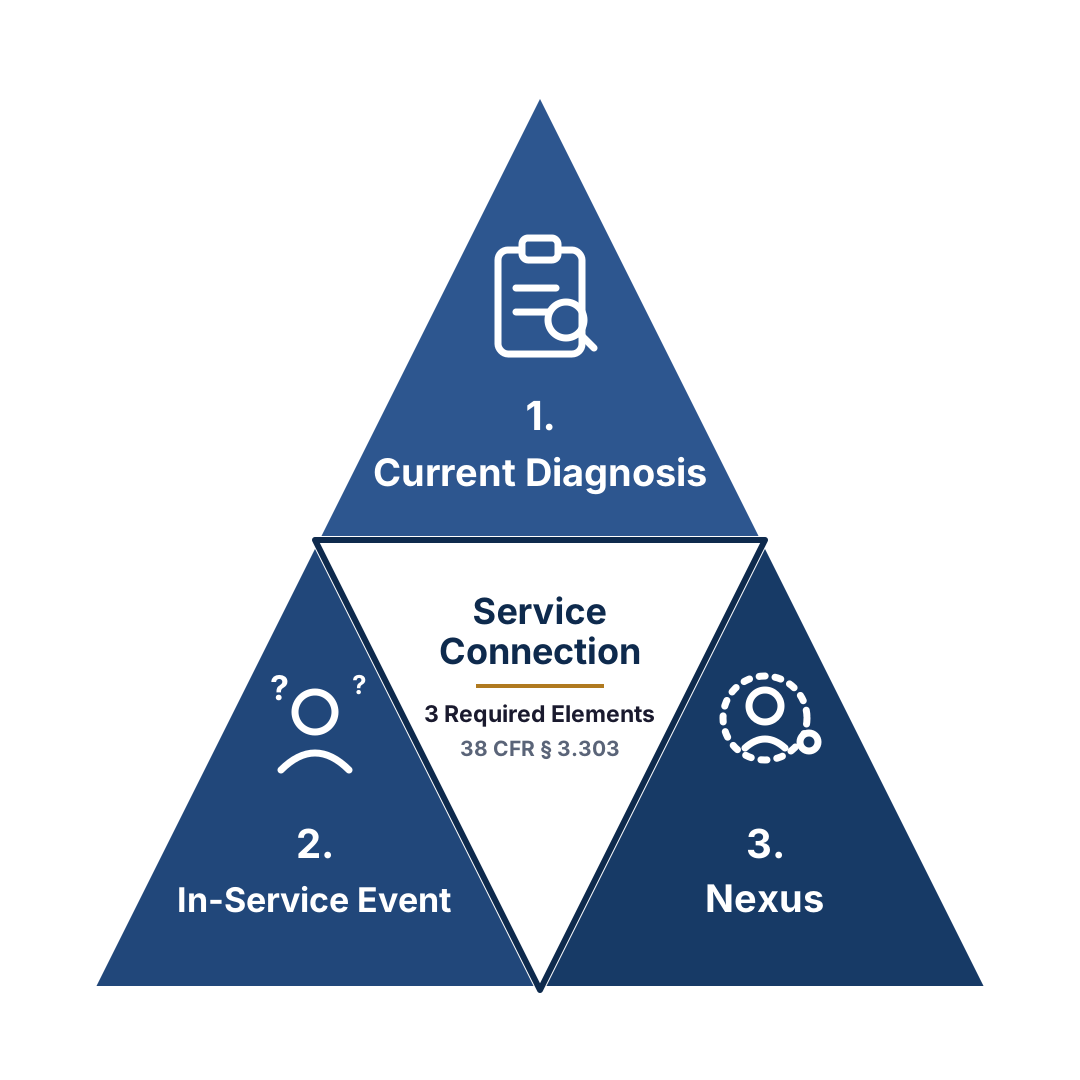
Every service connection claim, whether direct, secondary, or aggravation, requires these three things:
Current Diagnosis
A medical professional has diagnosed you with the condition now. Symptoms alone aren't enough. You need an actual diagnosis.
In-Service Event
Something happened during your service (an injury, illness, exposure, or ongoing duty) that could have caused or contributed to the condition.
Nexus (Link)
Medical evidence connecting your current diagnosis to the in-service event. This is where most claims are decided.
The 4 Pathways to Service Connection
There's more than one way to establish the link between your condition and your service. Understanding which pathway fits your situation is critical.
Direct Service Connection
The condition was caused by something that happened during service. This is the most common pathway. (see 38 CFR § 3.303)
- You got hurt, sick, or exposed to something during service
- You have a diagnosis of that condition today
- A medical opinion links the two
Example: You hurt your knee during a training exercise in 2010. You now have degenerative joint disease in that knee. A doctor writes that the current condition is "at least as likely as not" related to the in-service injury.
Secondary Service Connection
A new condition caused or worsened by a disability that's already service-connected. (see 38 CFR § 3.310)
- You have an existing service-connected disability
- That disability caused or aggravated a new condition
- A medical opinion explains the link
Example: Your service-connected knee injury changed your gait. You now have hip pain from years of compensating. A doctor links the hip condition to the altered mechanics caused by the knee.
Presumptive Service Connection
Certain conditions are automatically presumed to be service-connected for veterans who served in specific locations, time periods, or occupational roles, no nexus letter needed. (see 38 CFR § 3.307, § 3.309, PACT Act (2022))
- Agent Orange: Vietnam-era veterans (bladder cancer, hypertension, MGUS, and many more)
- Burn pits / toxic exposure (PACT Act): Post-9/11 veterans (many cancers, respiratory conditions)
- Gulf War presumptives: Undiagnosed illnesses, chronic fatigue, fibromyalgia, IBS
- Chronic diseases: Arthritis, diabetes, cardiovascular disease, etc., if manifested to 10% within 1 year of discharge
- Camp Lejeune: 8 presumptive conditions for service during 1953-1987
Aggravation of a Pre-Existing Condition
A condition you had before service was made permanently worse by your service. (see 38 CFR § 3.306)
- The condition existed before you entered service
- Service made it permanently worse (not just a temporary flare-up)
- Medical evidence shows the worsening was beyond the natural progression of the disease
Example: You had mild asthma before enlistment. Exposure to burn pits during deployment permanently worsened it. You now need daily medication where you previously didn't.
Evidence That Wins Claims
The VA makes decisions based on evidence. You don't need all of these, but the more relevant evidence you submit, the stronger your claim.
| Evidence Type | What It Is | Why It Matters | Importance |
|---|---|---|---|
| Nexus Letter / IMO | A medical opinion from a qualified provider linking your condition to service | Provides the "nexus" element, the link the VA usually won't establish on its own | Critical |
| Service Treatment Records | Your in-service medical records (sick call, ER, surgery, dental, etc.) | Documents the in-service event or injury. If records are missing, the VA has a heightened duty to assist | Critical |
| Current Medical Records | Post-service treatment records from VA or private doctors | Proves you have a current diagnosis and shows continuity of treatment | Critical |
| C&P Exam | Compensation & Pension exam ordered by the VA | The VA's own medical evaluation, often the single most influential piece of evidence | Critical |
| Buddy / Lay Statements | Sworn statements from people who witnessed your injury, symptoms, or limitations | Fills gaps in medical records. Fellow service members, family, and coworkers can all submit these. See the legal framework → | High |
| DBQs | Disability Benefits Questionnaires, standardized medical forms | Ensures examiners capture the exact criteria the VA rates on. Browse our DBQ Library | High |
| Personnel Records | DD-214, service records, deployment orders, MOS documentation | Proves where you served, what you did, and potential exposures (noise, chemicals, combat) | High |
| Medical Literature | Peer-reviewed studies supporting the connection between your service and condition | Strengthens the nexus by showing a recognized medical relationship | Helpful |
| Personal Statement | Your own written account of what happened and how it affects you | Provides context and fills in details that medical records may not capture | Helpful |
The Standard of Proof: "At Least as Likely as Not"
The VA doesn't require 100% certainty. The standard is called the benefit of the doubt doctrine (see 38 U.S.C. § 5107(b); 38 CFR § 3.102):
- If the evidence is at least 50/50 (as likely as not) that your condition is connected to service, the VA must decide in your favor
- You don't need to prove it "beyond a reasonable doubt". That's criminal law, not VA law
- You don't even need to prove it's "more likely than not", just that it's roughly equal
The Duty to Assist
The VA has a legal obligation to help you develop your claim (38 U.S.C. § 5103A). This means they must:
- Help you obtain service treatment records and other federal records
- Provide a C&P exam when there's evidence of a current disability and an in-service event but insufficient evidence to decide
- Notify you of what evidence is needed and who is responsible for getting it
The 8 Most Common Mistakes
These are the mistakes that cost veterans ratings, and years of back pay. Every one of them is avoidable.
- Filing without a nexus letter. Unless your claim is presumptive or your service treatment records explicitly diagnose the condition, you probably need a nexus letter. The C&P examiner may provide a favorable opinion, but counting on it is a gamble.
- Not claiming secondary conditions. A single service-connected disability can cause or worsen many other conditions. Back injuries cause radiculopathy. PTSD causes insomnia and migraines. Medications cause GERD. Check our Secondary Condition Suggester.
- Using vague language. "My back hurts" is a symptom. "Degenerative disc disease, lumbar spine" is a diagnosis. Claims with specific diagnostic terms are processed faster and rated more accurately. Look up your condition in our Condition Lookup to find the right diagnostic code.
- Not filing an Intent to File (ITF). An ITF locks in your effective date for up to one year while you gather evidence. If you wait 6 months to file, that's 6 months of back pay you lose. File the ITF on VA.gov immediately, then take your time building the claim. Read our Effective Dates guide.
- Downplaying symptoms at the C&P exam. Veterans are trained to push through pain. The C&P exam is not the time for that. Report your worst days, not your best. If you have flare-ups, say so. If pain limits your function, describe exactly how.
- Not appealing denials. Roughly 35-40% of BVA appeals are granted. A denial is not the end, it's often just the beginning. Many claims are denied because of insufficient evidence, not because the veteran doesn't deserve the rating. See BVA appeal data for your condition.
- Ignoring presumptive conditions. Post-9/11 veterans especially. The PACT Act added dozens of presumptive conditions. If you served near burn pits, in the Gulf War, or at Camp Lejeune, you may qualify without needing to prove direct causation. Check PACT Act conditions.
- Going it alone. Accredited VSO representatives help you file claims for free. They know the system, can access your records, and attend C&P exams with you. There is zero reason not to have one. Find a representative near you.
What to Do After a Denial
A denial letter is not the final word. You have three options under the Appeals Modernization Act (AMA):
1. Supplemental Claim
File new and relevant evidence the VA hasn't seen before: a nexus letter, buddy statement, updated medical records, or private DBQ. This is the most common and often the fastest path. (see 38 CFR § 3.2501)
2. Higher-Level Review (HLR)
A more senior reviewer looks at the same evidence and checks for errors. No new evidence is accepted, but the reviewer can identify "duty to assist" errors that require the VA to get additional evidence. Good for cases where you believe the original rater misapplied the law. (see 38 CFR § 3.2601)
3. Board of Veterans' Appeals (BVA)
Appeal directly to a Veterans Law Judge. You can submit new evidence and/or request a hearing. This is the slowest lane (often 1 to 2+ years, longer if you request a hearing), but a judge can grant appeals the regional office denied. See the Board Hearing guide for what a hearing is like. (see 38 CFR § 20.200)
How the VA Reviews Each Theory at the Exam and Rating Stage
After you file a claim, a Veterans Service Representative (VSR) reviews the evidence and a rater (sometimes called a rating specialist or Decision Review Officer on appeal) makes the actual determination. Understanding what each reviewer checks for each theory can help you organize your evidence to match their process. This is based on M21-1 adjudication guidance and the seven-paths framework.
Direct Service Connection (38 CFR 3.303)
The VSR checks three elements in sequence:
- Current disability or persistent/recurrent symptoms. A diagnosis satisfies this. Persistent symptoms without a formal diagnosis can also satisfy it under 38 CFR 3.303.
- In-service event, injury, or disease. Service treatment records, unit histories, or a lay statement from the veteran identifying when, where, and how the injury occurred.
- Link (nexus) between elements 1 and 2. Even a lay statement from the veteran connecting the two can satisfy element 3 well enough to trigger an exam. The bar at this stage is low. If all three are present, the VSR orders the appropriate DBQ exam.
After the exam, the rater weighs whether the medical opinion supports the link at the "at least as likely as not" standard.
Presumptive Service Connection (38 CFR 3.307, 3.309)
The VSR checks two elements:
- Current disability that is on a recognized presumptive list. The condition must appear in 38 CFR 3.309 (or a PACT Act list) for the presumption to apply.
- Qualifying service. The veteran must have served in the recognized location during the required time period. For Agent Orange: Vietnam during qualifying periods. For burn pits / PACT Act: Southwest Asia theater or other covered locations.
No nexus letter is needed. If both elements are present, the rater grants service connection without requiring a medical opinion linking the condition to service. Organizing your service history (unit, dates, locations) makes it straightforward for the VSR to check both boxes.
Secondary Service Connection (38 CFR 3.310)
The VSR checks:
- An existing service-connected disability. Must be already rated (or rated in the same decision).
- A new condition caused or aggravated by the service-connected disability. A medical opinion is nearly always required to establish the link. Unlike direct claims, a lay statement alone is usually insufficient for element 2 on secondary claims.
The rater looks for the medical opinion to specifically address the service-connected condition as the cause or aggravating factor, not just note that both conditions exist. If the claim is denied because the rater found the theory was never reviewed (no 38 CFR 3.310 analysis in the narrative), that is a duty-to-assist error that may support a Higher Level Review.
Aggravation of a Pre-Existing Condition (38 CFR 3.306)
The VSR checks:
- Condition existed before service (noted on entrance exam, or VA rebuts the presumption of soundness).
- Service permanently worsened the condition beyond its natural progression. Medical evidence is required to show the increase in disability is not simply the natural course of the disease.
If the entrance exam does not note the condition, the VA must presume the veteran entered service in sound condition. The burden is then on the VA to rebut soundness by clear and convincing evidence before the aggravation standard applies. The rater decides the final rating by comparing the baseline severity (at entry) to the current severity.
Related Tools and Guides
This guide is for educational purposes only and is not legal or medical advice. All legal references are from Title 38 of the U.S. Code and the Code of Federal Regulations. For help with your specific claim, find a free VSO representative or consult with a VA-accredited attorney.