Your ratings, explained
VA Disability Calculator
The VA does not simply add your ratings. Each disability is applied to your remaining "healthy" percentage, so see how yours combine, estimate your monthly pay, and explore what a new rating could change.

Calculate Your Combined Rating
Pick a percentage for each disability. The result updates as you edit.
When should I check Bilateral?
Per 38 CFR § 4.26, the 10% bilateral factor applies only to paired disabilities affecting both arms, both legs, or paired skeletal muscles (e.g., left + right knee, both shoulders). Do not check it for unrelated conditions that just happen to be on opposite sides (e.g., left knee + right wrist).
DependentsVeteran alone · affects pay at 30%+
Add your dependents to refine the pay estimate. Ratings below 30% do not receive dependent additions.
Special Monthly CompensationOptional · if already awarded by the VA
The math behind your ratingEvery combination, bilateral adjustment and final rounding.
Scroll the calculation sideways to see all columns →
Add a rating to see the step-by-step calculation.
Benefits at this ratingExplore what changes at different rating levels.
 Benefits by rating
See the benefits connected to each rating level.
Explore benefits →Estimate back payExplore past-due pay using your dates and ratings.
Open estimator → Understand your letter
Make sense of a VA decision in plain English.
Read your letter → Understand SMC
Learn how special compensation differs from a rating.
Explore SMC →How VA math worksWorked examples, the bilateral factor, 2026 pay rates, the Quick Check and common questions.
How VA Math Works
Step-by-Step Example
Say you have three ratings: 50%, 30%, and 20%.
- Start at 100% healthy.
- Apply the highest rating first (50%): 100% × 50% = 50% disabled. You have 50% "healthy" remaining.
- Apply the next highest (30%): 50% remaining × 30% = 15% additional disability. Total: 65% disabled, 35% remaining.
- Apply the next (20%): 35% remaining × 20% = 7% additional disability. Total: 72% disabled.
- Round to nearest 10%: 72% rounds to 70%. That's your combined rating.
If you just added them (50 + 30 + 20 = 100%), you'd expect 100%. But VA Math gives you 70%. This is why veterans say "VA Math". It always results in a lower number than simple addition.
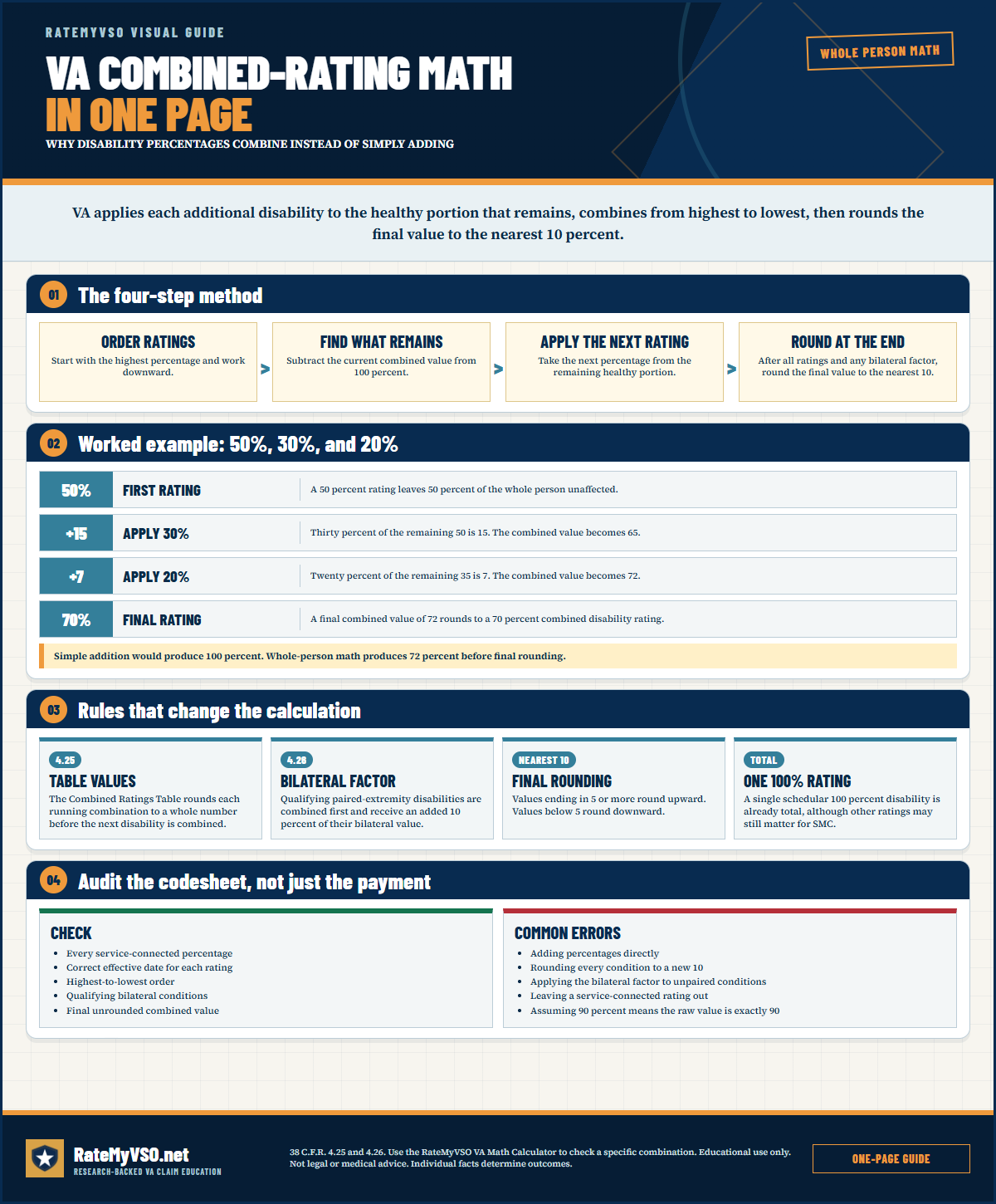 One-page guide: VA Combined-Rating Math In One Page
Follow the whole-person calculation from highest rating to final rounding. Opens the full-size chart, free to save or print.
One-page guide: VA Combined-Rating Math In One Page
Follow the whole-person calculation from highest rating to final rounding. Opens the full-size chart, free to save or print.
The Bilateral Factor
If you have disabilities affecting both sides of the body (e.g., both knees, both shoulders), the VA adds a 10% bonus to the combined value of those bilateral disabilities before combining them with your other ratings.
Example: Left knee 20% + Right knee 10% = 28% combined. The bilateral factor adds 10% of 28% = 2.8%, summing to 30.8%, which the Combined Ratings Table rounds to 31% before combining with other disabilities.
This is one of the few places where VA Math actually works slightly in your favor.
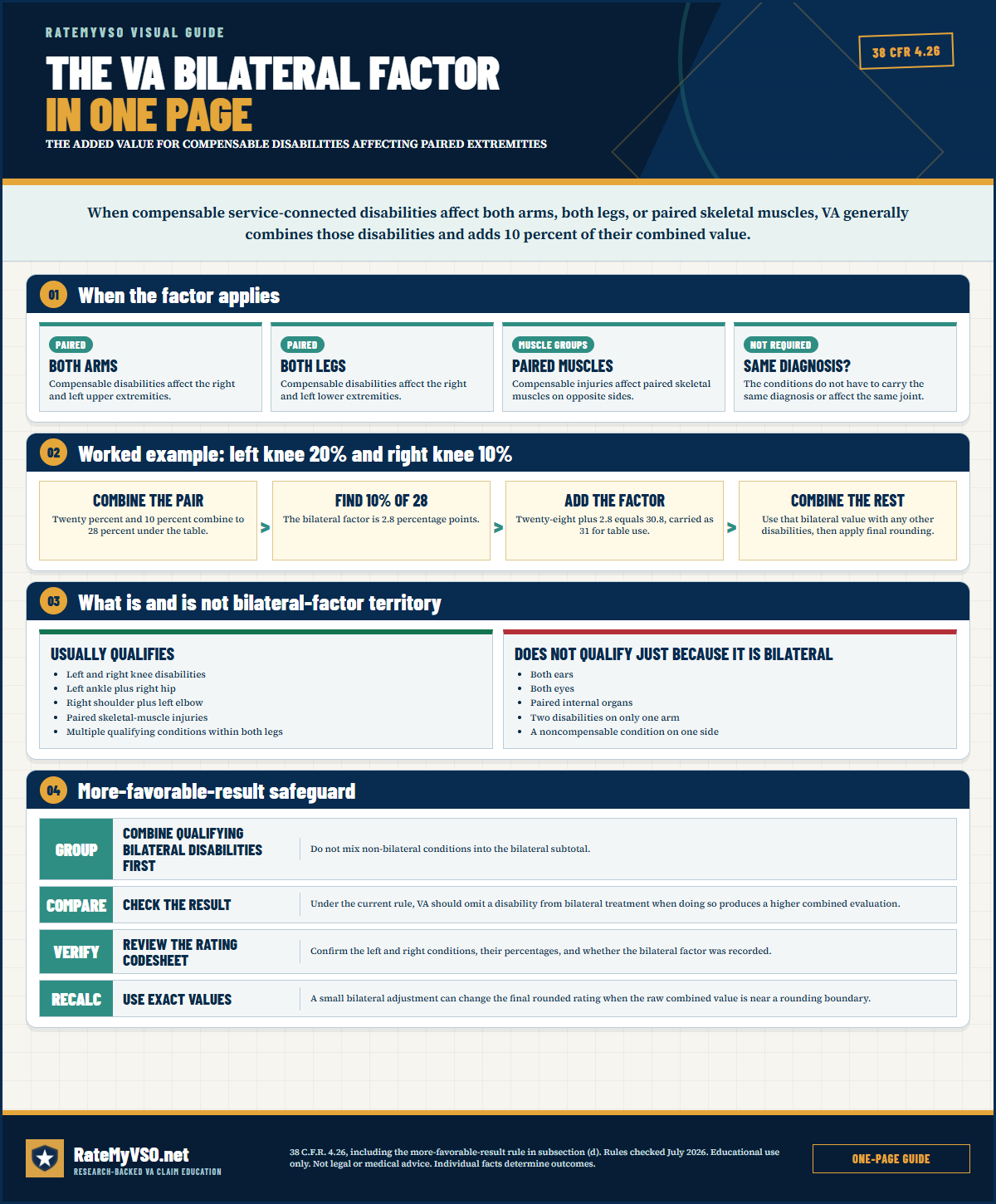 One-page guide: The VA Bilateral Factor In One Page
See which paired-extremity disabilities qualify and how the added value enters VA math. Opens the full-size chart, free to save or print.
One-page guide: The VA Bilateral Factor In One Page
See which paired-extremity disabilities qualify and how the added value enters VA math. Opens the full-size chart, free to save or print.
2026 Monthly Compensation Rates
Rates effective December 1, 2025 (2.8% COLA increase). Veteran alone, no dependents. Rates increase with dependents.
| Combined Rating | Monthly Rate (Veteran Alone) |
|---|---|
| 10% | $180.42 |
| 20% | $356.66 |
| 30% | $552.47 |
| 40% | $795.84 |
| 50% | $1,132.90 |
| 60% | $1,435.02 |
| 70% | $1,808.45 |
| 80% | $2,102.15 |
| 90% | $2,362.30 |
| 100% | $3,938.58 |
Source: VA.gov. 30%+ ratings include additional amounts for dependents not shown here.
Tips
- Always apply for increases near a rounding break. If your exact combined is 72%, you're rated at 70%. Getting even a small increase to push to 75% would round you to 80%, a significant pay jump.
- Secondary conditions matter. Even a 10% secondary condition on top of existing ratings can push you over a rounding threshold.
- Check for bilateral factor. If you have matching left/right conditions, make sure the VA applied the bilateral factor correctly.
- Remember: 100% is achievable. While VA Math makes it hard, enough combined conditions can get you there. 90% + 70% = 97%, which rounds to 100%.
Prefer a Spreadsheet?
Download the "Hutsky Star" VA Combined Rating Calculator spreadsheet, a trusted tool from the veteran community that includes the full CFR 38 § 4.25 table, bilateral factor support, and space to enter your own ratings.
Claim Quest: Quick Check
Five questions based only on this guide.
This checks what you understood from this guide. It is not a claim-readiness score, a prediction, an official test, or a record on your account.
Common Questions
How does VA math work?
What is the VA bilateral factor?
Why doesn't VA disability rating use simple addition?
What is the difference between VA combined rating and SMC?
This calculator is for educational purposes only. It includes optional bilateral factor support (§ 4.26). For official rates, see the VA compensation rates page. For help with your claim, find a VSO representative. Last reviewed: 2026-04-14.