Pyramiding Rules (§ 4.14)
This guide explains the VA pyramiding rule (38 CFR § 4.14): how the VA stops you from being paid twice for the same symptoms across multiple ratings. You will learn what "pyramiding" means, how the VA evaluates overlapping symptoms, and why you cannot be rated twice for the same functional impairment under different diagnostic codes. It also covers the key exception: separate ratings are allowed when one condition produces distinct, non-overlapping symptoms across different body systems, such as nerve damage, joint limitation, or scarring. You will find examples, common mistakes, and the legal standards the VA uses to decide whether symptoms are combined or rated separately. Whether you are reviewing a decision or building a new claim, this guide helps you avoid pyramiding problems and claim every rating you are entitled to.

What Is Pyramiding?
The VA cannot rate the same disability manifestation under multiple diagnostic codes (see 38 CFR § 4.14). This is called "pyramiding", stacking ratings for the same symptoms.
The purpose is to prevent double-compensation. If your knee pain is already being compensated under a limitation of motion code, you can't get a second rating for that same pain under a different code.
However, and this is the crucial part, different manifestations of the same underlying condition CAN be rated separately. A back condition can produce both limitation of motion (rated under spine codes) AND radiculopathy (rated under nerve codes). Those are separate manifestations, not pyramiding.
A simple way to picture it: two eye conditions
Say a veteran has two different service-connected eye conditions, and both end in the same result: total blindness. The VA rates the blindness once, because the end result is the same, one functional loss, one rating.
Now change the facts. One eye condition causes trouble seeing in bright light. The other causes trouble seeing in the dark. Same body part, but two different symptoms with two different functional impacts. Those can be rated separately.
The question is never "how many diagnoses are there?" It is "how many separate results are there?"
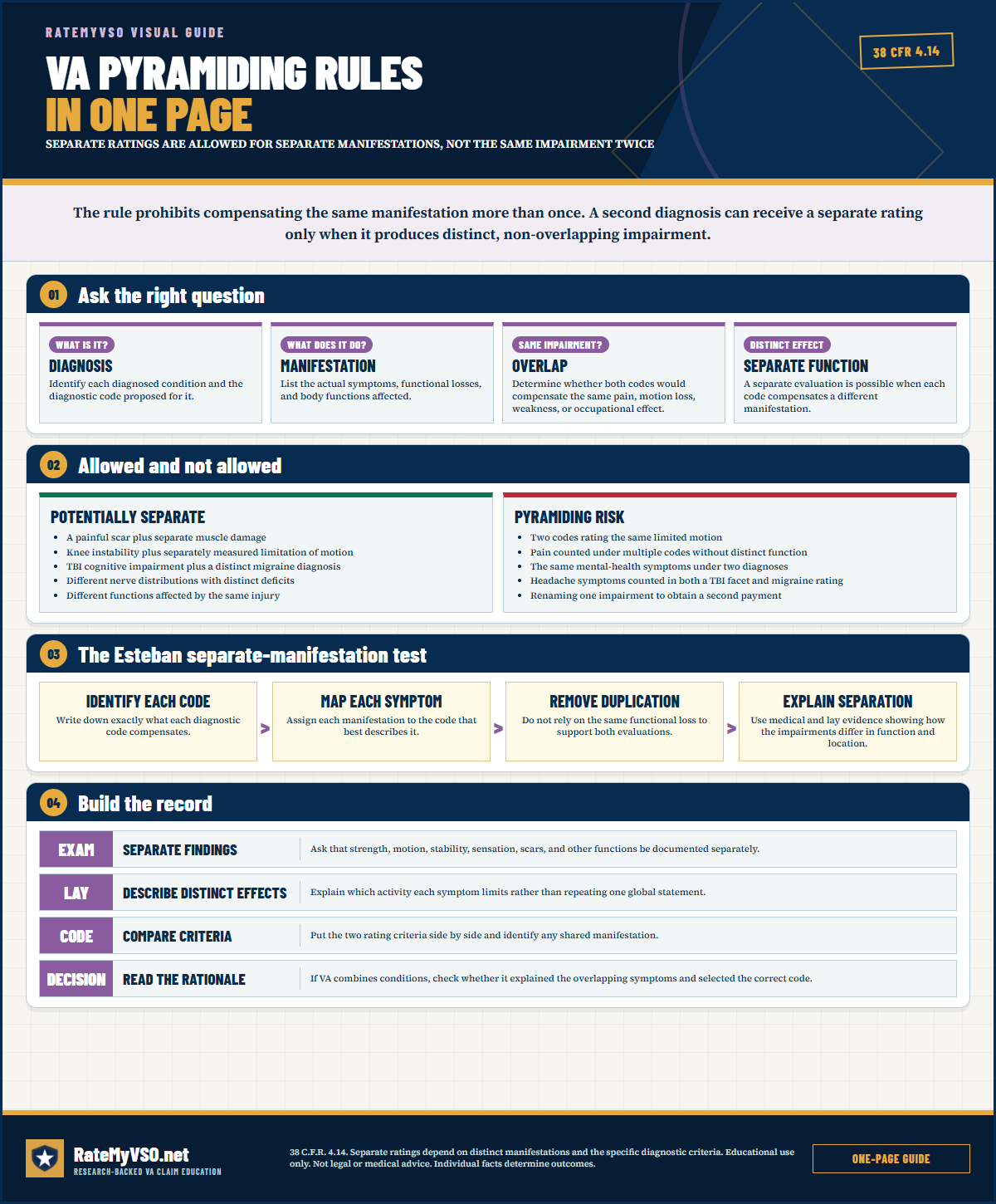 One-page guide: VA Pyramiding Rules In One Page
Compare separate manifestations with prohibited double counting under 38 CFR 4.14. Opens the full-size chart, free to save or print.
One-page guide: VA Pyramiding Rules In One Page
Compare separate manifestations with prohibited double counting under 38 CFR 4.14. Opens the full-size chart, free to save or print.
Allowed vs Not Allowed
Allowed (Separate Manifestations)
- Back pain (ROM limitation) + leg radiculopathy (nerve damage) from same spine condition
- Knee limitation of motion + knee instability from same injury
- PTSD (mental symptoms) + migraine headaches (physical symptom) from same TBI event
- Shoulder arthritis (ROM loss) + shoulder surgical scar (disfigurement/pain)
- Diabetes (endocrine) + diabetic neuropathy (neurological) + diabetic retinopathy (eye)
Not Allowed (Pyramiding)
- Rating knee pain under both DC 5260 (flexion) and DC 5003 (arthritis with pain), same symptom
- Rating anxiety symptoms under both PTSD (DC 9411) and generalized anxiety disorder (DC 9400)
- Rating the same limitation of motion under both an orthopedic code and a muscle injury code
- Rating hearing loss under both DC 6100 (hearing impairment) and a separate ear disease code for the same hearing deficit
The Esteban Rule - Separate Ratings for Separate Manifestations
Separate ratings are allowed when they pass a three-part test (Esteban v. Brown, 1994):
- The symptoms must be different. Each rating must compensate for a different set of symptoms or functional impairment.
- None of the rating criteria can overlap. The specific criteria used to assign one rating cannot be the same criteria used for the other.
- Each condition must separately satisfy its own rating criteria. You must independently qualify for each rating on its own merits.
If all three conditions are met, separate ratings are required. The VA can't lump them together into a single rating.
Real-World Examples
Back Condition + Radiculopathy
Allowed, separate ratings. Your lumbar spine is rated under DC 5242 for limitation of motion (how far you can bend). The radiculopathy shooting down your legs is rated under DC 8520 (sciatic nerve). Different body systems, different symptoms. You can, and should, have both.
Many veterans only have a spine rating when they should also have separate nerve ratings for each affected leg.
Knee: Limitation of Motion + Instability
Allowed, separate ratings. VA General Counsel Opinion VAOPGCPREC 23-97 explicitly allows separate ratings for knee arthritis (limitation of motion under DC 5260/5261) AND knee instability (under DC 5257). These evaluate different things, how far the knee bends vs whether it gives way.
Similarly, separate ratings for limitation of flexion (DC 5260) and limitation of extension (DC 5261) for the same knee are allowed under VAOPGCPREC 9-2004.
PTSD + TBI
Partially allowed, but complex. PTSD and TBI share overlapping emotional/behavioral symptoms. The VA cannot rate the same symptoms (e.g., irritability, sleep problems) under both. However, if the TBI causes additional cognitive symptoms (memory loss, concentration problems) beyond what PTSD covers, those cognitive deficits can be rated separately.
Physical manifestations of TBI (headaches, dizziness, vision problems) are always rated separately from the mental health rating.
GERD + IBS
Depends on the symptoms. If GERD causes upper GI symptoms (reflux, heartburn, chest pain) and IBS causes lower GI symptoms (diarrhea, constipation, abdominal cramping), separate ratings are appropriate. But if the VA determines both are manifestations of the same underlying GI disorder with overlapping symptoms, they may rate them together under the code that gives the higher rating.
Diabetes + Complications
Allowed, separate ratings for each complication. Diabetes itself is rated under DC 7913. Each complication gets its own separate rating: peripheral neuropathy (nerve codes per extremity), diabetic retinopathy (eye codes), nephropathy (kidney codes), erectile dysfunction (genitourinary + SMC-K). A veteran with diabetes and multiple complications can have 5+ separate ratings - all legitimate, not pyramiding.
Common Mistakes
Pyramiding often shows up in a rating decision as one boilerplate sentence, something like "you cannot be compensated twice for the same symptoms", with no explanation of which symptoms overlap or why. That copy-pasted line is not a real analysis. If you cannot tell from the decision exactly which symptom the VA thinks is being counted twice, that is a sign to look closer.
- Accepting a single combined rating when separate ratings are warranted. The VA sometimes rates everything under one code when multiple codes apply. Check your rating decision. If your condition causes symptoms in multiple body systems, you may be entitled to separate ratings.
- Not claiming radiculopathy separately from spine conditions. This is the #1 missed separate rating. If your back or neck condition causes numbness, tingling, or shooting pain in your arms or legs, those nerves should be rated separately.
- Failing to claim scars separately. Surgical scars from service-connected surgeries can be rated separately for pain, instability, or disfigurement, in addition to the underlying condition.
- Not claiming mental health secondary to chronic pain. Depression or anxiety caused by a service-connected physical condition is a separate manifestation rated under its own code.
- Trying to get separate ratings for overlapping mental health conditions. The VA will generally only assign one mental health rating (the General Rating Formula applies to all mental health DCs). You can't get separate ratings for PTSD, anxiety, and depression. They're all rated together under whichever code applies.
Conditions Often Already Captured Under Another Rating
Some claimed conditions rarely add to a combined rating because the symptom they describe is already weighted into the rating criteria for a condition you're already service-connected for. The underlying medical condition is real, but filing it as a standalone secondary typically doesn't move the combined number, § 4.14 captures it as the same manifestation.
Common examples that come up in this category:
- Insomnia secondary to PTSD or another mental health condition. Sleep impairment is a listed criterion under the General Rating Formula for Mental Disorders. A separate insomnia rating typically overlaps with the mental health rating that already accounts for sleep.
- Insomnia secondary to migraines or tinnitus. Sleep disruption is part of how those conditions present clinically and is reflected in their rating criteria.
- Bruxism (teeth grinding) on its own. Without independent dental damage rated under its own diagnostic code, bruxism is generally non-compensable. The underlying anxiety, PTSD, or TMJ condition tends to capture the symptom.
- Stress or generalized anxiety when PTSD is already service-connected. The General Rating Formula for Mental Disorders evaluates the whole mental-health picture under one rating. Multiple mental-health diagnoses are rated together under whichever code applies, not stacked.
This is the same § 4.14 logic driving the rest of this page: the test is whether the same symptom is being compensated twice, not whether the underlying medical conditions are technically distinct.
Arguing That Conditions Are Separate
If the VA has combined conditions that you believe should be rated separately, here's how to argue:
- Identify the different symptoms. Make a clear list showing which symptoms belong to which condition. No overlap.
- Show they map to different diagnostic codes. Each condition should match a different DC with different rating criteria.
- Get a medical opinion. A doctor explaining that the conditions produce separate and distinct functional impairments is the strongest evidence.
- Cite Esteban v. Brown. The three-part test is your legal basis for separate ratings.
- Show the rating criteria don't overlap. If one code rates ROM and another rates nerve function, those criteria are clearly distinct.
Tips
- Review your rating decision line by line. Each service-connected condition should appear with its own DC code and rating percentage. If multiple conditions are lumped under one code, ask why.
- Use our secondary condition tool to find related conditions that may warrant separate ratings.
- Think in body systems. Pain in the joint (musculoskeletal), numbness in the nerve (neurological), a scar from surgery (skin): three separate body systems, three separate ratings.
- The higher rating applies when the criteria fit. When the same symptoms could be rated under two codes, § 4.7 directs the VA to assign the higher evaluation if the disability picture more nearly approximates its criteria, otherwise the lower rating applies.
- Calculate your combined rating with our VA Math calculator to see how separate ratings would affect your total compensation.
This guide is for educational purposes only and is not legal advice. For help with your claim, find a VSO representative.