Claim Guide
Understand the filing process, find the records and tools you need, and prepare for your next step. Read this guide for the big picture, or start a guided path built around the conditions you choose.

Start with your conditions
Choose the conditions you want to work on. We'll organize the relevant guides and preparation tools into a path you can follow.
Adding a condition or seeking an increase? Choose another claim path.
Want someone to file with you? Find an accredited representative, free of charge.
Interactive preparation guide
See what to do inside each step.
Explore records, statements, exam preparation and review. Open a task for practical suggestions and the tool that helps you do it.
1 Get started
Who can file, protecting a start date, and choosing the claim path that fits.
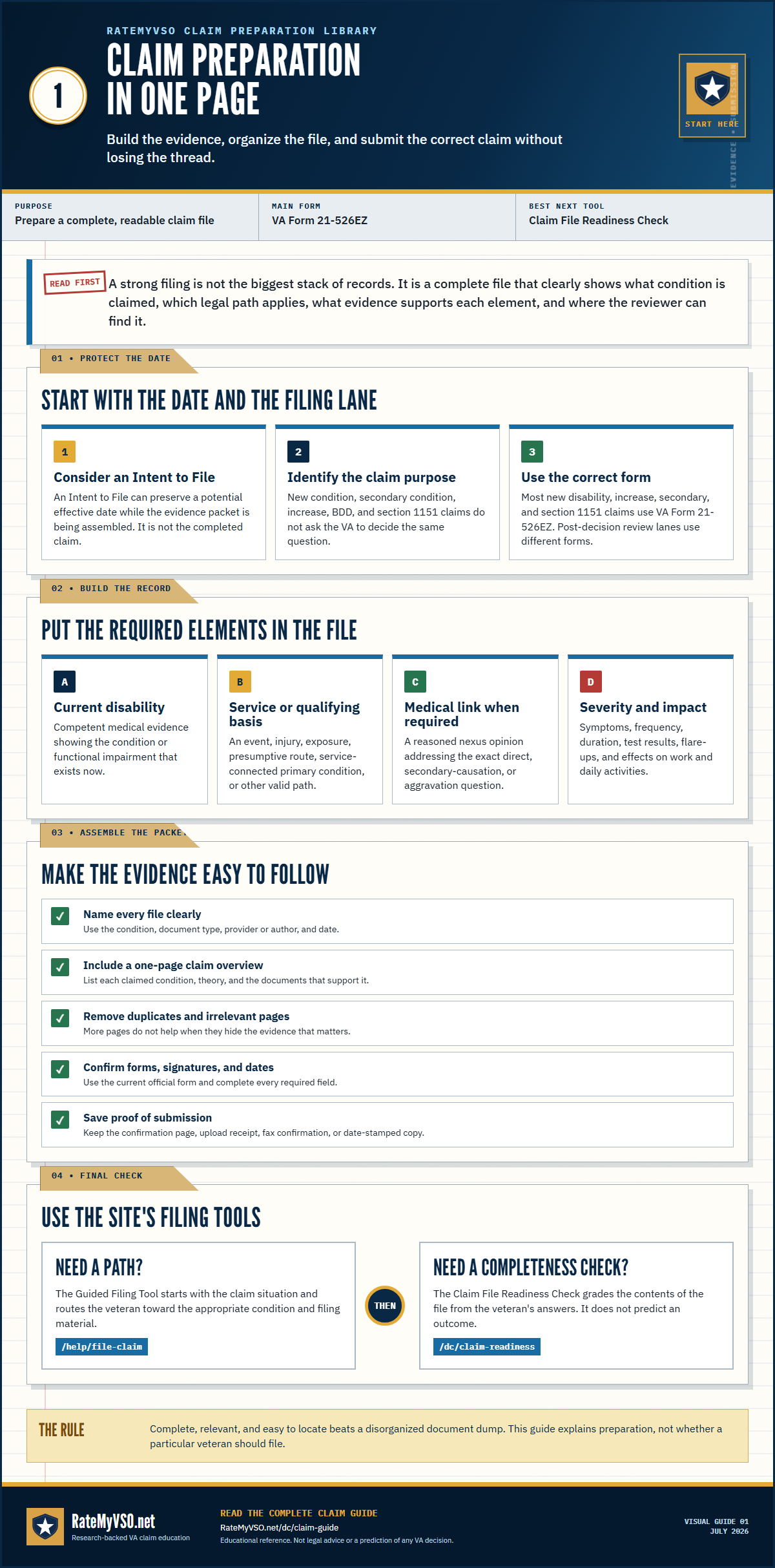 One-page guide: Claim Preparation and Filing in One Page
One-page VA claim preparation guide covering the filing lane, current disability, qualifying basis, medical link, severity evidence, packet organization, and final review. Opens the full-size chart, free to save or print.
One-page guide: Claim Preparation and Filing in One Page
One-page VA claim preparation guide covering the filing lane, current disability, qualifying basis, medical link, severity evidence, packet organization, and final review. Opens the full-size chart, free to save or print.
Who Can File a VA Disability Claim
Before stepping through the guide, confirm you're eligible. The VA evaluates four things up front: who you are, how you served, the character of your discharge, and whether the condition is connected to that service.
- Discharge character: Honorable, General (Under Honorable Conditions), and certain Other Than Honorable (OTH) discharges can qualify. Dishonorable discharges generally bar VA disability compensation. If your discharge character is the blocker, the discharge upgrade process may be available.
- Service type: Active duty, Active Duty for Training (ACDUTRA), and Inactive Duty for Training (IADT, the drill weekend) all count, but the rules differ for each. Most Guard and Reserve service members must show that a condition was incurred or aggravated during a specific qualifying period. Read the full Guard & Reserve guide before filing if your service was part-time.
- Uniformed services covered: Army, Navy, Marine Corps, Air Force, Space Force, Coast Guard, and commissioned officers of the Public Health Service (PHS), the Environmental Science Services Administration (ESSA), and the National Oceanic and Atmospheric Administration (NOAA) or its predecessor, the Coast and Geodetic Survey.
- Discharge papers: A first-time claim can include a copy of your service discharge form (DD-214, DD-215, or for some World War II veterans, a WD form). It shows your service dates and the type of discharge. If you do not provide a copy, VA will make every effort to get it for you and will tell you if it cannot.
- Merchant Marines: Generally not covered, with a narrow exception for those who served in oceangoing service between December 7, 1941 and August 15, 1945.
- Combat status: Combat veterans benefit from a relaxed proof rule for in-service events under 38 USC 1154(b), but combat status alone is not service connection. See what the combat presumption actually does, and what it does not do.
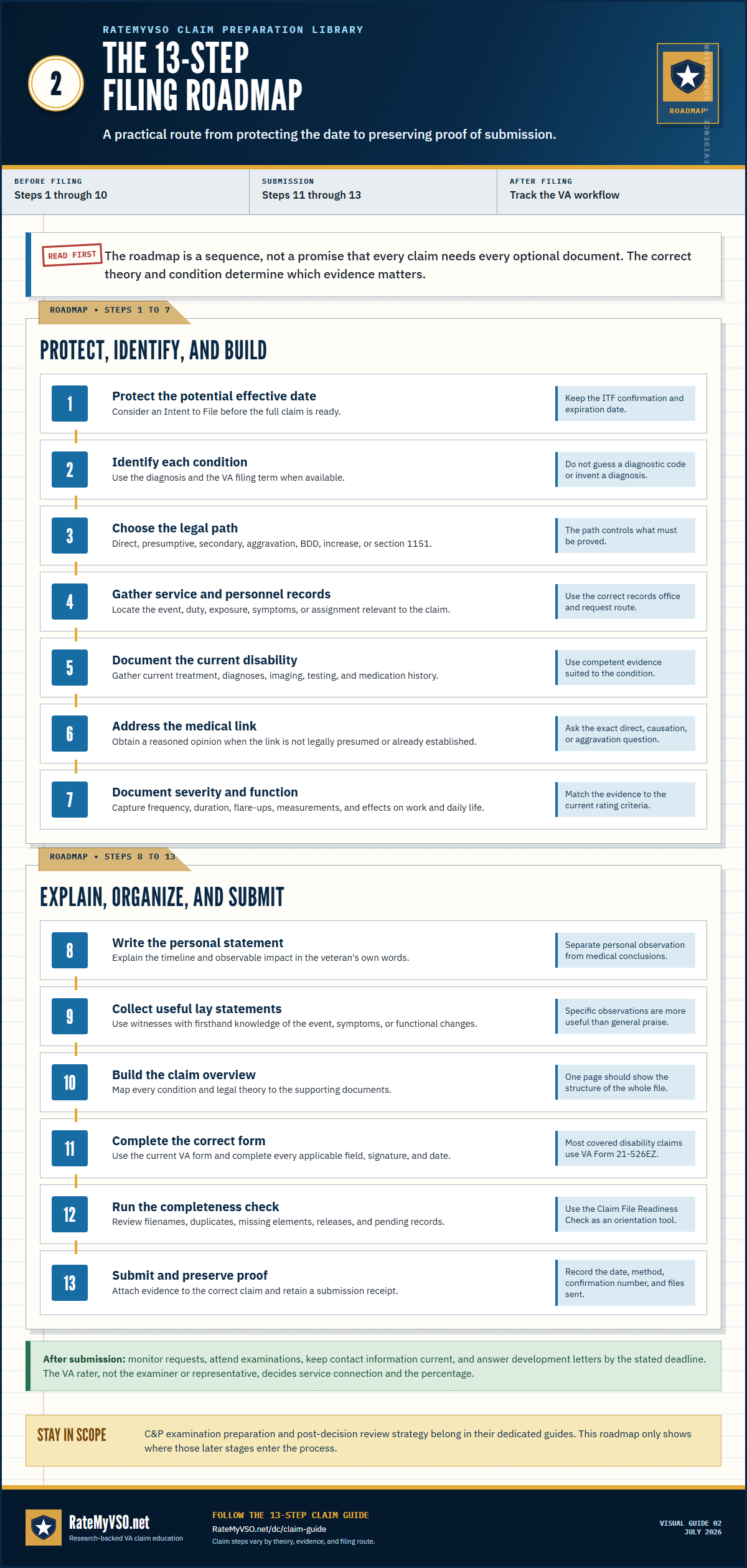
File Your Intent to File, Do This Today
An Intent to File (ITF) tells the VA "I plan to submit a disability claim." It can lock in an earlier effective date, the date the VA uses to calculate your back pay: if you file the complete claim within one year, VA treats it as filed on the ITF date.
Every day you wait without an ITF is a day of back pay you lose. You don't need to know your condition, your diagnostic code, or have any evidence ready.
How to File
- Call 1-800-827-1000, fastest option, no online account needed. Tell them you want to file an Intent to File for disability compensation.
- File online at VA.gov, requires a Login.gov or ID.me account (see File Your Claim or Meet Your VSO).
- Visit a VA Regional Office in person.
- Have your VSO file it, if you already have a representative.
Filing an Increase Claim Instead?
If you already have a service-connected condition and it has worsened, you file an "increase claim" rather than a new claim. The process is similar, but the strategic concerns are different.
How it works
- Same form: VA Form 21-526EZ. Select the existing condition and indicate the rating should be increased.
- Evidence of worsening: Not strictly required to file, but you should submit updated medical records, an updated DBQ, or a new C&P-ready statement showing the condition is more severe than at the last rating.
- Intent to File: An Intent to File can preserve a potential filing date while you prepare an increase claim. The final effective date still depends on when the evidence shows the increase occurred and, in some cases, may fall within the one-year period before the claim or Intent to File.
- Review the rating schedule first: Confirm your current symptoms actually match a higher tier on the rating schedule for that diagnostic code. Filing an increase when you do not meet a higher tier wastes time and exposes the claim file to review.
Read first: Filing a VA Rating Increase, A Strategic Guide, the full decision walkthrough (diagnostic code lookup, next-tier criteria mapping, pain myth, 38 CFR 3.344 protections, evidence packaging).
Talk to a VSO First →2 Gather records and identify conditions
Service records, private records and the conditions and codes they point to. Requests and records already in hand can be worked on together.
Get Your Service Records
Service Treatment Records (STRs) are your military medical records. They document anything medical that happened during your service. The VA uses them to verify in-service events, injuries, or exposures.
How to Get Them
- VA.gov, request through your VA.gov account
- National Personnel Records Center (NPRC), request via Standard Form 180
- Your VA medical facility, they may already have copies in your file
Tools for this step
Gather Private Medical Records
Collect all medical records related to your condition, not just from the VA. Private doctor visits, specialist referrals, physical therapy, prescriptions, and imaging all strengthen your claim.
What to Include
- Treatment records, from any provider who treated the condition
- Imaging, X-rays, MRIs, CT scans
- Prescription history, shows ongoing treatment
- Specialist reports, orthopedic, neurological, psychological evaluations
- Emergency room visits, if applicable
Tools for this step
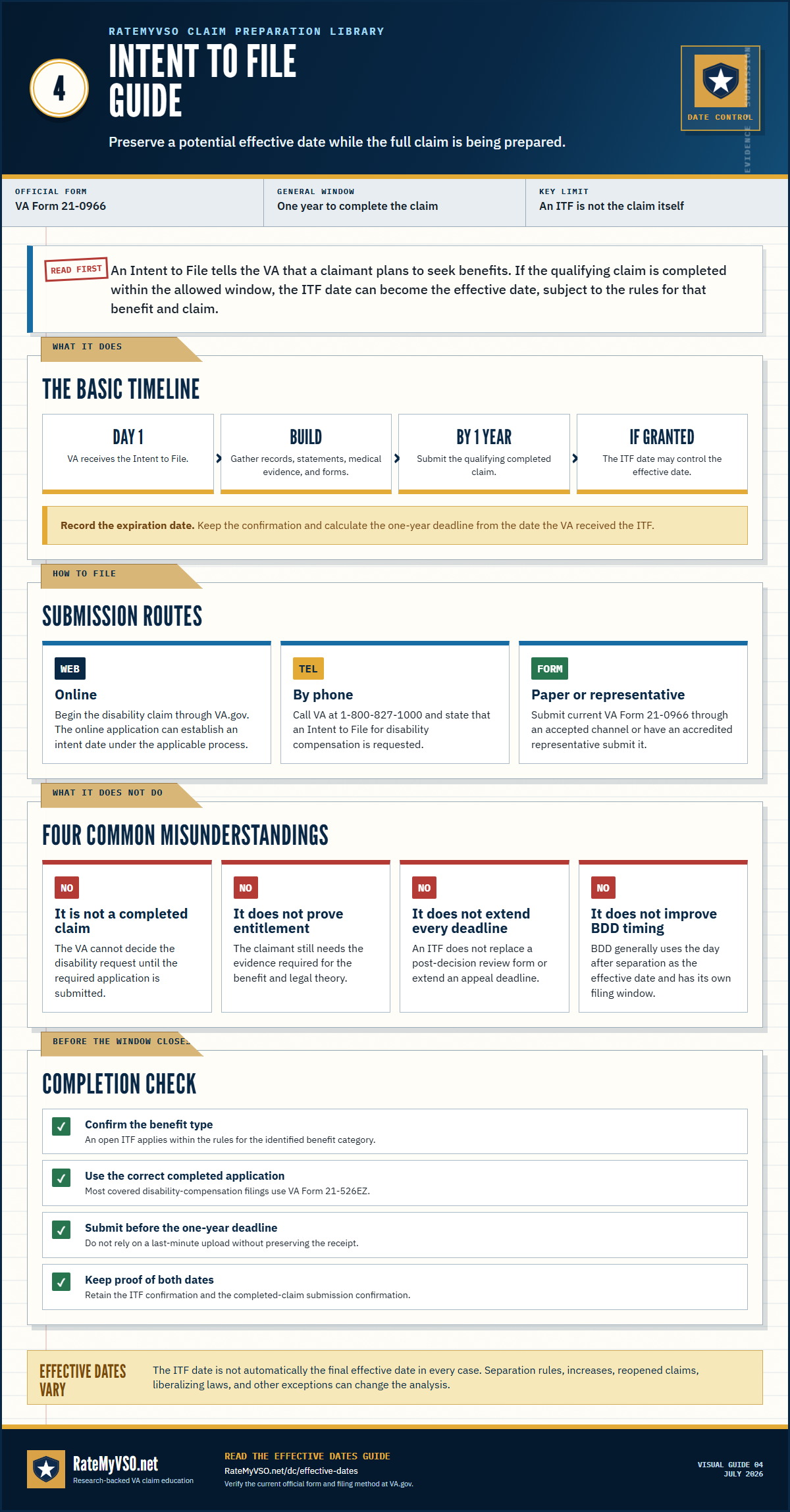
Find your conditions and codes.
Figure out what condition(s) you're claiming. You don't need to know the medical name, the VA assigns the diagnostic code. But understanding which code applies helps you build a stronger case.
Our AI-powered search lets you describe your symptoms in plain English to help you research the most likely VA diagnostic codes.
Tools for this step
Find codes in your records → review the source → record the details → connect to your conditions.
- Find diagnosis codes in your recordsFree Windows tool. Scan records on your computer and keep the source file and page references.
- Look up ICD codes and possible VA code matchesAlready have codes? Explore their cross-references and condition information.
- Open my record findingsThe entries you have already recorded, with the document and page each came from.
- Record what your records say in your claim journeySave the exact entry, code and source page as a record finding, then connect it to a condition you choose. It carries into My Preparation.
Condition guides also include working pages for your records, symptoms, provider questions, and decision notes. Open the guide for a condition from your selected path to use its worksheets.
3 Prepare supporting evidence
How service connection is shown, the diagnosis, the rating criteria, the medical link, and the statements that describe daily life.
Determine Your Service Connection Type
The VA needs to know how your condition is connected to your military service. There are four types:
- Direct service connection, your condition happened in service or was directly caused by your service (e.g., hearing loss from artillery, knee injury from a training accident).
- Secondary service connection, your condition was caused or made worse by a condition you're already service-connected for (e.g., depression caused by chronic pain from a service-connected back injury).
- Presumptive service connection, the VA presumes your condition is related to service based on when/where you served. PACT Act, Agent Orange, Gulf War, and radiation exposure conditions fall here. No nexus letter needed, but one could help in some cases involving secondary conditions getting connected to a presumptive condition.
- Aggravation, an existing condition that got worse. Two different rules, depending on what made it worse. Pre-service aggravation (38 CFR 3.306): a condition noted when you entered service increased in severity during service, and the increase was not just the natural progress of the disease. Secondary aggravation (38 CFR 3.310(b)): a condition that is not service-connected got worse because of one that is; here the worsening does not have to be permanent, and VA compares it to a medically established baseline. See the aggravation guide.
Get a Current Medical Diagnosis
VA needs competent evidence of a current disability. For most conditions that means a doctor, VA or private, confirming a current diagnosis. It is not always a named diagnosis: pain that causes functional impairment can qualify as a disability even where no diagnosis has been assigned. A current diagnosis remains the strongest and simplest way to establish this element.
- VA doctor, if you're enrolled in VA healthcare, your VA provider can diagnose you. This goes directly into your VA medical record.
- Private doctor, the VA accepts private medical records. Get the diagnosis in writing.
Review Your Rating Criteria
Before your C&P exam, understand exactly what the VA is looking for. Each diagnostic code has specific rating criteria, the symptoms and limitations that qualify for each percentage level (0%, 10%, 20%, etc.).
Knowing the difference between a 30% and a 50% rating helps you describe your symptoms accurately and completely during the exam.
Document the medical link with a Nexus opinion
A nexus letter is a written medical opinion from a doctor stating that your condition is "at least as likely as not" connected to your military service. This is the legal standard the VA uses.
A missing medical link is one of the most common problems in non-presumptive claims: the file shows a current condition and an in-service event, but nothing connecting the two.
What Makes a Good Nexus Letter
- Written by a qualified medical professional (MD, DO, NP, PA)
- Uses the words: "at least as likely as not" (50% or greater probability)
- Explains the medical reasoning, not just a conclusion
- References your service records and medical history
- For secondary claims: explains how the primary condition caused or aggravated the secondary
Tools for this step
Get a DBQ Filled Out
A Disability Benefits Questionnaire (DBQ) is a standardized VA form that documents the severity of your condition in the exact format VA raters need. Having your own doctor complete one gives the VA detailed evidence before the C&P exam.
- Find the DBQ specific to your condition in our library
- Have your treating physician complete it. They know your condition best
- Submit it with your claim as supporting evidence
Write & Collect Lay / Buddy Statements
Lay statements (also called buddy statements) are written accounts from people who have witnessed your symptoms or the event that caused your condition. The VA gives these real weight.
Who Can Write Them
- Fellow service members, who witnessed the event or your symptoms in service
- Spouse or partner, who sees how symptoms affect your daily life
- Family members, who noticed changes in you after service
- Coworkers, who see how your condition affects your work
- You, your own personal statement describing your experience
What to Include
- Specific observations: what they saw, heard, or experienced
- Dates or timeframes, when symptoms started or events occurred
- How your condition affects daily activities: sleeping, working, driving, relationships
- Changes they noticed, before vs after service, or over time
Tools for this step
Worked Examples: What Triggers a C&P Exam vs. a Denial
You are responsible for identifying the conditions you are claiming and for submitting or identifying the evidence that supports them, and VA has its own Duty to Assist in obtaining federal records, VA treatment records, and private records you authorise, and in providing an examination where one is required. Before the rest of the steps, see how the three-element rule (current disability + in-service event + nexus) plays out in real claim scenarios. The VA may deny a claim without scheduling a C&P exam if one of the three elements is missing on the face of the application.
4 Organize, review and file
Assemble what you have gathered into one file a rater can follow, then file it or take it to a representative.
Organize and Review Your File
A pile of records is not a claim file. Our companion guide walks you through organizing, naming, and labeling everything into one clear file the rater can follow, with a printable master-overview template.
Build a Complete Claim File →Tools for this step
- Open My PreparationYour saved worksheets, record findings and reference cases, with the journey selection and print chooser you already use.
- Organize your file with the Claim Overview templateA blank master overview you can download as a Word document or print.
- Check how complete your claim file isA completeness check against the elements a rater looks for. It does not score or predict an outcome.
File Your Claim or Meet Your VSO
Tools for this step
- VA Form 21-526EZ GuideThe application itself, section by section, with what each box is asking for.
- Check your claim file's completenessSee which elements your file still needs before you file. A completeness check, not a prediction.
Self-Filing
- Create a VA.gov account, you'll need Login.gov or ID.me for identity verification
- Start VA Form 21-526EZ at VA.gov, this is the actual claim form
- List all conditions, use the exact terms from VA.gov's dropdown. See our filing terms reference to know exactly what to select.
- Upload all evidence, nexus letter, DBQ, buddy statements, medical records
- Consider a Fully Developed Claim (FDC) if you already have all your evidence. An FDC puts the available evidence in the file at submission, which can avoid delay VA would otherwise spend developing it. The FDC label itself does not grant automatic priority processing. See the Fully Developed Claim guide.
- Submit
Meeting Your VSO Representative
A VSO representative files on your behalf and advocates for you throughout the process, all for free. Bring your evidence packet to your first meeting.
What to Bring
- Your DD-214 (discharge paperwork)
- List of conditions you want to claim
- Service treatment records (or note that you've requested them)
- Current diagnosis documentation
- Nexus letter(s) if you have them
- DBQ(s) if you have them
- Buddy statements
- Private medical records
5 While waiting
Following your claim while it is being worked, and preparing for an exam if the VA schedules one.
While You Wait
Track Your Claim While You Wait
The VA's claim status page shows limited information. This free Chrome extension gives you more detail on your claim phases, timelines, and status updates, all from data the VA already provides but hides.
Third-party tool, not made by RateMyVSO or the VA. Review the permissions before installing.
Tools for this step
Prepare for Your C&P Exam
After you file, the VA will usually schedule a Compensation & Pension (C&P) exam. This is not your doctor. It is a VA or contract examiner documenting your condition. The examiner creates medical evidence; they do not decide your claim. A VA rating specialist reads that exam alongside the rest of your file and decides service connection and the percentage.
Do
- Report your worst days, not how you feel right now, but how bad it gets
- Describe functional impact, "I can't tie my shoes" matters more than "my back hurts"
- Bring documentation, your buddy statements, medical records, anything supporting your claim
- Mention flare-ups, how often, how severe, how long they last
- Be honest, exaggeration hurts your credibility, but minimizing costs you money
Don't
- Don't lie about or exaggerate symptoms, this destroys your credibility and can result in fraud charges. Be honest about what you experience.
- Don't say "I'm fine", this is not a social conversation
- Don't minimize, the examiner documents exactly what you report
- Don't be tough, this is not the time for military bearing
Tools for this step
6 Understand the decision
Reading the decision letter, checking the rating, and the review paths open to you.
After the Decision
Processing time varies by claim type, evidence and workload, and VA publishes its current average rather than a fixed range. Check the live figure on VA.gov. When your decision letter arrives, review it carefully.
Check Your Rating
- Verify your VA Math, the VA combines ratings using a special formula, not simple addition. Use our calculator to confirm your combined rating is correct.
- Check for SMC, if you have a single 100% rating plus additional 60%+, you may qualify for SMC-S housebound rate. If you have loss of use of a creative organ, check SMC-K.
- Review the reasoning, the decision letter explains why you got each rating. Look for errors.
Tools for this step
- Understand your VA letterPaste your decision letter and get a plain-English explanation of what VA decided and why.
- Read the parts of a rating decisionThe narrative you receive, the codesheet that drives payment, and what each section means.
If You're Denied or Underrated
You have three appeal options:
- Supplemental Claim, submit new and relevant evidence the VA hasn't seen
- Higher-Level Review, a senior rater re-reviews the same evidence for errors
- Board of Veterans' Appeals (BVA), a judge reviews your case
Tools for this step
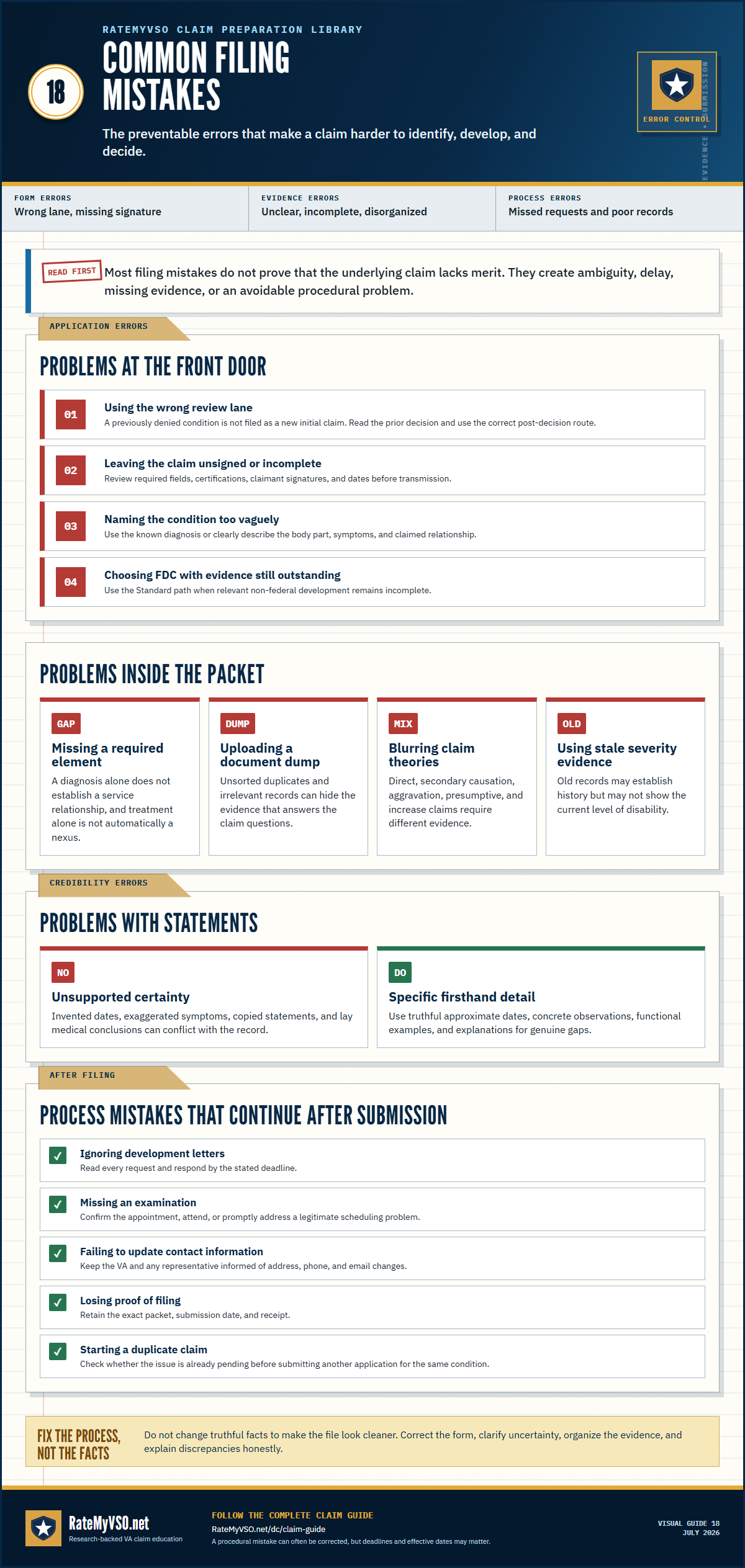
Common Filing Errors That Get Claims Denied
These are the mistakes that get winnable claims denied. Most are avoidable in five minutes. See the dedicated 10 Most Common VA Claim Mistakes guide for the full list with fixes.
- Unsigned forms. An unsigned VA Form 21-526EZ is not a claim. Sign and date every form.
- Expired or wrong-version forms. The VA updates forms periodically. Pull the current version from VA.gov, not a search-engine PDF from three years ago.
- Missing dates. Date the form on the day you sign it. A blank signature date can delay or invalidate the submission.
- Attorney signing the initial claim. Only the veteran (or a legal guardian / fiduciary) can sign the initial VA Form 21-526EZ. An accredited attorney or claims agent can sign later submissions and represent the veteran, but the veteran's signature is required to open the claim.
- Vague condition language. "Back problems" is not a claim. Use specific terms ("lumbar strain", "intervertebral disc syndrome") or use the VA.gov dropdown options. See our filing terms reference.
- Requesting review before the VA issues a decision. A Supplemental Claim or Higher-Level Review reviews a decision the VA has already issued. Wait for the decision letter, then select the appropriate review option. Do not wait for the decision to become final. If you disagree, acting within one year generally preserves continuous pursuit and protects the potential effective date.
- Evidence submitted without referencing the claim. Records uploaded to the wrong claim, or to no claim, can sit in the file unrouted. When uploading on VA.gov, attach evidence to the open claim.
- Filing without requesting STRs. If your service treatment records are not already in the VA's hands, request them before or alongside the claim. Do not assume the VA will pull them automatically. See the Records Request Guide.
Claim Quest: Quick Check
Five questions based only on this guide.
This checks what you understood from this guide. It is not a claim-readiness score, a prediction, an official test, or a record on your account.
Frequently Asked Questions
How long does a VA disability claim take?
Processing time varies widely and VA publishes a current average rather than a fixed range. Complex claims, claims with missing records, or claims requiring multiple C&P exams take considerably longer than straightforward ones. Check the current average at VA.gov.
Can I file at any age, or is there a deadline?
No deadline for the initial claim. A veteran can file decades after separation. The condition still must be service-connected and currently diagnosed. The one timing pressure is that effective dates run from the ITF or claim submission, so every month of delay is a month of back pay lost.
Will filing a new claim risk reducing my existing ratings?
Filing for a new, separate condition does not automatically reopen ratings for unrelated conditions. Filing an increase claim, on the other hand, does open the file for review. Stabilized ratings of five years or more, and 100% ratings, are protected by 38 CFR 3.344 and 38 CFR 3.343, but reductions can still happen if symptoms improve substantially.
How do I check the status of my claim?
Sign in to VA.gov with Login.gov or ID.me. The claim status page shows the phase your claim is in and the estimated decision date. Call 1-800-827-1000 if the online status has not updated in 30 days.
Can I file for a condition the VA already denied?
Yes. File a Supplemental Claim with new and relevant evidence (a new diagnosis, a nexus letter the VA has not seen, additional buddy statements). If the original denial is still within one year, you can also choose a Higher-Level Review or a Board appeal instead. See the appeals guide.
Do I need a lawyer to file a VA claim?
No. An accredited Veterans Service Organization (VSO) representative will file and advocate for you at no cost. Federal law restricts who may charge fees on VA claims, and most accredited attorneys cannot charge until after a Notice of Disagreement or appeal stage. For an initial claim, a VSO is usually the right starting point.
Can I request priority processing or pick where I take my C&P exam?
You can request priority processing in writing if you are terminally ill, homeless, over age 85, in extreme financial hardship, or a former POW. You can also request a specific C&P examiner type (VA versus contractor), a telehealth exam, or a preferred VA facility through a personal statement attached to the claim. The VA does not have to honor every preference, but reasonable requests tied to medical or logistical needs are often accommodated.
Related Tools and Guides
Estimate Your Combined Rating
Use the 38 CFR §4.25 combined rating calculator to model what your VA combined rating would be with existing and expected ratings.
Open the Combined Rating Estimator →Email this guide to yourself
Get the six-stage guide in your inbox with links to the tools. We won't store your email or send you anything else.
This guide is for educational purposes only and is not legal advice. For personalized help with your claim, find a VSO representative. All RateMyVSO tools are free. We never sell anything.