VA Rating Reductions & "Poking the Bear"
Can the VA lower your rating if you file for more? Yes, it can happen, but it's rarer than you think, and you have more legal protections than you know. Here's the truth, the law, and exactly what to do.

What Is "Poking the Bear"?
"Poking the bear" is veteran slang for the fear that filing a new claim, requesting an increase, or reopening an old decision could cause the VA to reduce an existing rating instead of increasing it.
The concern is real but often overblown. When you file a claim, the VA assigns a rater to your file. That rater reviews your evidence and may order a new C&P exam. If the exam shows improvement in a condition you're already rated for, the VA could propose a reduction.
Why Veterans Fear It
- Financial stakes are high. A reduction from 70% to 50% costs over $600/month. A reduction from 100% costs over $2,000/month.
- The process feels adversarial. The VA sent you a letter saying they want to take away something you earned.
- Horror stories spread fast. One veteran's bad experience on Reddit gets 500 upvotes. The thousands who filed for increases and got them don't post about it.
Your Legal Protections Against Reductions
Congress and the courts have built substantial protections into the system. The VA can't just lower your rating because one exam looked better. They have to clear specific legal hurdles.
Stabilized Rating
Rating at the same level for 5+ years. VA must show sustained improvement across multiple exams, not just one good day.
Service Connection Protected
After 10 years, the VA cannot sever service connection entirely, except for fraud in the original grant or military records clearly showing you lacked the required service or discharge character. Your rating can still be reduced, but the condition stays on your record. M21-1, Part X, Subpart ii, Chapter 5, Section B (severance of SC) was updated 2026-05-13 with revised rater guidance, the 10-year statutory protection under 38 CFR § 3.957 and the clear-and-convincing-evidence rebuttal standard under § 3.105(d) are unchanged.
Rating Floor
Rating at the same level for 20+ continuous years cannot be reduced below that level, period. Only exception: fraud.
Exam Exemption
Veterans over 55 are generally exempt from routine reexaminations, which are the primary trigger for proposed reductions.
Permanent & Total
If your rating is designated P&T, you are not subject to future routine exams under 38 CFR § 3.327. That's a different protection than the 20-year floor, P&T removes the routine-reexamination trigger; it doesn't by itself create a locked-in percentage the way 20 continuous years does.
5-year rule: 38 CFR § 3.344(a)-(b) • 10-year rule: 38 CFR § 3.957 • 20-year rule: 38 CFR § 3.951(b)
The "Sustained Improvement" Standard
For ratings in effect 5 or more years, the VA must prove sustained material improvement under the ordinary conditions of life. This is a high bar:
- Improvement must be shown across multiple examinations, not just one
- The exam used to justify the reduction must be at least as thorough as the exam that established the rating
- Temporary or episodic improvement doesn't count. It must be consistent over time
- The improvement must reflect real change in the veteran's ability to function in daily life and work, not just a change in test numbers
The governing rule reads: "Ratings on account of diseases subject to temporary or episodic improvement...will not be reduced on any one examination, except in those instances where all the evidence of record clearly warrants the conclusion that sustained improvement has been demonstrated." (see 38 CFR § 3.344(a))
The "Sustained Improvement" Standard
For any rating that has been in effect for five or more years, the VA cannot reduce it based on a single examination showing apparent improvement. The regulation at 38 CFR 3.344 requires the VA to demonstrate sustained material improvement before reducing a stabilized rating.
What "Sustained" Requires
Improvement is not "sustained" unless it is shown consistently, not just on one exam (see 38 CFR 3.344(a)). The regulation states that a rating will not be reduced on any one examination, except in those instances where all the evidence of record clearly warrants the conclusion that sustained improvement has been demonstrated. That exception matters: for ratings in effect five or more years, a single thorough exam CAN support a reduction if the full record, not just that exam, clearly supports it. In practice that exception is rarely met, so most reductions of long-standing ratings do rely on more than one examination, but the rule is not an absolute one-exam ban.
- A single C&P exam that catches a good day does not satisfy the standard.
- The examiner's report must address the veteran's ability to function under the ordinary conditions of life and work, not only clinical test results.
- The examination used to support the reduction must be at least as thorough and complete as the examination that originally established the rating.
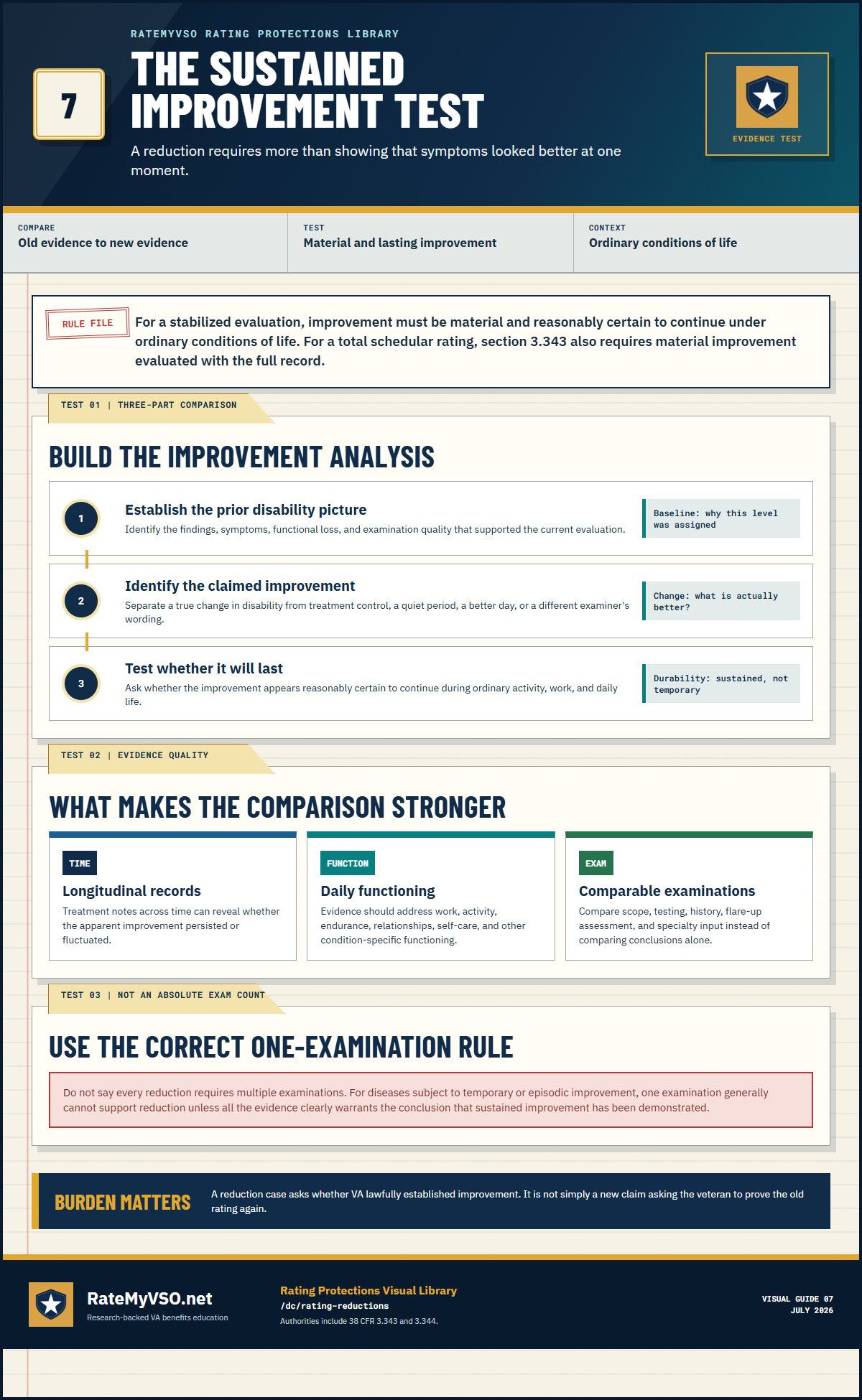 One-page guide: The VA Sustained Improvement Test
Sustained-improvement test comparing the prior disability picture, claimed improvement, examination quality, and durability under ordinary conditions of life. Opens the full-size chart, free to save or print.
One-page guide: The VA Sustained Improvement Test
Sustained-improvement test comparing the prior disability picture, claimed improvement, examination quality, and durability under ordinary conditions of life. Opens the full-size chart, free to save or print.
Episodic Conditions and "One Good Day"
Certain conditions are prone to episodic fluctuation: PTSD, migraines, chronic pain, seizure disorders, Meniere's disease, and many others. For these, a single exam may catch a period of relative stability. Under 38 CFR 3.344(a), that temporary improvement does not justify a reduction on its own, unless all the evidence of record clearly warrants the conclusion that sustained improvement has been demonstrated.
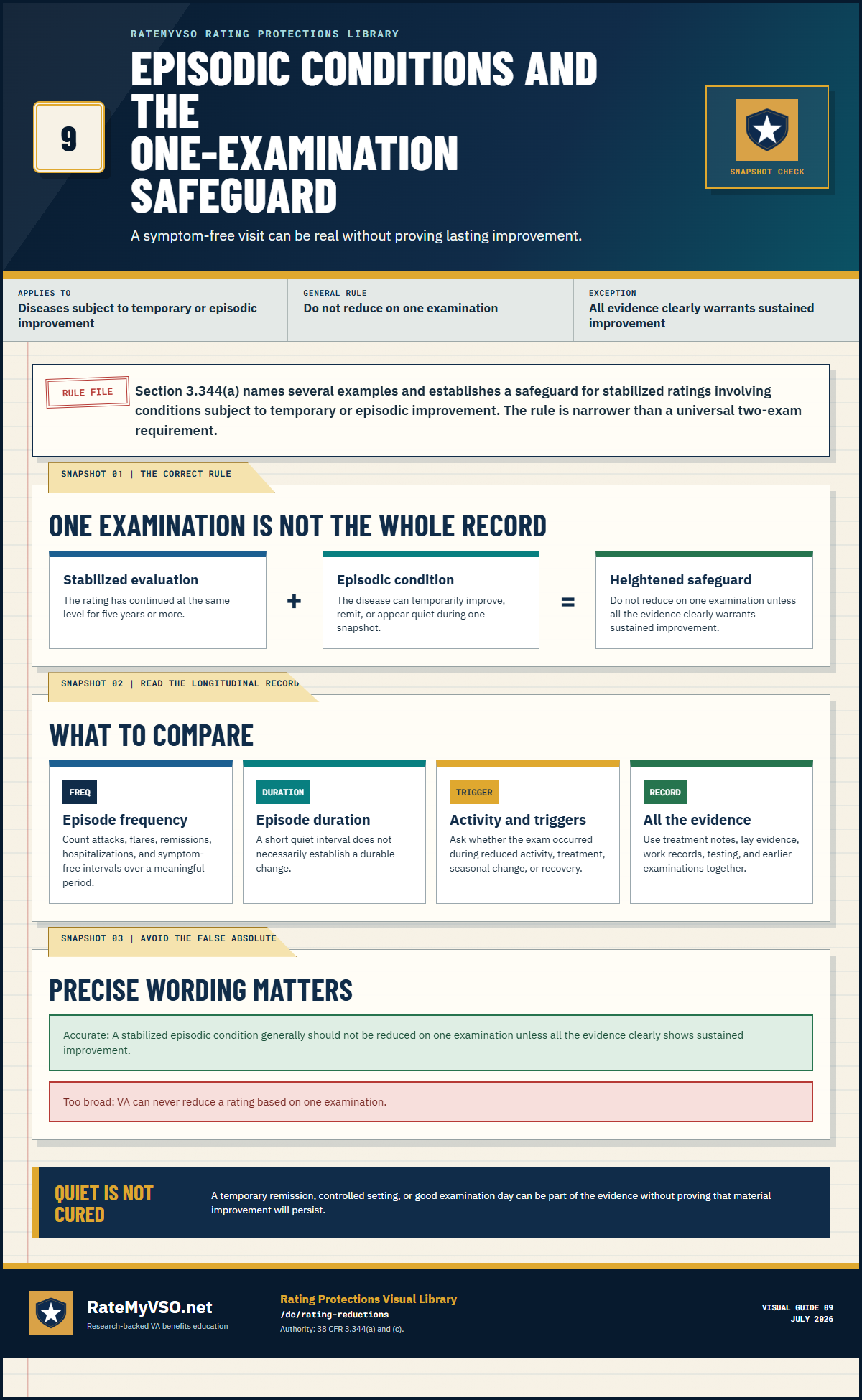 One-page guide: Episodic Conditions and the One-Examination Safeguard
Guide to stabilized episodic conditions and the rule against relying on one examination unless all evidence clearly warrants sustained improvement. Opens the full-size chart, free to save or print.
One-page guide: Episodic Conditions and the One-Examination Safeguard
Guide to stabilized episodic conditions and the rule against relying on one examination unless all evidence clearly warrants sustained improvement. Opens the full-size chart, free to save or print.
The "Ordinary Conditions of Life" Test
Even where improvement appears genuine across multiple examinations, the VA must assess whether that improvement holds under the ordinary conditions of life. This standard comes from 38 CFR 3.344(a) and was further defined in Schafrath v. Derwinski, 1 Vet. App. 589 (1991). The question is not whether the veteran appeared better in the controlled setting of a medical appointment but whether they can sustain normal daily and work activity. Evidence of ongoing limitations at work, difficulty with daily tasks, or continuing treatment supports the conclusion that improvement has not been demonstrated under this test.
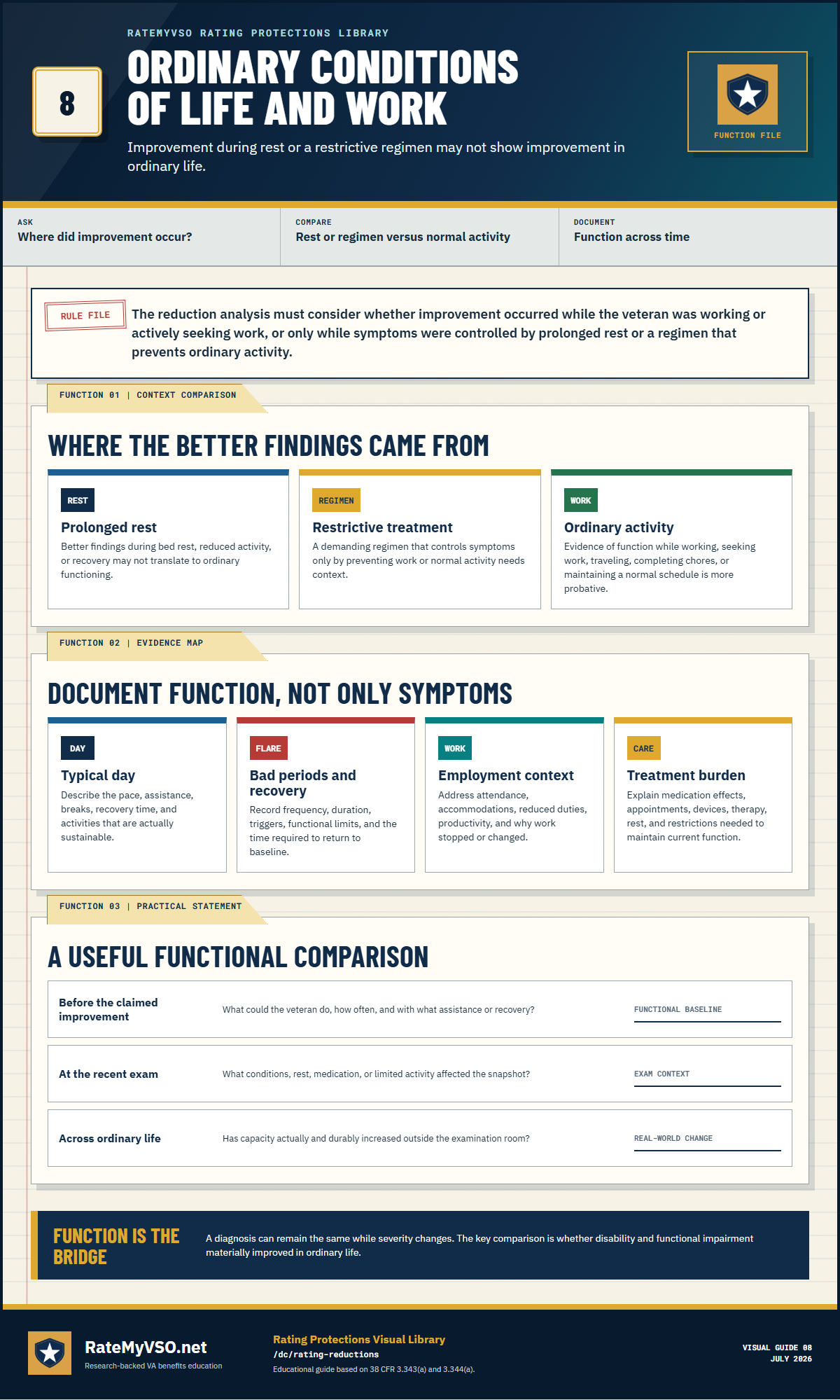 One-page guide: VA Rating Reductions and Ordinary Conditions of Life
Ordinary-conditions guide comparing improvement during rest or a restrictive regimen with functioning during daily activity and work. Opens the full-size chart, free to save or print.
One-page guide: VA Rating Reductions and Ordinary Conditions of Life
Ordinary-conditions guide comparing improvement during rest or a restrictive regimen with functioning during daily activity and work. Opens the full-size chart, free to save or print.
How to Invoke This Protection
- Respond to the proposed reduction letter. Explicitly cite 38 CFR 3.344 and state that your condition is subject to episodic symptoms, or that your rating has been in effect for five or more years.
- Document your worst days, not just your average days. Lay statements from you and people who see you regularly describing flare-ups, missed work, and functional limits are directly relevant to the ordinary-conditions-of-life test.
- Challenge an inadequate exam. If the C&P examination did not review your full treatment history, was shorter than the original exam, or did not address functional impact, raise that in writing.
- Request a predetermination hearing. A hearing gives you the opportunity to present the above arguments before any reduction becomes final.
Source: 38 CFR 3.344(a)-(c) • Schafrath v. Derwinski, 1 Vet. App. 589 (1991) • Brown v. Brown, 5 Vet. App. 413 (1993)
What Actually Triggers a Reduction
The VA doesn't randomly reduce ratings. Reductions happen under specific circumstances:
1. Routine Reexamination (Most Common)
When you were first rated, the VA may have scheduled a future reexamination, typically 2 to 5 years out. If that exam shows improvement, the VA may propose a reduction. This happens whether or not you file a new claim.
2. C&P Exam for a New Claim
When you file for an increase or a related secondary condition, the VA orders a new C&P exam. If the examiner documents improvement in a condition you're already rated for, the rater may propose a reduction, even though you filed for an increase.
3. Fraud or Error Discovery
If the VA discovers clear and unmistakable error in the original rating or evidence of fraud, it can propose a reduction regardless of how long the rating has been in effect.
4. Hospitalization or Treatment Records
VA treatment records that document significant improvement can trigger a review, even without a formal reexamination.
Risk Level by Claim Type
Not all claims carry the same risk. Understanding which types invite more scrutiny helps you file strategically. The VA doesn't publish reduction rates by claim type, so the risk levels below are general procedural reasoning (does this claim type trigger a new exam of an already-rated condition), not a measured statistic.
| Claim Type | Risk | Why | Notes |
|---|---|---|---|
| Claim for Increase | Medium | New C&P exam directly evaluates current severity of the condition | Only risky if your condition has genuinely improved. If it's worse, an increase claim is the right move. |
| Secondary Condition | Medium | VA may reexamine the primary condition the secondary is based on | If your primary condition has improved, claiming a secondary to it invites scrutiny of both. |
| New Unrelated Condition | Low | Shouldn't trigger review of unrelated conditions | Safest type. Different body system, different exam, different rater focus. |
| Supplemental Claim | Medium | New evidence may trigger a new exam | Risk depends on whether the new evidence relates to a condition that may have improved. |
| Higher-Level Review | Low | Same evidence reviewed. No new exam ordered | Reviewer can identify "duty to assist" errors, but a duty-to-assist error by itself does not establish improvement, so this pathway is unlikely to trigger a reduction on its own. |
| BVA Appeal | Low | Board reviews the existing record | The Board can remand for a new exam, but it is reviewing your existing record on appeal, not ordering a fresh look at whether your condition has improved. |
| TDIU Application | Medium | Requires a full review of all service-connected conditions | The VA evaluates your overall employability, which means looking at everything. |
What Happens When the VA Proposes a Reduction
The VA cannot reduce your rating without due process. Here's the exact procedure required by 38 CFR § 3.105(e):
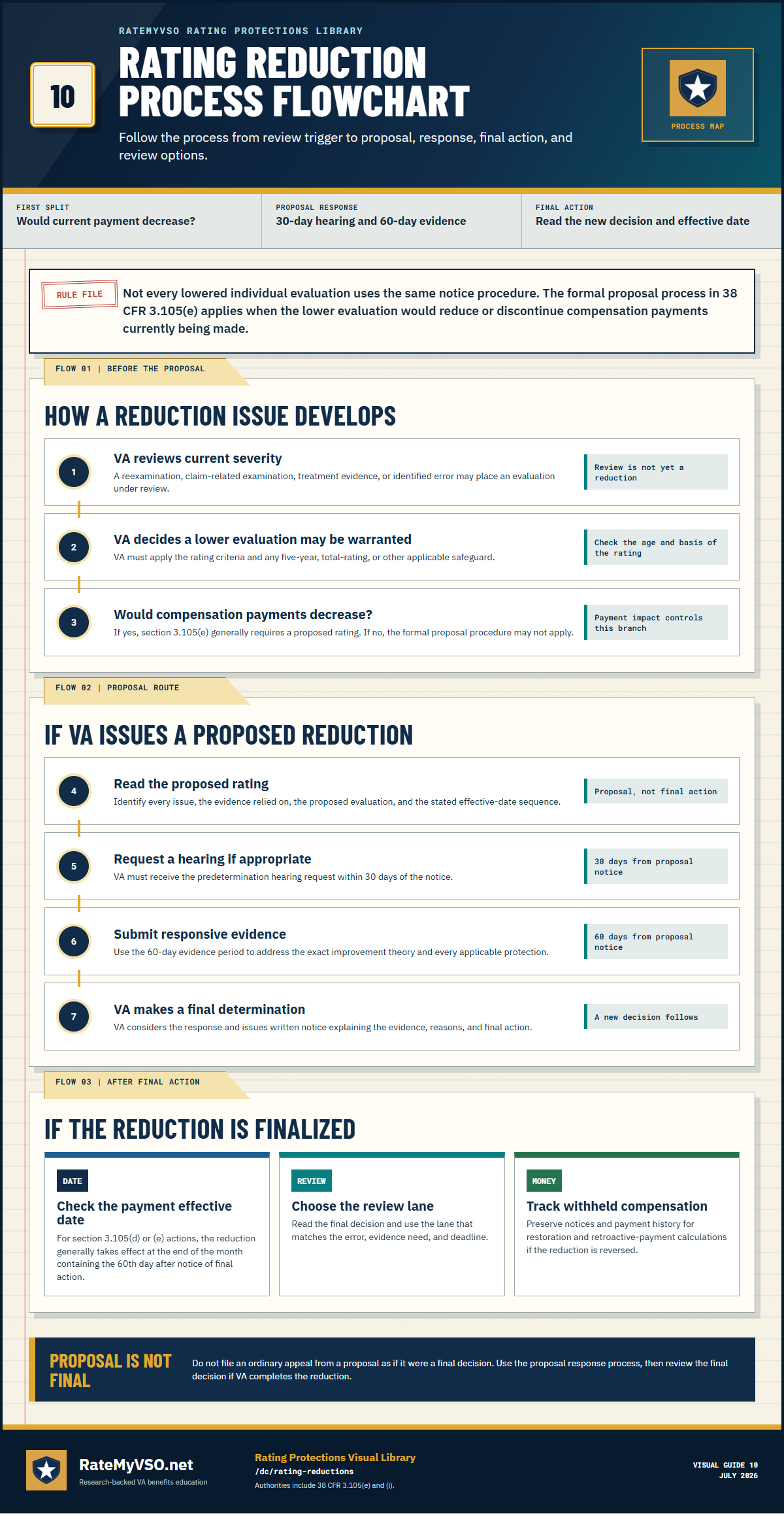
Step 1: Proposed Reduction Letter
The VA sends you a "Notice of Proposed Reduction" explaining which rating they want to reduce, why, and what evidence they're relying on. This is NOT a final decision. You cannot appeal it yet, because nothing has happened yet.
Step 2: Request a Hearing
You have 30 days to request a predetermination hearing. This is critical. Requesting a hearing delays the reduction until after the hearing takes place. It also buys you time to gather evidence.
Step 3: Submit Evidence
You have 60 days from the date of the proposal letter to submit evidence showing your condition has not improved. This can include medical records, buddy statements, private medical opinions, or your own statement about daily impact.
Step 4: VA Makes Final Decision
After reviewing your response (or if you don't respond), the VA issues a final rating decision. If they proceed with the reduction, it takes effect on the first day of the month following a 60-day period after the final decision.
Step 5: Appeal Rights
If the reduction becomes final, you can appeal through the standard AMA lanes: Supplemental Claim (with new evidence), Higher-Level Review, or Board of Veterans' Appeals.
After a Final Reduction Decision
If the VA issues a final decision and proceeds with the reduction, that final decision, not the earlier proposal letter, is what starts the clock on both the effective date and your appeal options. Audit the final decision letter against the proposal: did the VA rely on the same exam, or new evidence? Then choose a review lane (Supplemental Claim, Higher-Level Review, or Board appeal) and start tracking any payment change and the evidence you'll need to seek restoration.
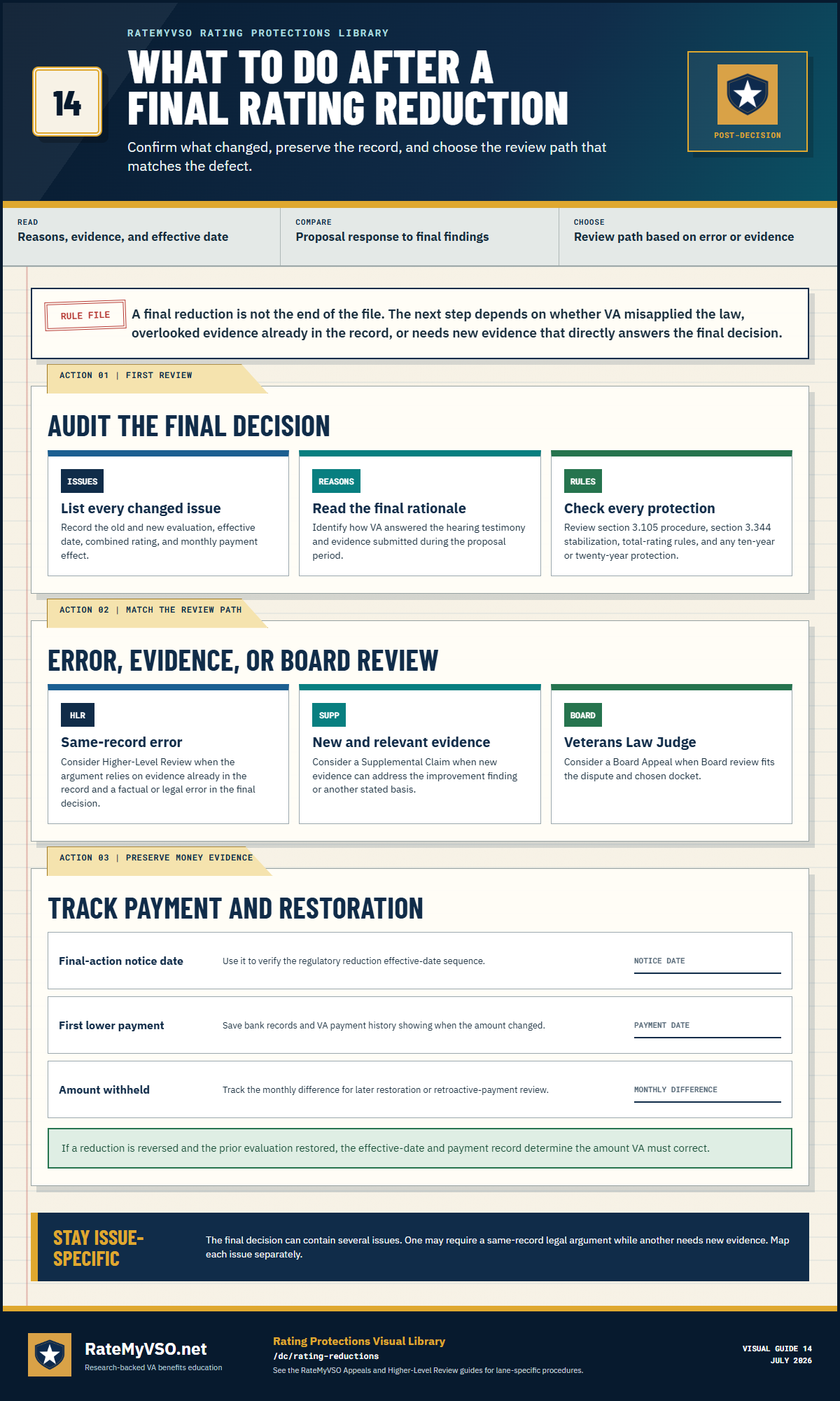 One-page guide: What to Do After a Final VA Rating Reduction
Post-reduction guide for auditing the final decision, choosing a review lane, and tracking payment and restoration evidence. Opens the full-size chart, free to save or print.
One-page guide: What to Do After a Final VA Rating Reduction
Post-reduction guide for auditing the final decision, choosing a review lane, and tracking payment and restoration evidence. Opens the full-size chart, free to save or print.
How to Fight a Proposed Reduction
If you receive a proposed reduction letter, here's your action plan:
- Request a predetermination hearing within 30 days. This delays the reduction and gives you more time. At the hearing, you can describe your condition in your own words and present evidence directly to the decision-maker.
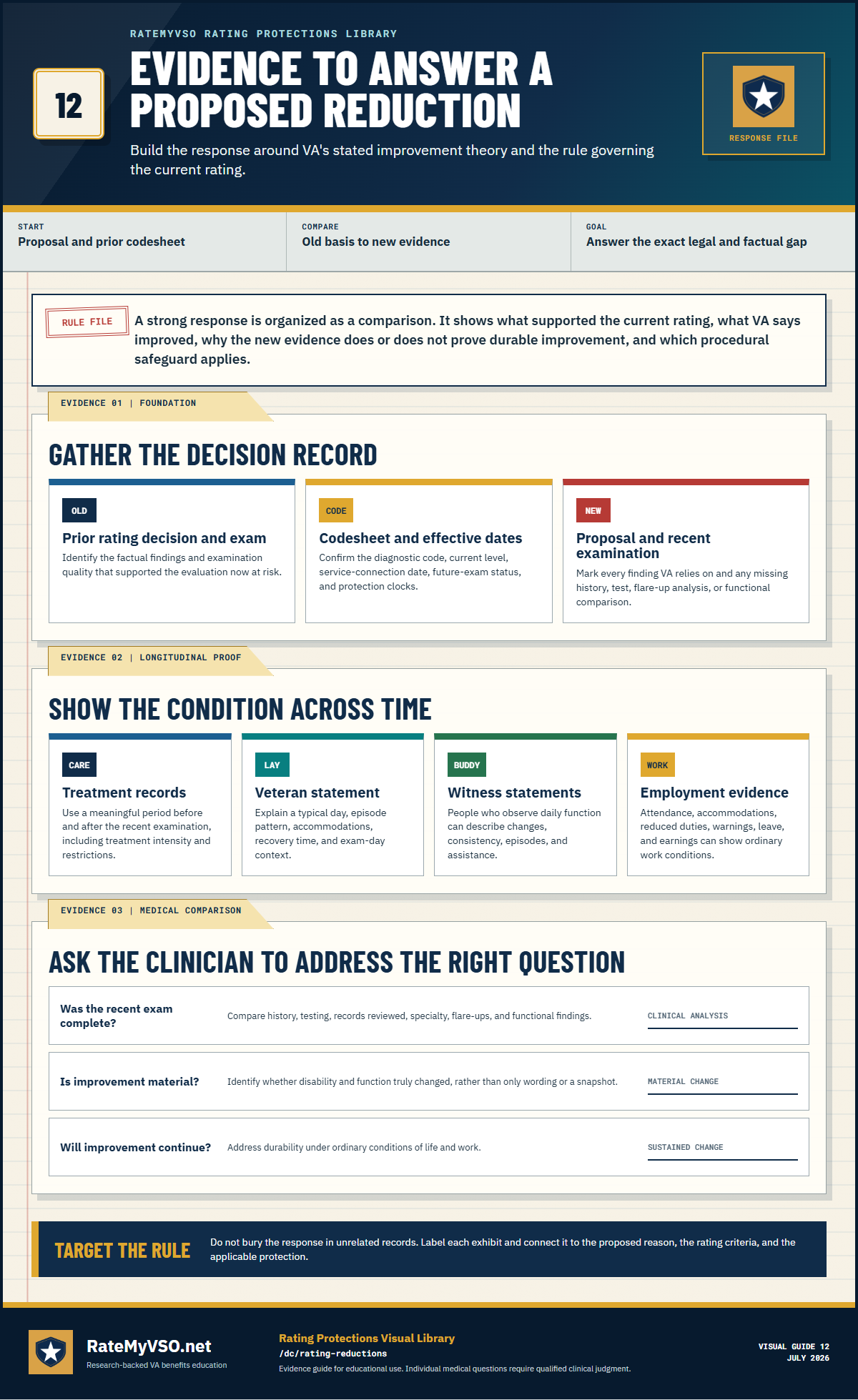
- Get a private medical opinion. Have your own doctor review the C&P exam findings and write an opinion explaining why your condition has NOT improved. Address the specific findings the VA is relying on.
- Submit current medical records. Ongoing treatment records, prescription history, and therapy notes showing persistent symptoms carry significant weight.
- Write buddy/lay statements. Statements from your spouse, family, coworkers, or friends describing how your condition affects your daily life. These are especially valuable for conditions with variable symptoms (PTSD, migraines, chronic pain).
- Challenge the C&P exam. Was it thorough? Did the examiner review your full medical history? Was it as complete as the exam that established your rating? If not, the reduction may be invalid under 38 CFR § 3.344.
- Invoke the 5-year rule. If your rating has been at the same level for 5+ years, the VA must show sustained improvement, not just one better exam. Cite 38 CFR § 3.344(a) specifically.
- Contact your VSO immediately. An accredited representative can review the proposal, help you build a response, and attend the hearing with you. Find a VSO representative →
What NOT to Do
- Don't panic and don't ignore it. You have time and you have rights.
- Don't assume the VA is right. The VA bears the burden of proof in reduction cases, not you. They must prove improvement.
- Don't skip the hearing. Even if you have strong written evidence, the hearing gives you a chance to explain things the paper trail might not capture.
- Don't stop treatment. Gaps in treatment can be used to argue improvement. Keep going to your appointments.
Key Case Law: What the Courts Say
These cases define what the VA must do (and what they can't do) when reducing a rating. If your reduction didn't follow these rules, it may be void from the beginning.
VA must review your entire medical history before reducing a rating (Brown v. Brown)
The foundational case. Before reducing any rating, the VA must comply with 38 CFR §§ 4.1, 4.2, 4.10, and 4.13, meaning they must review your entire medical history, not just one exam. A reduction made without following these regulations is void ab initio (void from the beginning).
Improvement must reflect a real change in ability to function (Schafrath v. Derwinski)
Improvement must reflect an actual change in the veteran's ability to function under the ordinary conditions of life and work, not just a failure to meet specific numbers on a diagnostic code. Where a reduction was made without following the law, the erroneous reduction must be vacated and the prior rating restored.
The burden of proof falls on the VA in reduction cases (Peyton v. Derwinski)
The burden of proof is on the VA in reduction cases. This is the opposite of increase claims, where the veteran bears the burden. The VA must establish that improvement has occurred. The veteran doesn't have to prove it hasn't.
A reduction that ignores the rules is void, not just voidable (Greyzck v. West)
Reductions made without compliance with applicable regulations are void. Not "voidable", void. As if they never happened. The prior rating must be restored.
BVA Decision A25009385
Recent example: The Board found a reduction from 100% to 10% for a heart condition was improper because the C&P exam was inadequate and the regional office failed to analyze whether improvement reflected actual functional change. The reduction was declared void ab initio and the 100% rating was restored.
Smart Strategies: When and How to File
The goal isn't to avoid filing. It's to file with your eyes open.
Before You File for an Increase
- Look up your rating criteria. Use our Condition Lookup to find your diagnostic code and see exactly what the VA looks for at each rating level. Does your current evidence support the rating you have?
- Get current medical evidence first. Don't file with stale records. See your doctor, document your current symptoms, and build the paper trail before the C&P exam.
- Check your protections. How long has your rating been in effect? Are you over 55? Do you have P&T status? The more protections you have, the lower your risk. See our Rating Protections guide.
- Document your worst days. Keep a symptom journal. Note flare-ups, missed work, activities you can't do. This becomes strong evidence if your condition is variable.
- Talk to your VSO first. An accredited representative can review your file and give you an honest assessment of whether an increase claim makes sense.
Filing Strategies That Minimize Risk
- File for unrelated conditions separately. A new claim for a condition in a different body system shouldn't trigger review of your other ratings.
- For secondary claims, make sure the primary condition is well-documented. Since the VA may reexamine the primary condition, ensure your records show it hasn't improved.
- Consider the timing. If you recently had a good stretch and your last medical records look better than usual, wait until you have documentation of your typical (or worse) days.
- Prepare for the C&P exam. Know what the examiner will evaluate. Be honest, but don't downplay symptoms. Report your worst days, not your best. If you have flare-ups, say so clearly.
- Get a private DBQ completed. Having your own doctor fill out a Disability Benefits Questionnaire before the C&P exam gives you a documented baseline.
The Bottom Line
What Happens to Your Money
A reduction lowers your monthly check going forward, but the bigger fear is a surprise debt (the VA calls it an overpayment). In most reductions, no debt is created. Here is when one can arise and what the law allows.
Most Reductions Do Not Create a Debt
A reduction takes effect on the first day of the month after a 60-day period that follows the final decision (see 38 CFR § 3.105(e)). Because the lower rate is future-dated, you keep everything you were already paid. No retroactive clawback, no debt.
When a Debt Can Happen
- Missed reexamination. If the VA scheduled a reexamination and you did not report, benefits can be stopped or reduced effective an earlier date under 38 CFR § 3.655, which can create a retroactive overpayment.
- Fraud or clear and unmistakable error. When a rating is corrected back to an earlier date, the months paid at the higher rate become an overpayment. (A correction made solely for the VA's own clear and unmistakable error generally does not create a debt for the veteran.)
- Running award not stopped in time. If the VA keeps paying the old rate while the final decision is processing, the difference can post as a small overpayment.
Three Things You Can Do With a Debt
- Dispute the debt. If you believe the overpayment is wrong or miscalculated, you can dispute its validity. The debt letter explains the window to request that collection pause while the dispute is reviewed.
- Request a waiver. Under 38 USC § 5302, the VA can waive all or part of a debt when collection would be against "equity and good conscience." The six balancing factors (fault, hardship, unjust enrichment, and others) are listed in 38 CFR § 1.965. A waiver request usually includes VA Form 5655 (Financial Status Report).
- Set up a repayment plan. If the debt is valid and not waived, the DMC offers monthly payment plans and compromise offers.
If You Win the Reduction Fight, You Get Back Pay
If a reduction is later reversed (for example, found void for not following 38 CFR § 3.344), the prior rating is restored back to the date it was reduced, and the VA owes you the difference for every month you were paid at the lower rate.
Related Tools and Guides
This guide is for educational purposes only and is not legal or medical advice. Legal references are from Title 38 of the U.S. Code and the Code of Federal Regulations. Case law citations are from the U.S. Court of Appeals for Veterans Claims (CAVC) and the Board of Veterans' Appeals (BVA). For help with your specific situation, find a free VSO representative or consult with a VA-accredited attorney.