VA Rating Protections
VA Disability Rating Protections and Reduction Rules Explained (5, 10, and 20-Year Rules)
This guide explains the legal safeguards that protect your VA disability rating from being reduced over time. You will learn the key thresholds under federal law: the 5-year stabilization rule, which requires sustained improvement before a reduction, the 10-year rule, which protects service connection from being severed except for fraud, and the 20-year rule, which locks a rating at its lowest sustained level during that period. It also covers the extra safeguards for 100 percent ratings, Permanent and Total (P&T) status, and static conditions, plus the strict due process the VA must follow before proposing any reduction. Whether you are newly rated or have held your benefits for decades, this guide shows you exactly how your rating is protected, when the VA can and cannot reduce it, and what evidence you need if a reduction is ever proposed.

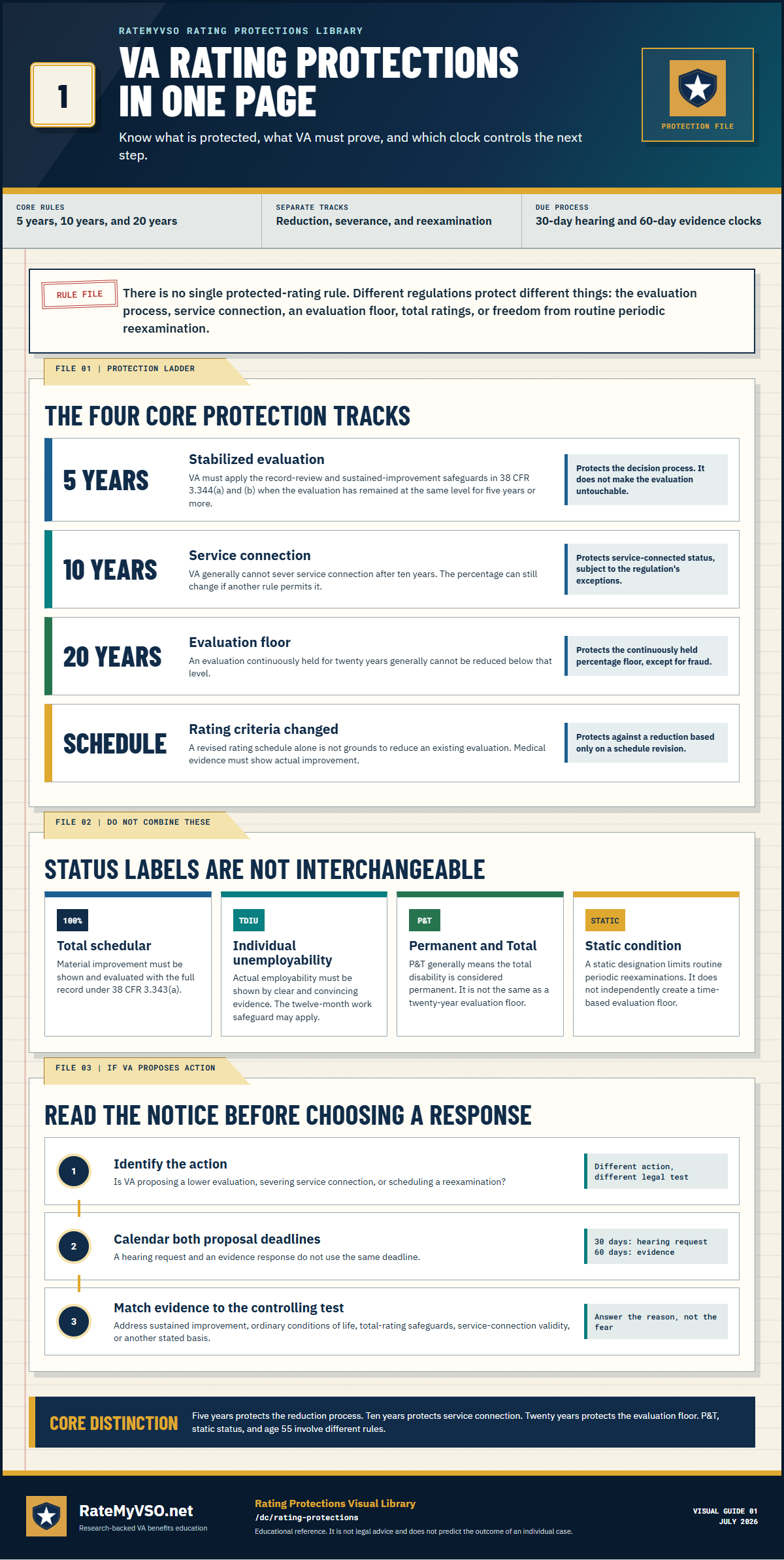 One-page guide: VA Rating Protections in One Page
One-page VA rating protections guide separating the five-year stabilization rule, ten-year service-connection protection, twenty-year evaluation floor, schedule-change protection, total ratings, P&T, static status, and proposal deadlines. Opens the full-size chart, free to save or print.
One-page guide: VA Rating Protections in One Page
One-page VA rating protections guide separating the five-year stabilization rule, ten-year service-connection protection, twenty-year evaluation floor, schedule-change protection, total ratings, P&T, static status, and proposal deadlines. Opens the full-size chart, free to save or print.
How Rating Protections Work
Many veterans live in fear that the VA will reduce their rating. While reductions do happen, the law provides increasing levels of protection the longer a rating has been in effect. Understanding these rules means you can stop worrying and know exactly where you stand.
There are three main time-based protections, plus additional protections for total ratings and static conditions.
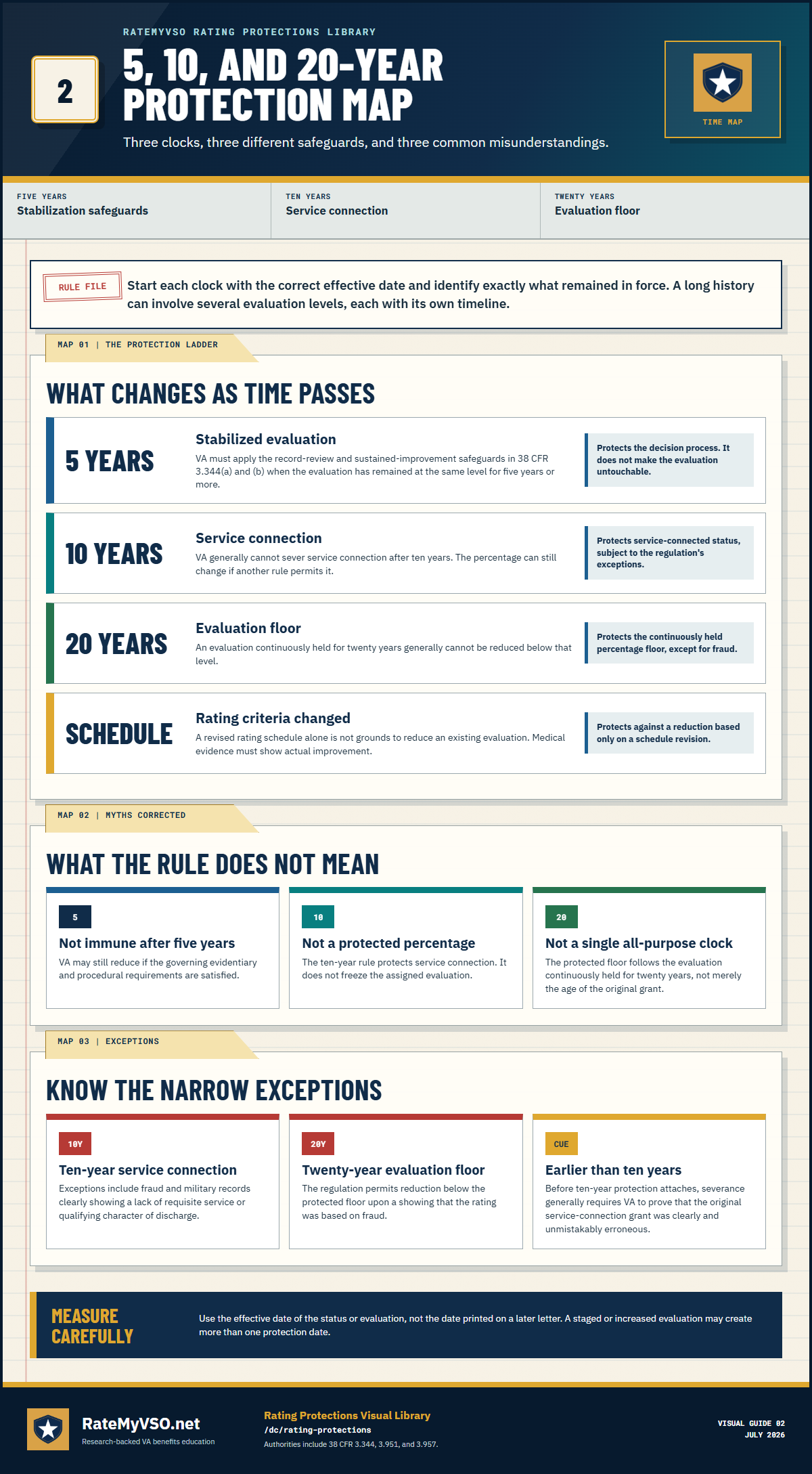
The 5-Year Rule (38 CFR § 3.344(a))
Once your rating has been in effect for 5 or more years, the VA cannot reduce it unless:
- There is sustained improvement shown by the full record, not just one exam.
- The improvement is shown under the ordinary conditions of life, not just in a clinical setting.
- The re-examination is at least as full and complete as the exam used to establish the rating.
- The VA considers whether the improvement is reasonably certain to continue under everyday conditions.
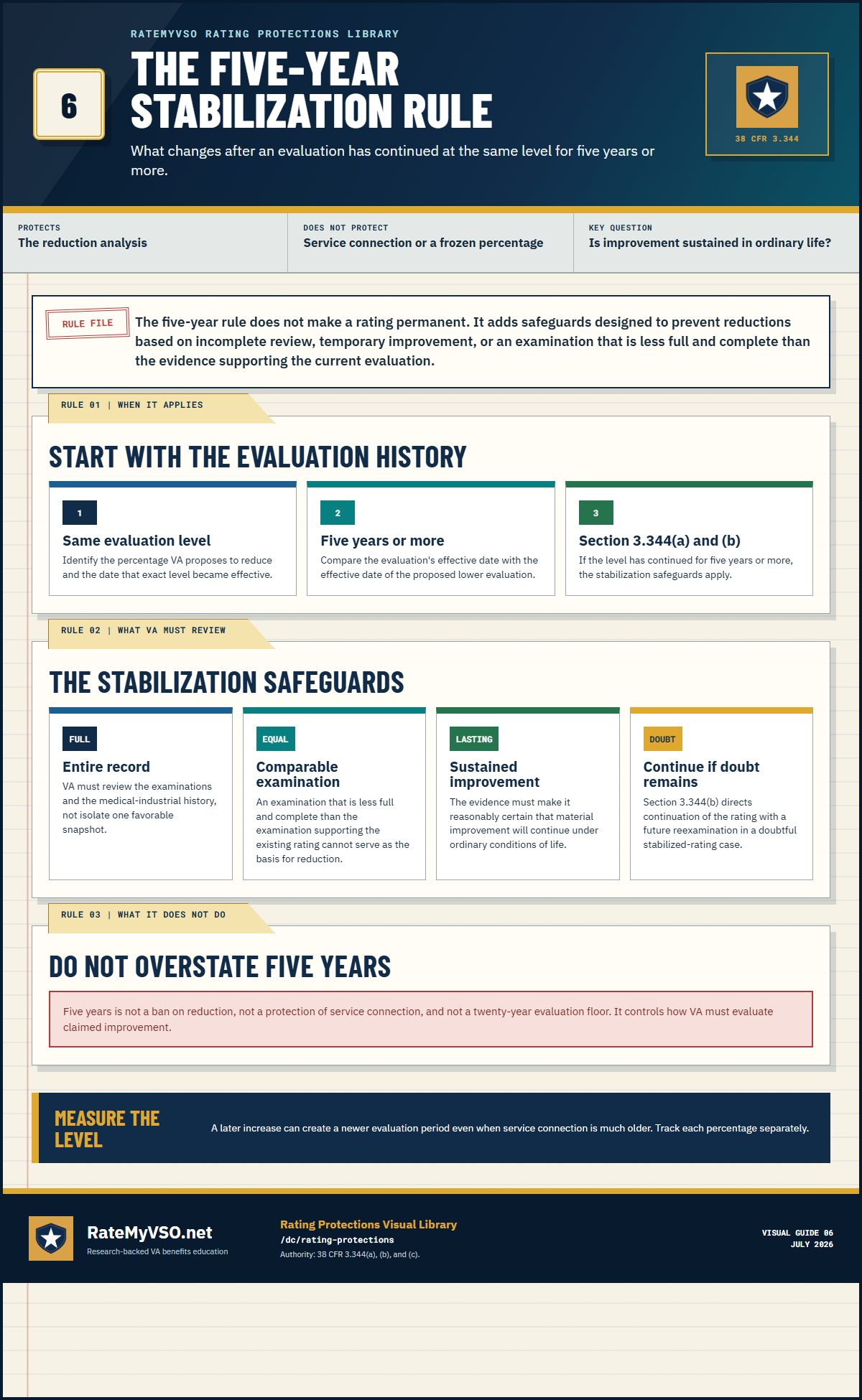 One-page guide: The Five-Year VA Rating Stabilization Rule
Five-year stabilization guide covering the evaluation-history test, full-record review, comparable examinations, sustained improvement, and doubtful stabilized-rating cases. Opens the full-size chart, free to save or print.
One-page guide: The Five-Year VA Rating Stabilization Rule
Five-year stabilization guide covering the evaluation-history test, full-record review, comparable examinations, sustained improvement, and doubtful stabilized-rating cases. Opens the full-size chart, free to save or print.
The 10-Year Rule (38 U.S.C. § 1159)
Once your service connection has been in effect for 10 or more years, the VA cannot sever service connection, meaning they can't say your condition isn't related to service anymore.
- This protects the connection to service, not the specific rating percentage.
- The VA could still reduce your rating percentage (subject to the 5-year rule), but they can't take away service connection entirely.
- Exceptions: There are only two ways to sever after 10 years: the original grant was based on fraud, or military records clearly show the person did not have the required service or the character of discharge needed for the benefit.
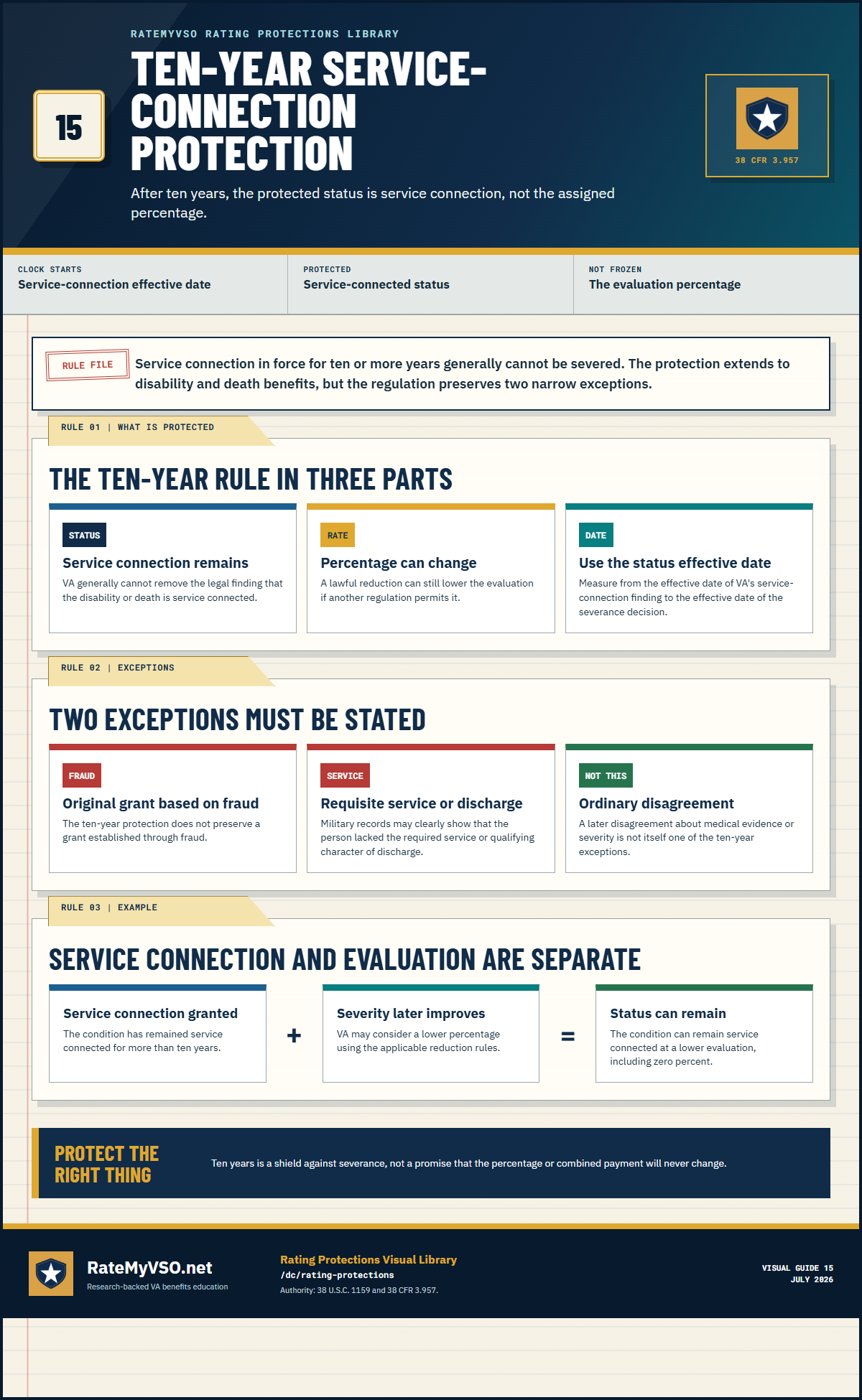 One-page guide: Ten-Year VA Service-Connection Protection
Ten-year service-connection protection guide explaining the protected status, percentage boundary, clock calculation, fraud exception, and service-eligibility exception. Opens the full-size chart, free to save or print.
One-page guide: Ten-Year VA Service-Connection Protection
Ten-year service-connection protection guide explaining the protected status, percentage boundary, clock calculation, fraud exception, and service-eligibility exception. Opens the full-size chart, free to save or print.
The 20-Year Rule (38 CFR § 3.951(b))
Once a rating has been continuously in effect for 20 or more years, it cannot be reduced below the lowest rating it has held during that 20-year period.
- This is the strongest time-based protection.
- If you've been rated at 70% for 20+ years, the VA cannot reduce it below 70%. Period.
- If your rating was 50% for 15 years and then increased to 70% for 5 years, the floor is 50% (the lowest during the 20-year period).
- Exception: Only fraud can override the 20-year rule.
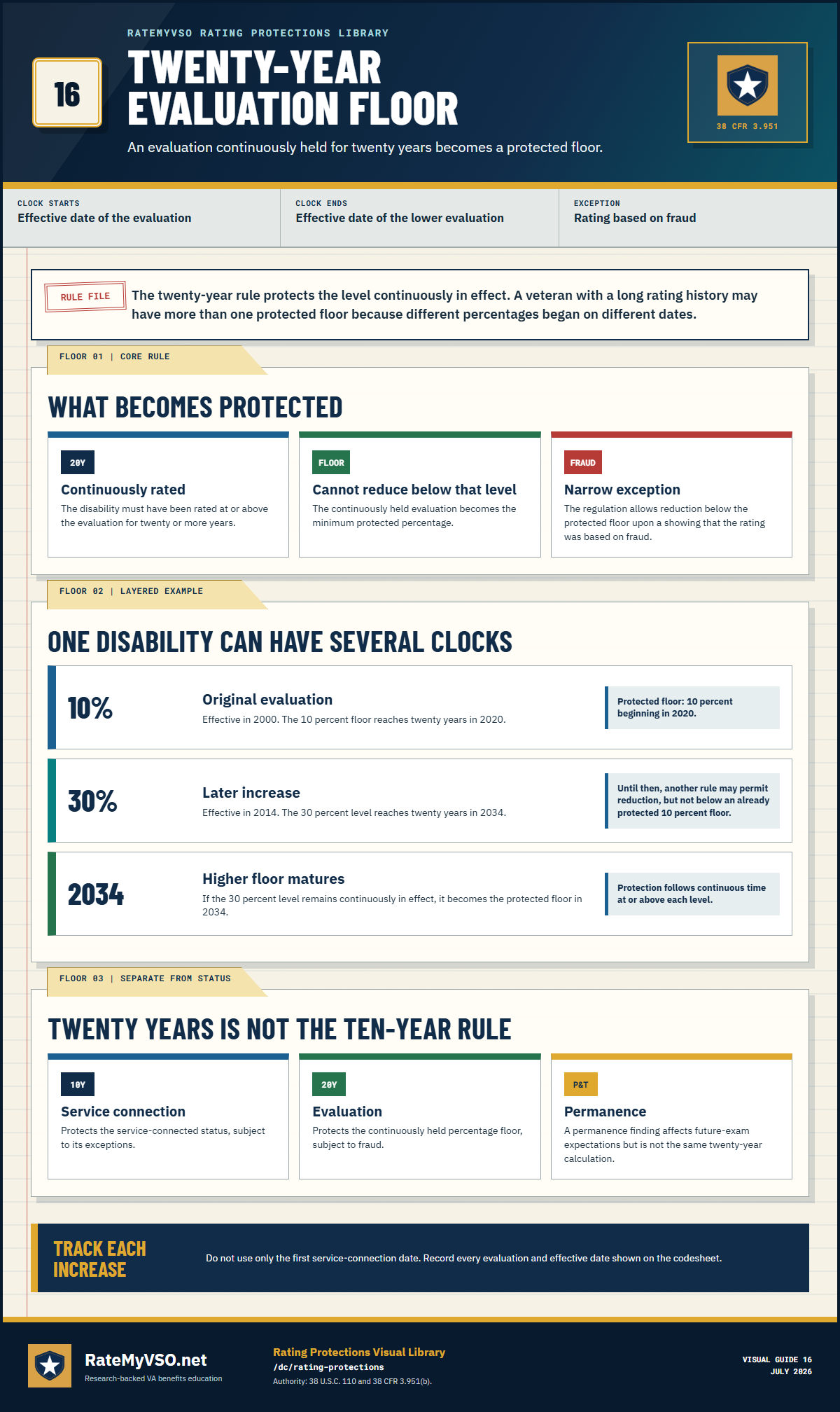 One-page guide: Twenty-Year VA Evaluation Floor
Twenty-year evaluation-floor guide showing continuous-rating requirements, layered protection clocks after increases, and the fraud exception. Opens the full-size chart, free to save or print.
One-page guide: Twenty-Year VA Evaluation Floor
Twenty-year evaluation-floor guide showing continuous-rating requirements, layered protection clocks after increases, and the fraud exception. Opens the full-size chart, free to save or print.
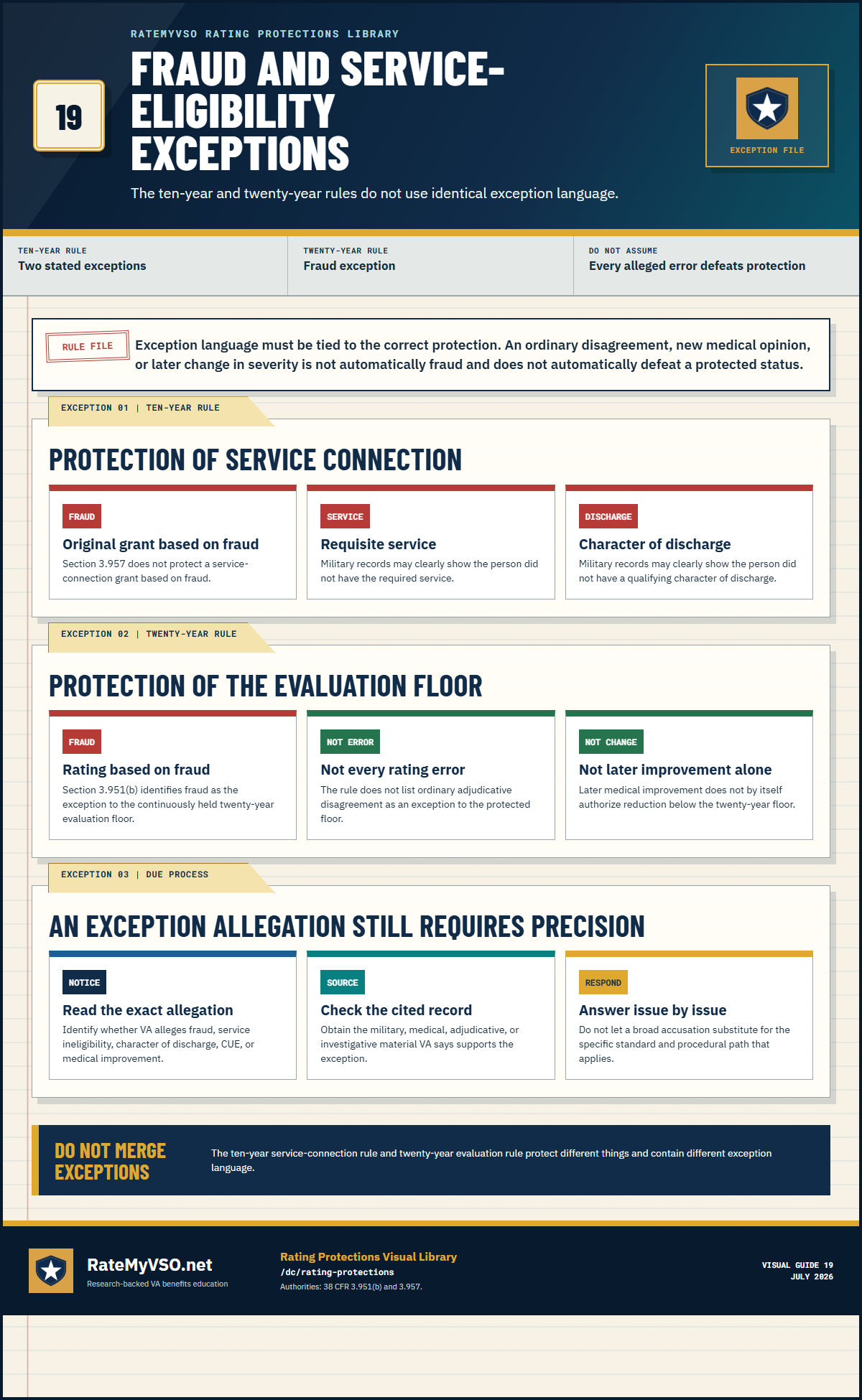 One-page guide: Fraud and Service-Eligibility Exceptions to VA Rating Protections
Guide distinguishing the ten-year fraud and service-eligibility exceptions from the twenty-year fraud exception. Opens the full-size chart, free to save or print.
One-page guide: Fraud and Service-Eligibility Exceptions to VA Rating Protections
Guide distinguishing the ten-year fraud and service-eligibility exceptions from the twenty-year fraud exception. Opens the full-size chart, free to save or print.
100% Rating Protections
Total disability ratings (100%) have additional protections under 38 CFR § 3.343. This rule is different depending on how your 100% was reached:
- A schedular 100% rating (earned under the rating tables in 38 CFR Part 4) cannot be reduced unless the evidence shows material improvement under the ordinary conditions of life. Employability is not the test here.
- A TDIU rating (Total Disability based on Individual Unemployability, granted because your condition prevents substantially gainful employment even though it doesn't reach 100% on the schedule) has its own, stricter continuance rule: it can only be reduced with clear and convincing evidence that the veteran is actually able to hold substantially gainful work, sustained for 12 consecutive months. See the TDIU guide.
- Either way, a single exam showing improvement generally is not enough by itself. The VA must show the improvement is reasonably certain to continue.
- If you're rated 100% and have been for 5+ years, both the total-rating protections AND the 5-year sustained improvement standard apply, making reduction extremely difficult.
Permanent & Total (P&T)
If the VA designates your total rating as "permanent", it means they've determined your disabilities are not expected to improve. This designation:
- Means no future re-examinations will be scheduled.
- Qualifies your dependents for Chapter 35 education benefits.
- Qualifies you for Dependency and Indemnity Compensation (DIC) for your survivors.
- Grants access to commissary, exchange, and MWR facilities.
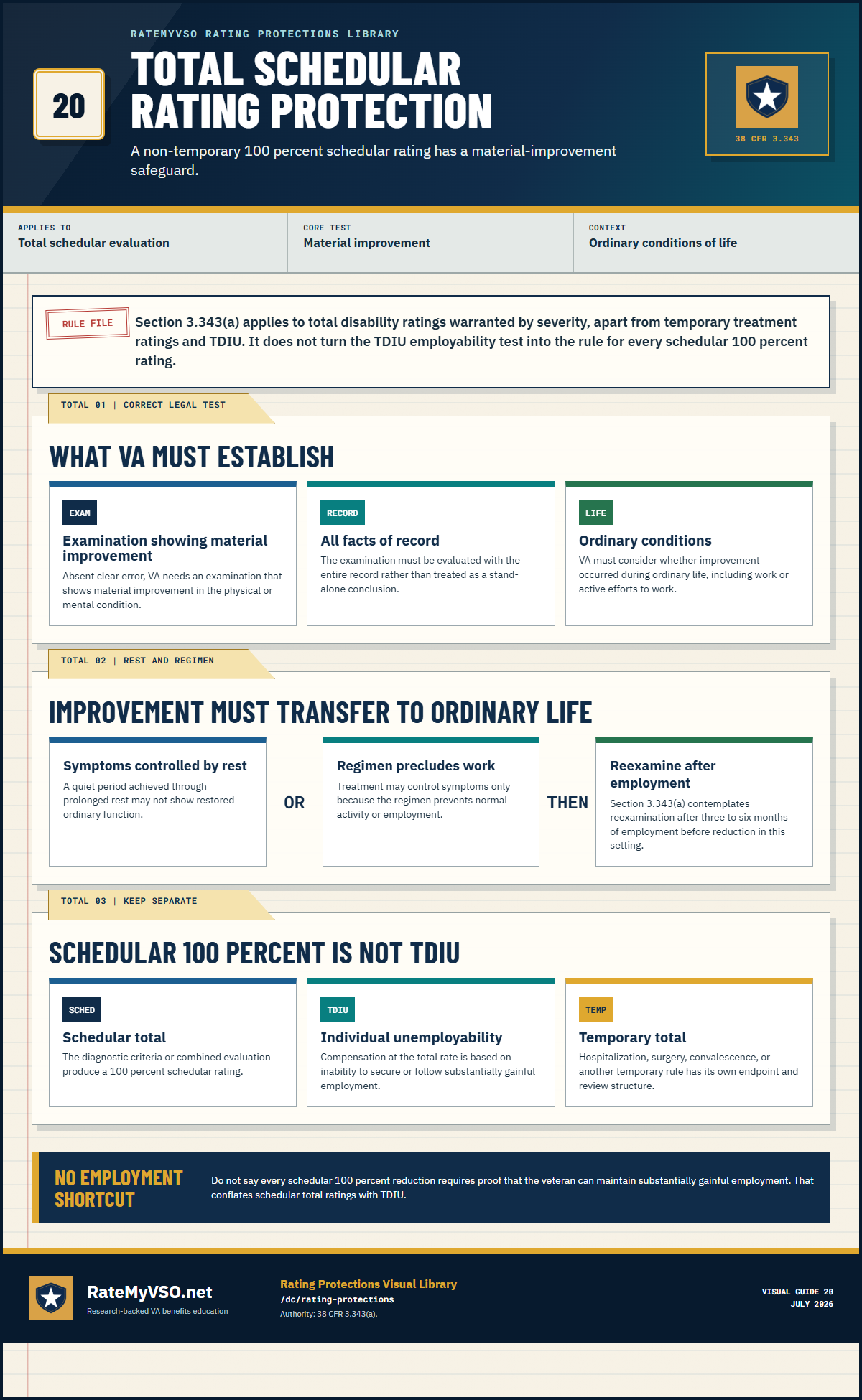 One-page guide: Total Schedular VA Rating Protection
Total schedular rating protection guide explaining material improvement, full-record review, ordinary conditions of life, and the boundary between schedular total ratings and TDIU. Opens the full-size chart, free to save or print.
One-page guide: Total Schedular VA Rating Protection
Total schedular rating protection guide explaining material improvement, full-record review, ordinary conditions of life, and the boundary between schedular total ratings and TDIU. Opens the full-size chart, free to save or print.
What to Do If the VA Proposes a Reduction
Under 38 CFR § 3.105(e), this formal proposal process applies when a reduction or discontinuance would lower or stop compensation you are currently being paid. An evaluation change that doesn't reduce your current payment (for example, a change on a codesheet that doesn't lower your combined rate) can happen without going through this process.
Where it applies, the VA must follow a specific process before reducing your rating:
- Proposed reduction letter: The VA sends you a letter proposing the reduction and explaining why.
- 60-day response window: You have 60 days from that letter to submit evidence showing why the rating shouldn't be reduced.
- Hearing request: You can request a hearing within 30 days of the proposal letter.
- Final action notice: After considering your evidence (and any hearing), the VA issues its final decision and sends you notice of that final action.
- If reduction occurs: It takes effect the last day of the month in which a further 60-day period, counted from the date of the notice of the final action, expires. This is a separate clock from the initial 60-day response window.
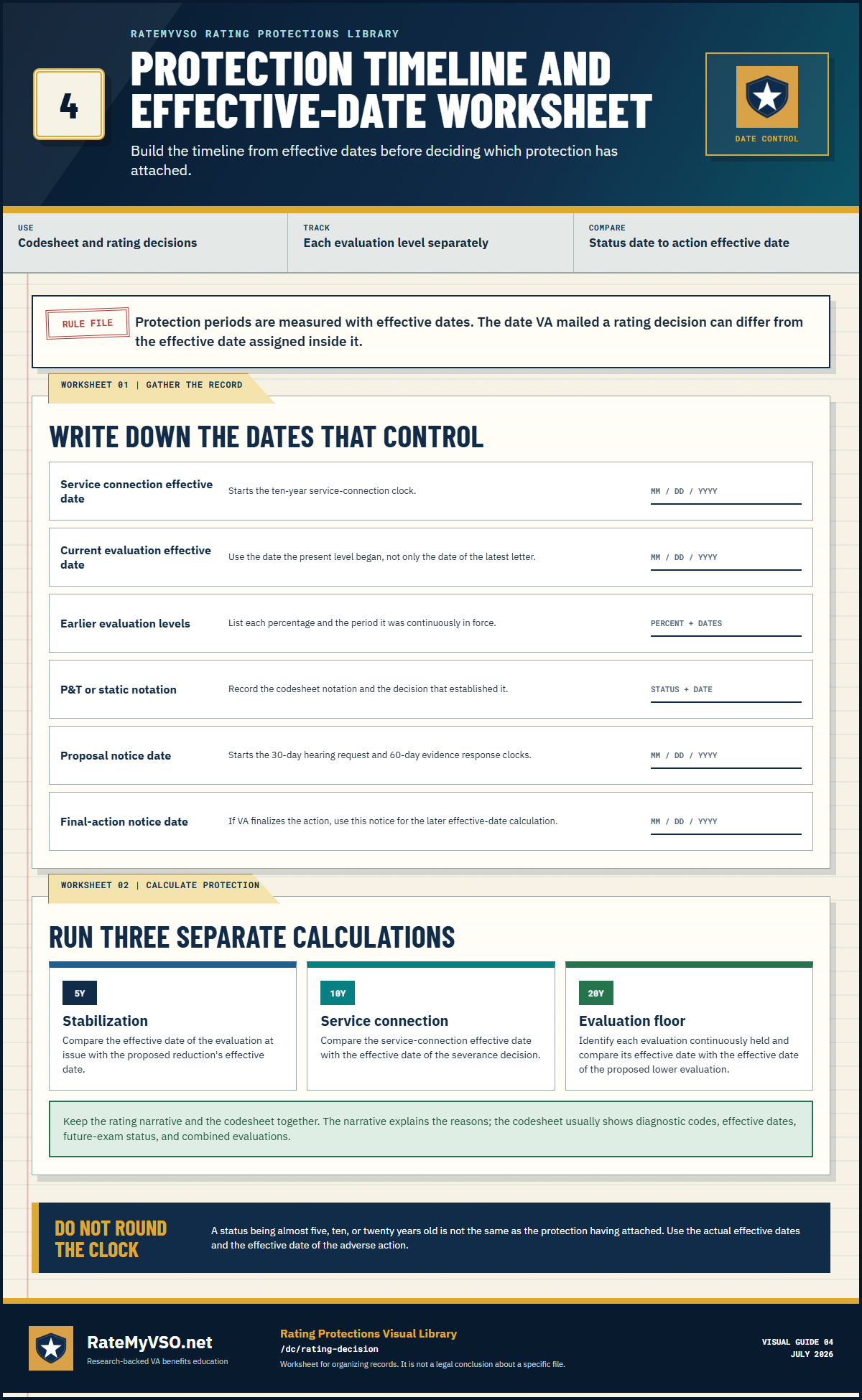
Strong Responses to a Proposed Reduction
- A current medical opinion stating your condition has NOT materially improved
- Evidence that a "good day" exam doesn't reflect your typical daily functioning
- Treatment records showing ongoing symptoms and treatment
- Buddy statements from family/friends describing your continued limitations
- If 5+ years: argue the VA hasn't met the sustained improvement standard
Static vs Non-Static Conditions
Conditions classified as "static" are not subject to routine re-examination because they are not expected to improve:
- Anatomical losses - amputations, loss of organs
- Conditions that are stable and unlikely to change - healed fractures with permanent limitation, fully resolved cancers with residuals
Being age 55 or older is treated differently. It is not itself a "static" condition or a protected rating. Under 38 CFR § 3.327, a veteran's age is one of several factors that limit routine, scheduled periodic reexaminations, alongside static disabilities, permanent diseases with no likelihood of improvement, prescribed schedular minimums, and cases where no reasonable possibility exists that a reexamination would change the combined evaluation. Even so, the VA can still order an exam at any age when it is needed to verify a condition's existence or severity, check for material change, or correct a possible error.
If your condition is static, the VA should not schedule routine future exams. If they do, contact your representative. See the future reexaminations guide for the four situations where a reexamination is authorized, the six bars that prohibit one, and how to challenge an unauthorized notice.
Tips
- Know your timeline. Check your rating decision letters to find when each service-connected condition was effective. Count forward to know when your protections start.
- Attend scheduled exams. Failing to show up for a re-examination can result in a proposed reduction, regardless of what protections you have.
- Describe your worst days. At a C&P exam, don't downplay it. Describe how your condition affects you on bad days, not just average days.
- Don't panic over a re-exam notice. Routine re-exams are normal for non-static conditions. Having a re-exam doesn't mean a reduction is coming.
- Keep treating. Ongoing medical treatment records showing continued symptoms are your best protection against reduction.
- Check for P&T status. Your decision letter or eBenefits/VA.gov will indicate whether your total rating is "permanent." If it should be but isn't, request it.
Related Tools and Guides
This guide is for educational purposes only and is not legal advice. For help protecting your rating, find a VSO representative.