C&P Exam Prep Guide for Non-Hodgkin's lymphoma (DC 7715)
YOUR EXAM BLUEPRINT
Non-Hodgkin's lymphoma
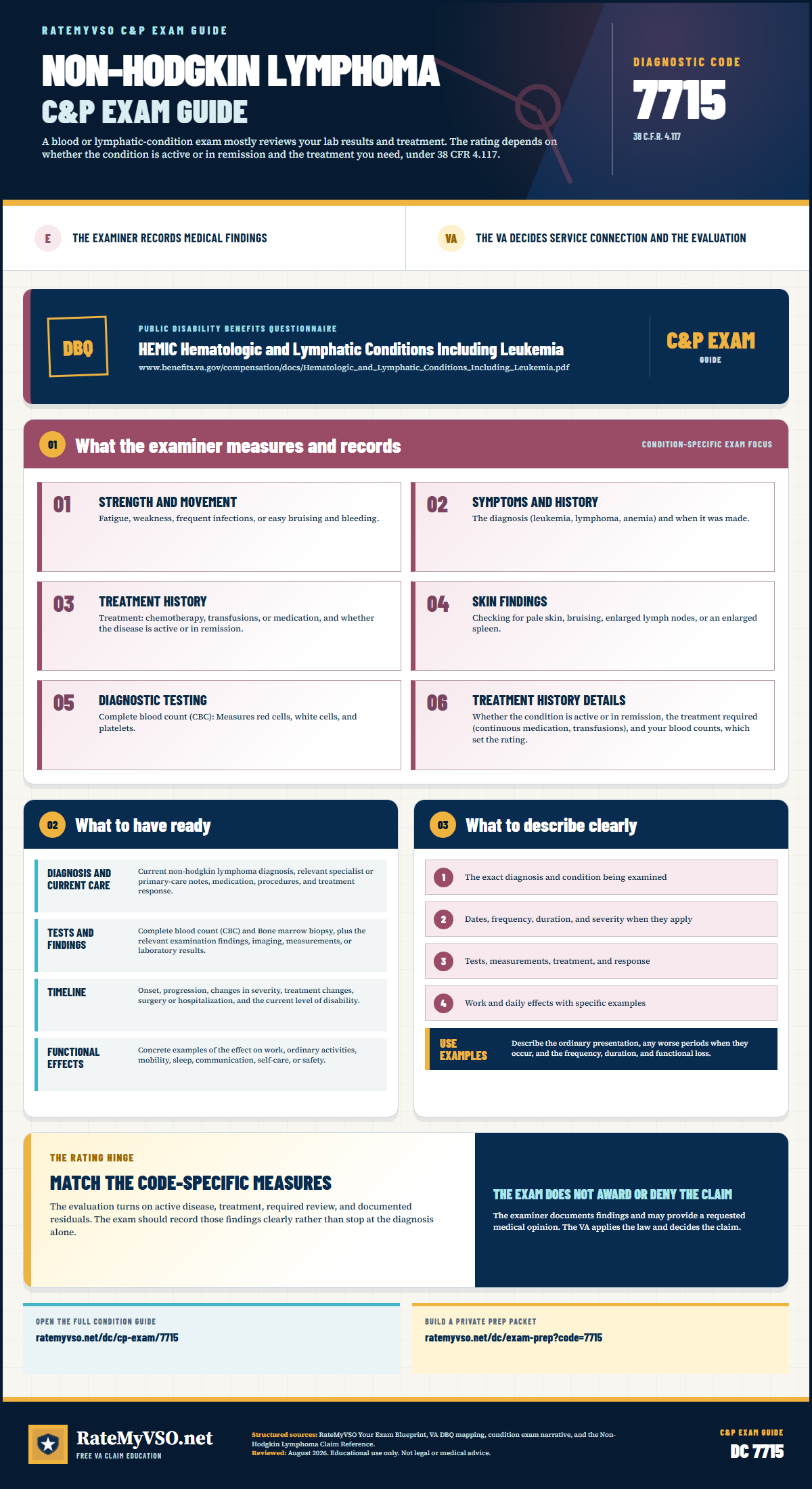
A blood or lymphatic-condition exam mostly reviews your lab results and treatment. The rating depends on whether the condition is active or in remission and the treatment you need, under 38 CFR 4.117.
DBQ used for this condition
- PPublic formDBQ HEMIC Hematologic and Lymphatic Conditions Including LeukemiaOpen the public DBQ
What the examination is likely to focus on
Functional-impact topics to describe
- Whether the condition is active or in remission, the treatment required (continuous medication, transfusions), and your blood counts, which set the rating.
- Findings map to the tiers in 38 CFR 4.117 (e.g. leukemia DC 7703; non-Hodgkin's lymphoma DC 7715; anemia DC 7720).
Which form the examiner uses
For non-hodgkin's lymphoma (DC 7715), the C&P examiner completes the following Disability Benefits Questionnaire (DBQ):
- DBQ HEMIC Hematologic and Lymphatic Conditions Including Leukemia (public PDF on VA.gov)
DBQs are Department of Veterans Affairs Form 21-0960 series documents. Public DBQs are hosted on benefits.va.gov. A handful are examiner-only and are not posted publicly.
What to expect at your C&P exam
A blood or lymphatic-condition exam mostly reviews your lab results and treatment. The rating depends on whether the condition is active or in remission and the treatment you need, under 38 CFR 4.117.
1Initial interview (history)
- Fatigue, weakness, frequent infections, or easy bruising and bleeding.
- The diagnosis (leukemia, lymphoma, anemia) and when it was made.
- Treatment: chemotherapy, transfusions, or medication, and whether the disease is active or in remission.
- Hospitalizations and the effect on daily life.
2Physical examination
- Checking for pale skin, bruising, enlarged lymph nodes, or an enlarged spleen.
- A general exam.
3Diagnostic tests the examiner may rely on
Lab tests the examiner reviews to gauge severity.
4Functional assessment
- Whether the condition is active or in remission, the treatment required (continuous medication, transfusions), and your blood counts, which set the rating.
- Findings map to the tiers in 38 CFR 4.117 (e.g. leukemia DC 7703; non-Hodgkin's lymphoma DC 7715; anemia DC 7720).
Test explainers open MedlinePlus (NIH National Library of Medicine), or Wikipedia where MedlinePlus has no matching page. This describes what happens and what is measured, not how to influence a result.
What the examiner records (full DBQ form)
The fields below are reproduced from the DBQ form the examiner completes for this diagnostic code. This is the structural map of the form, showing what the examiner is asked to measure, observe, and record. It is a factual reproduction of the public DBQ, not advice on how to answer.
This DBQ evaluates hematologic and lymphatic conditions including anemia, thrombocytopenia, leukemia, multiple myeloma, lymphomas, polycythemia vera, and solitary plasmacytoma.
How DC 7715 maps to this DBQ: for this diagnostic code specifically, the examiner typically completes sections I-III and VI-IX of this form. Section III is the condition-specific section for this code. Sections IV-V cover unrelated conditions on this DBQ and are skipped.
DIAGNOSIS (Section I)
- 1A. List the claimed condition(s) that pertain to this questionnaire: Note: These are the diagnoses determined during this current evaluation of the claimed condition(s) listed above. If there is no diagnosis, if the diagnosis is different from a previous diagnosis for this condition, or if there is a diagnosis of a complication due to the claimed condition(s), explain your findings and reasons…
- 1B. Select diagnoses associated with the claimed condition(s) (check all that apply): The Veteran does not have a current diagnosis associated with any claimed condition(s) listed above. (Explain your findings and reasons in the Remarks section) Agranulocytosis, acquired ICD code: Date of diagnosis: Leukemia Chronic myelogenous leukemia (CML) (chronic myeloid leukemia or chronic granulocytic…
- 1C. If there are additional or prior diagnoses that pertain to hematologic or lymphatic conditions, list using above format:
MEDICAL HISTORY (Section II)
- 2A. Describe the history (including cause (if known), onset and course) of the Veteran's current hematologic or lymphatic condition(s) (brief summary):
- 2B. Is continuous medication required for control of a hematologic or lymphatic condition, including anemia or thrombocytopenia caused by treatment for a hematologic or lymphatic condition? Yes No If yes, list only those medications required for control of the Veteran's hematologic or lymphatic condition, including anemia or thrombocytopenia caused by treatment for a hematologic or lymphatic…
- 2C. Has the Veteran completed any treatment or is the Veteran currently undergoing any treatment for any hematologic or lymphatic condition, including leukemia? Yes No; watchful waiting If yes, indicate type of treatment the Veteran is currently undergoing or has completed in the applicable section(s) below.
ANEMIA AND THROMBOCYTOPENIA (Section III)
- 3A. Does the Veteran have anemia or thrombocytopenia including that which is caused by treatment for a hematologic or lymphatic condition? Yes No If yes, please check type: Aplastic anemia (complete 3B) Iron deficiency anemia (complete 3C) Folic acid deficiency (complete 3D)
- 3B. What is the status of aplastic anemia? Requiring peripheral blood or bone marrow stem cell transplant If checked, provide the following: Describe the type of transplant and date of hospitalization: Date of hospital discharge following transplant (if known): Unknown Requiring transfusion of platelets, on average, at least: once every six weeks per 12-month period once every three months per…
- 3C. What is the status of iron deficiency anemia? Requiring intravenous iron infusions 4 or more times per 12-month period Requiring intravenous iron infusions at least 1 time but less than 4 times per 12-month period Requiring continuous treatment with oral supplementation Requiring treatment only by dietary modification Asymptomatic
- 3D. What is the status of folic acid deficiency? Requiring continuous treatment with high-dose oral supplementation Requiring treatment only by dietary modification Asymptomatic
- 3E. What is the status of pernicious anemia or other vitamin B12 deficiency anemia? Initial diagnosis requiring transfusion due to severe anemia If checked, provide the following: Date of initial diagnosis requiring transfusion: Date of hospital discharge following transfusion (if known): Unknown Signs or symptoms related to central nervous system impairment, such as encephalopathy, myelopathy,…
- 3F. What is the status of acquired hemolytic anemia? Required a bone marrow transplant If checked, provide the following: Date of hospitalization: Date of hospital discharge following transplant (if known): Unknown Requiring continuous intravenous or immunosuppressive therapy (e.g., prednisone, Cytoxan, azathioprine, or rituximab) Requiring immunosuppressive medication 4 or more times per…
- 3G. What is the status of immune thrombocytopenia? Requiring chemotherapy for chronic refractory thrombocytopenia If checked, provide the following: Date treatment began: Date of completion or anticipated date of completion of treatment (if known): Unknown Requiring immunosuppressive therapy Platelet count 30,000 or below despite treatment Platelet count higher than 30,000 but not higher than…
- 3H. What is the status of sickle cell anemia? With 4 or more painful episodes per 12-month period (occurring in skin, joints, bones, or any major organs) caused by hemolysis and sickling of red blood cells with anemia, thrombosis, and infarction; symptoms preclude light manual labor With 3 painful episodes per 12-month period With 1 or 2 painful episodes per 12-month period Symptoms preclude…
LEUKEMIA, MULTIPLE MYELOMA, MONOCLONAL GAMMOPATHY OF UNDETERMINED SIGNIFICANCE (MGUS) (Section IV)
- 4A. Does the Veteran have leukemia, multiple myeloma, monoclonal gammopathy of undetermined significance (MGUS), agranulocytosis, acquired, essential thrombocythemia, primary myelofibrosis, or myelodysplastic syndromes? Yes No If yes, please check type: Chronic lymphocytic leukemia (complete 4B) Monoclonal B-cell lymphocytosis (MBL) (complete 4B) Hairy cell or other B-cell leukemia (complete 4B)
- 4B. What is the status of chronic lymphocytic leukemia, hairy cell leukemia, other B-cell leukemia, or monoclonal B-cell lymphocytosis? Active (no treatment) (including Rai Stage I, II, III, or IV) Undergoing treatment (chemotherapy, radiation therapy, surgical therapy, or other therapeutic procedures/treatment) If checked, provide the following: Describe the type of treatment and date treatment…
- 4C. What is the status of chronic myelogenous leukemia (CML) (chronic myeloid leukemia, or chronic granulocytic leukemia)? Condition has undergone leukemic transformation (complete 4B) Requiring peripheral blood or bone marrow stem cell transplant If checked, provide the following: Describe the type of transplant and date of hospitalization: Date of hospital discharge following transplant (if…
- 4D. What is the status of multiple myeloma? Symptomatic If checked, provide date of diagnosis of symptomatic multiple myeloma: Note: Current validated biomarkers of symptomatic multiple myeloma, asymptomatic, smoldering or monoclonal gammopathy of undetermined significance (MGUS) are acceptable for the diagnosis of multiple myeloma as defined by the American Society of Hematology (ASH) and…
- 4E. What is the status of agranulocytosis, acquired? Requiring bone marrow transplant If checked, provide the following: Date of hospital admission for bone marrow transplant: Date of hospital discharge following transplant (if known): Unknown Requiring intermittent myeloid growth factors (granulocyte colony-stimulating factor (G-CSF) to maintain absolute neutrophil count (ANC) greater than…
- 4F. What is the status of essential thrombocythemia and primary myelofibrosis? Condition has undergone leukemic transformation (complete 4B) Requiring continuous myelosuppressive therapy Requiring hospital admission for peripheral blood or bone marrow stem cell transplant If checked, provide the following: Describe the type of transplant and date of hospitalization: Date of hospital discharge…
- 4G. What is the status of myelodysplastic syndromes? Condition has undergone progression to leukemia (complete 4B) Requiring peripheral blood or bone marrow stem cell transplant If checked, provide the following: Describe the type of transplant and date of hospitalization: Date of hospital discharge following transplant (if known): Unknown Requiring chemotherapy If checked, provide the following:…
LYMPHOMAS, POLYCYTHEMIA VERA, AND SOLITARY PLASMACYTOMA (Section V)
- 5A. Does the Veteran have Hodgkin's lymphoma, Non-Hodgkin's lymphoma, polycythemia vera or solitary plasmacytoma? Yes No If yes, please check type: Hodgkin's lymphoma (complete 5B) Non-Hodgkin's lymphoma (NHL) (complete 5B) Polycythemia vera (complete 5C) Plasmacytoma (complete 5D)
- 5B. What is the status of the Hodgkin's lymphoma or Non-Hodgkin's lymphoma? Active disease (no treatment) Indolent and non-contiguous phase of low grade NHL Undergoing treatment (chemotherapy, radiation therapy, surgical therapy, or other therapeutic procedures/treatment) If checked, provide the following: Describe the type of treatment and date treatment began: Anticipated date of completion of…
- 5C. What is the status of the polycythemia vera? Condition has undergone leukemic transformation (complete 4B) Requiring peripheral blood or bone marrow stem-cell transplant for the purpose of ameliorating the symptom burden If checked, provide the following: Describe the type of transplant and date of hospitalization: Date of hospital discharge following transplant: Unknown Requiring…
- 5D. What is the status of the solitary plasmacytoma? Active disease (no treatment) Developed into multiple myeloma (complete 4D) Undergoing treatment (chemotherapy, radiation therapy, surgical therapy, or other therapeutic procedures/treatment (including autologous stem cell transplantation)) If checked, provide the following: Describe the type of treatment and date treatment began: Anticipated…
OTHER PERTINENT PHYSICAL FINDINGS, COMPLICATIONS, CONDITIONS, SIGNS, SYMPTOMS, AND SCARS (Section VI)
- 6A. Does the Veteran have any other pertinent physical findings, complications, conditions, signs or symptoms related to any conditions listed in the diagnosis section above? Yes No If yes, describe (brief summary) (Also if indicated, complete the appropriate questionnaire for each condition):
- 6B. Does the Veteran have any scars or other disfigurement (of the skin) related to any conditions or to the treatment of any conditions listed in the diagnosis section? Yes No If yes, also complete the appropriate dermatological questionnaire.
DIAGNOSTIC TESTING (Section VII)
- 7A. Has clinically relevant laboratory testing been performed or reviewed in conjunction with this examination? Yes No If yes, provide results: Hemoglobin (HgB) (gm/dL): Date: Hematocrit (HCT) %: Date: Red blood cell (RBC) count: Date: White blood cell (WBC) count: Date:
- 7B. Are there any other clinically relevant diagnostic test findings or results related to the claimed condition(s) and/or diagnosis(es), that were reviewed in conjunction with this examination? Yes No If yes, provide type of test or procedure, date and results (brief summary):
- 7C. If any test results are other than normal, indicate relationship of abnormal findings to diagnosed conditions:
FUNCTIONAL IMPACT (Section VIII)
- 8A. Regardless of the Veteran's current employment status, do the conditions listed in the diagnosis section impact his/her ability to perform any type of occupational task (such as standing, walking, lifting, sitting, etc.)? Yes No If yes, describe the functional impact of each condition, providing one or more examples:
REMARKS (Section IX)
- 9A. Remarks (if any - please identify the section to which the remark pertains when appropriate).
Rating Levels for DC 7715
The following tiers are reproduced from 38 CFR Part 4, the VA Schedule for Rating Disabilities. Toggle between the official VA criteria and a Plain English explanation.
Plain-English summaries are AI-generated to explain the official criteria. The official 38 CFR language is the binding legal standard. When in doubt, ask a VSO.
Evidence cited in published BVA decisions for DC 7715
The counts below are aggregated from published Board of Veterans Appeals decisions for this diagnostic code, among issues the Board granted or denied (remanded issues are not included). Each row reports how often a given evidence type was discussed in the decision text, broken down by outcome. This is a factual aggregate of the public record, not a prediction or recommendation about any specific claim.
- Service treatment records: appeared in 289 granted decisions (710 denied; 999 decided total)
- Buddy / lay statements: appeared in 195 granted decisions (446 denied; 641 decided total)
- Medical literature: appeared in 103 granted decisions (118 denied; 221 decided total)
When the Board found the exam inadequate (DC 7715)
In 293 published Board of Veterans' Appeals decisions involving this condition, the Board found a C&P examination or medical opinion inadequate. Where the defect could be read from the decision, it was most often one of the following (counts are a floor from the decisions on file, not a total):
- 74 Conclusion given without a supporting rationale
- 59 Failed to address a contention or part of the condition
- 23 Veteran's lay statements not considered
- 17 Claims file or records not reviewed
- 9 Examiner said an opinion would require speculation
- 5 Opinion relied on the absence of records instead of the evidence
An inadequate exam is usually sent back for a new one rather than decided against the veteran. This is a factual report of published decisions, not advice about any exam or claim; whether an exam is adequate is decided case by case.
Disclaimer: This page reproduces public Department of Veterans Affairs forms (DBQs) and verbatim text from 38 CFR Part 4 (the VA Schedule for Rating Disabilities). It is informational only and is not legal or medical advice. For guidance on a specific claim, contact a VA-accredited representative.