C&P Exam Prep: DBQ Forms and Rating Criteria for 596 VA Conditions
A VA Compensation and Pension exam, the C&P exam, is the appointment where a clinician measures your condition and writes down what they find. That written record is what the rater uses to decide your percentage, so what gets measured and how it is described matters more than almost anything else in the claim. Knowing beforehand which form your examiner will fill out, and what the regulation requires them to record, is the difference between an exam that captures your worst days and one that does not.
Find your condition below. Each of the 596 pages names the exact Disability Benefits Questionnaire (DBQ) the examiner uses, lists what they measure, and reproduces the verbatim 38 CFR Part 4 criteria for every rating percentage, so you can see what separates a 10 percent from a 30 or a 70. What happens at the exam, and what to bring, is further down this page.
Cardiovascular System C&P Exams
(33)
- DC 7101: Hypertensive vascular disease (hypertension and isolated systolic hypertension)
- DC 7005: Arteriosclerotic heart disease (coronary artery disease)
- DC 7120: Varicose veins
- DC 7122: Cold injury residuals
- DC 7010: Supraventricular tachycardia
- DC 7000: Valvular heart disease (including rheumatic heart disease),
- DC 7017: Coronary bypass surgery
- DC 7007: Hypertensive heart disease
- DC 7114: Peripheral arterial disease
- DC 7121: Post-phlebitic syndrome of any etiology
- DC 7006: Myocardial infarction
- DC 7011: Ventricular arrhythmias (sustained)
- DC 7020: Cardiomyopathy
- DC 7117: Raynaud's syndrome (also known as secondary Raynaud's phenomenon or secondary Raynaud's)
- DC 7015: Atrioventricular block
- DC 7115: Thrombo-angiitis obliterans (Buerger's Disease)
- DC 7111: Aneurysm, any large artery
- DC 7016: Heart valve replacement (prosthesis)
- DC 7123: Soft tissue sarcoma (of vascular origin)
- DC 7118: Angioneurotic edema
- DC 7009: Bradycardia (Bradyarrhythmia), symptomatic, requiring permanent pacemaker implantation
- DC 7002: Pericarditis
- DC 7110: Aortic aneurysm: Ascending, thoracic, or abdominal
- DC 7124: Raynaud's disease (also known as primary Raynaud's)
- DC 7018: Implantable cardiac pacemakers
- DC 7019: Cardiac transplantation
- DC 7008: Hyperthyroid heart disease
- DC 7004: Syphilitic heart disease
- DC 7112: Aneurysm, any small artery
- DC 7001: Endocarditis, or
- DC 7113: Arteriovenous fistula, traumatic
- DC 7119: Erythromelalgia
- DC 7003: Pericardial adhesions
Dental and Oral Conditions C&P Exams
(15)
- DC 9913: Teeth, loss of, due to loss of substance of body of maxilla or mandible without loss of continuity
- DC 9905: Temporomandibular disorder (TMD)
- DC 9900: Maxilla or mandible, chronic osteomyelitis, osteonecrosis or osteoradionecrosis of
- DC 9916: Maxilla, malunion or nonunion of
- DC 9904: Mandible, malunion of
- DC 9903: Mandible, nonunion of, confirmed by diagnostic imaging studies
- DC 9901: Mandible, loss of, complete, between angles
- DC 9918: Neoplasm, hard and soft tissue, malignant
- DC 9902: Mandible, loss of, including ramus, unilaterally or bilaterally
- DC 9915: Maxilla, loss of half or less
- DC 9914: Maxilla, loss of more than half
- DC 9911: Hard palate, loss of
- DC 9908: Condyloid process, loss of, one or both sides
- DC 9909: Coronoid process, loss of
- DC 9917: Neoplasm, hard and soft tissue, benign
Digestive System C&P Exams
(43)
- DC 7346: Hiatal hernia and paraesophageal hernia
- DC 7206: Gastroesophageal reflux disease
- DC 7319: Irritable bowel syndrome (IBS)
- DC 7336: Hemorrhoids, external or internal
- DC 7338: Hernia, including femoral, inguinal, umbilical, ventral, incisional, and other (but not including hiatal)
- DC 7354: Hepatitis C (or non-A, non-B hepatitis)
- DC 7301: Peritoneum, adhesions of, due to surgery, trauma, disease, or infection
- DC 7308: Postgastrectomy syndrome
- DC 7304: Peptic ulcer disease
- DC 7307: Gastritis, chronic
- DC 7345: Chronic liver disease without cirrhosis
- DC 7343: Malignant neoplasms of the digestive system, exclusive of skin growths
- DC 7323: Colitis, ulcerative
- DC 7332: Rectum and anus, impairment of sphincter control
- DC 7203: Esophagus, stricture of
- DC 7327: Diverticulitis and diverticulosis
- DC 7312: Cirrhosis of the liver
- DC 7326: Crohn's disease or undifferentiated form of inflammatory bowel disease
- DC 7329: Intestine, large, resection of
- DC 7344: Benign neoplasms, exclusive of skin growths
- DC 7335: Ano, fistula in, including anorectal fistula and anorectal abscess
- DC 7318: Cholecystectomy (gallbladder removal), complications of (such as strictures and biliary leaks)
- DC 7328: Intestine, small, resection of
- DC 7311: Residuals of injury of the liver
- DC 7200: Soft tissue injury of the mouth, other than tongue or lips
- DC 7207: Barrett's esophagus
- DC 7317: Gallbladder, injury of
- DC 7333: Rectum and anus, stricture of
- DC 7348: Vagotomy with pyloroplasty or gastroenterostomy
- DC 7334: Rectum, prolapse of
- DC 7330: Intestinal fistulous disease, external
- DC 7315: Cholelithiasis, chronic
- DC 7351: Liver transplant
- DC 7337: Pruritus ani (anal itching)
- DC 7355: Celiac disease
- DC 7356: Gastrointestinal dysmotility syndrome
- DC 7303: Chronic complications of upper gastrointestinal surgery
- DC 7325: Enteritis, chronic
- DC 7204: Esophageal motility disorder
- DC 7350: Liver abscess
- DC 7309: Stomach, stenosis of
- DC 7205: Esophagus, diverticulum of, acquired
- DC 7342: Visceroptosis, symptomatic, marked
Ear C&P Exams
(12)
- DC 6260: Tinnitus, recurrent
- DC 6100: Hearing loss
- DC 6204: Peripheral vestibular disorders
- DC 6205: Meniere's syndrome (endolymphatic hydrops)
- DC 6200: Chronic suppurative otitis media, mastoiditis, or cholesteatoma (or any combination)
- DC 6201: Chronic nonsuppurative otitis media with effusion (serous otitis media)
- DC 6207: Loss of auricle
- DC 6211: Tympanic membrane, perforation of
- DC 6210: Chronic otitis externa
- DC 6202: Otosclerosis
- DC 6209: Benign neoplasms of the ear (other than skin only)
- DC 6208: Malignant neoplasm of the ear (other than skin only)
Endocrine System C&P Exams
(11)
- DC 7913: Diabetes mellitus
- DC 7903: Hypothyroidism
- DC 7907: Cushing's syndrome
- DC 7900: Hyperthyroidism, including, but not limited to, Graves' disease
- DC 7914: Neoplasm, malignant, any specified part of the endocrine system
- DC 7901: Thyroid enlargement, toxic
- DC 7902: Thyroid enlargement, nontoxic
- DC 7904: Hyperparathyroidism
- DC 7906: Thyroiditis
- DC 7905: Hypoparathyroidism
- DC 7919: C-cell hyperplasia of the thyroid
Eye C&P Exams
(43)
- DC 6065: Vision in one eye 5/200 (1.5/60)
- DC 6061: Anatomical loss of both eyes
- DC 6066: Visual acuity in one eye 10/200 (3/60) or better
- DC 6013: Open-angle glaucoma
- DC 6080: Visual field defects
- DC 6027: Cataract
- DC 6000: Choroidopathy, including uveitis, iritis, cyclitis, or choroiditis
- DC 6090: Diplopia (double vision)
- DC 6018: Chronic conjunctivitis (nontrachomatous)
- DC 6009: Unhealed eye injury
- DC 6040: Diabetic retinopathy
- DC 6025: Disorders of the lacrimal apparatus (epiphora, dacryocystitis, etc.)
- DC 6063: Anatomical loss of one eye
- DC 6006: Retinopathy or maculopathy not otherwise specified
- DC 6034: Pterygium
- DC 6011: Retinal scars, atrophy, or irregularities
- DC 6042: Retinal dystrophy (including retinitis pigmentosa, wet or dry macular degeneration, early-onset macular degeneration, rod and/or cone dystrophy)
- DC 6029: Aphakia or dislocation of crystalline lens
- DC 6008: Detachment of retina
- DC 6064: No more than light perception in one eye
- DC 6037: Pinguecula
- DC 6091: Symblepharon
- DC 6001: Keratopathy
- DC 6081: Scotoma, unilateral
- DC 6035: Keratoconus
- DC 6019: Ptosis, unilateral or bilateral
- DC 6062: No more than light perception in both eyes
- DC 6026: Optic neuropathy
- DC 6046: Post-chiasmal disorders
- DC 6007: Intraocular hemorrhage
- DC 6032: Loss of eyelids, partial or complete
- DC 6014: Malignant neoplasms of the eye, orbit, and adnexa (excluding skin)
- DC 6022: Lagophthalmos
- DC 6036: Status post corneal transplant
- DC 6015: Benign neoplasms of the eye, orbit, and adnexa (excluding skin)
- DC 6002: Scleritis
- DC 6012: Angle-closure glaucoma
- DC 6020: Ectropion
- DC 6017: Trachomatous conjunctivitis
- DC 6016: Nystagmus, central
- DC 6030: Paralysis of accommodation (due to neuropathy of the Oculomotor Nerve (cranial nerve III))
- DC 6021: Entropion
- DC 6024: Loss of eyelashes, complete, unilateral or bilateral
Genitourinary System C&P Exams
(37)
- DC 7522: Erectile dysfunction, with or without penile deformity
- DC 7528: Malignant neoplasms of the genitourinary system
- DC 7500: Kidney, removal of one
- DC 7523: Testis, atrophy complete
- DC 7527: Prostate gland injuries, infections, hypertrophy, postoperative residuals, bladder outlet obstruction
- DC 7525: Prostatitis, urethritis, epididymitis, orchitis (unilateral or bilateral), chronic only
- DC 7530: Chronic renal disease requiring regular dialysis
- DC 7508: Nephrolithiasis/Ureterolithiasis/Nephrocalcinosis
- DC 7512: Cystitis, chronic, includes interstitial and all etiologies, infectious and non-infectious
- DC 7542: Neurogenic bladder
- DC 7541: Renal involvement in diabetes mellitus type I or II
- DC 7517: Bladder, injury of
- DC 7524: Testis, removal
- DC 7509: Hydronephrosis
- DC 7529: Benign neoplasms of the genitourinary system
- DC 7520: Penis, removal of half or more
- DC 7502: Nephritis, chronic
- DC 7543: Varicocele/Hydrocele
- DC 7518: Urethra, stricture of
- DC 7536: Glomerulonephritis
- DC 7521: Penis, removal of glans
- DC 7538: Papillary necrosis
- DC 7501: Kidney, abscess of
- DC 7507: Nephrosclerosis, arteriolar
- DC 7515: Bladder, calculus in, with symptoms interfering with function
- DC 7533: Cystic diseases of the kidneys
- DC 7537: Interstitial nephritis, including gouty nephropathy, disorders of calcium metabolism
- DC 7531: Kidney transplant
- DC 7504: Pyelonephritis, chronic
- DC 7511: Ureter, stricture of
- DC 7519: Urethra, fistula of
- DC 7532: Renal tubular disorders (such as renal glycosurias, aminoacidurias, renal tubular acidosis, Fanconi's syndrome, Bartter's syndrome, related disorders of Henle's loop and proximal or distal nephron function, etc.)
- DC 7540: Disseminated intravascular coagulation with renal cortical necrosis
- DC 7535: Toxic nephropathy (antibotics, radiocontrast agents, nonsteroidal anti-inflammatory agents, heavy metals, and similar agents)
- DC 7545: Bladder, diverticulum of
- DC 7534: Atherosclerotic renal disease (renal artery stenosis, atheroembolic renal disease, or large vessel disease, unspecified)
- DC 7516: Bladder, fistula of
Gynecological Conditions C&P Exams
(19)
- DC 7615: Ovary, disease, injury, or adhesions of
- DC 7618: Uterus, removal of, including corpus
- DC 7629: Endometriosis
- DC 7628: Benign neoplasms of gynecological system
- DC 7626: Breast, surgery of
- DC 7630: Malignant neoplasms of the breast
- DC 7617: Uterus and both ovaries, removal of, complete
- DC 7610: Vulva or clitoris, disease or injury of (including vulvovaginitis)
- DC 7613: Uterus, disease, injury, or adhesions of
- DC 7619: Ovary, removal of
- DC 7612: Cervix, disease or injury of
- DC 7614: Fallopian tube, disease, injury, or adhesions of (including pelvic inflammatory disease (PID))
- DC 7631: Benign neoplasms of the breast and other injuries of the breast
- DC 7627: Malignant neoplasms of gynecological system
- DC 7632: Female sexual arousal disorder (FSAD)
- DC 7611: Vagina, disease or injury of
- DC 7621: Complete or incomplete pelvic organ prolapse due to injury, disease, or surgical complications of pregnancy
- DC 7620: Ovaries, atrophy of both, complete
- DC 7624: Fistula, rectovaginal
Hemic and Lymphatic Systems C&P Exams
(20)
- DC 7712: Multiple myeloma
- DC 7703: Leukemia (except for chronic myelogenous leukemia)
- DC 7715: Non-Hodgkin's lymphoma
- DC 7722: Pernicious anemia and Vitamin B12 deficiency anemia
- DC 7709: Hodgkin's lymphoma
- DC 7705: Immune thrombocytopenia
- DC 7704: Polycythemia vera
- DC 7720: Iron deficiency anemia
- DC 7714: Sickle cell anemia
- DC 7702: Agranulocytosis, acquired
- DC 7706: Splenectomy
- DC 7716: Aplastic anemia
- DC 7719: Chronic myelogenous leukemia (CML) (chronic myeloid leukemia or chronic granulocytic leukemia)
- DC 7718: Essential thrombocythemia and primary myelofibrosis
- DC 7723: Acquired hemolytic anemia
- DC 7717: AL amyloidosis (primary amyloidosis)
- DC 7724: Solitary plasmacytoma
- DC 7725: Myelodysplastic syndromes
- DC 7707: Spleen, injury of, healed
- DC 7721: Folic acid deficiency
Infectious Diseases, Immune Disorders, and Nutritional Deficiencies C&P Exams
(7)
Mental Disorders C&P Exams
(31)
- DC 9411: Posttraumatic stress disorder
- DC 9434: Major depressive disorder
- DC 9400: Generalized anxiety disorder
- DC 9440: Chronic adjustment disorder
- DC 9435: Unspecified depressive disorder
- DC 9413: Unspecified anxiety disorder
- DC 9201: Schizophrenia
- DC 9421: Somatic symptom disorder
- DC 9433: Persistent depressive disorder (dysthymia)
- DC 9432: Bipolar disorder
- DC 9304: Major or mild neurocognitive disorder due to traumatic brain injury
- DC 9210: Other specified and unspecified schizophrenia spectrum and other psychotic disorders
- DC 9410: Other specified anxiety disorder
- DC 9412: Panic disorder and/or agoraphobia
- DC 9211: Schizoaffective disorder
- DC 9416: Dissociative amnesia; dissociative identity disorder
- DC 9424: Conversion disorder (functional neurological symptom disorder)
- DC 9310: Unspecified neurocognitive disorder
- DC 9403: Specific phobia; social anxiety disorder (social phobia)
- DC 9326: Major or mild neurocognitive disorder due to another medical condition or substance/medication-induced major or mild neurocognitive disorder
- DC 9404: Obsessive compulsive disorder
- DC 9521: Bulimia nervosa
- DC 9208: Delusional disorder
- DC 9305: Major or mild vascular neurocognitive disorder
- DC 9422: Other specified somatic symptom and related disorder
- DC 9431: Cyclothymic disorder
- DC 9300: Delirium
- DC 9312: Major or mild neurocognitive disorder due to Alzheimer's disease
- DC 9520: Anorexia nervosa
- DC 9423: Unspecified somatic symptom and related disorder
- DC 9425: Illness anxiety disorder
Muscle Injuries C&P Exams
(29)
- DC 5301: Group I. Function: Upward rotation of scapula; elevation of arm above shoulder level. Extrinsic muscles of shoulder girdle: (1) Trapezius; (2) levator scapulae; (3) serratus magnus
- DC 5303: Group III. Function: Elevation and abduction of arm to level of shoulder; act with 1 and 2 of Group II in forward and backward swing of arm. Intrinsic muscles of shoulder girdle: (1) Pectoralis major I (clavicular); (2) deltoid
- DC 5311: Group XI. Function: Propulsion, plantar flexion of foot (1); stabilization of arch (2, 3); flexion of toes (4, 5); Flexion of knee (6). Posterior and lateral crural muscles, and muscles of the calf: (1) Triceps surae (gastrocnemius and soleus); (2) tibialis posterior; (3) peroneus longus; (4) peroneus brevis; (5) flexor hallucis longus; (6) flexor digitorum longus; (7) popliteus; (8) plantaris
- DC 5314: Group XIV. Function: Extension of knee (2, 3, 4, 5); simultaneous flexion of hip and flexion of knee (1); tension of fascia lata and iliotibial (Maissiat's) band, acting with XVII (1) in postural support of body (6); acting with hamstrings in synchronizing hip and knee (1, 2). Anterior thigh group: (1) Sartorius; (2) rectus femoris; (3) vastus externus; (4) vastus intermedius; (5) vastus internus; (6) tensor vaginae femoris
- DC 5313: Group XIII. Function: Extension of hip and flexion of knee; outward and inward rotation of flexed knee; acting with rectus femoris and sartorius (see XIV, 1, 2) synchronizing simultaneous flexion of hip and knee and extension of hip and knee by belt-over-pulley action at knee joint. Posterior thigh group, Hamstring complex of 2-joint muscles: (1) Biceps femoris; (2) semimembranosus; (3) semitendinosus
- DC 5307: Group VII. Function: Flexion of wrist and fingers. Muscles arising from internal condyle of humerus: Flexors of the carpus and long flexors of fingers and thumb; pronator
- DC 5310: Group X. Function: Movements of forefoot and toes; propulsion thrust in walking. Intrinsic muscles of the foot: Plantar: (1) Flexor digitorum brevis; (2) abductor hallucis; (3) abductor digiti minimi; (4) quadratus plantae; (5) lumbricales; (6) flexor hallucis brevis; (7) adductor hallucis; (8) flexor digiti minimi brevis; (9) dorsal and plantar interossei. Other important plantar structures: Plantar aponeurosis, long plantar and calcaneonavicular ligament, tendons of posterior tibial, peroneus longus, and long flexors of great and little toes
- DC 5321: Group XXI. Function: Respiration. Muscles of respiration: Thoracic muscle group
- DC 5312: Group XII. Function: Dorsiflexion (1); extension of toes (2); stabilization of arch (3). Anterior muscles of the leg: (1) Tibialis anterior; (2) extensor digitorum longus; (3) extensor hallucis longus; (4) peroneus tertius
- DC 5319: Group XIX. Function: Support and compression of abdominal wall and lower thorax; flexion and lateral motions of spine; synergists in strong downward movements of arm (1). Muscles of the abdominal wall: (1) Rectus abdominis; (2) external oblique; (3) internal oblique; (4) transversalis; (5) quadratus lumborum
- DC 5309: Group IX. Function: The forearm muscles act in strong grasping movements and are supplemented by the intrinsic muscles in delicate manipulative movements. Intrinsic muscles of hand: Thenar eminence; short flexor, opponens, abductor and adductor of thumb; hypothenar eminence; short flexor, opponens and abductor of little finger; 4 lumbricales; 4 dorsal and 3 palmar interossei
- DC 5317: Group XVII. Function: Extension of hip (1); abduction of thigh; elevation of opposite side of pelvis (2, 3); tension of fascia lata and iliotibial (Maissiat's) band, acting with XIV (6) in postural support of body steadying pelvis upon head of femur and condyles of femur on tibia (1). Pelvic girdle group 2: (1) Gluteus maximus; (2) gluteus medius; (3) gluteus minimus
- DC 5305: Group V. Function: Elbow supination (1) (long head of biceps is stabilizer of shoulder joint); flexion of elbow (1, 2, 3). Flexor muscles of elbow: (1) Biceps; (2) brachialis; (3) brachioradialis
- DC 5304: Group IV. Function: Stabilization of shoulder against injury in strong movements, holding head of humerus in socket; abduction; outward rotation and inward rotation of arm. Intrinsic muscles of shoulder girdle: (1) Supraspinatus; (2) infraspinatus and teres minor; (3) subscapularis; (4) coracobrachialis
- DC 5325: Muscle injury, facial muscles
- DC 5320: Group XX. Function: Postural support of body; extension and lateral movements of spine. Spinal muscles: Sacrospinalis (erector spinae and its prolongations in thoracic and cervical regions)
- DC 5302: Group II. Function: Depression of arm from vertical overhead to hanging at side (1, 2); downward rotation of scapula (3, 4); 1 and 2 act with Group III in forward and backward swing of arm. Extrinsic muscles of shoulder girdle: (1) Pectoralis major II (costosternal); (2) latissimus dorsi and teres major (teres major, although technically an intrinsic muscle, is included with latissimus dorsi); (3) pectoralis minor; (4) rhomboid
- DC 5308: Group VIII. Function: Extension of wrist, fingers, and thumb; abduction of thumb. Muscles arising mainly from external condyle of humerus: Extensors of carpus, fingers, and thumb; supinator
- DC 5315: Group XV. Function: Adduction of hip (1, 2, 3, 4); flexion of hip (1, 2); flexion of knee (4). Mesial thigh group: (1) Adductor longus; (2) adductor brevis; (3) adductor magnus; (4) gracilis
- DC 5306: Group VI. Function: Extension of elbow (long head of triceps is stabilizer of shoulder joint). Extensor muscles of the elbow: (1) Triceps; (2) anconeus
- DC 5328: Muscle, neoplasm of, benign, postoperative
- DC 5323: Group XXIII. Function: Movements of the head; fixation of shoulder movements. Muscles of the side and back of the neck: Suboccipital; lateral vertebral and anterior vertebral muscles
- DC 5329: Sarcoma, soft tissue (of muscle, fat, or fibrous connective tissue)
- DC 5324: Diaphragm, rupture of, with herniation
- DC 5318: Group XVIII. Function: Outward rotation of thigh and stabilization of hip joint. Pelvic girdle group 3: (1) Pyriformis; (2) gemellus (superior or inferior); (3) obturator (external or internal); (4) quadratus femoris
- DC 5326: Muscle hernia, extensive. Without other injury to the muscle
- DC 5322: Group XXII. Function: Rotary and forward movements of the head; respiration; deglutition. Muscles of the front of the neck: (Lateral, supra-, and infrahyoid group.) (1) Trapezius I (clavicular insertion); (2) sternocleidomastoid; (3) the "hyoid" muscles; (4) sternothyroid; (5) digastric
- DC 5327: Muscle, neoplasm of, malignant (excluding soft tissue sarcoma)
- DC 5316: Group XVI. Function: Flexion of hip (1, 2, 3). Pelvic girdle group 1: (1) Psoas; (2) iliacus; (3) pectineus
Musculoskeletal System C&P Exams
(123)
- DC 5003: Degenerative arthritis, other than post-traumatic
- DC 5257: Knee, other impairment of
- DC 5260: Leg, limitation of flexion of
- DC 5243: Intervertebral disc syndrome
- DC 5261: Leg, limitation of extension of
- DC 5237: Lumbosacral or cervical strain
- DC 5010: Post-traumatic arthritis
- DC 5242: Degenerative arthritis, degenerative disc disease other than intervertebral disc syndrome (also, see either DC 5003 or 5010)
- DC 5256: Knee, ankylosis of
- DC 5235: Vertebral fracture or dislocation
- DC 5258: Cartilage, semilunar, dislocated, with frequent episodes of "locking," pain, and effusion into the joint
- DC 5276: Flatfoot, acquired
- DC 5262: Tibia and fibula, impairment of
- DC 5259: Cartilage, semilunar, removal of, symptomatic
- DC 5271: Ankle, limited motion of
- DC 5201: Arm, limitation of motion of
- DC 5284: Foot injuries, other
- DC 5200: Scapulohumeral articulation, ankylosis of
- DC 5002: Multi-joint arthritis (except post-traumatic and gout), 2 or more joints, as an active process
- DC 5270: Ankle, ankylosis of
- DC 5263: Genu recurvatum (acquired, traumatic, with weakness and insecurity in weight-bearing objectively demonstrated)
- DC 5055: Knee, resurfacing or replacement (prosthesis)
- DC 5203: Clavicle or scapula, impairment of
- DC 5202: Humerus, other impairment of
- DC 5269: Plantar fasciitis
- DC 5215: Wrist, limitation of motion of
- DC 5252: Thigh, limitation of flexion of
- DC 5280: Hallux valgus, unilateral
- DC 5253: Thigh, impairment of
- DC 5251: Thigh, limitation of extension of
- DC 5025: Fibromyalgia (fibrositis, primary fibromyalgia syndrome)
- DC 5214: Wrist, ankylosis of
- DC 5024: Tenosynovitis, tendinitis, tendinosis or tendinopathy
- DC 5250: Hip, ankylosis of
- DC 5278: Claw foot (pes cavus), acquired
- DC 5255: Femur, impairment of
- DC 5019: Bursitis
- DC 5230: Ring or little finger, limitation of motion
- DC 5283: Tarsal, or metatarsal bones, malunion of, or nonunion of
- DC 5110: Loss of use of both feet
- DC 5227: Ring or little finger, ankylosis of
- DC 5013: Osteoporosis, residuals of
- DC 5238: Spinal stenosis
- DC 5279: Metatarsalgia, anterior (Morton's disease), unilateral, or bilateral
- DC 5206: Forearm, limitation of flexion of
- DC 5273: Os calcis or astragalus, malunion of
- DC 5239: Spondylolisthesis or segmental instability
- DC 5277: Weak foot, bilateral
- DC 5272: Subastragalar or tarsal joint, ankylosis of
- DC 5274: Astragalectomy
- DC 5282: Hammer toe
- DC 5229: Index or long finger, limitation of motion
- DC 5228: Thumb, limitation of motion
- DC 5213: Supination and pronation, impairment of
- DC 5207: Forearm, limitation of extension of
- DC 5017: Gout
- DC 5254: Hip, flail joint
- DC 5241: Spinal fusion
- DC 5236: Sacroiliac injury and weakness
- DC 5205: Elbow, ankylosis of
- DC 5216: Five digits of one hand, unfavorable ankylosis of
- DC 5281: Hallux rigidus, unilateral, severe
- DC 5224: Thumb, ankylosis of
- DC 5054: Hip, resurfacing or replacement (prosthesis)
- DC 5021: Myositis
- DC 5240: Ankylosing spondylitis
- DC 5014: Osteomalacia, residuals of
- DC 5208: Forearm, flexion limited to 100° and extension to 45°
- DC 5297: Ribs, removal of
- DC 5156: Little finger, amputation of
- DC 5275: Bones, of the lower extremity, shortening of
- DC 5125: Hand, loss of use of
- DC 5212: Radius, impairment of
- DC 5209: Elbow, other impairment of Flail joint
- DC 5023: Heterotopic ossification
- DC 5223: Two digits of one hand, favorable ankylosis of
- DC 5211: Ulna, impairment of
- DC 5226: Long finger, ankylosis of
- DC 5225: Index finger, ankylosis of
- DC 5165: At a lower level, permitting prosthesis
- DC 5167: Foot, loss of use of
- DC 5210: Radius and ulna, nonunion of, with flail false joint
- DC 5151: Ring and little
- DC 5015: Bones, neoplasm, benign
- DC 5155: Ring finger, amputation of
- DC 5162: Middle or lower thirds
- DC 5051: Shoulder replacement (prosthesis)
- DC 5152: Thumb, amputation of
- DC 5219: Two digits of one hand, unfavorable ankylosis of
- DC 5000: Osteomyelitis, acute, subacute, or chronic
- DC 5171: Toe, great, amputation of
- DC 5173: Toes, three or four, amputation of, without metatarsal involvement
- DC 5296: Skull, loss of part of, both inner and outer tables
- DC 5220: Five digits of one hand, favorable ankylosis of
- DC 5154: Long finger, amputation of
- DC 5244: Traumatic paralysis, complete
- DC 5153: Index finger, amputation of
- DC 5009: Other specified forms of arthropathy (excluding gout)
- DC 5164: Amputation not improvable by prosthesis controlled by natural knee action
- DC 5222: Three digits of one hand, favorable ankylosis of
- DC 5298: Coccyx, removal of
- DC 5161: Upper third, one-third of the distance from perineum to knee joint measured from perineum
- DC 5172: Toes, other than great, amputation of, with removal of metatarsal head
- DC 5122: Below insertion of deltoid
- DC 5160: Complete amputation, lower extremity
- DC 5109: Loss of use of both hands
- DC 5056: Ankle replacement (prosthesis)
- DC 5053: Wrist replacement (prosthesis)
- DC 5217: Four digits of one hand, unfavorable ankylosis of
- DC 5166: Forefoot, amputation proximal to metatarsal bones (more than one-half of metatarsal loss)
- DC 5163: With defective stump, thigh amputation recommended
- DC 5052: Elbow replacement (prosthesis)
- DC 5170: Toes, all, amputation of, without metatarsal loss or transmetatarsal, amputation of, with up to half of metatarsal loss
- DC 5218: Three digits of one hand, unfavorable ankylosis of
- DC 5126: Five digits of one hand, amputation of
- DC 5111: Loss of use of one hand and one foot
- DC 5221: Four digits of one hand, favorable ankylosis of
- DC 5123: Above insertion of pronator teres
- DC 5120: Complete amputation, upper extremity
- DC 5104: Anatomical loss of one hand and loss of use of one foot
- DC 5124: Below insertion of pronator teres
- DC 5121: Above insertion of deltoid
- DC 5107: Anatomical loss of both feet
Neurological Conditions and Convulsive Disorders C&P Exams
(85)
- DC 8100: Migraine
- DC 8520: Paralysis of sciatic nerve
- DC 8045: Residuals of traumatic brain injury (TBI)
- DC 8515: Paralysis of median nerve
- DC 8512: Paralysis of lower radicular group
- DC 8623: Neuritis of anterior tibial nerve (deep peroneal)
- DC 8526: Paralysis of anterior crural nerve (femoral)
- DC 8911: Epilepsy, petit mal
- DC 8521: Paralysis of external popliteal nerve (common peroneal)
- DC 8516: Paralysis of ulnar nerve
- DC 8620: Neuritis of sciatic nerve
- DC 8004: Paralysis agitans
- DC 8510: Paralysis of upper radicular group (fifth and sixth cervicals)
- DC 8513: Paralysis of all radicular groups
- DC 8720: Neuralgia of sciatic nerve
- DC 8514: Paralysis of musculospiral nerve (radial nerve)
- DC 8018: Multiple sclerosis
- DC 8910: Epilepsy, grand mal
- DC 8207: Paralysis of seventh (facial) cranial nerve
- DC 8205: Paralysis of fifth (trigeminal) cranial nerve
- DC 8522: Paralysis of musculocutaneous nerve (superficial peroneal)
- DC 8525: Paralysis of posterior tibial nerve
- DC 8017: Amyotrophic lateral sclerosis
- DC 8511: Paralysis of middle radicular group
- DC 8103: Tic, convulsive
- DC 8530: Paralysis of ilio-inguinal nerve
- DC 8529: Paralysis of external cutaneous nerve of thigh
- DC 8523: Paralysis of anterior tibial nerve (deep peroneal)
- DC 8108: Narcolepsy
- DC 8615: Neuritis of median nerve
- DC 8730: Neuralgia of ilio-inguinal nerve
- DC 8524: Paralysis of internal popliteal nerve (tibial)
- DC 8626: Neuritis of anterior crural nerve (femoral)
- DC 8000: Encephalitis, epidemic, chronic
- DC 8025: Myasthenia gravis
- DC 8621: Neuritis of external popliteal nerve (common peroneal)
- DC 8519: Paralysis of long thoracic nerve
- DC 8616: Neuritis of ulnar nerve
- DC 8715: Neuralgia of median nerve
- DC 8009: Brain, vessels, hemorrhage from
- DC 8019: Meningitis, cerebrospinal, epidemic
- DC 8210: Paralysis of tenth (pneumogastric, vagus) cranial nerve
- DC 8008: Brain, vessels, thrombosis of
- DC 8527: Paralysis of internal saphenous nerve
- DC 8719: Neuralgia of long thoracic nerve
- DC 8002: Malignant
- DC 8914: Epilepsy, psychomotor
- DC 8540: Soft-tissue sarcoma (of neurogenic origin)
- DC 8517: Paralysis of musculocutaneous nerve
- DC 8211: Paralysis of eleventh (spinal accessory, external branch) cranial nerve
- DC 8405: Neuralgia of fifth (trigeminal) cranial nerve
- DC 8610: Neuritis of upper radicular group (fifth and sixth cervicals)
- DC 8622: Neuritis of musculocutaneous nerve (superficial peroneal)
- DC 8913: Epilepsy, diencephalic
- DC 8611: Neuritis of middle radicular group
- DC 8710: Neuralgia of upper radicular group (fifth and sixth cervicals)
- DC 8721: Neuralgia of external popliteal nerve (common peroneal)
- DC 8528: Paralysis of obturator nerve
- DC 8612: Neuritis of lower radicular group
- DC 8613: Neuritis of all radicular groups
- DC 8726: Neuralgia of anterior crural nerve (femoral)
- DC 8725: Neuralgia of posterior tibial nerve
- DC 8717: Neuralgia of musculocutaneous nerve
- DC 8714: Neuralgia of musculospiral nerve (radial nerve)
- DC 8614: Neuritis of musculospiral nerve (radial nerve)
- DC 8716: Neuralgia of ulnar nerve
- DC 8518: Paralysis of circumflex nerve
- DC 8630: Neuritis of ilio-inguinal nerve
- DC 8912: Epilepsy, Jacksonian and focal motor or sensory
- DC 8713: Neuralgia of all radicular groups
- DC 8624: Neuritis of internal popliteal nerve (tibial)
- DC 8625: Neuritis of posterior tibial nerve
- DC 8712: Neuralgia of lower radicular group
- DC 8723: Neuralgia of anterior tibial nerve (deep peroneal)
- DC 8629: Neuritis of external cutaneous nerve of thigh
- DC 8729: Neuralgia of external cutaneous nerve of thigh
- DC 8711: Neuralgia of middle radicular group
- DC 8618: Neuritis of circumflex nerve
- DC 8628: Neuritis of obturator nerve
- DC 8619: Neuritis of long thoracic nerve
- DC 8722: Neuralgia of musculocutaneous nerve (superficial peroneal)
- DC 8627: Neuritis of internal saphenous nerve
- DC 8617: Neuritis of musculocutaneous nerve
- DC 8724: Neuralgia of internal popliteal nerve (tibial)
- DC 8727: Neuralgia of internal saphenous nerve
Respiratory System C&P Exams
(57)
- DC 6847: Sleep Apnea Syndromes (Obstructive, Central, Mixed)
- DC 6602: Asthma, bronchial
- DC 6604: Chronic obstructive pulmonary disease
- DC 6522: Allergic or vasomotor rhinitis
- DC 6600: Bronchitis, chronic
- DC 6510: Sinusitis, pansinusitis, chronic
- DC 6502: Septum, nasal, deviation of
- DC 6833: Asbestosis
- DC 6513: Sinusitis, maxillary, chronic
- DC 6840: Diaphragm paralysis or paresis
- DC 6819: Neoplasms, malignant, any specified part of respiratory system exclusive of skin growths
- DC 6846: Sarcoidosis
- DC 6603: Emphysema, pulmonary
- DC 6514: Sinusitis, sphenoid, chronic
- DC 6516: Laryngitis, chronic
- DC 6512: Sinusitis, frontal, chronic
- DC 6825: Diffuse interstitial fibrosis (interstitial pneumonitis, fibrosing alveolitis)
- DC 6845: Chronic pleural effusion or fibrosis
- DC 6843: Traumatic chest wall defect, pneumothorax, hernia, etc
- DC 6842: Kyphoscoliosis, pectus excavatum, pectus carinatum
- DC 6504: Nose, loss of part of, or scars
- DC 6844: Post-surgical residual (lobectomy, pneumonectomy, etc.)
- DC 6601: Bronchiectasis
- DC 6523: Bacterial rhinitis
- DC 6817: Pulmonary Vascular Disease
- DC 6511: Sinusitis, ethmoid, chronic
- DC 6519: Aphonia, complete organic
- DC 6524: Granulomatous rhinitis
- DC 6731: Tuberculosis, pulmonary, chronic, inactive
- DC 6820: Neoplasms, benign, any specified part of respiratory system
- DC 6521: Pharynx, injuries to
- DC 6520: Larynx, stenosis of, including residuals of laryngeal trauma (unilateral or bilateral)
- DC 6701: Tuberculosis, pulmonary, chronic, far advanced, active
- DC 6823: Nocardiosis
- DC 6837: Cryptococcosis
- DC 6834: Histoplasmosis of lung
- DC 6835: Coccidioidomycosis
- DC 6832: Pneumoconiosis (silicosis, anthracosis, etc.)
- DC 6828: Eosinophilic granuloma of lung
- DC 6822: Actinomycosis
- DC 6830: Radiation-induced pulmonary pneumonitis and fibrosis
- DC 6724: Tuberculosis, pulmonary, chronic, inactive, advancement unspecified
- DC 6841: Spinal cord injury with respiratory insufficiency
- DC 6518: Laryngectomy, total
- DC 6722: Tuberculosis, pulmonary, chronic, moderately advanced, inactive
- DC 6732: Pleurisy, tuberculous, active or inactive
- DC 6721: Tuberculosis, pulmonary, chronic, far advanced, inactive
- DC 6723: Tuberculosis, pulmonary, chronic, minimal, inactive
- DC 6824: Chronic lung abscess
- DC 6703: Tuberculosis, pulmonary, chronic, minimal, active
- DC 6826: Desquamative interstitial pneumonitis
- DC 6515: Laryngitis, tuberculous, active or inactive
- DC 6838: Aspergillosis
- DC 6831: Hypersensitivity pneumonitis (extrinsic allergic alveolitis)
- DC 6827: Pulmonary alveolar proteinosis
- DC 6730: Tuberculosis, pulmonary, chronic, active
- DC 6836: Blastomycosis
Skin C&P Exams
(29)
- DC 7805: Scars, other; and other effects of scars evaluated under diagnostic codes 7800, 7801, 7802, or 7804
- DC 7804: Scar(s), unstable or painful
- DC 7800: Burn scar(s) of the head, face, or neck; scar(s) of the head, face, or neck due to other causes; or other disfigurement of the head, face, or neck
- DC 7801: Burn scar(s) or scar(s) due to other causes, not of the head, face, or neck, that are associated with underlying soft tissue damage
- DC 7806: Dermatitis or eczema
- DC 7802: Burn scar(s) or scar(s) due to other causes, not of the head, face, or neck, that are not associated with underlying soft tissue damage
- DC 7813: Dermatophytosis (ringworm: Of body, tinea corporis; of head, tinea capitis; of feet, tinea pedis; of beard area, tinea barbae; of nails, tinea unguium (onychomycosis); of inguinal area (jock itch), tinea cruris; tinea versicolor)
- DC 7820: Infections of the skin not listed elsewhere (including bacterial, fungal, viral, treponemal, and parasitic diseases)
- DC 7819: Benign skin neoplasms
- DC 7818: Malignant skin neoplasms (other than malignant melanoma)
- DC 7828: Acne
- DC 7816: Psoriasis
- DC 7833: Malignant melanoma
- DC 7829: Chloracne
- DC 7824: Diseases of keratinization (including icthyoses, Darier's disease, and palmoplantar keratoderma)
- DC 7825: Chronic urticaria
- DC 7817: Erythroderma
- DC 7807: American (New World) leishmaniasis (mucocutaneous, espundia)
- DC 7815: Bullous disorders (including pemphigus vulgaris, pemphigus foliaceous, bullous pemphigoid, dermatitis herpetiformis, epidermolysis bullosa acquisita, benign chronic familial pemphigus (Hailey-Hailey), and porphyria cutanea tarda)
- DC 7830: Scarring alopecia
- DC 7831: Alopecia areata
- DC 7822: Papulosquamous disorders not listed elsewhere (including lichen planus, large or small plaque parapsoriasis, pityriasis lichenoides et varioliformis acuta (PLEVA), lymphomatoid papulosus, mycosis fungoides, and pityriasis rubra pilaris (PRP))
- DC 7827: Erythema multiforme; Toxic epidermal necrolysis
- DC 7809: Discoid lupus erythematosus
- DC 7823: Vitiligo
- DC 7821: Cutaneous manifestations of collagen-vascular diseases not listed elsewhere (including scleroderma, calcinosis cutis, subacute cutaneous lupus erythematosus, and dermatomyositis)
- DC 7832: Hyperhidrosis
- DC 7826: Vasculitis, primary cutaneous
- DC 7808: Old World leishmaniasis (cutaneous, Oriental sore)
Smell and Taste C&P Exams
(2)
What Happens at a C&P Exam, and How to Prepare
What Veterans Need to Know Before Your Appointment
This guide explains what the VA's Compensation & Pension (C&P) exam is and how to walk in prepared. You will learn what the exam covers, why it matters to your claim, and how examiners document your symptoms and functional limits so the VA can assign an accurate rating. It shows you how to review your claim, read the relevant DBQs and rating criteria, describe your symptoms in terms of functional impact, and avoid the missteps that weaken your exam record. Whether this is your first exam or you're appealing a decision, this guide helps you communicate your condition clearly and protect the evidence that matters most.
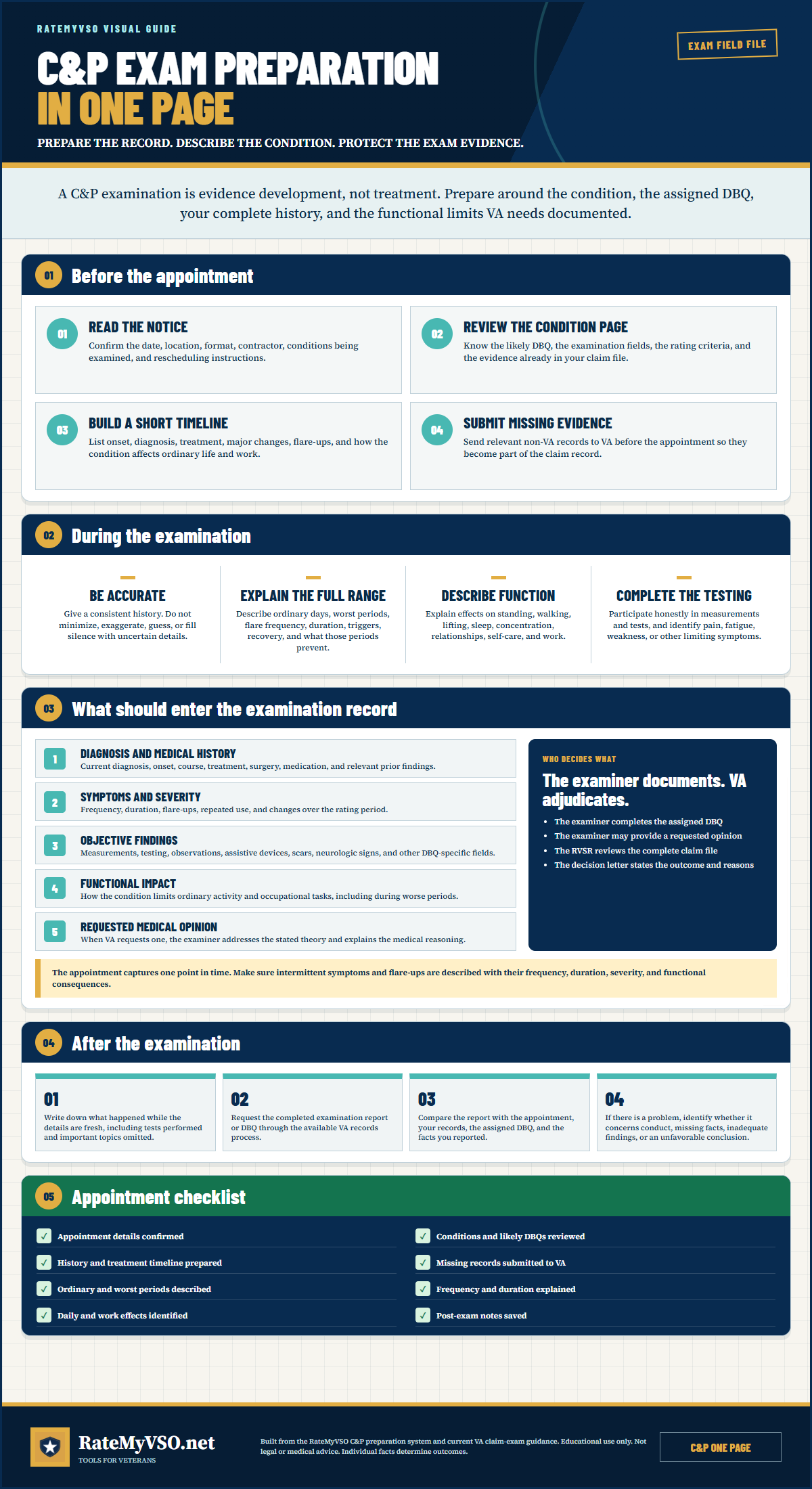
Structure of the exam
A typical C&P exam has four parts:
- Medical history review: When symptoms started and how they progressed.
- Symptom evaluation: Current symptoms, frequency, severity, and triggers.
- Physical examination: Varies by claim. Range of motion (with a goniometer) for orthopedic claims, a clinical interview for mental-health claims, pulmonary function testing for respiratory claims, and so on.
- Functional impact assessment: How the condition affects work and daily activities. For examples of how the Board has described these effects, see the Functional Impact Library.
Questions the examiner will ask
- When the condition started.
- Description of current symptoms, frequency, severity.
- Treatments that have been tried.
- How the condition affects daily life.
- How the condition affects work.
- Mental-health exams: standardized screening questions about thoughts of self-harm or harm to others (PC-PTSD-5, PHQ-2, C-SSRS, etc., depending on the DBQ).
What VA regulations require examiners to record
The examiner is filling out a Disability Benefits Questionnaire (DBQ). The fields the examiner has to complete are governed by these regulations and case law:
- Severity over the rating period, not a single snapshot. 38 CFR § 4.2 requires examiners and raters to reconcile the medical evidence to reflect the level of disability over the rating period.
- Range of motion is recorded at the point pain begins. 38 CFR § 4.59 and Mitchell v. Shinseki, 25 Vet. App. 32 (2011), require examiners to document where painful motion begins.
- Functional loss after repetitive use. 38 CFR § 4.40 and § 4.45 require examiners to assess any additional limitation due to pain, weakness, fatigability, or incoordination after repetitive use.
- Average impairment of earning capacity. 38 CFR § 4.1 directs raters to evaluate the average impairment of earning capacity from the disability.
- Reasonable doubt. 38 CFR § 4.3 directs that, when there is an approximate balance of positive and negative evidence, reasonable doubt is resolved in the veteran’s favor.
- Pyramiding. 38 CFR § 4.14 bars rating the same disability under different diagnoses. Examiners are expected to identify each separately ratable manifestation.
What to bring
- A current medication list (dosages and prescribers).
- A written symptom history (dates, frequency, triggers).
- The DBQ for the condition. DBQs are public forms published at va.gov/find-forms. Reading the DBQ in advance shows exactly which fields the examiner is required to complete.
After the exam
- The examiner’s completed DBQ goes into the claims file (the “C-file”) and is reviewed by a VA Rating Veterans Service Representative (RVSR), who applies the 38 CFR Part 4 rating schedule.
- Veterans can request a copy of the completed DBQ through a FOIA / Privacy Act request or by viewing it in the C-file via the VA self-service URLs.
- If the rating decision relies on the C&P exam, the regulations cited above are the standards a decision letter or appeal can be evaluated against.
What the exam request document tells you
Before the exam takes place, the VA creates an internal document called the exam request (sometimes called the exam scheduling request). This document specifies the conditions to be examined, the Disability Benefits Questionnaire (DBQ) the examiner is required to complete, the type of medical opinion requested (direct service connection, secondary, increased rating, etc.), and the records that have been released to the examiner or the contracted exam company.
Contracted exam vendors (QTC, VES, LHI, and others) receive only the records the VA lists in the exam request. The examiner reviews those listed records and completes the assigned DBQ. They are not given access to the full claims file or any records not listed. Under the 38 CFR § 3.159 duty to assist, the VA is required to make reasonable efforts to obtain relevant service treatment records and other evidence before a rating decision is issued. If records are missing from the exam request, that gap can be documented and raised in a higher-level review as a potential duty-to-assist error.
Veterans can request a copy of the exam request through a FOIA or Privacy Act request, or by asking at a regional VA office for the specific document. The exam request is also sometimes accessible through the VA self-service tools or via a FOIA request. Key things to look for when reviewing your exam request:
- Conditions listed: Are all conditions you claimed included, with the correct claim type (new, increase, secondary)?
- DBQ assigned: Does the DBQ match the condition? For example, a sleep disturbance could be assigned a mental health DBQ or a respiratory DBQ depending on how it was categorized.
- Records provided: Are service treatment records (government facility records) listed? Are relevant VA medical records (CAPRI records) included for the condition being examined? Are private treatment records you submitted listed?
- Medical opinions requested: If you claimed something as secondary to another condition, does the exam request include a secondary medical opinion? If not, the examiner cannot provide one.
The exam request does not appear in the rating decision narrative. Under VA procedures, most rating decisions use a short-form narrative that does not have to cite each piece of evidence reviewed. The exam request is the document that shows what evidence was actually before the examiner.
Understanding the examiner's role
The C&P examiner is a licensed clinician, either a VA employee or a contractor. Their job is to document findings on the assigned DBQ. They do not issue a rating. The rater (Rating Veterans Service Representative, or RVSR) is the VA employee who reads the completed DBQ and applies the 38 CFR Part 4 rating schedule to assign a disability percentage.
The examiner's scope is defined by the exam request. They complete the DBQ fields for the assigned condition, document current severity, and, when a medical opinion is requested, provide a rationale with a standard such as "at least as likely as not." They may also order additional testing (such as range-of-motion measurements or pulmonary function tests) if that testing is needed to complete the DBQ. They are not permitted to review records outside what was listed in the exam request or to expand the exam beyond what was requested.
Examiners are required to reconcile their findings with the prior medical history in the record (see 38 CFR § 4.2). Where a discrepancy exists, the examiner should note it and provide an explanation.
After the exam, the examiner has no further role in the rating decision. The completed DBQ becomes part of the claims file (the C-file). If a veteran believes the examiner did not review all available records, the exam request (not the rating decision) is the document that shows which records were provided. If the examiner did not receive relevant records, a higher-level review can cite that as a duty-to-assist issue under 38 CFR § 3.159. If the examiner received all the relevant records but reached a different medical conclusion, a supplemental claim with new and relevant evidence would be the appropriate next step.
Veterans may ask the examiner factual questions during the appointment, such as confirming which records were provided to them or whether the DBQ they are completing covers all conditions that were claimed. The examiner documents findings. All rating decisions are made separately by the RVSR. See the VA's C&P exam overview on VA.gov for more on the exam process.
Claim Quest: Quick Check
Five questions based only on this guide.
This checks what you understood from the exam guide above. It is not a claim-readiness score, a prediction, an official test, or a record on your account.
5238), a body part (e.g. knee), or a diagnosis name.Disclaimer: These pages reproduce public Department of Veterans Affairs forms (DBQs) and verbatim text from 38 CFR Part 4 (the VA Schedule for Rating Disabilities). Informational only, not legal or medical advice.