C&P Exam Prep Guide for Paralysis agitans (DC 8004)
YOUR EXAM BLUEPRINT
Paralysis agitans
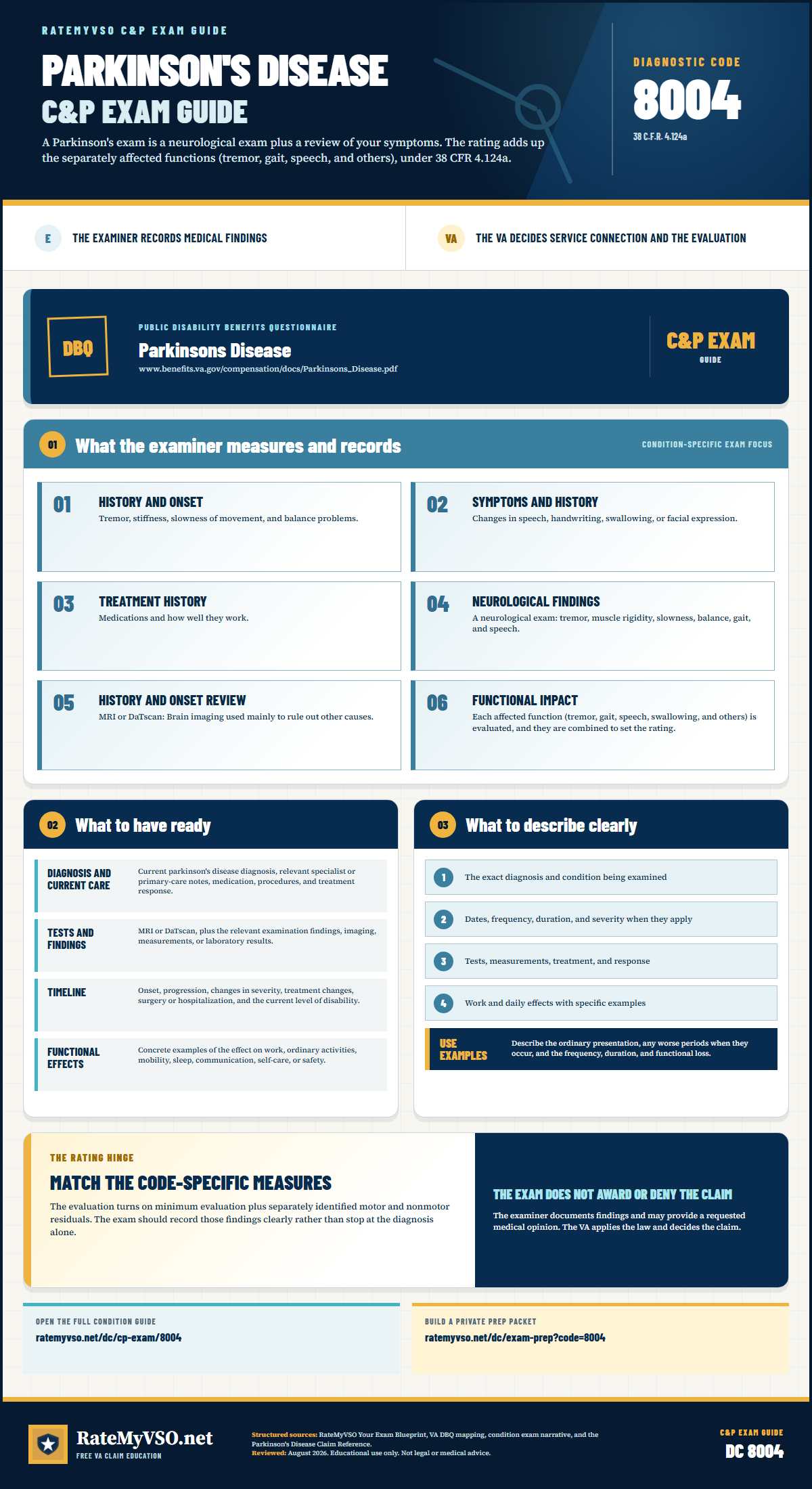
A Parkinson's exam is a neurological exam plus a review of your symptoms. The rating adds up the separately affected functions (tremor, gait, speech, and others), under 38 CFR 4.124a.
DBQ used for this condition
- PPublic formDBQ NEURO Parkinsons DiseaseOpen the public DBQ
What the examination is likely to focus on
Functional-impact topics to describe
- Each affected function (tremor, gait, speech, swallowing, and others) is evaluated, and they are combined to set the rating.
- Findings map to 38 CFR 4.124a (paralysis agitans DC 8004).
Which form the examiner uses
For paralysis agitans (DC 8004), the C&P examiner completes the following Disability Benefits Questionnaire (DBQ):
- DBQ NEURO Parkinsons Disease (public PDF on VA.gov)
DBQs are Department of Veterans Affairs Form 21-0960 series documents. Public DBQs are hosted on benefits.va.gov. A handful are examiner-only and are not posted publicly.
What to expect at your C&P exam
A Parkinson's exam is a neurological exam plus a review of your symptoms. The rating adds up the separately affected functions (tremor, gait, speech, and others), under 38 CFR 4.124a.
1Initial interview (history)
- Tremor, stiffness, slowness of movement, and balance problems.
- Changes in speech, handwriting, swallowing, or facial expression.
- Medications and how well they work.
- Effect on daily activities and work.
2Physical examination
- A neurological exam: tremor, muscle rigidity, slowness, balance, gait, and speech.
3Diagnostic tests the examiner may rely on
Parkinson's is diagnosed clinically; imaging rules out other causes.
4Functional assessment
- Each affected function (tremor, gait, speech, swallowing, and others) is evaluated, and they are combined to set the rating.
- Findings map to 38 CFR 4.124a (paralysis agitans DC 8004).
Test explainers open MedlinePlus (NIH National Library of Medicine), or Wikipedia where MedlinePlus has no matching page. This describes what happens and what is measured, not how to influence a result.
What the examiner records (full DBQ form)
The fields below are reproduced from the DBQ form the examiner completes for this diagnostic code. This is the structural map of the form, showing what the examiner is asked to measure, observe, and record. It is a factual reproduction of the public DBQ, not advice on how to answer.
This DBQ evaluates Parkinson's disease including motor manifestations, digestive, urinary, and mental manifestations.
How DC 8004 maps to this DBQ: for this diagnostic code specifically, the examiner typically completes sections I-III and X-XIII of this form. Section III is the condition-specific section for this code. Sections IV-IX cover unrelated conditions on this DBQ and are skipped.
DIAGNOSIS (Section I)
- 1A. List the claimed condition(s) that pertain to this questionnaire: Parkinson's Disease Note: These are the diagnoses determined during this current evaluation of the claimed condition(s) listed above. If there is no diagnosis, if the diagnosis is different from a previous diagnosis for this condition, or if there is a diagnosis of a complication due to the claimed condition(s), explain your…
- 1B. Select diagnoses associated with the claimed condition(s) (check all that apply): The Veteran does not have a current diagnosis associated with any claimed condition(s) listed above. (Explain your findings and reasons in the Remarks section) Parkinson's disease ICD code: Date of diagnosis: Parkinsonism (identify type if known) ICD Code: Date of diagnosis: Progressive supranuclear palsy (PSP)…
MEDICAL HISTORY (Section II)
- 2A. Describe the history (including onset and course) of the Veteran's Parkinson's disease or Parkinsonism (brief summary):
DOMINANT HAND (Section III)
- 3A. Dominant hand: Right Left Ambidextrous
MOTOR MANIFESTATIONS (Section IV)
- 4A. Hypomimia (facial masking): Is there reported/documented hypomimia due to Parkinson's Disease/Parkinsonism or its treatment? Yes No If "Yes", indicate side affected and severity Right Mild Moderate Severe Left Mild Moderate Severe
- 4B. Stooped posture: Is there reported/documented stooped posture due to Parkinson's Disease/Parkinsonism or its treatment? Yes No If "Yes", indicate severity Mild Moderate Severe Parkinson's Disease
- 4C. Balance impairment: Is there reported/documented balance impairment due to Parkinson's Disease/Parkinsonism or its treatment? Yes No If "Yes", indicate severity Mild Moderate Severe
- 4D. Bradykinesia or slowed motion (difficulty initiating movement, "freezing", short shuffling steps): Is there reported/documented bradykinesia or slowed motion due to Parkinson's Disease/Parkinsonism or its treatment? Yes No If "Yes", identify extremities affected Right upper extremity (If checked, indicate severity) Mild Moderate Severe Left upper extremity (If checked, indicate severity) Mild…
- 4E. Tremors (characteristic hand shaking, "pill rolling"): Is there reported/documented tremors due to Parkinson's Disease/Parkinsonism or its treatment? Yes No If "Yes", identify extremities affected Right upper extremity (If checked, indicate severity) Mild Moderate Severe Left upper extremity (If checked, indicate severity) Mild Moderate Severe Right lower extremity (If checked, indicate…
- 4F. Muscle rigidity and stiffness: Is there reported/documented muscle rigidity and/or stiffness due to Parkinson's Disease/Parkinsonism or its treatment? Yes No If "Yes", identify extremities affected Right upper extremity (If checked, indicate severity) Mild Moderate Severe Left upper extremity (If checked, indicate severity) Mild Moderate Severe Right lower extremity (If checked, indicate…
- 4G. Muscle weakness: Does the Veteran have any muscle weakness in the upper and/or lower extremities due to Parkinson's Disease/Parkinsonism or its treatment? Yes No If "Yes", rate strength according to the following scale for the extremity(ies) involved 0/5 No muscle movement 1/5 Visible muscle movement, but no joint movement 2/5 No movement against gravity 3/5 No movement against resistance 4/5…
- 4H. Reflexes: Does the Veteran have any impaired reflexes in the upper and/or lower extremities due to Parkinson's Disease/Parkinsonism or its treatment? Yes No If "Yes", rate reflexes according to the following scale 0 Absent 1+ Decreased 2+ Normal 3+ Increased without clonus 4+ Increased with clonus Biceps: Right: 0 1+ 2+ 3+ 4+ Left: 0 1+ 2+ 3+ 4+ Triceps: Right: 0 1+ 2+ 3+ 4+
- 4I. Gait: Does the Veteran have an abnormal gait due to Parkinson's Disease/Parkinsonism or its treatment? Yes No If yes, describe:
- 4J. Muscle atrophy: Does the Veteran have muscle atrophy due to Parkinson's Disease/Parkinsonism or its treatment? Yes No If "Yes", indicate location Right upper extremity Left upper extremity Parkinson's Disease
DIGESTIVE MANIFESTATIONS (Section V)
- Note 1: Findings must be documented by barium swallow, computerized tomography (CT), or esophagogastroduodenoscopy (EGD). (Indicate date of study in
URINARY MANIFESTATIONS (Section VI)
- 6A. Urinary leakage: Is there reported/documented urinary leakage due to Parkinson's Disease/Parkinsonism or its treatment? Yes No If "Yes", indicate severity Requires wearing of absorbent materials (if checked, indicate how often they must be changed) Less then 2 times a day 2 to 4 times a day More than 4 times a day Requires the use of an appliance If checked, describe:
- 6B. Urinary frequency: Is there reported/documented increased urinary frequency due to Parkinson's Disease/Parkinsonism or its treatment? Yes No If "Yes", indicate frequency Daytime voiding interval greater than 3 hours Nighttime awakening to void less than 2 times Daytime voiding interval between 2 and 3 hours Nighttime awakening to void 2 times Daytime voiding interval between 1 and 2 hours…
- 6C. Obstructive voiding: Is there reported/documented obstructive voiding due to Parkinson's Disease/Parkinsonism or its treatment? Yes No If "Yes", check all that apply Hesitancy (If checked, is hesitancy marked?) Yes No Slow or weak stream (If checked, is stream markedly slow or weak?) Yes No
- 6D. Recurrent urinary tract infections: Is there reported/documented recurrent urinary tract infections due to Parkinson's Disease/Parkinsonism or its treatment? Yes No If "Yes", check all that apply No treatment Suppressive drug therapy (if checked, indicate frequency) Lasting 6 months or longer For less than 6 months Hospitalization (if checked, indicate frequency of hospitalizations per year)
OTHER MANIFESTATIONS (Section VII)
- 7A. Speech changes (monotone, slurring words, soft or rapid speech): Is there reported/documented speech changes or is the Veteran's speech otherwise abnormal due to Parkinson's Disease/Parkinsonism or its treatment? Yes No If "Yes", check all that apply Hoarseness Inflammation of vocal cords or mucous membranes Thickening of vocal cords Nodules of vocal cords
- 7B. Sense of smell: Is there reported/documented loss of sense of smell due to Parkinson's Disease/Parkinsonism or its treatment? Yes No If "Yes", indicate severity Partial Complete
- 7C. Sense of taste: Is there reported/documented loss of sense of taste due to Parkinson's Disease/Parkinsonism or its treatment? Yes No If "Yes", indicate severity Partial Complete
- 7D. Sleep disturbance: Is there reported/documented sleep disturbance due to Parkinson's Disease/Parkinsonism or its treatment? Yes No If "Yes", check all that apply Insomnia Signs and/or symptoms of sleep apnea or a sleep apnea-like condition (if selected, check all that apply) Note: If signs and/or symptoms of sleep apnea or a sleep apnea-like condition are due to Parkinson's…
- 7E. Sexual dysfunction: Is there reported/documented erectile dysfunction or female sexual arousal disorder (FSAD) due to Parkinson's Disease/Parkinsonism or its treatment? Note: Female Sexual Arousal Disorder (FSAD) refers to the continual or recurrent physical inability of a woman to accomplish or maintain an ample lubrication-swelling reaction during sexual intercourse. Decreased blood flow to…
MENTAL MANIFESTATIONS (Section VIII)
- 8A. Does the Veteran have signs or symptoms of depression, cognitive impairment or dementia, or any other mental health condition(s) attributable to Parkinson's disease/Parkinsonism and/or its treatment? Yes No If yes, schedule with appropriate provider to complete a Mental Disorders Questionnaire
REMAINING EFFECTIVE FUNCTION OF THE EXTREMITIES (Section IX)
- 9A. Due to the Veteran's Parkinson's Disease/Parkinsonism or its treatment, is there functional impairment of an extremity such that no effective function remains other than that which would be equally well served by an amputation with prosthesis (functions of the upper extremity include grasping, manipulation, etc., while functions of the lower extremity include balance, propulsion, etc.)? Yes,…
- 9B. For each checked extremity, identify the condition causing loss of function, describe loss of effective function and provide specific examples (brief summary):
ASSISTIVE DEVICES (Section X)
- 10A. Does the Veteran use any assistive devices? Yes No If yes, identify the assistive devices used. Check all that apply and indicate frequency. Wheelchair Frequency of use: Occasional Regular Constant Brace(s) Frequency of use: Occasional Regular Constant Crutch(es) Frequency of use: Occasional Regular Constant Cane(s) Frequency of use: Occasional Regular Constant
- 10B. If the Veteran uses any assistive devices, specify the condition, indicate the side, and identify the assistive device used for each condition. Parkinson's Disease
OTHER PERTINENT PHYSICAL FINDINGS, COMPLICATIONS, CONDITIONS, SIGNS, SYMPTOMS, AND SCARS (Section XI)
- 11A. Does the Veteran have any other pertinent physical findings, complications, conditions, signs, or symptoms, including any subjective symptoms not capable of objective verification (i.e., headaches, dizziness, fatigability), related to any conditions listed in the diagnosis section above? Yes No If "Yes", describe (brief summary):
- 11B. Does the Veteran have any scars or other disfigurement (of the skin) related to any conditions or to the treatment of any conditions listed in the diagnosis section? Yes No If "Yes", also complete the appropriate dermatological questionnaire.
FUNCTIONAL IMPACT (Section XII)
- 12A. Regardless of the Veteran's current employment status, do the conditions listed in the diagnosis section impact his/her ability to perform any type of occupational task (such as standing, walking, lifting, sitting, etc.)? Yes No If yes, describe the functional impact of each condition, providing one or more examples:
REMARKS (Section XIII)
- 13A. Remarks (if any – please identify the section to which the remark pertains when appropriate).
Rating Levels for DC 8004
The following tiers are reproduced from 38 CFR Part 4, the VA Schedule for Rating Disabilities. Toggle between the official VA criteria and a Plain English explanation.
Plain-English summaries are AI-generated to explain the official criteria. The official 38 CFR language is the binding legal standard. When in doubt, ask a VSO.
Evidence cited in published BVA decisions for DC 8004
The counts below are aggregated from published Board of Veterans Appeals decisions for this diagnostic code, among issues the Board granted or denied (remanded issues are not included). Each row reports how often a given evidence type was discussed in the decision text, broken down by outcome. This is a factual aggregate of the public record, not a prediction or recommendation about any specific claim.
- Service treatment records: appeared in 180 granted decisions (251 denied; 431 decided total)
- Buddy / lay statements: appeared in 127 granted decisions (186 denied; 313 decided total)
- Medical literature: appeared in 30 granted decisions (39 denied; 69 decided total)
When the Board found the exam inadequate (DC 8004)
In 362 published Board of Veterans' Appeals decisions involving this condition, the Board found a C&P examination or medical opinion inadequate. Where the defect could be read from the decision, it was most often one of the following (counts are a floor from the decisions on file, not a total):
- 106 Failed to address a contention or part of the condition
- 89 Conclusion given without a supporting rationale
- 38 Veteran's lay statements not considered
- 21 Opinion relied on the absence of records instead of the evidence
- 12 Examiner said an opinion would require speculation
- 12 Claims file or records not reviewed
- 8 Flare-ups or functional loss not addressed
- 5 Wrong legal standard or question applied
An inadequate exam is usually sent back for a new one rather than decided against the veteran. This is a factual report of published decisions, not advice about any exam or claim; whether an exam is adequate is decided case by case.
Disclaimer: This page reproduces public Department of Veterans Affairs forms (DBQs) and verbatim text from 38 CFR Part 4 (the VA Schedule for Rating Disabilities). It is informational only and is not legal or medical advice. For guidance on a specific claim, contact a VA-accredited representative.