C&P Exam Prep Guide for Other specified and unspecified schizophrenia spectrum and other psychotic disorders (DC 9210)
YOUR EXAM BLUEPRINT
Other specified and unspecified schizophrenia spectrum and other psychotic disorders
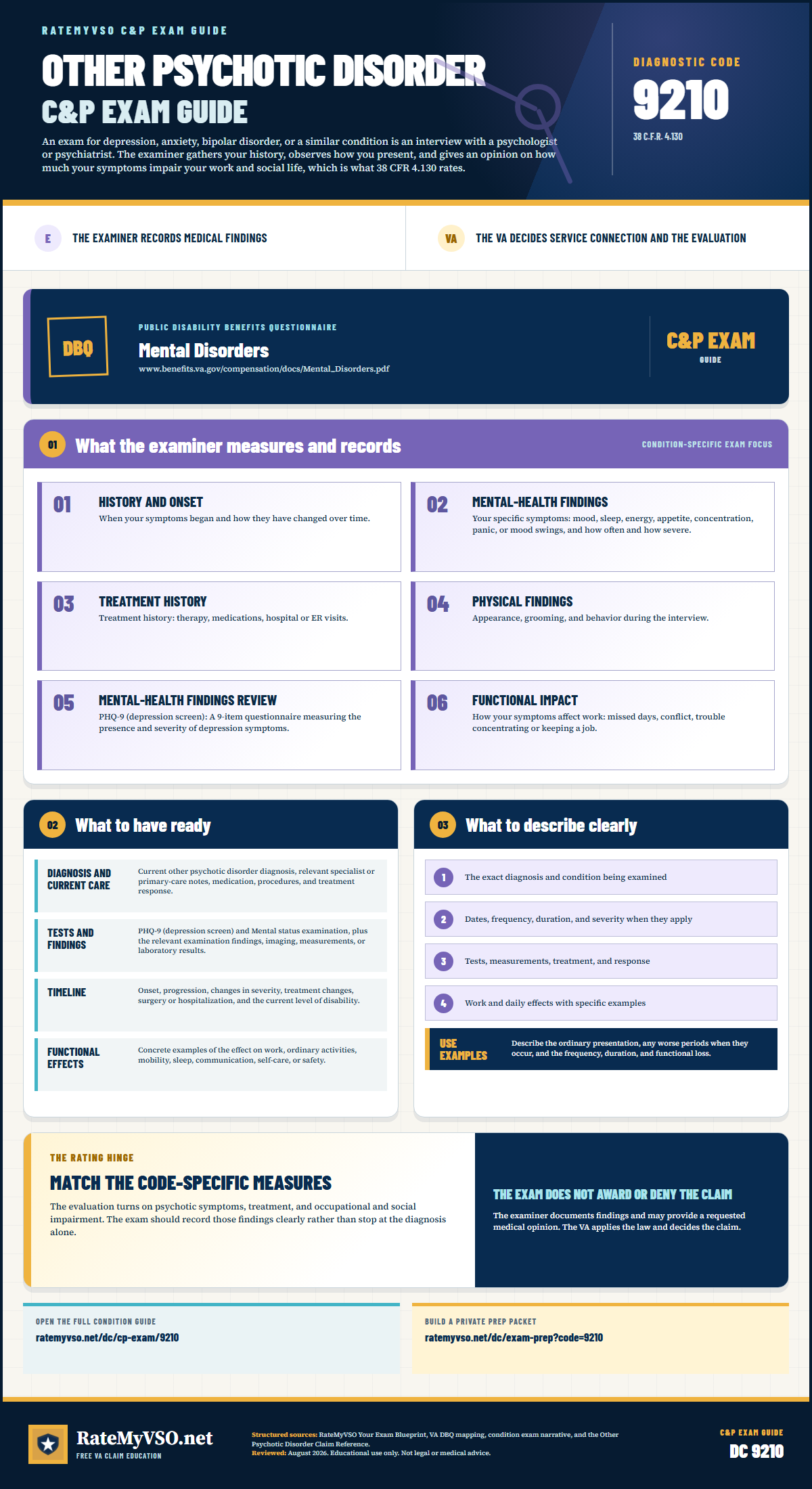
An exam for depression, anxiety, bipolar disorder, or a similar condition is an interview with a psychologist or psychiatrist. The examiner gathers your history, observes how you present, and gives an opinion on how much your symptoms impair your work and social life, which is what 38 CFR 4.130 rates.
DBQ used for this condition
- PPublic formDBQ PSYCH Mental DisordersOpen the public DBQ
What the examination is likely to focus on
Functional-impact topics to describe
- How your symptoms affect work: missed days, conflict, trouble concentrating or keeping a job.
- How they affect relationships, family, and social activities.
- Your ability to handle daily routines and self-care.
- The examiner gives an overall opinion on your level of occupational and social impairment, the scale 38 CFR 4.130 uses to set the rating from 0 to 100 percent.
Which form the examiner uses
For other specified and unspecified schizophrenia spectrum and other psychotic disorders (DC 9210), the C&P examiner completes the following Disability Benefits Questionnaire (DBQ):
- DBQ PSYCH Mental Disorders (public PDF on VA.gov)
DBQs are Department of Veterans Affairs Form 21-0960 series documents. Public DBQs are hosted on benefits.va.gov. A handful are examiner-only and are not posted publicly.
What to expect at your C&P exam
An exam for depression, anxiety, bipolar disorder, or a similar condition is an interview with a psychologist or psychiatrist. The examiner gathers your history, observes how you present, and gives an opinion on how much your symptoms impair your work and social life, which is what 38 CFR 4.130 rates.
1Initial interview (history)
- When your symptoms began and how they have changed over time.
- Your specific symptoms: mood, sleep, energy, appetite, concentration, panic, or mood swings, and how often and how severe.
- Treatment history: therapy, medications, hospital or ER visits.
- Alcohol or substance use.
- Relationships, family, and social life.
- Work history and how symptoms affect your job.
- Any thoughts of self-harm or suicide.
2Mental status examination
- Appearance, grooming, and behavior during the interview.
- Speech, mood, and affect (emotional expression).
- Thought process and content, and any delusions or hallucinations.
- Orientation, memory, and concentration.
- Insight, judgment, and impulse control.
- Whether you report thoughts of harming yourself or others.
3Diagnostic tests the examiner may rely on
The examiner may use a validated questionnaire or a structured interview. These are scored tools, not pass/fail tests.
4Functional assessment
- How your symptoms affect work: missed days, conflict, trouble concentrating or keeping a job.
- How they affect relationships, family, and social activities.
- Your ability to handle daily routines and self-care.
- The examiner gives an overall opinion on your level of occupational and social impairment, the scale 38 CFR 4.130 uses to set the rating from 0 to 100 percent.
If you are in crisis or thinking about suicide, call the Veterans Crisis Line at 988 and press 1, or text 838255. It is free, confidential, and available 24/7.
Test explainers open MedlinePlus (NIH National Library of Medicine), or Wikipedia where MedlinePlus has no matching page. This describes what happens and what is measured, not how to influence a result.
What the examiner records (full DBQ form)
The fields below are reproduced from the DBQ form the examiner completes for this diagnostic code. This is the structural map of the form, showing what the examiner is asked to measure, observe, and record. It is a factual reproduction of the public DBQ, not advice on how to answer.
This DBQ evaluates mental disorders (other than PTSD and eating disorders) for VA disability rating, documenting diagnosis, clinical findings, symptoms, behavioral observations, and competency.
How DC 9210 maps to this DBQ: for this diagnostic code specifically, the examiner typically completes sections I-VII of this form. Section I is the condition-specific section for this code.
DIAGNOSIS (Section I)
- A1. Does the Veteran now have or has he or she ever been diagnosed with a mental disorder(s)? NOTE: If the Veteran has a diagnosis of an eating disorder, complete the Eating Disorders Questionnaire, in lieu of this questionnaire. NOTE: If the Veteran has a diagnosis of PTSD, the Initial PTSD Questio
CLINICAL FINDINGS (Section II)
- 2A. Relevant social/marital/family history (pre-military, military, and post-military) Mental Disorders (Other Than PTSD and Eating Disorders)
- 2B. Relevant occupational and educational history (pre-military, military, and post-military)
- 2C. Relevant mental health history, to include prescribed medications and family mental health (pre-military, military, and postmilitary)
- 2D. Relevant legal and behavioral history (pre-military, military, and post-military)
- 2E. Relevant substance abuse history (pre-military, military, and post-military)
- 2F. Other, if any:
SYMPTOMS (Section III)
- 3A. For VA rating purposes, check all symptoms that apply to the Veteran's diagnoses Depressed Mood Anxiety Suspiciousness Panic attacks that occur weekly or less often Panic attacks more than once a week Mental Disorders (Other Than PTSD and Eating Disorders)
BEHAVIORAL OBSERVATIONS (Section IV)
- 4A. Behavioral Observations Mental Disorders (Other Than PTSD and Eating Disorders)
OTHER SYMPTOMS (Section V)
- 5A. Does the Veteran have any other symptoms attributable to mental disorders that are not listed above? Yes No If "Yes," describe
COMPETENCY (Section VI)
- 6A. Is the Veteran capable of managing his or her financial affairs? Yes No If "No," specify each injury or disease resulting in incompetency and provide a rationale to support this finding: Mental Disorders (Other Than PTSD and Eating Disorders)
REMARKS (Section VII)
- 7A. Remarks (Including any testing results), if any:
Rating Levels for DC 9210
The following tiers are reproduced from 38 CFR Part 4, the VA Schedule for Rating Disabilities. Toggle between the official VA criteria and a Plain English explanation.
Plain-English summaries are AI-generated to explain the official criteria. The official 38 CFR language is the binding legal standard. When in doubt, ask a VSO.
Evidence cited in published BVA decisions for DC 9210
The counts below are aggregated from published Board of Veterans Appeals decisions for this diagnostic code, among issues the Board granted or denied (remanded issues are not included). Each row reports how often a given evidence type was discussed in the decision text, broken down by outcome. This is a factual aggregate of the public record, not a prediction or recommendation about any specific claim.
- Service treatment records: appeared in 241 granted decisions (366 denied; 607 decided total)
- Buddy / lay statements: appeared in 169 granted decisions (256 denied; 425 decided total)
- Medical literature: appeared in 11 granted decisions (17 denied; 28 decided total)
When the Board found the exam inadequate (DC 9210)
In 191 published Board of Veterans' Appeals decisions involving this condition, the Board found a C&P examination or medical opinion inadequate. Where the defect could be read from the decision, it was most often one of the following (counts are a floor from the decisions on file, not a total):
- 55 Failed to address a contention or part of the condition
- 33 Conclusion given without a supporting rationale
- 33 Veteran's lay statements not considered
- 14 Claims file or records not reviewed
- 10 Examiner said an opinion would require speculation
- 9 Opinion relied on the absence of records instead of the evidence
An inadequate exam is usually sent back for a new one rather than decided against the veteran. This is a factual report of published decisions, not advice about any exam or claim; whether an exam is adequate is decided case by case.
Disclaimer: This page reproduces public Department of Veterans Affairs forms (DBQs) and verbatim text from 38 CFR Part 4 (the VA Schedule for Rating Disabilities). It is informational only and is not legal or medical advice. For guidance on a specific claim, contact a VA-accredited representative.