Rating Traumatic Brain Injury (TBI)
How the VA rates residuals of a traumatic brain injury under Diagnostic Code 8045, in plain English. A TBI can leave behind problems in three different areas, and each area is rated on its own.
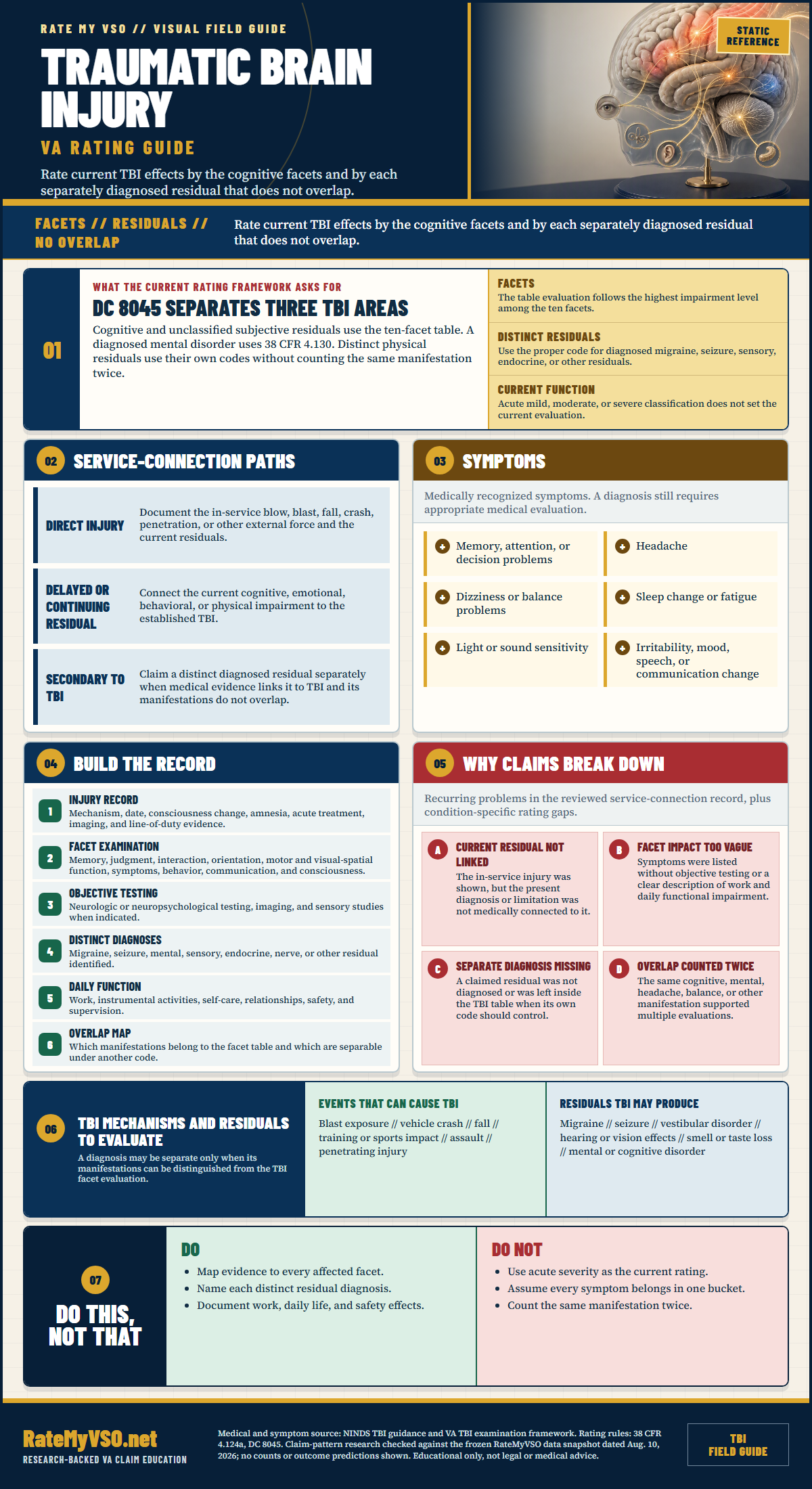 One-page guide: Rating Traumatic Brain Injury in One Page
TBI guide covering DC 8045, the ten-facet framework, separate mental and physical residuals, service paths, symptoms, examinations, overlap rules, and common claim gaps. Opens the full-size chart, free to save or print.
One-page guide: Rating Traumatic Brain Injury in One Page
TBI guide covering DC 8045, the ten-facet framework, separate mental and physical residuals, service paths, symptoms, examinations, overlap rules, and common claim gaps. Opens the full-size chart, free to save or print.
The Three Areas of TBI Dysfunction
A TBI can affect you in three different ways. The VA looks at each one separately, rates whatever applies to you, and then combines the ratings using VA math.
1. Thinking Problems (Cognitive)
Trouble with memory, attention, focus, planning, organizing, problem-solving, decision-making, or controlling impulses. Symptoms can change from day to day. Rated under the special 10-category TBI table (see below).
2. Mood and Behavior (Emotional / Behavioral)
If you have a diagnosed mental health condition (PTSD, depression, anxiety), it is rated under the regular mental-disorder rules (38 CFR § 4.130). If you have mood or behavior symptoms but no separate mental-health diagnosis, they go in the TBI table.
3. Physical Problems
Anything physical the TBI caused: weakness, numbness, vision/hearing/smell/taste loss, seizures, balance problems, speech or swallowing problems, bladder or bowel control, hormone problems. Each is rated under its own diagnostic code, then combined with the other TBI ratings.
Thinking Problems (The 10-Facet Table)
Cognitive impairment means a drop in your memory, attention, concentration, and "executive functions." Executive functions include goal-setting, planning, organizing, prioritizing, problem-solving, judgment, decision-making, self-monitoring, and the ability to change course when something is not working.
Not all of these are affected in everyone, and some may be worse than others. Symptoms can fluctuate day-to-day.
VA scores you on 10 categories (called facets). Each facet is scored 0, 1, 2, 3, or "total" (the highest level). The highest single facet score drives your overall rating, not the average.
How Facet Scores Convert to a Percentage
| Highest Facet Score | Overall TBI Rating |
|---|---|
| 0 | 0% |
| 1 | 10% |
| 2 | 40% |
| 3 | 70% |
| "Total" on any one facet | 100% |
The 10 Facets
- Memory, attention, concentration, executive functions
- Judgment
- Social interaction
- Orientation
- Motor activity (with intact motor/sensory system)
- Visual spatial orientation
- Subjective symptoms
- Neurobehavioral effects
- Communication
- Consciousness (only "total" is possible, any level of impaired consciousness is 100%)
Mood and Behavior
This is the "two-track" rule that confuses a lot of veterans.
Track A: You Have a Diagnosed Mental Health Condition
If a clinician has diagnosed PTSD, depression, anxiety, adjustment disorder, or another mental health condition, the emotional/behavioral piece is rated under the regular mental-disorder rules (38 CFR § 4.130). That can be a separate rating from your TBI cognitive rating, and the two are combined.
Track B: No Mental Health Diagnosis
If you have mood swings, irritability, or behavior changes from the TBI but no separate mental health diagnosis, those symptoms are scored in the "Neurobehavioral effects" facet of the TBI table and counted toward your overall TBI rating.
Physical Problems
Each physical residual gets rated under its own diagnostic code, not the TBI table. Common physical residuals include:
- Weakness, numbness, or pain in arms, legs, or face (motor and sensory dysfunction)
- Vision loss or eye problems
- Hearing loss and tinnitus
- Loss of smell or taste
- Seizures
- Trouble walking, balance problems, coordination problems
- Speech and communication problems (including aphasia and dysarthria)
- Bladder control problems (neurogenic bladder)
- Bowel control problems (neurogenic bowel)
- Cranial nerve damage
- Autonomic nerve problems (blood pressure, heart rate, sweating)
- Hormone problems (endocrine dysfunction)
This list is not complete. Any other physical condition that came from the TBI gets rated under whichever diagnostic code best fits.
Subjective Symptoms
Subjective symptoms are the things only you can describe, like headaches, dizziness, ringing in the ears, fatigue, or sleep problems. They are common after TBI.
- Subjective symptoms with no separate diagnosis: rated inside the TBI table under the "Subjective symptoms" facet.
- Subjective symptoms that match a named diagnosis (migraine headache, Meniere's disease, etc.): rated under their own diagnostic code, NOT inside the TBI table, even though the diagnosis is based on what you describe.
How the Ratings Combine
Each separately-rated condition (cognitive, mental-disorder, each physical residual) is combined under VA math (38 CFR § 4.25), the same combining table used for all VA ratings. Use our VA Math calculator to combine your ratings.
For combining purposes, the rating you get from the TBI cognitive table is treated as one single condition (not 10 separate facet ratings). That single number combines with your mental-disorder rating, your physical-residual ratings, and any other service-connected ratings.
Special Monthly Compensation (SMC)
If your TBI is severe, VA must also consider whether you qualify for Special Monthly Compensation on top of your percentage rating. SMC pays extra for situations like:
- Loss of use of an arm, leg, hand, or foot
- Blindness or near-blindness
- Deafness in both ears
- Erectile dysfunction
- Needing aid and attendance, including supervision because of cognitive problems (such as needing someone to keep you from wandering off, leaving the stove on, or other hazards)
- Being housebound
SMC for TBI is most often awarded at the SMC-T level, which pays at the same rate as SMC-R.2 ($10,000+/month) for veterans who would need to be in a nursing home or institutional setting because of their TBI but are being cared for at home. See our SMC-T for TBI guide for details.
Important Notes (The CFR Footnotes)
"Mild," "Moderate," "Severe" TBI in Medical Records
These labels classify the injury at the time it happened (based on loss of consciousness duration, Glasgow Coma Score, post-traumatic amnesia). They do NOT control your VA rating. A "mild" TBI at the time of injury can produce severe residuals years later, and the rating goes by current functioning, not the original classification.
ADLs vs IADLs
The TBI table considers both, and they mean different things:
- Activities of Daily Living (ADLs): basic self-care, bathing, dressing, eating, getting in and out of bed, using the toilet.
- Instrumental Activities of Daily Living (IADLs): independent-living tasks, cooking, housework, shopping, doing laundry, managing medications, using a phone, getting around.
Inability to perform ADLs is more severe than inability to perform IADLs and pushes facet scores higher.
Pre-October 23, 2008 TBI Ratings
If you were rated under the older DC 8045 (before the 2008 rewrite), you can ask VA at any time to re-review your rating under the current rules, even if your TBI has not gotten worse. The review is treated as a claim for an increased rating. If the new rules give you a higher rating, the effective date can go back as far as October 23, 2008, but no earlier.
Evidence Cited in Published Traumatic brain injury Decisions
We analyzed 33,404 published Board decisions involving traumatic brain injury for condition-specific evidence, counting only case-specific mentions (boilerplate recitations excluded). "Favorable" is the share of decisions citing that evidence where every issue was granted or the outcome was mixed; the baseline across all these decisions is 46.9%. Evidence appearing in a decision does not mean it decided the case. Descriptive of the published record, not a prediction.
Bar length shows decisions citing the evidence.
Detected by phrase-reading the decision text with condition-specific vocabularies. Source: Board of Veterans' Appeals decisions, RateMyVSO analysis.
Symptoms Recorded in Granted Traumatic brain injury Decisions
We analyzed 1,795 granted Board decisions involving traumatic brain injury for symptoms named in sentences about the condition (rating-criteria recitations excluded). Descriptive of the published record, what the Board wrote down, not a checklist of what to report.
Bar length shows decisions. Percentages remain context.
Detected by phrase-reading the decision text with condition-specific vocabularies. Source: Board of Veterans' Appeals decisions, RateMyVSO analysis.
Frequently Asked Questions
Can I get both a TBI cognitive rating AND a separate PTSD rating?
Yes, as long as the symptoms supporting each rating can be cleanly separated. PTSD is rated under § 4.130 (mental disorders) and TBI cognitive is rated under the 10-facet table. The two ratings combine under VA math. The catch: if a specific symptom (for example, irritability) cannot be clearly attributed to one or the other, VA must use whichever rule gives the better overall picture, not both.
Why is "2" worth 40% but "1" only worth 10%?
The TBI rating brackets are 0%, 10%, 40%, 70%, 100%. There is no 20% or 30% under DC 8045. That is a deliberate choice in the regulation, intended to push moderately-impaired veterans into the 40% category rather than under-rating them at 20% or 30%.
What if my headaches are severe but not formally diagnosed as migraines?
Push for a formal migraine diagnosis. The TBI subjective-symptoms facet caps headaches at the facet score (max 3 = 70% if it is your highest facet), but DC 8100 migraines can reach 50% with characteristic prostrating attacks producing economic inadaptability. A formal migraine diagnosis pulls your headaches OUT of the TBI table and into their own ratable code, where they can be combined separately. See the DC 8100 migraine page for the full rating criteria.
Does VA need to give me a TBI rating if I had a head injury in service?
A head injury alone is not enough. VA needs three things: (1) a current diagnosis of TBI residuals, (2) evidence of an in-service head injury or event, and (3) a medical nexus opinion linking the current residuals to the in-service event. Document everything: incident reports, line-of-duty determinations, buddy statements about what you were like before vs after the event, and current neurology or neuropsychology evaluations.
I was rated 10% for TBI in 2010. Can I get it re-reviewed?
Yes. The 2008 rewrite created a permanent right to ask for re-review. File a claim for increased rating and explicitly cite "Note 5 to DC 8045" and ask VA to apply the current 10-facet table. If you qualify for a higher rating under the new rules, the effective date can go back as far as October 23, 2008.
This guide is for educational purposes only and is not legal advice. To look up DC 8045 directly, see the DC 8045 page. For help with your TBI claim, find a VSO representative. To combine your ratings, use the VA Math calculator.