Traumatic brain injury. Care at home.
SMC-T: Aid & Attendance for Traumatic Brain Injury
SMC-T is a Special Monthly Compensation tier specifically for service-connected traumatic brain injury requiring care that would otherwise demand institutionalization. Created by the 2010 Caregivers and Veterans Omnibus Health Services Act. Authority: 38 USC § 1114(t), implemented at 38 CFR § 3.350(j).
Find the part that matters to you
Three topics. Start with yours.
Shortcuts into the guide, not an eligibility decision. The full criteria are in each chapter.

Who qualifies
The requirements, starting with a service-connected TBI.
Read the eligibility rules
The care level it describes
Care that would otherwise require a hospital or nursing home.
Read the standard
What the record should show
Records, statements and caregiver-program documents.
Read the evidenceThe complete reference
The details behind each topic.
All of the guidance is here. Open a section when you need it.
01What Is SMC-T?
The TBI tier, paid at the SMC-R-2 rate.
SMC-T pays the same monthly rate as SMC-R-2 (~$11,272/month in 2026) for veterans whose service-connected traumatic brain injury requires a level of personal-care services that, without family or in-home care, would necessitate hospitalization, nursing home, or other residential institutional care.
SMC-T was created to make sure TBI veterans cared for at home by family members receive the same compensation as if they were institutionalized, a recognition that family caregiving for severe TBI is itself a form of skilled care.
02Eligibility
The requirements, and the 2024 court decision.
Per 38 CFR § 3.350(j), a veteran qualifies for SMC-T if all the following are met:
- Service-connected TBI. The traumatic brain injury must be service-connected (presumptive or direct).
- Need for regular A&A. The veteran needs regular aid and attendance (the SMC-L § 3.352(a) criteria).
- Without home care, institutionalization would be required. The veteran's TBI residuals are severe enough that absent in-home care from family or others, the veteran would need hospital or nursing-home placement.
- Not in receipt of SMC-R-2. SMC-T and R-2 are mutually exclusive at the same payment level, VA awards whichever is appropriate.
03Illustrative Example
A fictional scenario to illustrate the guidance.
Fictional example, not a real claimant. Names and facts are invented to show how the criteria above could apply in a single case.
Michael L. is a post-9/11 Army veteran who suffered a severe traumatic brain injury in Afghanistan in 2009. Because of his TBI alone, he needs daily aid and attendance with cognition, medication management, and basic daily living. He does not meet the regulatory criteria for SMC-O or higher on a non-TBI basis, but without his wife providing in-home care he would require nursing-home placement. Michael qualifies for SMC-T at approximately $11,272 per month (the same rate as SMC-R-2) under 38 USC § 1114(t), a tier created in 2010 specifically for TBI veterans who would otherwise need institutional care.
04SMC-T vs SMC-R-2
The same rate, with different eligibility paths.
SMC-R-2
Reg: § 3.350(h)(2)
Predicate: Must first qualify for SMC-O (paraplegia, bilateral amputation, etc.).
Care level: Daily higher-level care from a licensed professional, or from an unlicensed carer under a professional's regular supervision, required.
Underlying cause: Any qualifying SMC-O condition.
SMC-T
Reg: § 3.350(j)
Predicate: NO SMC-O requirement. Pure TBI pathway.
Care level: Regular A&A that, absent home care, would require institutionalization.
Underlying cause: Service-connected TBI specifically.
Same monthly rate. Different eligibility paths. TBI veterans almost always pursue SMC-T because the criteria are easier to meet (no SMC-O predicate) and the evidence pattern is TBI-specific.
05"Institutional Care" Standard
What would otherwise require institutional care.
The "would otherwise require hospitalization or nursing-home care" standard is the heart of SMC-T. VA evaluates whether the TBI veteran's care needs are at the level that would necessitate residential placement, not whether they are actually currently institutionalized.
Indicators that meet this bar (commonly cited in BVA grants):
- Inability to perform any activities of daily living without assistance (bathing, dressing, feeding, toileting).
- Cognitive deficits requiring 24-hour supervision to prevent self-harm or wandering.
- Severe behavioral dyscontrol requiring constant redirection or physical management.
- Seizure disorder secondary to TBI requiring continuous monitoring.
- Communication impairment so severe that medical needs cannot be self-reported.
- Physical mobility limitations requiring two-person transfers.
The veteran does not have to demonstrate ALL of these, but the combined picture should match what a skilled nursing facility would provide if the family weren't there.
06Evidence That Wins
Records and statements that document the need.
- Service-connection of TBI: service treatment records documenting the brain injury (combat injury, blast exposure, MVA in service), or post-service medical evidence linking residuals to documented in-service event.
- Neuropsychological testing showing the TBI residuals (cognitive impairment severity).
- VA Form 21-2680 completed by treating neurologist or physiatrist documenting the A&A criteria.
- Caregiver statements describing the around-the-clock supervision and care provided.
- Treatment records from Polytrauma System of Care if applicable, VA's TBI specialty network often documents the institutional-care equivalence directly.
- VA Caregiver Support Program records, if the veteran is enrolled in the Comprehensive Caregiver Program at the highest tier, this is strong corroborating evidence.
- Statement from a physician explicitly addressing the institutional-care standard: "Without the in-home care provided by the veteran's spouse, this veteran would require placement in a skilled nursing facility because [specific reasons]."
072026 Monthly Rate
The approximate 2026 amount.
SMC-T's 2026 monthly rate is approximately $11,272/month (single veteran, no dependents), the same as SMC-R-2. Set by VA each December 1 alongside COLA-adjusted compensation rates. Dependent supplements add to the base.
This is one of the highest VA disability compensation rates available.
08Interaction with the VA Caregiver Program
How PCAFC and SMC-T relate.
The VA Comprehensive Assistance for Family Caregivers Program (PCAFC, 38 USC § 1720G) and SMC-T are separate but related. PCAFC pays a stipend to the family caregiver. SMC-T pays the veteran. A veteran can receive both.
PCAFC enrollment is strong corroborating evidence for SMC-T eligibility because the PCAFC eligibility evaluation already documents the same care needs SMC-T requires. If you are enrolled in the highest PCAFC tier, attach the enrollment documentation to the SMC-T claim.
09How to File
The steps and the documents.
- Establish service-connection of TBI first (if not already rated).
- File VA Form 21-526EZ identifying the SMC-T claim.
- Submit VA Form 21-2680 from the treating neurologist / physiatrist.
- Submit a physician statement addressing the institutional-care standard explicitly.
- Attach PCAFC enrollment documentation if applicable.
- Caregiver statements describing daily care needs and 24-hour supervision pattern.
10Common Mistakes
Where SMC-T claims go wrong.
- Filing under SMC-R-2 instead of SMC-T. Same rate, but SMC-R-2 requires entitlement to SMC-O or to the maximum rate under 38 U.S.C. 1114(p). A TBI case that meets neither predicate uses SMC-T, which has its own criteria and does not require them.
- Not addressing the institutional-care standard explicitly. The physician statement must say (in substance) "without home care, this veteran would require a skilled nursing facility because…"
- Failing to document service-connection of the underlying TBI. SMC-T only pays for service-connected TBI residuals. Document the in-service event and the nexus.
- Missing PCAFC corroborating evidence. Caregiver Program enrollment is strong evidence, attach it.
- Not claiming SMC-K stacks. SMC-T replaces the schedular rate, but SMC-K still stacks on top for any qualifying anatomical losses.
11What Published Board Decisions Show About SMC-T Care
Care patterns in published SMC-T decisions.
We analyzed all 179 published Board decisions ruling on SMC-T: 111 granted, 68 denied (AI-assisted extraction, hand-checked, August 2026; universe confirmed against the production database). Family care wins these cases. The court held in 2024 that SMC-T does not require licensed or professionally supervised care; help from a spouse or family member counts (Laska v. McDonough, 37 Vet. App. 460 (2024)). Each percentage below is the share of decisions in that outcome group.
Care needs the Board discussed
Share of decisions in each outcome group whose text discussed the care need. 110 granted readable for this measure, 68 denied.
Evidence the Board cited, and how it received it
| Evidence | Cited, grants | Grants: relied / mentioned / discounted | Cited, denials | Denials: relied / mentioned / discounted |
|---|---|---|---|---|
| VA exam | 85% | 158 / 74 / 45 | 88% | 111 / 75 / 12 |
| Lay statements | 75% | 111 / 21 / 4 | 69% | 21 / 43 / 23 |
| Treatment records | 63% | 86 / 66 / 7 | 69% | 87 / 59 / 11 |
| Private medical opinion | 55% | 74 / 13 / 4 | 35% | 10 / 10 / 13 |
| VA Form 21-2680 | 47% | 60 / 9 / 4 | 41% | 20 / 6 / 9 |
| Caregiver program records | 23% | 30 / 7 / 3 | 22% | 12 / 7 / 4 |
| Nursing assessment | 8% | 8 / 1 / 1 | 1% | 0 / 0 / 1 |
The lay-statement row is the sharpest split: in grants the Board relied on lay statements 111 times and discounted 4; in denials it relied 21 times against 43 merely mentioned and 23 discounted.
The licensed-care standard persists after the court rejected it. Of the 34 SMC-T denials in our corpus decided after Laska (September 6, 2024), our hand review confirmed 14 still turned the claim on whether the caregiver was licensed or professionally supervised, the standard Laska rejected for SMC-T, and only 1 of the 14 mentioned Laska at all. The regulation text the Board applies (38 CFR § 3.352(b)) has not been amended since the ruling, which is how the old standard keeps appearing.
Source: published Board of Veterans' Appeals decisions ruled on SMC-T, decision grain, extracted August 2026; universe confirmed against the production database on August 13, 2026, and the post-Laska count was verified decision-by-decision against the full text. Published decisions are a selected sample; these shares report what those records contained, not any individual claim's odds.
A different way to take it in
Two guides to keep close.
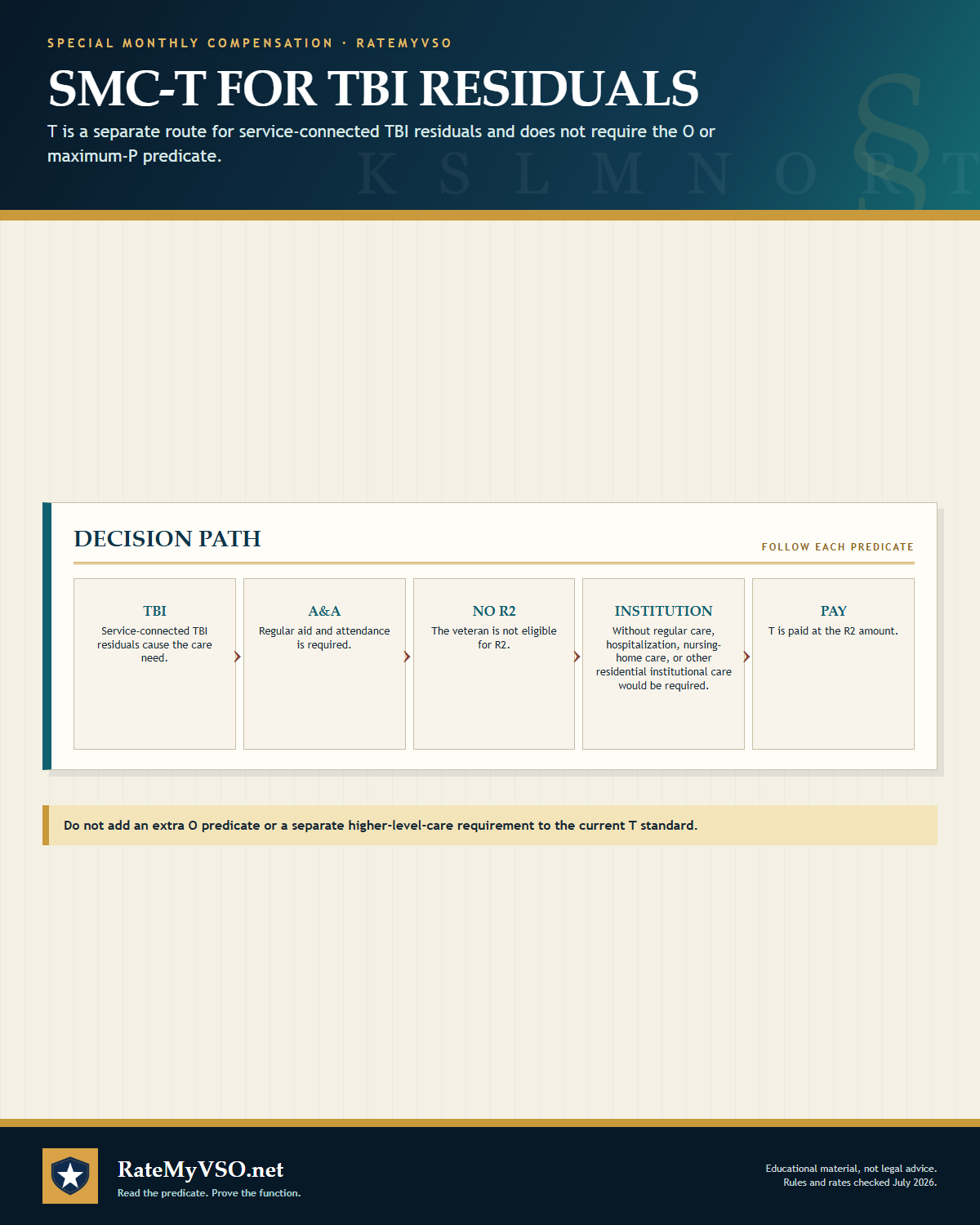
Visual guide: SMC-T for TBI Residuals
The decision path from service-connected TBI residuals to the institutional-care need.
View full size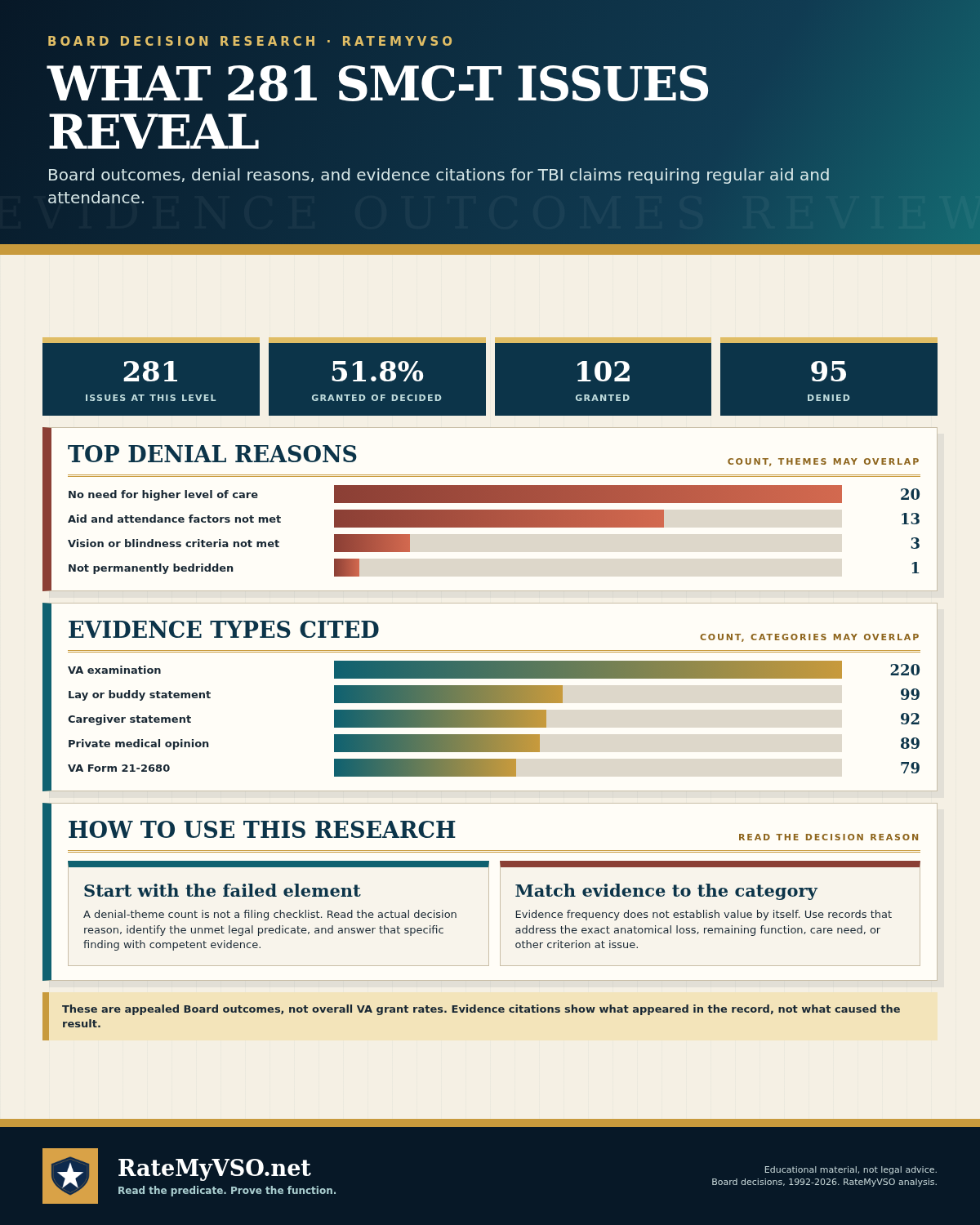
Visual guide: SMC-T Board Outcomes
The appealed record, named denial reasons and cited evidence.
View full sizeThe published Board record
What the appealed cases show.
Patterns to understand, not odds for your own claim.

The live Board outcome figures for SMC-T appear here when they are available. They are also published on SMC Appeals Data, linked in the related guides below.
This page is educational and is not legal advice. SMC-T claims involve complex TBI clinical evidence, work with a VA-accredited representative.