Court precedent research
CAVC Precedent Search
Search 2,970 precedent-setting decisions of the U.S. Court of Appeals for Veterans Claims (1989 to present). For each case: what it changed, how often the Board relies on it, the regulations it touches, and the Board decision it reviewed. This is research on published court opinions, not legal advice.

A free account is required to search our CAVC precedent database, and here's why.
This is not a personal information grab. Court of Appeals for Veterans Claims decisions are public, and searching all 2,970 of them stays free forever. We ask for a free account for one reason: a login lets us stop automated bots from scraping and overloading the search index, so it stays fast and free for veterans. An account ties each search to a person, not to endless anonymous bots scraping data and slowing the site down.
- Use Google, Apple, or an email and password. With Google or Apple, we only get your name and email, never a password.
- We never sell, rent, or share your data with anyone.
- We do not track you across other websites.
- Your searches stay private to your account.
- You can delete your account and all of your data at any time.
Landmark precedents
The decisions the Board relies on most. Each rule below binds the VA in every claim.
Recent precedent-setting decisions
The newest rules from the court. Too new to be widely cited yet, but they are current law.
What the CAVC is, and how it differs from the Board
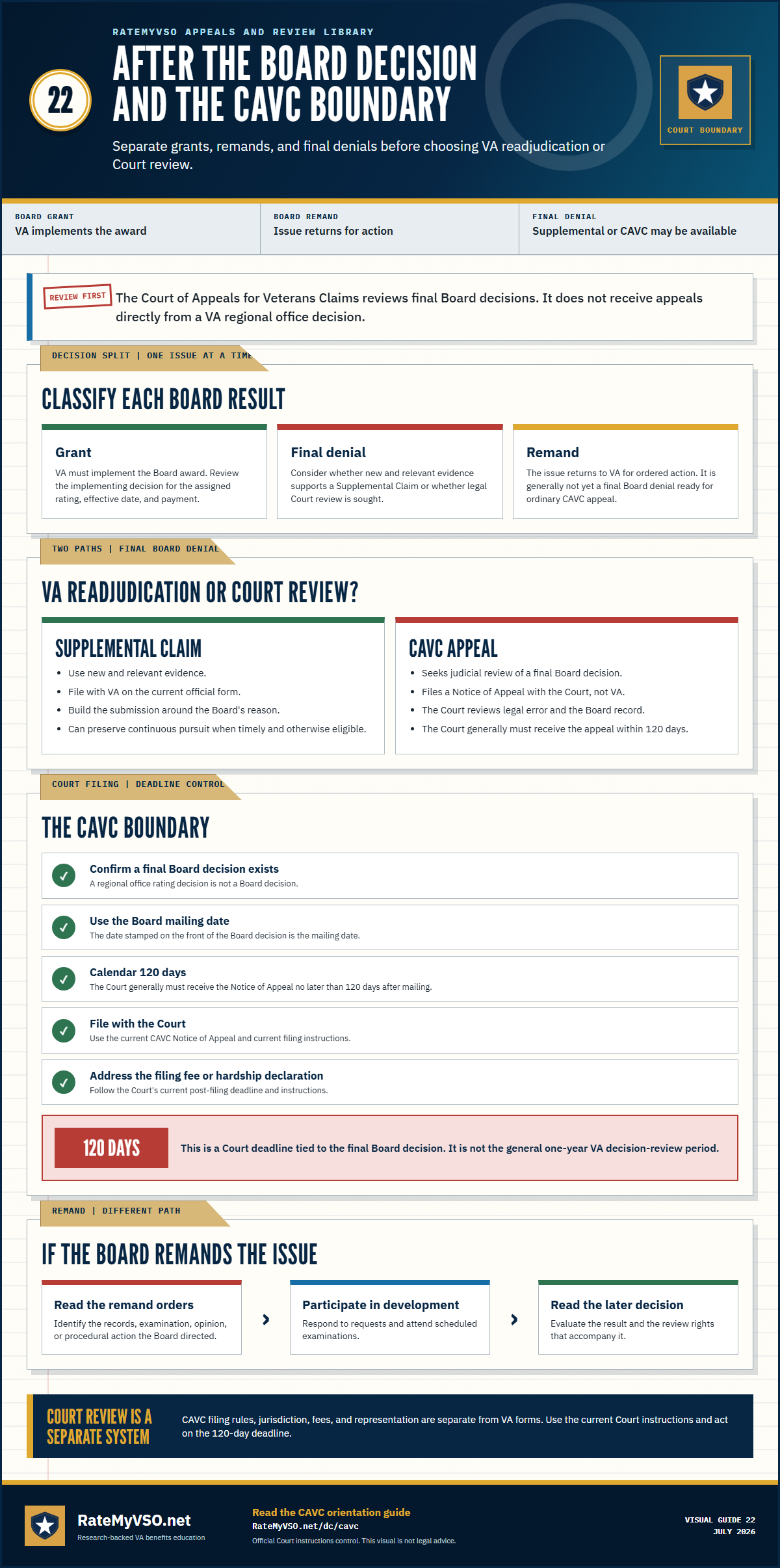
The Court of Appeals for Veterans Claims (CAVC) is an independent federal court. It is not part of the VA. Congress created it in 1988 so veterans could challenge the VA in a real court. It reviews decisions of the Board of Veterans' Appeals (BVA) for legal error.
- The Board is inside the VA. It is the last step of the VA's own appeal process. A Veterans Law Judge re-decides your claim.
- The CAVC is outside the VA. It is a court. It does not re-decide your claim. It checks whether the Board followed the law, and can affirm the decision, reverse it, or send it back to the Board (a remand).
How a case reaches the CAVC
When the CAVC sets a rule, the Board and the VA must follow it in every future case. That is why one CAVC decision, like Gilbert's benefit-of-the-doubt rule, shows up in hundreds of thousands of later Board decisions.
How you appeal a Board decision to the CAVC
- Watch the deadline. You have 120 days from the date the Board mailed its decision. Miss it and you usually lose the right to appeal (38 U.S.C. § 7266).
- File a Notice of Appeal with the Court, not the VA. It can be the Court's Notice of Appeal form or a simple letter that says you are appealing the Board's decision, with your name, the Board decision date, and your VA file number. Send it to the Clerk of the Court any of these ways:
- Mail: U.S. Court of Appeals for Veterans Claims, 625 Indiana Avenue NW, Suite 900, Washington, DC 20004-2950
- Fax: (202) 501-5848
- Email (if you represent yourself): [email protected]
- Online: the Court's electronic filing system
- Pay the $50 filing fee through Pay.gov after you receive a case number, or file a Declaration of Financial Hardship to ask the Court to waive it. You have 14 days after your appeal to do one or the other (not both).
- The case is briefed. The VA's lawyers (its Office of General Counsel) assemble the record. You or your attorney lay out the legal errors the Board made. Many cases end in a Joint Motion for Remand, where both sides agree to send the case back to the Board to fix the problem.
- The Court decides. It can affirm the Board, reverse it, or remand. A remand sends your case back to the Board to be re-decided correctly.
You can represent yourself, but most veterans use a VA-accredited attorney at this stage. If you win, the Equal Access to Justice Act (EAJA) often makes the VA pay your attorney's fees, so many attorneys take CAVC appeals with no money up front. Find a VA-accredited attorney, or read the Court's official How to Appeal page for the current steps.
Disclaimer: This tool reports published CAVC decisions for research. It is not legal advice and does not predict the outcome of any appeal. CAVC decisions are precedent; single-judge memorandum decisions (not included here) are not. For your own appeal, work with a VA-accredited representative or a VA-accredited attorney.