Which VA Appeal Should You File?
Everything you need in one place to understand the VA claim appeals process and pick the right lane. A VA denial is not the end: you have three review lanes, a Supplemental Claim, a Higher-Level Review, and a Board appeal before a Veterans Law Judge. Each one fits a different problem, and you can switch lanes after each decision.
This page helps you decode your decision, see what each lane does, and work out when to stay in the lower lanes versus when to take your case to the Board.

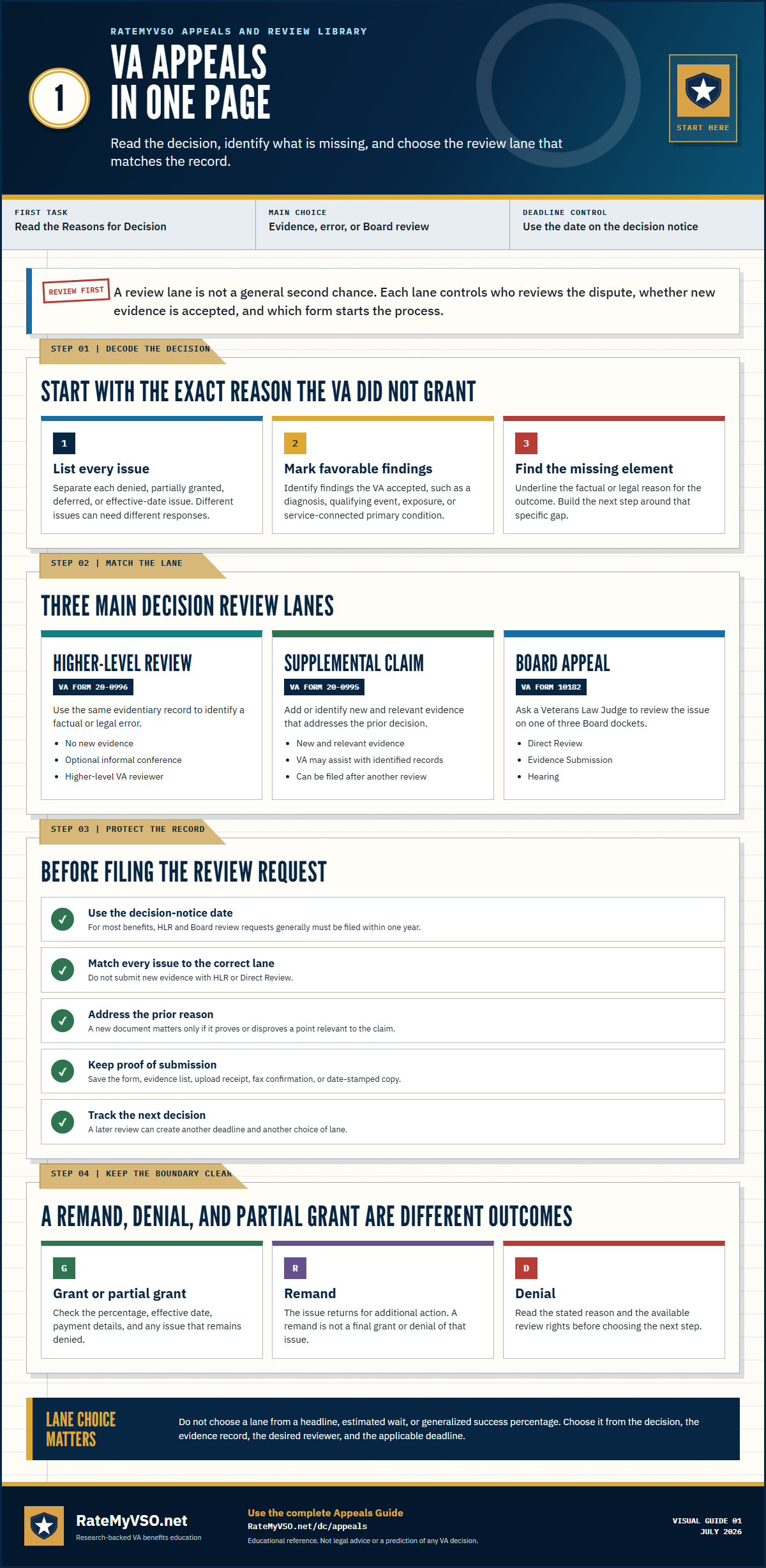 One-page guide: VA Appeals in One Page
One-page VA appeals guide showing how to read a decision, compare HLR, Supplemental Claim, and Board review, preserve deadlines, and distinguish grants, remands, and denials. Opens the full-size chart, free to save or print.
One-page guide: VA Appeals in One Page
One-page VA appeals guide showing how to read a decision, compare HLR, Supplemental Claim, and Board review, preserve deadlines, and distinguish grants, remands, and denials. Opens the full-size chart, free to save or print.
Choosing a Lane: When is the Board the Next Step
You can switch lanes after each decision. The question most veterans wrestle with is when to stop refiling in the lower lanes and take the case to a Veterans Law Judge. Here is what the rules actually say.
Points toward the Board
- No new evidence left: a Supplemental requires new and relevant evidence. With nothing new, refiling repeats the result.
- HLR already used on the same record: a second look at the same file belongs with a judge.
- The error is legal, not evidentiary: rating-criteria reading, effective dates, secondary or aggravation theory.
- You want a hearing: only the Board offers testimony before a judge.
- Repeated same-evidence denials: diminishing returns below the Board.
Points toward staying in HLR or Supplemental
- You have new evidence: a new diagnosis, a private nexus letter, or found records. The Supplemental lane is built for it, and is the only lane where VA keeps its duty to assist.
- A clear VA mistake or duty-to-assist error: Higher-Level Review can flag an error on the existing record without submitting new evidence or waiting for a hearing docket.
- The fix does not need a hearing: HLR and Supplemental Claim decisions do not involve a hearing. If your issue is a straightforward record error or a piece of new evidence, a non-hearing lane skips that added step.
One nuance about Board hearings: under the current system the Veterans Law Judge who holds your hearing is not always the one who decides the case. A different judge may issue the decision from the written transcript (Frantzis v. McDonough, affirmed by the Federal Circuit in 2024). See Choosing a Board Docket and the Board Hearing Guide.
Keep your effective date. File your next step within one year of the decision you are challenging, in any lane (38 CFR 3.2500). Every cycle adds another review, so the trade-off is another cycle below versus a judge's authority at the Board.
Walk through your situation
This explains how the lanes apply to common situations. It is general education, not legal advice or a recommendation about your claim.
Before You Appeal: Decode Your Decision
The right lane depends on why VA decided the way it did. Use these to read your decision and understand your options.
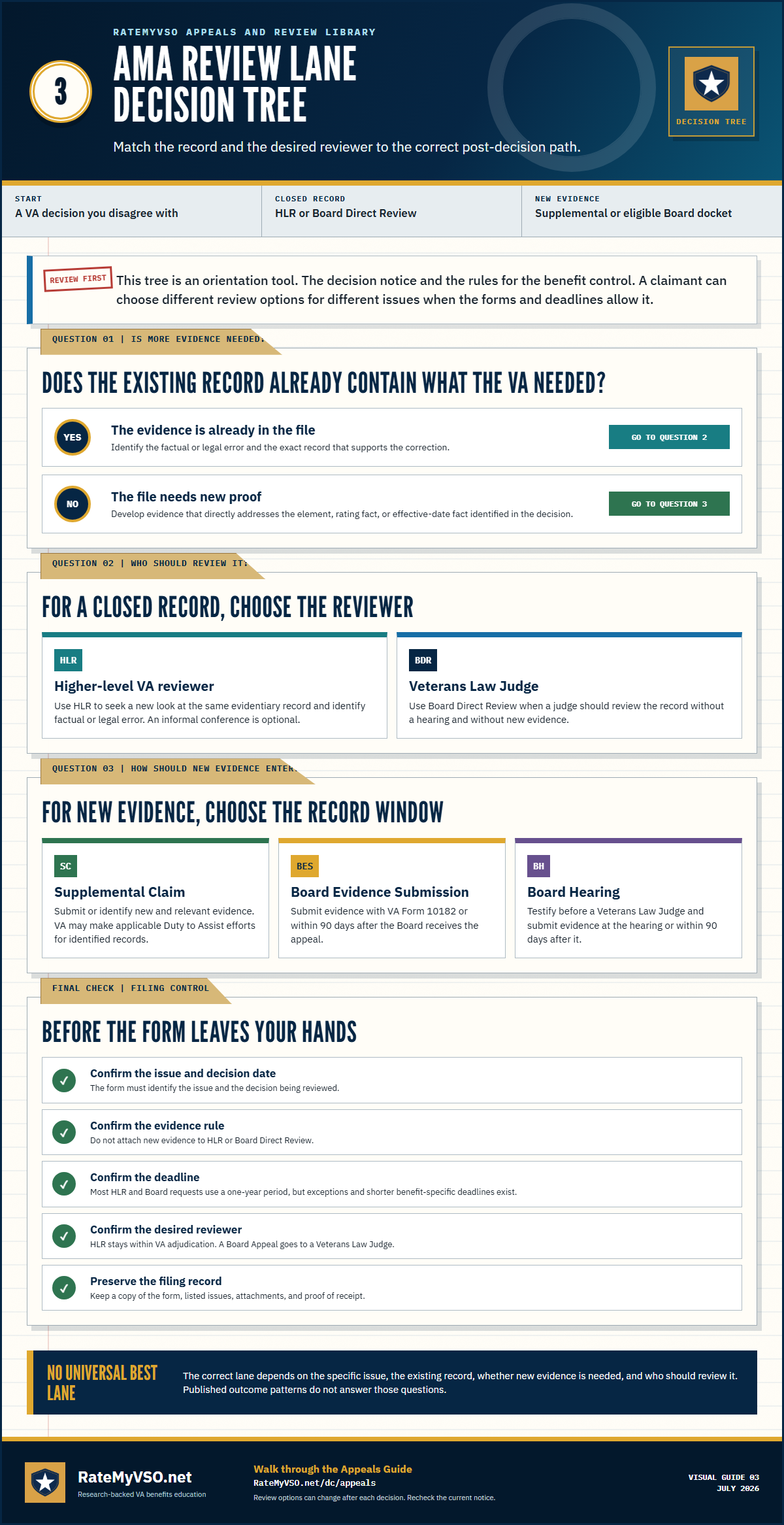
Appeal Lanes and Steps
Higher-Level Review
A senior reviewer takes a fresh look at the same evidence. No new evidence allowed.HLR Informal Conference
The optional phone call where you point the HLR reviewer to the error.Supplemental Claim
Reopen the claim with new and relevant evidence.How to File a Board (BVA) Appeal
VA Form 10182, the three dockets, the 1-year deadline, and where to submit.Board Hearing Guide
What a hearing before a Veterans Law Judge is like and how to prepare.Choosing a Board Docket
What VA data show about outcomes and wait times across the three dockets, and the case law behind the hearing shift.Clear and Unmistakable Error (CUE)
The narrow path to revise a final decision and recover back pay.Earlier Effective Date
Fighting for an earlier effective date and more retroactive pay.SMC Appeals
Appealing a denied or under-paid Special Monthly Compensation level.Withdraw a Claim or Appeal
How and when to pull back a claim or appeal.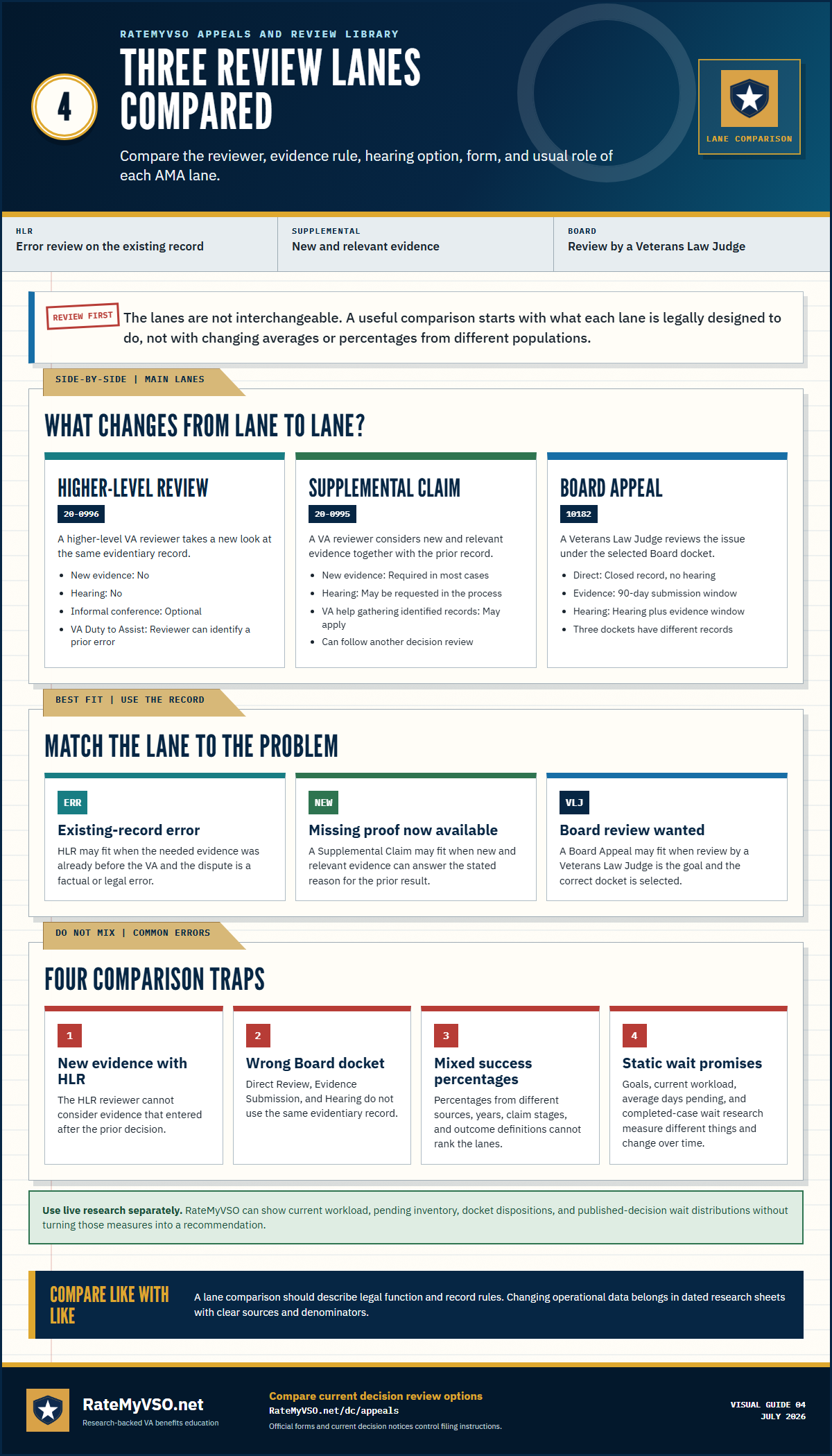
Board Data and Research
BVA Decision Search
Search 1.9M published Board decisions by condition, judge, or citation.What Wins at the Board
Evidence patterns and grant rates pulled from published decisions.BVA Overview
The big picture: how the Board decides and how often it grants.Judge Analytics
Per-judge grant, denial, and remand rates.Board Wait Times
Current docket wait times at the Board.VA Appeals Pulse
Live wait times and 12-month trends across all three lanes.Trending Denials
What the VA is denying most right now, by code and reason.Top Appealed Conditions
The most-appealed conditions at the Board.CAVC Precedent Search
Precedent-setting Court decisions, the case law the Board must follow.Negative Evidence
How the Board weighs evidence that cuts against your claim.How to Use BVA Decision Search
A walkthrough of the search tool's fields, filters, and chart builder.The VA Says BVA Appeals Are Faster, But Are They?
The VA reports faster BVA appeals, but hearing waits and open-case figures tell a more complicated story.Claim Quest: Quick Check
Five questions based only on this guide.
This checks what you understood from this guide. It is not a claim-readiness score, a prediction, an official test, or a record on your account.