VA Cancer Claims
Everything you need in one place to file and rate a VA cancer claim. Cancer claims move through three stages: getting the cancer service-connected (often through a presumptive exposure pathway), the 100% rating the VA assigns while you are in active treatment, and the residual conditions that may remain after the cancer is in remission. This hub walks each stage, the toxic-exposure pathways that link a cancer to service, how treatment and residuals are rated, the Special Monthly Compensation a cancer can trigger, and the diagnostic codes behind each claim.

Start here: understand cancer claims

VA Cancer Claims Guide
The full walkthrough: service connection, active treatment, residuals, and pitfalls.
Cancer Visual Guides
24 printable one-page charts covering the whole cancer claim, free to save or print.
Cancer Residuals Network
By cancer type, the residual conditions veterans claimed after treatment and how often the Board granted them. Search a cancer by name.Get it service-connected: presumptive exposure pathways

PACT Act
The presumptive cancers and conditions added for burn pits and other toxic exposures.
Agent Orange
Herbicide-presumptive cancers for Vietnam, Korea DMZ, and other locations.
Burn Pits
Post-9/11 airborne-hazard exposure and the cancers presumed connected.
Camp Lejeune
Contaminated water (1953-1987) and the presumptive cancers tied to it.
Ionizing Radiation
Radiation-risk activities and the radiogenic cancers VA recognizes.
Gulf War
Southwest Asia service and the exposure claims that flow from it.Exposure appeals and Board data
After treatment and higher pay
SMC-K (Loss of Use)
When cancer surgery removes an organ, SMC-K adds compensation on top of the rating.Special Monthly Compensation
The full SMC ladder for severe loss, aid and attendance, and housebound status.TDIU
If cancer or its residuals keep you from working, the 100% unemployability path.Scars and Surgical Residuals
Surgical scars from cancer treatment are ratable residuals under 38 CFR 4.118.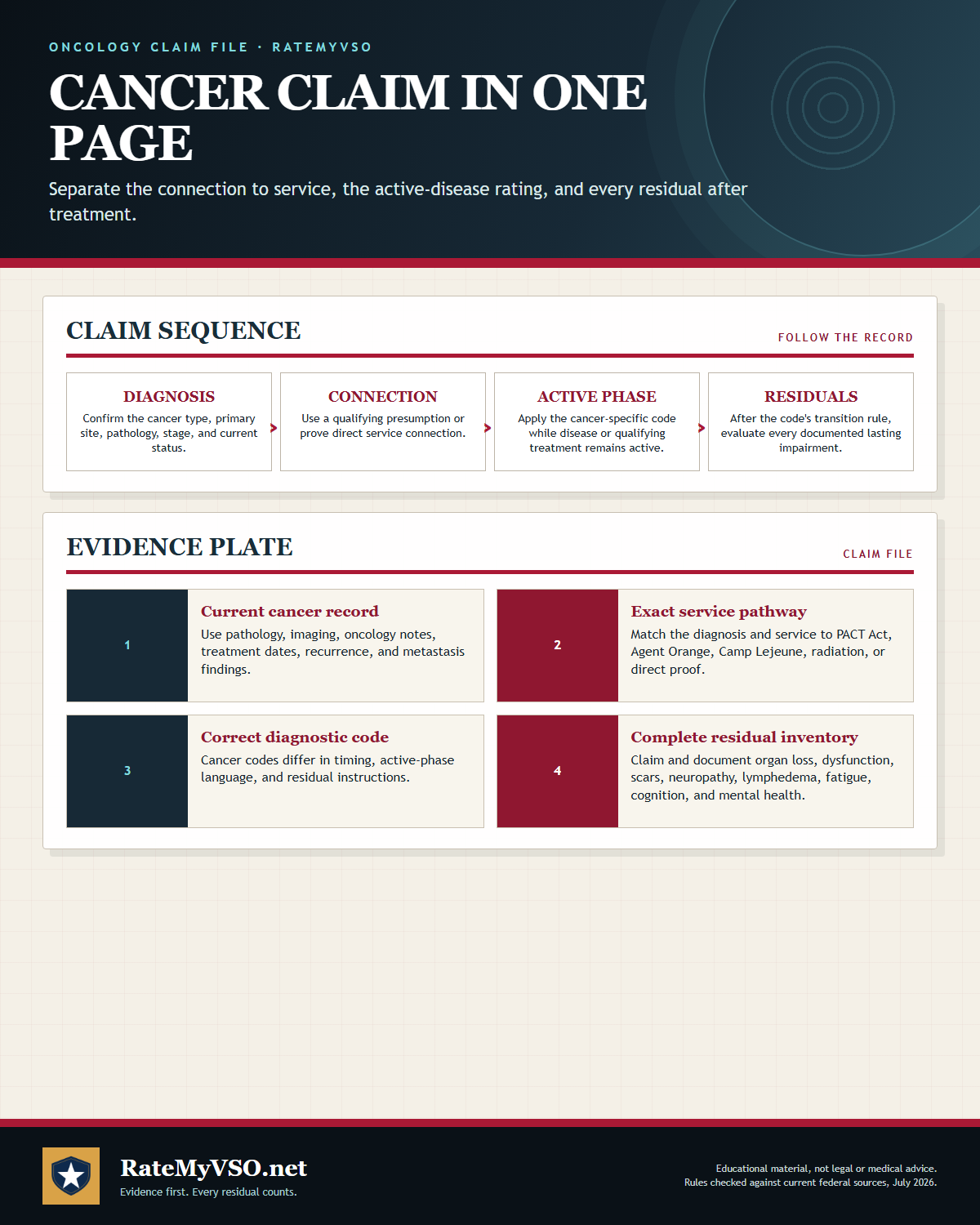 One-page guide: Cancer Claim in One Page
Five-part visual guide to cancer claims covering exact diagnosis, presumptive and direct service connection, active treatment, mandatory review, residual ratings, and a filing checklist. Opens the full-size chart, free to save or print.
One-page guide: Cancer Claim in One Page
Five-part visual guide to cancer claims covering exact diagnosis, presumptive and direct service connection, active treatment, mandatory review, residual ratings, and a filing checklist. Opens the full-size chart, free to save or print.
How the VA Rates Cancer
An active, service-connected cancer undergoing treatment is rated 100%. That 100% rating continues through treatment and for a period after it ends, then the VA schedules a re-examination. Six months after treatment stops is the usual trigger, but the window is written into each diagnostic code and several are different: non-Hodgkin's lymphoma (DC 7715) runs two years, and multiple myeloma (DC 7712) runs five years from the diagnosis of symptomatic disease rather than from the end of treatment. Hodgkin's lymphoma (DC 7709) uses the ordinary six months despite the NHL exception. Check the note under your own code.
At that exam, the rating depends on what is left:
- In remission with no measurable residuals. The rating may drop, sometimes to 0%.
- In remission with residual effects. Each residual condition, the lasting damage from the cancer or its treatment, gets its own rating under its own diagnostic code. A removed organ, a surgical scar that limits motion, nerve damage, chronic fatigue, or incontinence are all ratable when documented and linked to the service-connected cancer.
The residual stage is where the most consequential decisions are made. Residuals are only counted if they are documented, and the C&P examiner evaluates what they are asked to evaluate. The Cancer Residuals Network shows, by cancer type, which residuals veterans actually claimed and how the Board ruled.
Browse cancer diagnostic codes
Each code page shows the rating criteria, the active-treatment and residual framework, C&P exam tips, and Board appeal data.
Show all cancer diagnostic codes
This hub is for educational purposes only and is not medical or legal advice. Rating and presumptive rules come from 38 CFR and the PACT Act. For help with your claim, find a VSO representative near you.