The PACT Act of 2022 added more than 20 presumptive conditions and new qualifying service for burn pits, Agent Orange, and more, so many veterans no longer have to prove how an exposure caused their condition. Start with the PACT Act and a presumptive check, then dig into each exposure type and how to file.
Start here
Ask our AI Chat about your exposures
Describe where and when you served and what you were exposed to, more detail is better than a short question. The answer links to pages on this site that can help you do further research on possible exposures and quotes them.
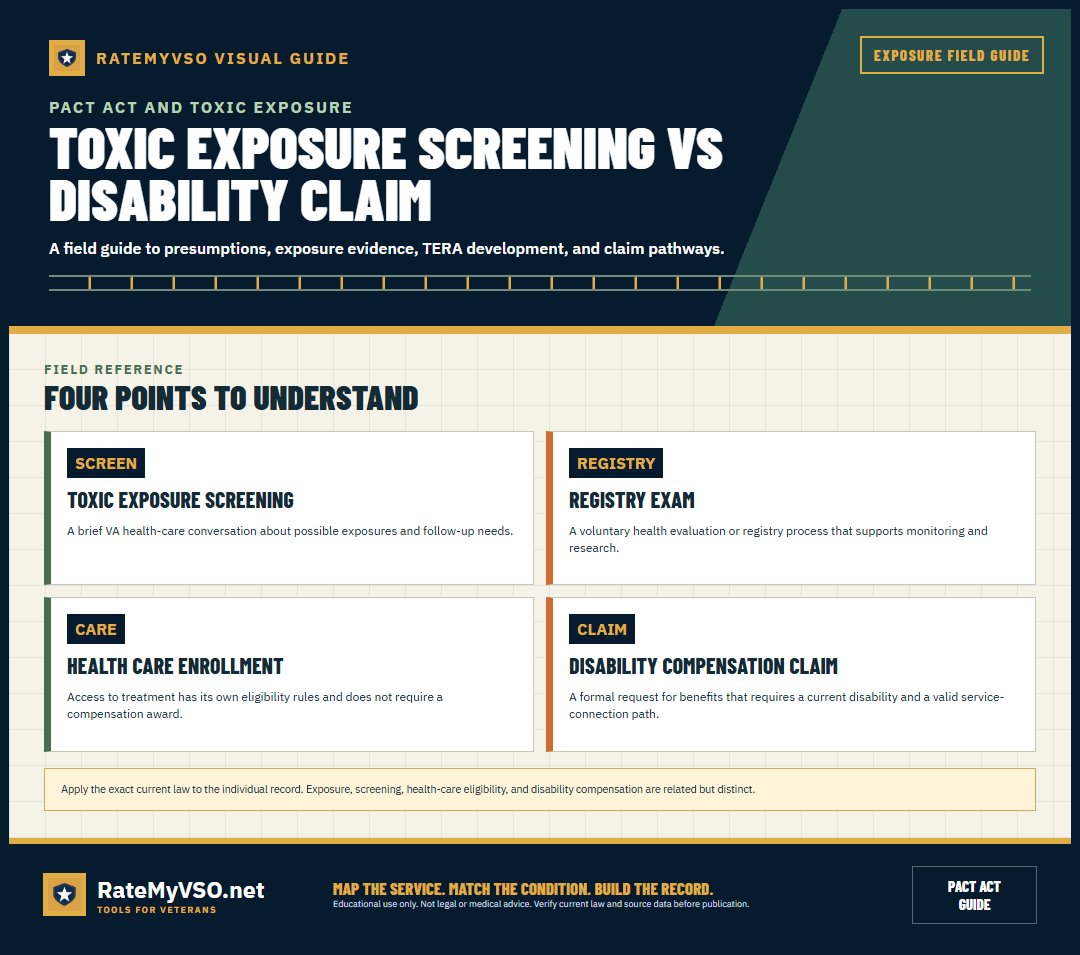
A health registry evaluation is not a claim. Certain veterans can join a VA health registry (ionizing radiation, Agent Orange, Gulf War/OEF/OIF/OND depleted uranium, and the Airborne Hazards and Open Burn Pit Registry) and get a free environmental health evaluation and related information. To join, contact the environmental health coordinator at your nearest VA health care facility (find one here) or call 1-800-MyVA411 (1-800-698-2411). VA says a registry evaluation is not a disability compensation exam, does not start a claim for compensation, and is not required for any VA benefit. Compensation needs its own disability claim. Source: VA, Federal Benefits for Veterans, Dependents, Survivors, and Caregivers, 2026 edition (Pamphlet 80-26-1).
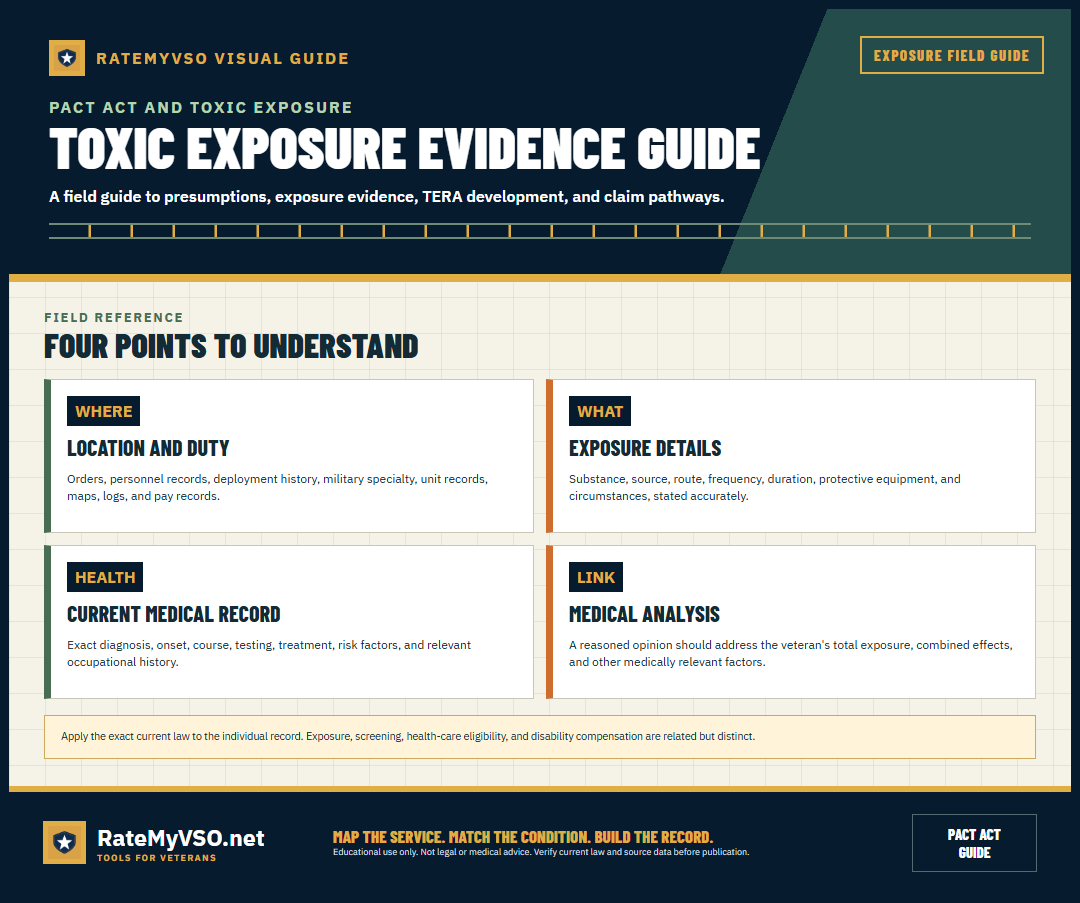
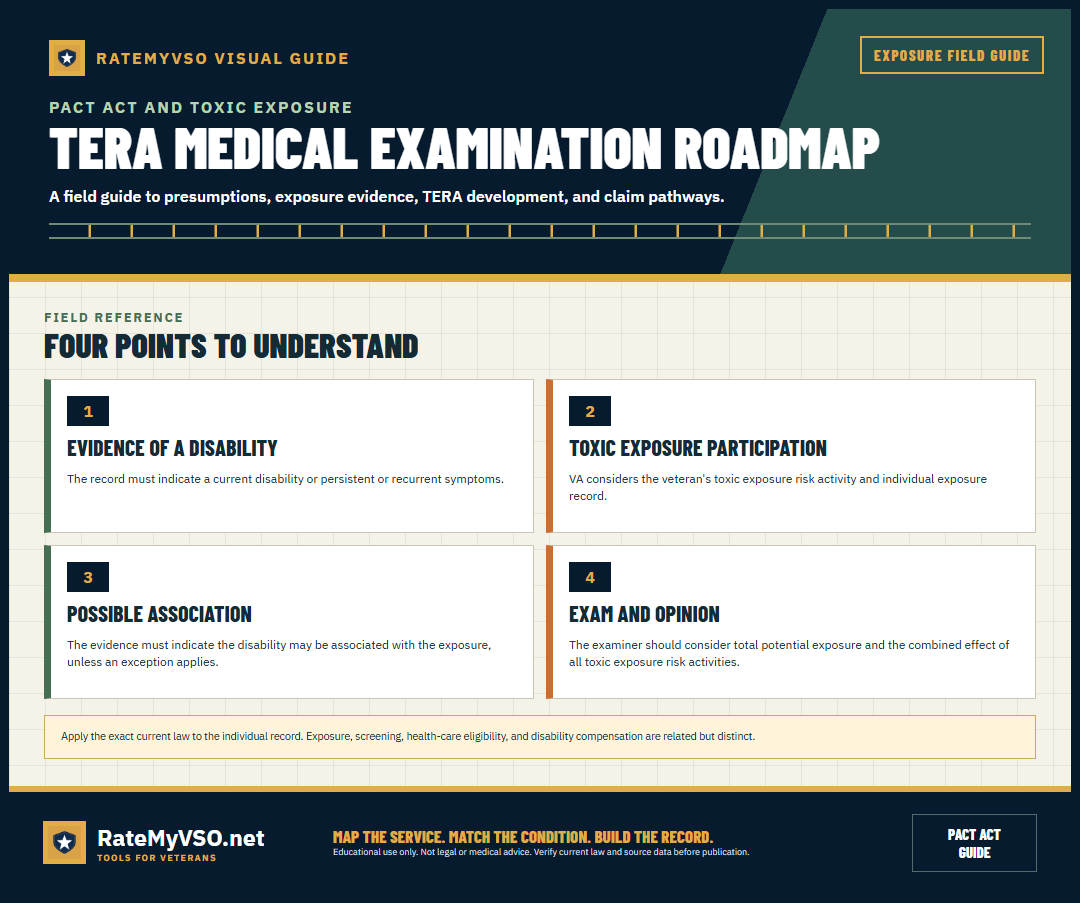
Presumptive does not mean automatic. Even when your condition is on a presumptive list, you still need a current diagnosis and proof of qualifying service. The presumption removes the burden of proving how the exposure caused the condition, not the need to file a claim and show the diagnosis.
This hub is for educational purposes only and is not legal advice. For official guidance on the PACT Act and presumptive conditions see VA.gov. For help with your claim, find a VSO representative near you.
Common Questions
What is a presumptive condition under the PACT Act?
A presumptive condition is one that VA presumes was caused by qualifying military service, such as exposure to burn pits, Agent Orange, or contaminated water. If you served in a covered time and place and have a listed condition, VA accepts the service connection without requiring you to prove how the exposure caused it. The PACT Act of 2022 expanded the list of presumptive conditions and the qualifying locations for toxic exposure.
Do you need a nexus letter for a presumptive condition?
Generally no. For a presumptive condition, VA already presumes the link between your service and the condition, so a private nexus letter establishing causation is usually not required. You still need a current diagnosis and proof of qualifying service. A nexus letter is mainly used for direct-service-connection claims where the link is not presumed.