Types of VA Disability Claims and When to File Each
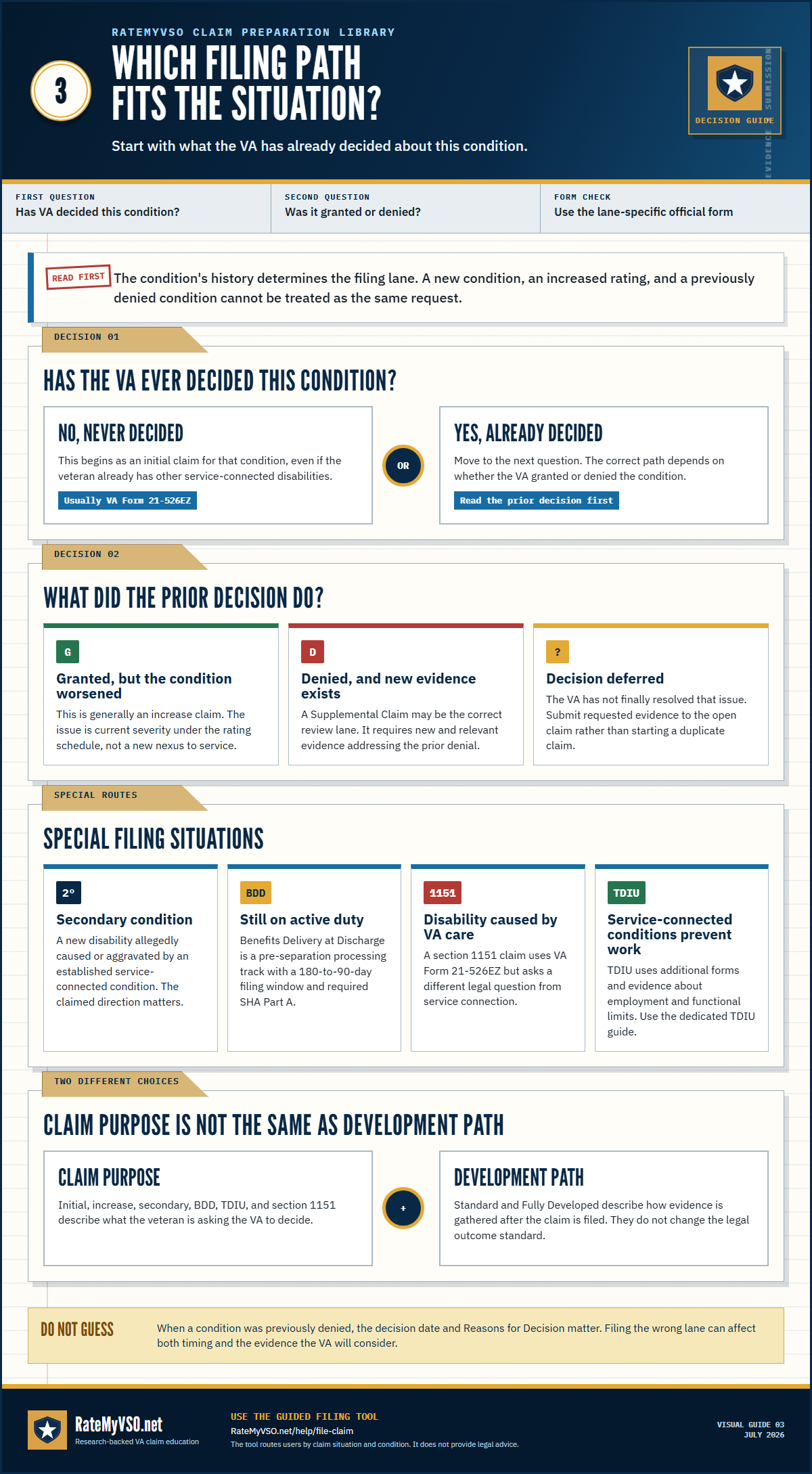
"VA disability claim" is not one thing. The VA uses at least nine different claim categories, each with its own paperwork path, evidence rules, and timing implications. Knowing which type you are filing changes what evidence you need to gather, what protections you have, and what risks you take on.

Initial Claim First filing
A veteran's first application for service connection for a specific condition. Every new condition starts as an Initial Claim, regardless of how many other claims the veteran has filed in the past. The VA's regulations call this an "original claim" (38 CFR 3.160(b)); VA.gov and the processing systems usually call it an initial claim. Same filing, two labels.
Initial claims are labeled in VA systems as "Initial Compensation" claims. The internal label has no effect on outcome. Only the underlying evidence does.
Full guide: How a VA Initial Claim Works.
Fully Developed Claim (FDC) Veteran-submitted evidence
Filed when the veteran has gathered all available evidence and certifies that nothing else is expected. The VA does not request additional records from outside sources, which can shorten processing time compared to a Standard Claim.
Full guide: How the Fully Developed Claim Program Works.
Standard Claim VA gathers evidence
The default claim path when the veteran does not submit all evidence with the application. The VA invokes its Duty to Assist and requests records on the veteran's behalf, including the DD-214, service treatment records, military personnel records, and any private medical records the veteran identifies.
Most claims convert from FDC to Standard along the way if new evidence is submitted, if a related appeal opens, or if the VA must request records from a third party. The conversion does not by itself harm the claim, but it lengthens the timeline.
Full guide: How a VA Standard Claim Works.
Increase Claim Existing condition worsened
Filed when a condition that is already service-connected has gotten worse and the veteran believes it now meets a higher rating tier in 38 CFR Part 4. There is no minimum waiting period between increase claims, but practical timing matters.
Strategy walkthrough: Filing a VA Rating Increase, before you file, read this.
Secondary Claim Caused by service-connected condition
A claim that a service-connected condition (the "primary") has caused or aggravated a new condition (the "secondary"). Common examples: sleep apnea secondary to PTSD, depression secondary to chronic pain, erectile dysfunction secondary to PTSD or to a medication for a service-connected condition.
Filing a secondary claim invites the VA to look at the primary condition again. If the primary has improved, the rater can propose a reduction on the primary while granting the secondary. This is not common with stabilized ratings, but it happens.
Full guide: How a VA Secondary Claim Works.
Supplemental Claim Appeals Modernization lane
Technically not a "new claim" at all. The Supplemental Claim is one of the three appeal lanes created by the Veterans Appeals Improvement and Modernization Act of 2017 (in force February 19, 2019). It is the appropriate path when a veteran has new and relevant evidence the VA has not yet seen.
The full appeals process is covered separately. See the appeals guide for the difference between Supplemental Claim, Higher-Level Review, and Board appeal.
Deferred Claim Decision postponed
Not a separate claim type so much as a status. A claim is "deferred" when the rater decides some conditions but holds others open pending additional development: a missing C&P exam result, federal records still being retrieved, an examiner clarification, or rater consultation on a complex issue.
Inferred Claim Added by VA without express filing
Conditions a rater adds to the claim without the veteran filing for them. The VA is permitted to infer claims in a narrow set of circumstances, and is required to do so in some.
The three established pathways:
- Veteran statement received with the claim. A condition described in the veteran's personal statement, even if not on the form, can be inferred into the claim if it was received on or about the same day.
- Within the scope of the claimed condition. When a claimed condition (e.g. "knee pain") evolves on diagnosis into multiple ratable conditions (e.g. patellofemoral pain syndrome plus separately ratable instability under DC 5257), the additional ratings can be inferred.
- Ancillary benefits. Special Monthly Compensation (SMC), Total Disability Individual Unemployability (TDIU), and similar ancillary determinations are required by regulation to be considered whenever the underlying ratings make them potentially payable. See the SMC guide.
1151 Claim VA-caused injury
A claim under 38 USC 1151 for compensation when a disability was caused or worsened by VA medical care, VA vocational rehabilitation, or compensated work therapy. Treated as if the condition were service-connected for benefit purposes, but evaluated under tort-style standards (carelessness, fault, or an event not reasonably foreseeable).
1151 claims have their own evidentiary standards and procedural rules. A consultation with a VSO or attorney is typically appropriate before filing.
Full guide: How a 38 USC 1151 Claim Works.
Informal Claim Historical, retired 2015
Before March 24, 2015, any written communication from a veteran showing intent to apply for benefits could count as an "informal claim" and lock in an earlier effective date. The Intent to File (ITF) system replaced informal claims on that date.
- Statements made during a C&P exam never qualified as informal claims even under the old rules.
- For any claim filed on or after March 24, 2015, the ITF is the only mechanism to preserve an effective date.
- Old informal claims that pre-date March 24, 2015 can still be the basis for an earlier effective date argument on appeal.
Side by side: what each claim type requires
| Claim type | Who files | Evidence path | Typical risk |
|---|---|---|---|
| Initial | Veteran | 3 elements: diagnosis, in-service event, nexus | Denial without exam if any element missing |
| Fully Developed (FDC) | Veteran | All evidence submitted at filing | Reverts to Standard if any record is added later |
| Standard | Veteran (often by default) | VA gathers evidence under Duty to Assist | Longer processing |
| Increase | Veteran | Evidence of worsening, current rating schedule check | Opens file to CUE review and possible reduction |
| Secondary | Veteran | Medical opinion linking primary to secondary | VA may re-examine the primary condition |
| Supplemental | Veteran (appeals lane) | New and relevant evidence | Effective-date loss if filed after the one-year window |
| Deferred | VA (status, not action) | Pending records or exam | Lengthens timeline; no signal on likely outcome |
| Inferred | VA rater | Within one of three permitted pathways only | Outside pathways, rater cannot add; veteran must file separately |
| 1151 | Veteran | Proof of VA fault, lack of consent, or unforeseen event | Tort-style standard, often needs representation |
Frequently Asked Questions
If my Fully Developed Claim turns into a Standard Claim, did I lose something?
Not in terms of outcome. The FDC label only affected processing path and (before 2022) priority. Once the FDC priority benefit was removed, the conversion to Standard mostly lengthens timeline. Evidence already submitted stays in the file and is still considered.
What is the difference between a Supplemental Claim and a new Initial Claim?
A Supplemental Claim is an appeal of a prior decision and requires new and relevant evidence. A new Initial Claim is for a condition the VA has not previously decided. For a previously denied condition, the correct path is generally a Supplemental Claim or another appeal lane, not a new Initial Claim. See the appeals guide.
Can I file a Secondary Claim if my primary condition is only rated at 0%?
Yes. A 0% rating still means service-connected, and a secondary condition can be granted on the strength of the 0% primary. The rating for the secondary is independent of the primary's rating.
My decision letter says one of my conditions is "deferred." Is that good or bad?
Neither. Deferred only means the VA is not ready to decide that condition yet because something is missing (an exam, a record, an addendum, or a rater consultation). The eventual rating can be a grant, a denial, or anything in between.
The C&P examiner suggested another diagnosis I never claimed. Will the VA rate it?
Usually no, unless it falls within the three inferred-claim pathways: a statement received the same day as your claim, a condition within the scope of one you claimed, or an ancillary benefit (SMC, TDIU). If it does not fit one of those pathways, you generally need to file a separate Initial Claim or amend the existing one before a decision is issued.
Are 1151 claims the same as a lawsuit against the VA?
No. A 1151 claim is a VA administrative compensation claim under 38 USC 1151 and is decided by VA raters. A lawsuit against the VA for medical malpractice is a separate process under the Federal Tort Claims Act (FTCA) and is decided in federal court. The two can sometimes both apply to the same underlying injury, but they are different proceedings with different standards and different remedies.
Can I still file an Informal Claim?
No, not since March 24, 2015. Use the Intent to File (ITF) system instead. Informal claims that pre-date that cutoff can still be argued on appeal for an earlier effective date.
Related Tools and Guides
RateMyVSO. Educational resource. Not affiliated with the U.S. Department of Veterans Affairs. Not legal advice. All RateMyVSO tools are free. Find a VSO representative for personalized guidance.