C&P Exam Prep Guide for Chronic fatigue syndrome (DC 6354)
YOUR EXAM BLUEPRINT
Chronic fatigue syndrome
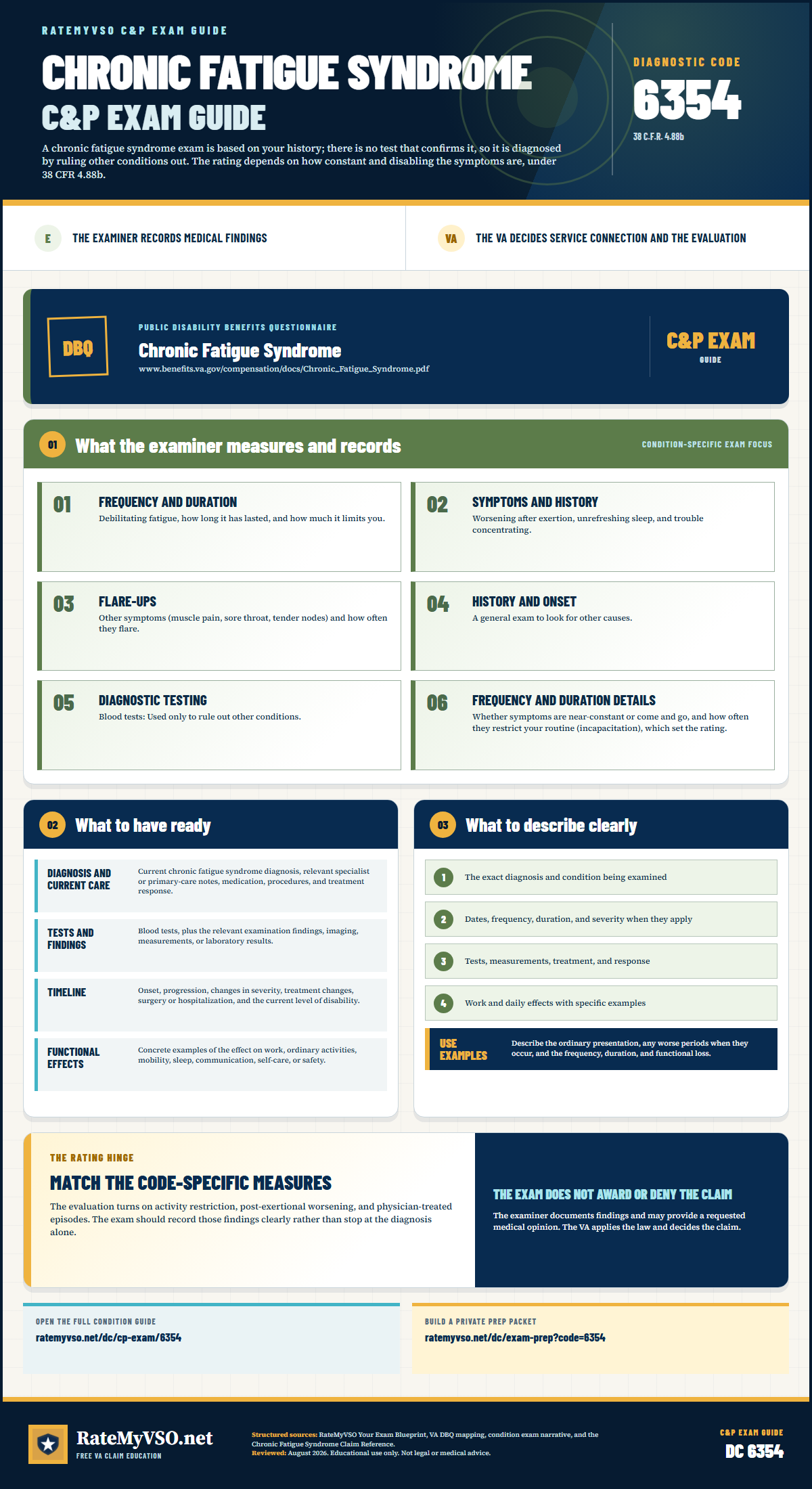
A chronic fatigue syndrome exam is based on your history; there is no test that confirms it, so it is diagnosed by ruling other conditions out. The rating depends on how constant and disabling the symptoms are, under 38 CFR 4.88b.
DBQ used for this condition
- PPublic formDBQ RHEUM Chronic Fatigue SyndromeOpen the public DBQ
What the examination is likely to focus on
Functional-impact topics to describe
- Whether symptoms are near-constant or come and go, and how often they restrict your routine (incapacitation), which set the rating.
- Findings map to the tiers in 38 CFR 4.88b (chronic fatigue syndrome DC 6354).
Which form the examiner uses
For chronic fatigue syndrome (DC 6354), the C&P examiner completes the following Disability Benefits Questionnaire (DBQ):
- DBQ RHEUM Chronic Fatigue Syndrome (public PDF on VA.gov)
DBQs are Department of Veterans Affairs Form 21-0960 series documents. Public DBQs are hosted on benefits.va.gov. A handful are examiner-only and are not posted publicly.
What to expect at your C&P exam
A chronic fatigue syndrome exam is based on your history; there is no test that confirms it, so it is diagnosed by ruling other conditions out. The rating depends on how constant and disabling the symptoms are, under 38 CFR 4.88b.
1Initial interview (history)
- Debilitating fatigue, how long it has lasted, and how much it limits you.
- Worsening after exertion, unrefreshing sleep, and trouble concentrating.
- Other symptoms (muscle pain, sore throat, tender nodes) and how often they flare.
- Effect on daily activities and work.
2Physical examination
- A general exam to look for other causes.
3Diagnostic tests the examiner may rely on
There is no test that confirms CFS. Tests are used only to rule out other conditions.
4Functional assessment
- Whether symptoms are near-constant or come and go, and how often they restrict your routine (incapacitation), which set the rating.
- Findings map to the tiers in 38 CFR 4.88b (chronic fatigue syndrome DC 6354).
Test explainers open MedlinePlus (NIH National Library of Medicine), or Wikipedia where MedlinePlus has no matching page. This describes what happens and what is measured, not how to influence a result.
What the examiner records (full DBQ form)
The fields below are reproduced from the DBQ form the examiner completes for this diagnostic code. This is the structural map of the form, showing what the examiner is asked to measure, observe, and record. It is a factual reproduction of the public DBQ, not advice on how to answer.
This DBQ evaluates chronic fatigue syndrome (CFS) including diagnosis, symptoms, severity, functional impact, and incapacitating episodes.
How DC 6354 maps to this DBQ: for this diagnostic code specifically, the examiner typically completes sections I-VII of this form. Section III is the condition-specific section for this code.
DIAGNOSIS (Section I)
- Does the Veteran currently have chronic fatigue syndrome (CFS)?
- ICD code
- Date of diagnosis
- OTHER (specify)
- Other diagnosis #1 / ICD code / Date of diagnosis
- Other diagnosis #2 / ICD code / Date of diagnosis
- If there are additional diagnoses that pertain to chronic fatigue syndrome, list using above format
MEDICAL HISTORY (Section II)
- Describe the history (including onset and course or whether the condition is now completely resolved and no longer requires treatment of any type) of the Veteran's chronic fatigue syndrome (brief summary)
- Is continuous medication required for control of chronic fatigue syndrome?
- If 'Yes,' are the Veteran's symptoms controlled by continuous medication?
- If 'Yes,' list only those medications required for the Veteran's chronic fatigue syndrome
- Have other clinical conditions that may produce similar symptoms been excluded by history, physical examination and/or laboratory tests to the extent possible?
- If 'No,' describe
- Did the Veteran have an acute onset of chronic fatigue syndrome?
- Has the debilitating fatigue reduced daily activity level to less than 50% of pre-illness level?
- If 'Yes,' specify length of time daily activity level has been reduced to less than 50% of pre-illness level: Less than 6 months / 6 months or longer
FINDINGS, SIGNS AND SYMPTOMS (Section III)
- Does the Veteran now have or has the Veteran had any findings, signs and symptoms attributable to chronic fatigue syndrome?
- Debilitating fatigue
- Low grade fever
- Nonexudative pharyngitis
- Palpable or tender cervical or axillary lymph nodes
- Generalized muscle aches or weakness
- Fatigue lasting 24 hours or longer after exercise
- Headaches (of a type, severity or pattern that is different from headaches in the pre-morbid state)
- Migratory joint pain
- Neuropsychologic symptoms
- Sleep disturbance
- Other
- For all checked conditions, describe
- Does the Veteran now have or has the Veteran had any cognitive impairment attributable to chronic fatigue syndrome?
- Inability to concentrate
- Forgetfulness
- Confusion
- Other cognitive impairments
- For all checked conditions, describe
- Specify frequency of symptoms: Symptoms are nearly constant / Symptoms wax and wane
- If the symptoms due to chronic fatigue syndrome are nearly constant, do they restrict routine daily activities as compared to the pre-illness level?
- Symptoms restrict routine daily activities almost completely and may occasionally preclude self-care
- Symptoms restrict routine daily activities to less than 50 percent of the pre-illness level
- Symptoms restrict daily activities from 50 to 75 percent of the pre-illness level
- Symptoms restrict routine daily activities by less than 25 percent of the pre-illness level
- Other (describe)
- Do the Veteran's symptoms due to chronic fatigue syndrome result in periods of incapacitation?
- If 'Yes,' indicate total duration of periods of incapacitation: At least 6 weeks per year
- At least 4 but less than 6 weeks per year
- At least 2 but less than 4 weeks per year
- At least 1 but less than 2 weeks per year
- Less than 1 week per year
OTHER PERTINENT PHYSICAL FINDINGS, SCARS, COMPLICATIONS, CONDITIONS, SIGNS AND/OR SYMPTOMS (Section IV)
- Does the Veteran have any other pertinent physical findings, complications, conditions, signs and/or symptoms related to any of the conditions listed in the diagnosis section?
- If yes, describe (brief summary)
- Does the Veteran have any scars or other disfigurement (of the skin) related to any conditions or to the treatment of any conditions listed in the diagnosis section?
DIAGNOSTIC TESTING (Section V)
- Are there any significant diagnostic test findings and/or results?
- If 'Yes,' provide type of test or procedure, date and results - brief summary
FUNCTIONAL IMPACT (Section VI)
- Does the Veteran's chronic fatigue syndrome impact his or her ability to work?
- If 'Yes,' describe the impact of the Veteran's chronic fatigue syndrome, providing one or more examples
REMARKS (Section VII)
- 7A. Remarks (if any)
Rating Levels for DC 6354
The following tiers are reproduced from 38 CFR Part 4, the VA Schedule for Rating Disabilities. Toggle between the official VA criteria and a Plain English explanation.
Plain-English summaries are AI-generated to explain the official criteria. The official 38 CFR language is the binding legal standard. When in doubt, ask a VSO.
Evidence cited in published BVA decisions for DC 6354
The counts below are aggregated from published Board of Veterans Appeals decisions for this diagnostic code, among issues the Board granted or denied (remanded issues are not included). Each row reports how often a given evidence type was discussed in the decision text, broken down by outcome. This is a factual aggregate of the public record, not a prediction or recommendation about any specific claim.
- Service treatment records: appeared in 876 granted decisions (3275 denied; 4151 decided total)
- Buddy / lay statements: appeared in 730 granted decisions (2201 denied; 2931 decided total)
- Medical literature: appeared in 96 granted decisions (242 denied; 338 decided total)
What the Board discussed in granted decisions for DC 6354
The themes below were extracted by clustering 500 grant-factor sentences from published Board of Veterans Appeals decisions for this diagnostic code. Frequencies indicate how often each theme appeared in the sample. This is a factual aggregate of the public record, not advice or strategy for any specific claim.
- 32% Benefit of the doubt standard cited or appliedThe Board cited, described, or applied the benefit of the doubt doctrine, noting that when positive and negative evidence is in approximate balance the claimant prevails.161 of 500 sample sentences
- 22% Medical opinion found condition at least as likely as not service-relatedA VA examiner, private physician, or other clinician opined that a diagnosed condition was at least as likely as not incurred in, caused by, or related to active military service.112 of 500 sample sentences
- 14% Evidence found in equipoise supporting grant of claimThe Board found the lay and medical evidence was at least in relative equipoise on a material issue and resolved the balance in the Veteran's favor to grant the claim.72 of 500 sample sentences
- 14% Preponderance of evidence against claim; benefit of doubt inapplicableThe Board found the evidence persuasively weighed against the claim, extinguishing reasonable doubt and rendering the benefit of the doubt doctrine inapplicable.68 of 500 sample sentences
- 6% Examiner instructions requesting at-least-as-likely-as-not nexus opinionRemand or development instructions directed an examiner to opine whether a current disability was at least as likely as not related to service, a service-connected condition, or a toxic exposure risk activity.31 of 500 sample sentences
- 4% CFS diagnosis or symptomatology noted as service-connected or establishedThe Board found or noted that a diagnosis of chronic fatigue syndrome, or its qualifying symptomatology, was established and related to service or a service-connected disability.22 of 500 sample sentences
- 4% Secondary service connection nexus opinion citedA medical opinion noted that a disability was at least as likely as not caused or aggravated by an already service-connected condition, supporting secondary service connection.18 of 500 sample sentences
- 2% CFS rating level determined with benefit of doubt appliedThe Board applied the benefit of the doubt to assign or affirm a specific disability percentage rating for chronic fatigue syndrome based on the evidence of symptom severity.8 of 500 sample sentences
- 1% Standard of review for service connection claims notedThe Board articulated the general legal standard requiring VA to determine whether evidence supports a claim, is in relative equipoise, or preponderates against it.7 of 500 sample sentences
- 0% Lay evidence and credibility considered in equipoise findingThe Board weighed the Veteran's competent and credible lay statements alongside medical evidence to reach an equipoise finding on a material issue.1 of 500 sample sentences
When the Board found the exam inadequate (DC 6354)
In 2,235 published Board of Veterans' Appeals decisions involving this condition, the Board found a C&P examination or medical opinion inadequate. Where the defect could be read from the decision, it was most often one of the following (counts are a floor from the decisions on file, not a total):
- 679 Failed to address a contention or part of the condition
- 586 Conclusion given without a supporting rationale
- 381 Veteran's lay statements not considered
- 145 Opinion relied on the absence of records instead of the evidence
- 88 Claims file or records not reviewed
- 61 Flare-ups or functional loss not addressed
- 58 Examiner said an opinion would require speculation
- 20 Exam too old to reflect current severity
- 19 Wrong legal standard or question applied
An inadequate exam is usually sent back for a new one rather than decided against the veteran. This is a factual report of published decisions, not advice about any exam or claim; whether an exam is adequate is decided case by case.
Disclaimer: This page reproduces public Department of Veterans Affairs forms (DBQs) and verbatim text from 38 CFR Part 4 (the VA Schedule for Rating Disabilities). It is informational only and is not legal or medical advice. For guidance on a specific claim, contact a VA-accredited representative.