C&P Exam Prep Guide for Septum, nasal, deviation of (DC 6502)
YOUR EXAM BLUEPRINT
Septum, nasal, deviation of
A nose and sinus exam is a brief physical exam plus questions about how often you have symptoms or sinus infections. The rating depends on blockage and the number of infections per year, under 38 CFR 4.97.
DBQ used for this condition
- PPublic formDBQ ENT Sinusitis, Rhinitis and Other Conditions of the Nose, Throat, Larynx and PharynxOpen the public DBQ
What the examination is likely to focus on
Functional-impact topics to describe
- For rhinitis, how much the nasal passages are blocked and whether there are polyps.
- For sinusitis, the number of incapacitating and non-incapacitating infections per year, which sets the rating.
- Findings map to the tiers in 38 CFR 4.97 (allergic rhinitis DC 6522; chronic sinusitis DC 6513).
Which form the examiner uses
For septum, nasal, deviation of (DC 6502), the C&P examiner completes the following Disability Benefits Questionnaire (DBQ):
- DBQ ENT Sinusitis, Rhinitis and Other Conditions of the Nose, Throat, Larynx and Pharynx (public PDF on VA.gov)
DBQs are Department of Veterans Affairs Form 21-0960 series documents. Public DBQs are hosted on benefits.va.gov. A handful are examiner-only and are not posted publicly.
What to expect at your C&P exam
A nose and sinus exam is a brief physical exam plus questions about how often you have symptoms or sinus infections. The rating depends on blockage and the number of infections per year, under 38 CFR 4.97.
1Initial interview (history)
- Nasal congestion, runny nose, sneezing, post-nasal drip, or loss of smell.
- For sinusitis: how many sinus infections per year, how long they last, and whether they need antibiotics.
- Headaches and facial pain or pressure.
- Treatments (sprays, antibiotics, surgery) and effect on daily life.
2Physical examination
- Looking inside the nose for blockage, swelling, and polyps.
- Estimating how much each nasal passage is blocked.
- Checking the sinuses for tenderness.
3Diagnostic tests the examiner may rely on
Used when the diagnosis or cause needs confirming.
4Functional assessment
- For rhinitis, how much the nasal passages are blocked and whether there are polyps.
- For sinusitis, the number of incapacitating and non-incapacitating infections per year, which sets the rating.
- Findings map to the tiers in 38 CFR 4.97 (allergic rhinitis DC 6522; chronic sinusitis DC 6513).
Test explainers open MedlinePlus (NIH National Library of Medicine), or Wikipedia where MedlinePlus has no matching page. This describes what happens and what is measured, not how to influence a result.
What the examiner records (full DBQ form)
The fields below are reproduced from the DBQ form the examiner completes for this diagnostic code. This is the structural map of the form, showing what the examiner is asked to measure, observe, and record. It is a factual reproduction of the public DBQ, not advice on how to answer.
This DBQ evaluates sinusitis, rhinitis, and other conditions of the nose, throat, larynx, and pharynx, including deviated septum and laryngeal/pharyngeal disorders.
How DC 6502 maps to this DBQ: for this diagnostic code specifically, the examiner typically completes sections I-III, VII, and IX-XII of this form. Section VII is the condition-specific section for this code. Sections IV-VI and VIII cover unrelated conditions on this DBQ and are skipped.
DIAGNOSIS (Section I)
- 1A. List the claimed condition(s) that pertain to this questionnaire: Note: These are the diagnoses determined during this current evaluation of the claimed condition(s) listed above. If there is no diagnosis, if the diagnosis is different from a previous diagnosis for this condition, or if there is a diagnosis of a complication due to the claimed condition(s), explain your findings and reasons…
- 1B. Select diagnoses associated with the claimed condition(s) (check all that apply): The Veteran does not have a current diagnosis associated with any claimed condition(s) listed above. (Explain your findings and reasons in the Remarks section) Chronic sinusitis ICD code: Date of diagnosis: Allergic rhinitis ICD code: Date of diagnosis: Non-allergic rhinitis ICD code: Date of diagnosis:…
- 1C. If there are additional diagnoses that pertain to the sinuses, nose, throat, larynx or pharynx condition(s), list using above format:
MEDICAL HISTORY (Section II)
- 2A. Describe the history (including onset and course) of the Veteran's sinus, nose, throat, larynx, or pharynx condition: Sinusitis/Rhinitis and Other Conditions of the Nose, Throat, Larynx and Pharynx
NOSE, THROAT, LARYNX OR PHARYNX CONDITIONS (Section III)
- 3A. Does the Veteran have any of the following nose, throat, larynx or pharynx conditions? Yes No If no, proceed to Section 4: If yes, check all that apply: Sinusitis (If checked, complete Section 4 below) Rhinitis (If checked, complete Section 5 below) Larynx or pharynx condition (If checked, complete Section 6 below)
SINUSITIS (Section IV)
- 4A. Indicate the sinuses/type of sinusitis currently affected by the Veteran's chronic sinusitis. Check all that apply: None Maxillary Frontal Ethmoid Sphenoid Pansinusitis
- 4B. Has the Veteran had a sinus-related surgical procedure? Yes No If yes, check all that apply: Repeated sinus-related surgeries (of any type) Radical (open sinus) surgery If the Veteran has had radical sinus surgery, did chronic osteomyelitis follow the surgery? Yes No
- 4C. Describe any findings, signs or symptoms attributable to chronic sinusitis: Check all that apply: Chronic sinusitis detected only by imaging studies (See Diagnostic Testing Section) Headaches Pain of affected sinus Tenderness of affected sinus Purulent discharge
- 4D. Does the Veteran have near constant sinusitis? Yes No
- 4E. Has the Veteran had non-incapacitating episodes of sinusitis characterized by headaches, pain and purulent discharge or crusting in the past 12 months? Yes No If yes, provide the total number of non-incapacitating episodes over the past 12 months: 1 2 3 4 5 6 7 or more
- 4F. Has the Veteran had incapacitating episodes of sinusitis requiring prolonged (4 to 6 weeks) of antibiotics treatment in the past 12 months? NOTE - For VA purposes, an incapacitating episode of sinusitis means one that requires bed rest and treatment prescribed by a physician. Yes No If yes, provide the total number of incapacitating episodes of sinusitis requiring prolonged (4 to 6 weeks) of…
RHINITIS (Section V)
- 5A. Is there greater than 50% obstruction of the nasal passage on both sides due to rhinitis? Yes No
- 5B. Is there complete obstruction on the left side due to rhinitis? Yes No
- 5C. Is there complete obstruction on the right side due to rhinitis? Yes No
- 5D. Is there permanent hypertrophy of the nasal turbinates? Yes No
- 5E. Are there nasal polyps? Yes No
- 5F. Does the Veteran have any of the following granulomatous conditions? Yes No If yes, check all that apply: Granulomatous rhinitis Rhinoscleroma Wegener's granulomatosis Lethal midline granuloma Other granulomatous infection Describe:
LARYNX AND PHARYNX CONDITIONS (Section VI)
- 6A. Does the Veteran have chronic laryngitis? Yes No If yes, does the Veteran have any of the following symptoms due to chronic laryngitis? Yes No If yes, check all that apply: Hoarseness If checked, describe frequency: Inflammation of vocal cords
- 6B. Has the Veteran had a laryngectomy? Yes No If yes, specify: Total laryngectomy Partial laryngectomy If checked, does the Veteran have any residuals of the partial laryngectomy? Yes No
- 6C. Does the Veteran have laryngeal stenosis, including residuals of laryngeal trauma (unilateral or bilateral)? Yes No If yes, assess for upper airway obstruction with pulmonary function testing to include the Flow-Volume Loop, and provide results in the Diagnostic Testing Section.
- 6D. Does the Veteran have complete organic aphonia? Yes No If yes, check all that apply: Constant inability to speak above a whisper Constant inability to communicate by speech Other Describe:
- 6E. Does the Veteran have incomplete organic aphonia? Yes No If yes, check all that apply: Hoarseness If checked, describe frequency: Inflammation of vocal cords Inflammation of mucous membrane Thickening of vocal cords
- 6F. Has the Veteran had a permanent tracheostomy? Yes No If yes, describe reason for tracheostomy and potential for decannulation:
- 6G. Has the Veteran had an injury to the pharynx? Yes No If yes, check all findings, signs and symptoms that apply: Obstruction of the pharynx Obstruction of the nasopharynx Stricture of the pharynx Sinusitis/Rhinitis and Other Conditions of the Nose, Throat, Larynx and Pharynx
- 6H. Does the Veteran have vocal cord paralysis or any other pharyngeal or laryngeal conditions? Yes No If yes, describe:
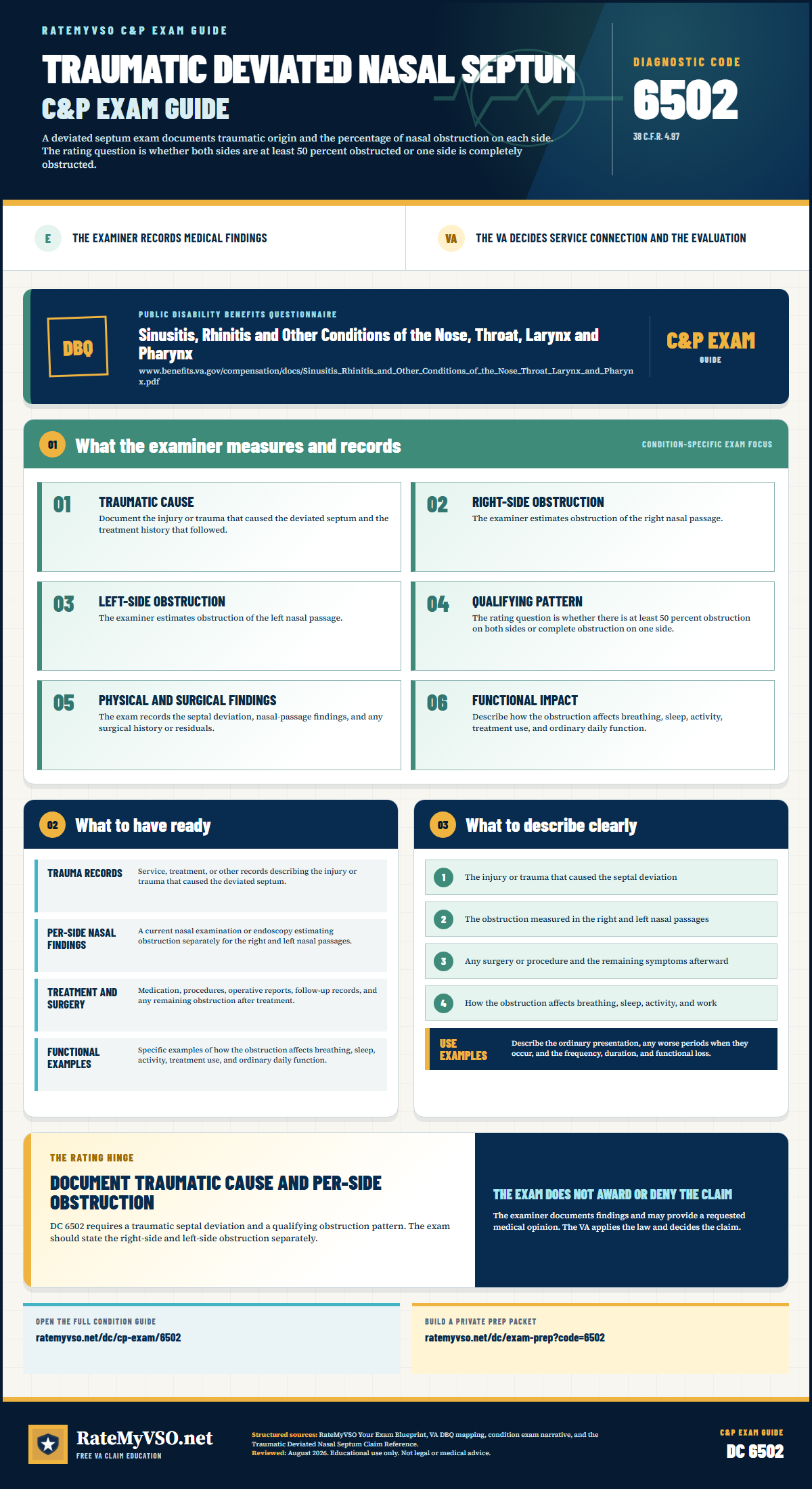
DEVIATED NASAL SEPTUM (Section VII)
- 7A. Is there at least 50% obstruction of the nasal passage on both sides due to traumatic septal deviation? Yes No
- 7B. Is there complete obstruction on left side due to traumatic septal deviation? Yes No
- 7C. Is there complete obstruction on right side due to traumatic septal deviation? Yes No
TUMORS AND NEOPLASMS (Section VIII)
- 8A. Does the Veteran currently have, or has had, a benign or malignant neoplasm or metastases related to any condition in the diagnosis section? Yes No If yes, complete the following section.
- 8B. Is the neoplasm: Benign Malignant If malignant complete the following: Active In remission Primary Secondary (metastatic) (If secondary, indicate the primary site, if known):
- 8C. Has the Veteran completed treatment or is the Veteran currently undergoing treatment for a benign or malignant neoplasm or metastases? Yes No; watchful waiting If yes, indicate type of treatment the Veteran is currently undergoing or has completed (check all that apply): Treatment completed Surgery If checked, describe: Date(s) of surgery:
- 8D. Does the Veteran currently have any residuals or complications due to the neoplasm (including metastases) or its treatment, other than those already documented in the report above? Yes No If yes, list residuals or complications (brief summary), and also complete the appropriate questionnaire:
- 8E. If there are additional benign or malignant neoplasms or metastases related to any of the diagnoses in the diagnosis section, describe using the above format:
OTHER PERTINENT PHYSICAL FINDINGS, COMPLICATIONS, CONDITIONS, SIGNS, SYMPTOMS, AND SCARS (Section IX)
- 9A. Does the Veteran have any other pertinent physical findings, complications, conditions, signs or symptoms related to the conditions listed in the diagnosis section above? Yes No If yes, describe (brief summary):
- 9B. Does the Veteran have loss of part of the nose or other scars of the nose exposing both nasal passages? Yes No
- 9C. Does the Veteran have loss of part of the nose or other scars causing loss of part of one ala? Yes No
- 9D. Does the Veteran have loss of part of the nose or other scars causing any other disfigurement? Yes No Sinusitis/Rhinitis and Other Conditions of the Nose, Throat, Larynx and Pharynx
- 9E. Does the Veteran have any scars (surgical or otherwise) related to any conditions or to the treatment of any conditions listed in the diagnosis section above? Yes No If yes, also complete the appropriate dermatological questionnaire.
- 9F. Comments, if any:
DIAGNOSTIC TESTING (Section X)
- 10A. Have clinically relevant imaging studies of the sinuses or other areas been performed or reviewed in conjunction with this examination? Yes No If yes, check all that apply: Magnetic resonance imaging (MRI) Date: Results: Computed tomography (CT) Date: Results: X-rays: Date: Results: Other: Date: Results:
- 10B. Has endoscopy been performed? Yes No If yes, check all that apply: Nasal endoscopy Date: Results: Laryngeal endoscopy Date: Results: Bronchoscopy Date: Results: Other endoscopy Date: Results:
- 10C. Has the Veteran had a biopsy of the larynx or pharynx? Yes No If yes, complete the following: Site of biopsy: Date: Results: Benign Pre-malignant Malignant Describe results:
- 10D. Has the Veteran had pulmonary function testing to assess for upper airway obstruction due to laryngeal stenosis? Yes No If yes, indicate results: FEV-1 of 71 to 80% predicted FEV-1 of 56 to 70% predicted FEV-1 of 40 to 55% predicted FEV-1 less than 40% predicted
- 10E. Are there any other significant diagnostic test findings and/or results? Yes No If yes, provide type of test or procedure, date and results (brief summary):
FUNCTIONAL IMPACT (Section XI)
- 11A. Regardless of the Veteran's current employment status, do the conditions listed in the diagnosis section impact his/her ability to perform any type of occupational task (such as standing, walking, lifting, sitting, etc.)? Yes No If yes, describe the functional impact of each condition, providing one or more examples:
REMARKS (Section XII)
- 12A. Remarks (if any – please identify the section to which the remark pertains when appropriate).
Rating Levels for DC 6502
The following tiers are reproduced from 38 CFR Part 4, the VA Schedule for Rating Disabilities. Toggle between the official VA criteria and a Plain English explanation.
Plain-English summaries are AI-generated to explain the official criteria. The official 38 CFR language is the binding legal standard. When in doubt, ask a VSO.
Evidence cited in published BVA decisions for DC 6502
The counts below are aggregated from published Board of Veterans Appeals decisions for this diagnostic code, among issues the Board granted or denied (remanded issues are not included). Each row reports how often a given evidence type was discussed in the decision text, broken down by outcome. This is a factual aggregate of the public record, not a prediction or recommendation about any specific claim.
- Service treatment records: appeared in 452 granted decisions (953 denied; 1405 decided total)
- Buddy / lay statements: appeared in 316 granted decisions (620 denied; 936 decided total)
- Medical literature: appeared in 12 granted decisions (50 denied; 62 decided total)
What the Board discussed in granted decisions for DC 6502
The themes below were extracted by clustering 500 grant-factor sentences from published Board of Veterans Appeals decisions for this diagnostic code. Frequencies indicate how often each theme appeared in the sample. This is a factual aggregate of the public record, not advice or strategy for any specific claim.
- 24% Benefit of doubt standard cited, claim deniedThe Board noted the benefit of the doubt doctrine but found the preponderance of evidence against the claim, making the doctrine inapplicable and requiring denial.118 of 500 sample sentences
- 20% VA or private examiner nexus opinion noted as at least as likely as notA VA or private medical examiner opined that the Veteran's claimed disability was at least as likely as not incurred in, caused by, or related to active service or a service-connected condition.98 of 500 sample sentences
- 18% Evidence in equipoise, benefit of doubt applied, claim grantedThe Board found the positive and negative evidence in approximate balance or relative equipoise and resolved the benefit of the doubt in the Veteran's favor to grant the claim.89 of 500 sample sentences
- 13% Benefit of doubt legal standard defined or quotedThe Board cited or quoted the statutory or regulatory definition of the benefit of the doubt doctrine, describing the approximate balance of positive and negative evidence standard.67 of 500 sample sentences
- 6% Deviated septum service connection nexus opinion recordedA medical examiner specifically opined that the Veteran's deviated nasal septum was at least as likely as not related to an in-service injury, event, or illness.32 of 500 sample sentences
- 6% Higher rating denied, benefit of doubt doctrine inapplicableThe Board found the preponderance of evidence against assigning a higher disability rating, rendering the benefit of the doubt doctrine inapplicable to the increased rating claim.28 of 500 sample sentences
- 5% OSA or sinusitis secondary to deviated septum nexus notedA medical examiner opined that the Veteran's obstructive sleep apnea, sinusitis, or related respiratory condition was at least as likely as not caused or aggravated by the service-connected deviated septum.24 of 500 sample sentences
- 4% Examiner opinion request on deviated septum or related conditionThe Board or remand order recorded a request for a medical opinion addressing whether the deviated septum or an associated nasal or sinus condition was at least as likely as not related to service.18 of 500 sample sentences
- 2% Finding of fact on deviated septum service connection recordedThe Board issued a formal finding of fact that the Veteran's deviated nasal septum was or was not related to an in-service injury, event, or disease.11 of 500 sample sentences
- 2% Negative nexus opinion or absence of evidence noted, claim deniedThe Board recorded that a medical examiner provided a negative nexus opinion or that no positive medical evidence supported the claimed relationship between the deviated septum and service.8 of 500 sample sentences
- 1% Credibility and lay evidence weighed in benefit of doubt analysisThe Board noted that the Veteran's credible lay statements regarding in-service injury or continuity of symptoms were considered in applying the benefit of the doubt doctrine.7 of 500 sample sentences
When the Board found the exam inadequate (DC 6502)
In 633 published Board of Veterans' Appeals decisions involving this condition, the Board found a C&P examination or medical opinion inadequate. Where the defect could be read from the decision, it was most often one of the following (counts are a floor from the decisions on file, not a total):
- 157 Failed to address a contention or part of the condition
- 141 Conclusion given without a supporting rationale
- 115 Veteran's lay statements not considered
- 44 Opinion relied on the absence of records instead of the evidence
- 34 Claims file or records not reviewed
- 25 Flare-ups or functional loss not addressed
- 15 Examiner said an opinion would require speculation
- 14 Wrong legal standard or question applied
- 9 Exam too old to reflect current severity
An inadequate exam is usually sent back for a new one rather than decided against the veteran. This is a factual report of published decisions, not advice about any exam or claim; whether an exam is adequate is decided case by case.
Disclaimer: This page reproduces public Department of Veterans Affairs forms (DBQs) and verbatim text from 38 CFR Part 4 (the VA Schedule for Rating Disabilities). It is informational only and is not legal or medical advice. For guidance on a specific claim, contact a VA-accredited representative.