C&P Exam Prep Guide for Asthma, bronchial (DC 6602)
YOUR EXAM BLUEPRINT
Asthma, bronchial
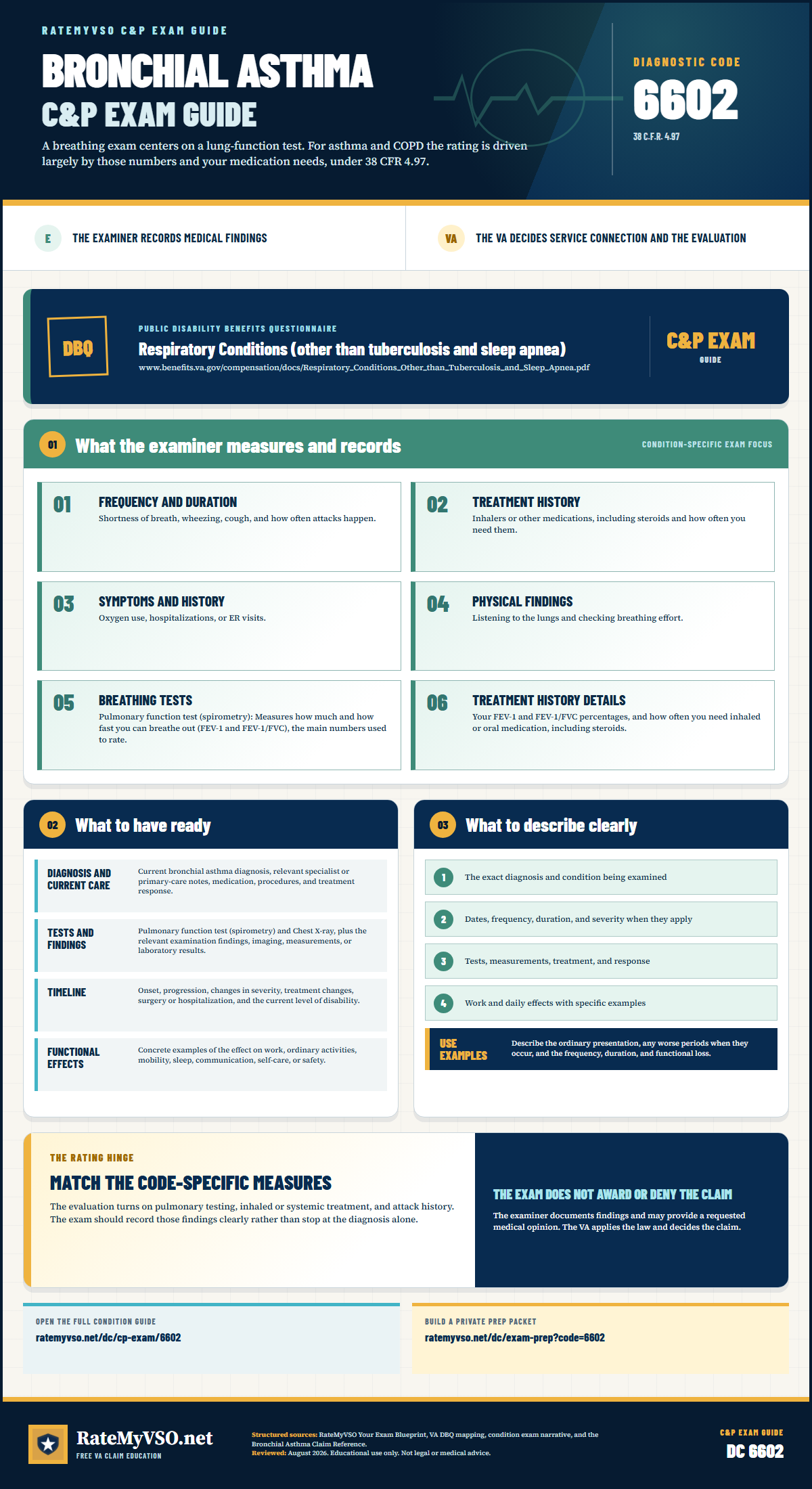
A breathing exam centers on a lung-function test. For asthma and COPD the rating is driven largely by those numbers and your medication needs, under 38 CFR 4.97.
DBQ used for this condition
- PPublic formDBQ RESP Respiratory Conditions (other than tuberculosis and sleep apnea)Open the public DBQ
What the examination is likely to focus on
Functional-impact topics to describe
- Your FEV-1 and FEV-1/FVC percentages, and how often you need inhaled or oral medication, including steroids.
- Oxygen use, hospitalizations, and the effect on activity and work.
- Findings map to the tiers in 38 CFR 4.97 (asthma DC 6602; COPD DC 6604).
Which form the examiner uses
For asthma, bronchial (DC 6602), the C&P examiner completes the following Disability Benefits Questionnaire (DBQ):
- DBQ RESP Respiratory Conditions (other than tuberculosis and sleep apnea) (public PDF on VA.gov)
DBQs are Department of Veterans Affairs Form 21-0960 series documents. Public DBQs are hosted on benefits.va.gov. A handful are examiner-only and are not posted publicly.
What to expect at your C&P exam
A breathing exam centers on a lung-function test. For asthma and COPD the rating is driven largely by those numbers and your medication needs, under 38 CFR 4.97.
1Initial interview (history)
- Shortness of breath, wheezing, cough, and how often attacks happen.
- Inhalers or other medications, including steroids and how often you need them.
- Oxygen use, hospitalizations, or ER visits.
- Triggers and the effect on activity and work.
2Physical examination
- Listening to the lungs and checking breathing effort.
- Heart and general exam.
3Diagnostic tests the examiner may rely on
A pulmonary function test is the key measurement for the rating.
4Functional assessment
- Your FEV-1 and FEV-1/FVC percentages, and how often you need inhaled or oral medication, including steroids.
- Oxygen use, hospitalizations, and the effect on activity and work.
- Findings map to the tiers in 38 CFR 4.97 (asthma DC 6602; COPD DC 6604).
Test explainers open MedlinePlus (NIH National Library of Medicine), or Wikipedia where MedlinePlus has no matching page. This describes what happens and what is measured, not how to influence a result.
What the examiner records (full DBQ form)
The fields below are reproduced from the DBQ form the examiner completes for this diagnostic code. This is the structural map of the form, showing what the examiner is asked to measure, observe, and record. It is a factual reproduction of the public DBQ, not advice on how to answer.
This DBQ evaluates respiratory conditions (excluding tuberculosis and sleep apnea), including asthma, COPD, bronchitis, bronchiectasis, asbestosis, and diaphragm conditions, organized as Section III subsections per condition.
How DC 6602 maps to this DBQ: for this diagnostic code specifically, the examiner typically completes sections I-VI of this form. Section III is the condition-specific section for this code.
DIAGNOSIS (Section I)
- 1A. List the claimed condition(s) that pertain to this questionnaire: Note: These are the diagnoses determined during this current evaluation of the claimed condition(s) listed above. If there is no diagnosis, if the diagnosis is different from a previous diagnosis for this condition, or if there is a diagnosis of a complication due to the claimed condition(s), explain your findings and reasons…
- 1B. Select diagnoses associated with the claimed condition(s) (check all that apply): The Veteran does not have a current diagnosis associated with any claimed condition(s) listed above. (Explain your findings and reasons in the Remarks section) Asthma ICD code: Date of diagnosis: Emphysema ICD code: Date of diagnosis: Chronic obstructive pulmonary disease (COPD) ICD code: Date of diagnosis:…
- 1C. If there are additional diagnoses that pertain to respiratory conditions, list using above format: Note - If diagnosed with Sleep apnea and/or Narcolepsy complete the Sleep Apnea and/or Narcolepsy Questionnaire(s), in lieu of this one.
MEDICAL HISTORY (Section II)
- 2A. Describe the history, including onset and course, of the Veteran's respiratory condition(s). Brief summary:
- 2B. Does the Veteran's respiratory condition require the use of oral or parenteral corticosteroid medications? Yes No (If "Yes," complete the following): Requires chronic low dose (maintenance) corticosteroids Requires intermittent courses or bursts of systemic (oral or parenteral) corticosteriods (If checked, indicate number of courses or bursts in past 12 months): 0 1 2 3 4 or more Requires…
- 2C. Does the Veteran's respiratory condition require the use of inhaled medications? Yes No (If "Yes," check all that apply): Inhalational bronchodilator therapy (If checked, indicate frequency): Intermittent Daily Inhalational anti-inflammatory medication (If checked, indicate frequency): Intermittent Daily Other inhaled medications, describe:
- 2D. Does the Veteran's respiratory condition require the use of oral bronchodilators? Yes No (If "Yes," indicate frequency): Intermittent Daily
- 2E. Does the Veteran's respiratory condition require the use of antibiotics? Yes No (If "Yes," list antibiotics, dose, frequency and condition for which antibiotics are prescribed):
- 2F. Does the Veteran require outpatient oxygen therapy for his or her respiratory condition? Yes No (If "Yes," does the Veteran require continuous oxygen therapy (>17 hours/day)?): Yes No (If the Veteran has more than one respiratory condition, indicate the condition which is predominantly responsible for the requirement for oxygen therapy):
PULMONARY CONDITIONS (Section III)
- 3A. Does the Veteran have any of the following pulmonary conditions? Yes No (If "No," proceed to Section IV) (If "Yes," check all that apply): Asthma (If checked, complete Part A below) Bronchiectasis (If checked, complete Part B below) Sarcoidosis (If checked, complete Part C below) Pulmonary embolism and related diseases
- 1A. Has the Veteran had any asthma attacks with episodes of respiratory failure in the past 12 months? Yes No (If "Yes," indicate average number of asthma attacks with episodes of respiratory failure per week in past 12 months): 0 1 2 3 4 or more
- 1B. Has the Veteran had any physician visits for required care of exacerbations? Yes No (If "yes," describe frequency and severity of exacerbations): (Indicate frequency of physician visits for required care of exacerbations over past 12 months): Less frequently than monthly At least monthly PART B - BRONCHIECTASIS
- 2A. Indicate any findings, signs and symptoms that are attributable to bronchiectasis Productive cough (If checked, indicate frequency and severity of productive cough (check all that apply)): Intermittent Daily Near constant Purulent sputum at times Blood-tinged sputum at times
- 2B. Has the Veteran had any incapacitating episodes of infection due to bronchiectasis? (NOTE: For VA purposes, an incapacitating episode is a period of acute symptoms severe enough to require prescribed bed rest and treatment by a physician) Yes No (If "Yes," indicate total duration of incapacitating episodes of infection in past 12 months): 0 to no more than 2 weeks 2 to no more than 4 weeks 4…
- 3A. Does the Veteran have any findings, signs or symptoms attributable to sarcoidosis? Yes No (If "Yes," check all that apply): No physiologic impairment No symptoms Persistent symptoms (If checked, describe): Chronic hilar adenopathy
- 3B. Indicate stage disgnosed by x-ray findings Stage 1: Bihilar lymphadenopathy Stage 2: Bihilar lymphadenopathy and reticulonodular infiltrates Stage 3: Bilateral pulmonary infiltrates Stage 4: Fibrocystic sarcoidosis typically with upward hilar retraction, cystic and bullous changes
- 3C. Does the Veteran have opthalmologic, renal, cardiac, neurologic, or other organ system involvement due to sarcoidosis? Yes No (If "Yes," also complete appropriate additional Questionnaires) PART D - PULMONARY EMBOLISM AND RELATED DISEASES
- 4A. Select the statement(s) that best describe the Veteran's pulmonary vascular disease or pulmonary embolism condition (Check all that apply): Asymptomatic, following resolution of pulmonary thromboembolism Symptomatic, following resolution of acute pulmonary embolism Chronic pulmonary thromboembolism requiring anticoagulant therapy Following inferior vena cava surgery Chronic pulmonary…
- 5A. Identify type of bacterial lung infection: Actinomycosis Nocardiosis Chronic lung abscess Other, describe:
- 5B. Indicate current status of the Veteran's bacterial infection of the lung Active Inactive
- 5C. Does the Veteran have any findings, signs and symptoms attributable to a bacterial infection of the lung or chronic lung abscess? Yes No (If "Yes," check all that apply): Fever Night sweats Weight loss (If checked, provide baseline weight: and current weight: ) (NOTE: For VA purposes, baseline weight is the average weight for 2-year period preceding onset of disease) Hemoptysis
- 6A. Indicate status of mycotic lung disease (including histoplasmosis of lung, coccidioidomycosis, blastomycosis, cryptococcosis, aspergillosis, or mucormycosis) (Check all that apply): No symptoms Chronic pulmonary mycosis Healed and inactive mycotic lesions Occasional productive cough Occasional minor hemoptysis
- 7A. Indicate the type of pneumothorax, treatment and residual conditions, if any (Check all that apply): Spontaneous total pneumothorax Spontaneous partial pneumothorax Traumatic total pneumothorax Traumatic partial pneumothorax Resulting in hospitalization (If checked, provide date of hospital admission
- 8A. Select the statement(s) that best describe the Veteran's gunshot or fragment wound or the pleural cavity and residuals, if any (Check all that apply): Bullet or missile retained in lung Pain or discomfort on exertion Scattered rales Some limitation of excursion of diaphragm or of lower chest expansion Other, describe: NOTE: If any muscles (other than those which control respiration) are…
- 9A. Does the Veteran's respiratory condition result in cardiopulmonary complications such as cor pulmonale, right ventricular hypertrophy or pulmonary hypertension? Yes No (If "Yes," check all that apply): Cor pulmonale (right heart failure) Right ventricular hypertrophy Pulmonary hypertension (shown by echocardiogram or cardiac catheterization; report test results in Diagnostic Testing Section)…
- 9B. If the Veteran has more than one respiratory condition, indicate which condition is predominantly responsible for the cardiopulmonary complications: PART J - RESPIRATORY FAILURE
- 10A. Provide dates and describe the Veteran's episodes of acute respiratory failure:
- 10B. If the Veteran has more than one respiratory condition, indicate which condition is predominantly responsible for the episodes of respiratory failure: PART K - TUMORS AND NEOPLASMS
- 11A. Does the Veteran have a benign or malignant neoplasm or metastases related to any of the diagnoses in the diagnosis section? Yes No If yes, complete the following section.
- 11B. Is the neoplasm: Benign Malignant (if malignant complete the following): Active In remission Primary Secondary (metastatic) (if secondary, indicate the primary site, if known):
- 11C. Has the Veteran completed treatment or is the Veteran currently undergoing treatment for a benign or malignant neoplasm or metastases? Yes No; watchful waiting If yes, indicate type of treatment the Veteran is currently undergoing or has completed (check all that apply): Treatment completed Surgery If checked, describe: Date(s) of surgery:
- 11D. Does the Veteran currently have any residuals or complications due to the neoplasm (including metastases) or its treatment, other than those already documented in the report above? Yes No If yes, list residuals or complications (brief summary), and also complete the appropriate questionnaire:
- 11E. If there are additional benign or malignant neoplasms or metastases related to any of the diagnoses in the diagnosis section, describe using the above format: PART L - OTHER PERTINENT PHYSICAL FINDINGS, COMPLICATIONS, CONDITIONS, SIGNS, SYMPTOMS, AND SCARS
- 12A. Does the Veteran have any other pertinent physical findings, complications, conditions, signs or symptoms related to the conditions listed in the diagnosis section above? Yes No If yes, describe (brief summary):
- 12B. Does the Veteran have any scars (surgical or otherwise) related to any conditions or to the treatment of any conditions listed in the diagnosis section above? Yes No If yes, are any of these scars painful or unstable, have a total area equal to or greater than 39 square cm (6 square inches); or are located on the head, face or neck? (An "unstable scar" is one where, for any reason, there is…
- 12C. Comments, if any:
DIAGNOSTIC TESTING (Section IV)
- 4A. Have imaging studies or procedures been performed? (For VA purposes, imaging studies are not required for many respiratory conditions) Yes No (If "Yes," check all that apply): Chest x-ray Date: Results: Magnetic resonance imaging (MRI) Date: Results: Computed tomography (CT) Date: Results: High resolution computed tomography to evaluate interstitial lung disease such as
- 4B. Has pulmonary function testing (PFT) been performed? Yes No (If "Yes," do PFT results reported below reflect the Veteran's current pulmonary function?) Yes No Most respiratory conditions require pulmonary function testing, since PFT results represent a major basis for their evaluation. However, pulmonary function testing is not required in all instances. For VA purposes, if the Veteran has…
- 4C. PFT Results Date of test: Pre-bronchodilator: Post-bronchodilator, if indicated: FVC: % predicted FVC: % predicted FEV- 1: % predicted FEV-
- 4D. Which test result most accurately reflects the Veteran's level of disability (based on the condition that is being evaluated for this report)? This question is important for VA purposes. FVC % predicted FEV-1/FVC FEV-1 % predicted DLCO
- 4E. If post-bronchodilator testing has not been completed, indicate reason: Pre-bronchodilator results are normal Not indicated for Veteran's condition Not indicated in Veteran's particular case (If checked, provide reason): Other, describe:
- 4F. If diffusion capacity of the lung for carbon monoxide by the single breath method (DLCO) testing has not been completed, provide reason: Not indicated for Veteran's condition Not indicated in Veteran's particular case Not valid for Veteran's particular case Other, describe:
- 4G. Does the Veteran have multiple respiratory conditions? Yes No (If "Yes," list conditions and indicate which condition is predominantly responsible for the limitation in pulmonary function, if any limitation is present):
- 4H. Has exercise capacity testing been performed? Yes No (If "Yes," complete the following): Maximum exercise capacity less than 15 ml/kg/min oxygen consumption (with cardiac or respiratory limitation) Maximum oxygen consumption of 15-20 ml/kg/min (with cardiorespiratory limit) Maximum oxygen consumption of more than 20 ml/kg/min Unknown results
- 4I. Are there any other significant diagnostic test findings and/or results? Yes No (If "Yes," describe (brief summary)):
FUNCTIONAL IMPACT (Section V)
- 5A. Regardless of the Veteran's current employment status, do the conditions listed in the diagnosis section impact his/her ability to perform any type of occupational task (such as standing, walking, lifting, sitting, etc.)? Yes No If yes, describe the functional impact of each condition, providing one or more examples:
REMARKS (Section VI)
- 6A. Remarks (if any - please identify the section to which the remark pertains when appropriate).
Rating Levels for DC 6602
The following tiers are reproduced from 38 CFR Part 4, the VA Schedule for Rating Disabilities. Toggle between the official VA criteria and a Plain English explanation.
Plain-English summaries are AI-generated to explain the official criteria. The official 38 CFR language is the binding legal standard. When in doubt, ask a VSO.
Evidence cited in published BVA decisions for DC 6602
The counts below are aggregated from published Board of Veterans Appeals decisions for this diagnostic code, among issues the Board granted or denied (remanded issues are not included). Each row reports how often a given evidence type was discussed in the decision text, broken down by outcome. This is a factual aggregate of the public record, not a prediction or recommendation about any specific claim.
- Service treatment records: appeared in 2030 granted decisions (3772 denied; 5802 decided total)
- Buddy / lay statements: appeared in 1328 granted decisions (2288 denied; 3616 decided total)
- Medical literature: appeared in 151 granted decisions (181 denied; 332 decided total)
What the Board discussed in granted decisions for DC 6602
The themes below were extracted by clustering 500 grant-factor sentences from published Board of Veterans Appeals decisions for this diagnostic code. Frequencies indicate how often each theme appeared in the sample. This is a factual aggregate of the public record, not advice or strategy for any specific claim.
- 27% Benefit of the doubt doctrine cited as legal standardThe Board or decision cited the statutory benefit-of-the-doubt rule requiring VA to resolve approximate balance of positive and negative evidence in the claimant's favor.134 of 500 sample sentences
- 13% Evidence found in equipoise supporting asthma service connectionThe Board found the competent and probative evidence at least in relative equipoise as to whether the Veteran's asthma was incurred in, related to, or aggravated by active military service.63 of 500 sample sentences
- 12% VA or private examiner nexus opinion cited for asthmaA VA or private medical examiner opined that the Veteran's asthma was at least as likely as not caused by, incurred in, or related to active duty service or a service-connected condition.62 of 500 sample sentences
- 12% Preponderance of evidence found against claim; benefit of doubt inapplicableThe Board determined that the weight of probative evidence persuasively weighed against the claim, making the benefit-of-the-doubt doctrine inapplicable.62 of 500 sample sentences
- 12% Examiner nexus opinion cited for non-asthma conditionsA VA or private medical examiner opined that a condition other than asthma (e.g., tinnitus, PTSD, hearing loss, OSA, COPD) was at least as likely as not related to service or a service-connected disability.62 of 500 sample sentences
- 8% Relative equipoise standard and veteran-prevails rule notedThe Board recorded the legal standard that when evidence supports the claim or is in relative equipoise the veteran prevails, and a preponderance against the claim results in denial.42 of 500 sample sentences
- 4% Examiner opinion request documented for asthma nexusThe Board or remand order documented a request for a medical examiner to opine whether the Veteran's asthma or respiratory condition was at least as likely as not related to service or a toxic exposure.22 of 500 sample sentences
- 4% Benefit of doubt applied to asthma rating or symptom criteriaThe Board recorded application of the benefit-of-the-doubt doctrine to resolve an approximate balance of evidence regarding the degree of asthma disability or whether specific rating criteria were met.22 of 500 sample sentences
- 4% OSA or secondary condition linked to asthma in equipoise findingThe Board found the evidence at least in equipoise as to whether a secondary condition such as obstructive sleep apnea, pulmonary hypertension, or COPD was caused or aggravated by service-connected asthma.18 of 500 sample sentences
- 3% Board conclusion cited granting service connection for asthmaThe Board recorded a finding of fact or conclusion of law that service connection for asthma or a respiratory disorder was warranted after resolving reasonable doubt in the Veteran's favor.13 of 500 sample sentences
When the Board found the exam inadequate (DC 6602)
In 2,755 published Board of Veterans' Appeals decisions involving this condition, the Board found a C&P examination or medical opinion inadequate. Where the defect could be read from the decision, it was most often one of the following (counts are a floor from the decisions on file, not a total):
- 796 Failed to address a contention or part of the condition
- 649 Conclusion given without a supporting rationale
- 467 Veteran's lay statements not considered
- 176 Opinion relied on the absence of records instead of the evidence
- 140 Claims file or records not reviewed
- 76 Flare-ups or functional loss not addressed
- 71 Examiner said an opinion would require speculation
- 45 Wrong legal standard or question applied
- 24 Exam too old to reflect current severity
An inadequate exam is usually sent back for a new one rather than decided against the veteran. This is a factual report of published decisions, not advice about any exam or claim; whether an exam is adequate is decided case by case.
Disclaimer: This page reproduces public Department of Veterans Affairs forms (DBQs) and verbatim text from 38 CFR Part 4 (the VA Schedule for Rating Disabilities). It is informational only and is not legal or medical advice. For guidance on a specific claim, contact a VA-accredited representative.