C&P Exam Prep Guide for Residuals of traumatic brain injury (DC 8045)
YOUR EXAM BLUEPRINT
Residuals of traumatic brain injury
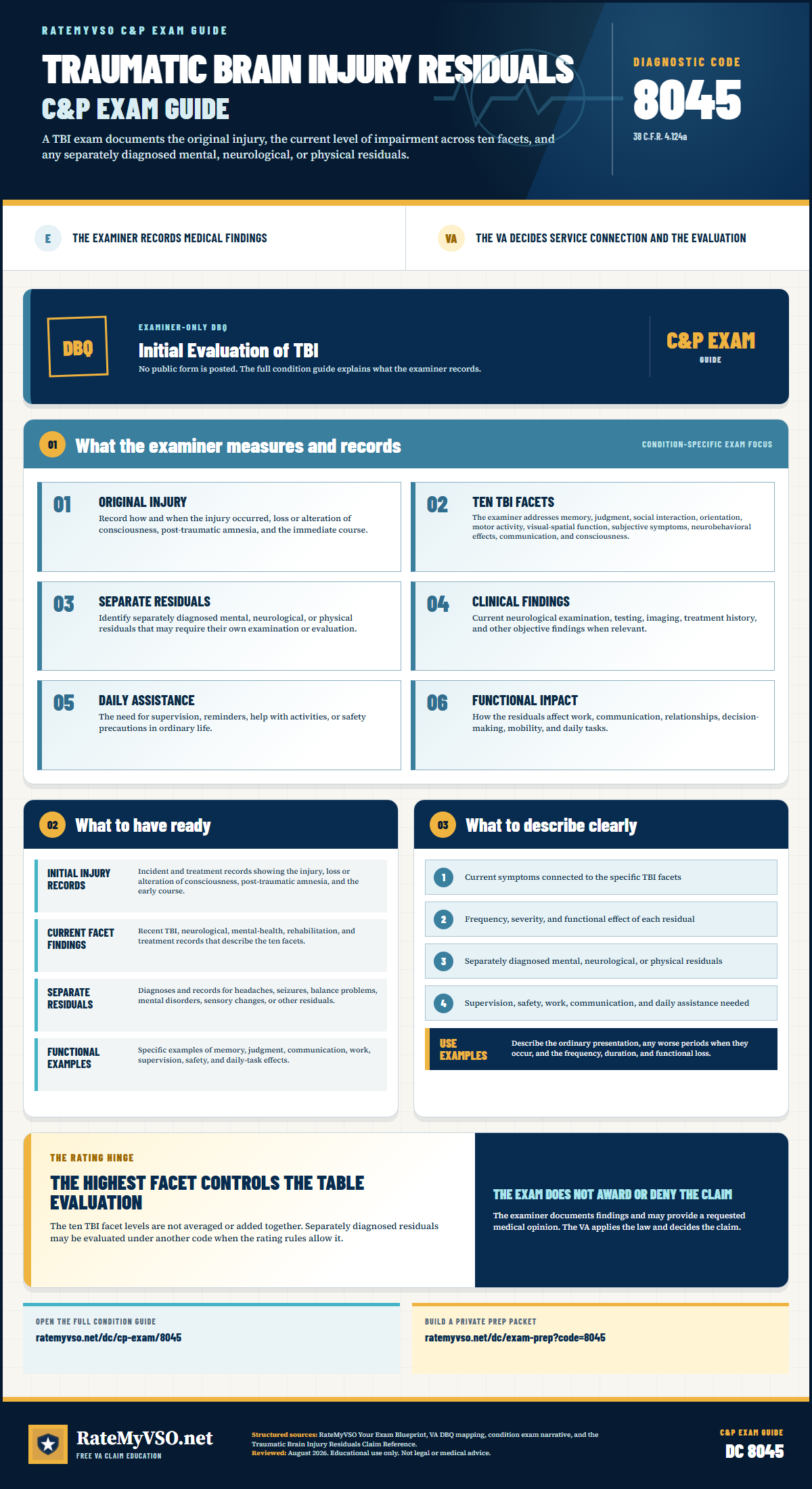
A TBI exam looks at the lasting effects of a head injury across thinking, physical, and behavioral areas. The examiner scores ten specific facets, and the single highest facet level sets the rating under 38 CFR 4.124a, DC 8045.
DBQ used for this condition
- EExaminer onlyDBQ NEURO Initial Evaluation of TBI
What the examination is likely to focus on
Functional-impact topics to describe
- The exam scores ten facets, including memory and attention, judgment, social interaction, orientation, motor activity, visual-spatial skills, subjective symptoms, neurobehavioral effects, communication, and consciousness.
- The single highest facet level sets the rating.
- Symptoms that belong to a separately diagnosed condition (such as migraines or PTSD) are rated under that condition instead.
- Findings map to 38 CFR 4.124a, DC 8045.
Which form the examiner uses
For residuals of traumatic brain injury (DC 8045), the C&P examiner completes the following Disability Benefits Questionnaire (DBQ):
- DBQ NEURO Initial Evaluation of TBI (examiner-only DBQ, no public version. Link opens VA Find-A-Form search)
DBQs are Department of Veterans Affairs Form 21-0960 series documents. Public DBQs are hosted on benefits.va.gov. A handful are examiner-only and are not posted publicly.
What to expect at your C&P exam
A TBI exam looks at the lasting effects of a head injury across thinking, physical, and behavioral areas. The examiner scores ten specific facets, and the single highest facet level sets the rating under 38 CFR 4.124a, DC 8045.
1Initial interview (history)
- How and when the head injury happened, and whether you lost consciousness.
- Current symptoms: memory and concentration problems, headaches, dizziness, sensitivity to light or noise, irritability, mood changes, and sleep problems.
- How symptoms affect work, relationships, and daily tasks.
- Other conditions that overlap (PTSD, headaches), and current treatment.
2Physical examination
- A neurological exam: strength, sensation, coordination, balance, reflexes, vision, and speech.
- A check of memory, attention, and orientation.
3Diagnostic tests the examiner may rely on
Used to document the injury and its cognitive effects.
4Functional assessment
- The exam scores ten facets, including memory and attention, judgment, social interaction, orientation, motor activity, visual-spatial skills, subjective symptoms, neurobehavioral effects, communication, and consciousness.
- The single highest facet level sets the rating.
- Symptoms that belong to a separately diagnosed condition (such as migraines or PTSD) are rated under that condition instead.
- Findings map to 38 CFR 4.124a, DC 8045.
Test explainers open MedlinePlus (NIH National Library of Medicine), or Wikipedia where MedlinePlus has no matching page. This describes what happens and what is measured, not how to influence a result.
Rating Levels for DC 8045
The following tiers are reproduced from 38 CFR Part 4, the VA Schedule for Rating Disabilities. Toggle between the official VA criteria and a Plain English explanation.
Plain-English summaries are AI-generated to explain the official criteria. The official 38 CFR language is the binding legal standard. When in doubt, ask a VSO.
Evidence cited in published BVA decisions for DC 8045
The counts below are aggregated from published Board of Veterans Appeals decisions for this diagnostic code, among issues the Board granted or denied (remanded issues are not included). Each row reports how often a given evidence type was discussed in the decision text, broken down by outcome. This is a factual aggregate of the public record, not a prediction or recommendation about any specific claim.
- Service treatment records: appeared in 2192 granted decisions (5581 denied; 7773 decided total)
- Buddy / lay statements: appeared in 1804 granted decisions (3886 denied; 5690 decided total)
- Medical literature: appeared in 139 granted decisions (251 denied; 390 decided total)
What the Board discussed in granted decisions for DC 8045
The themes below were extracted by clustering 500 grant-factor sentences from published Board of Veterans Appeals decisions for this diagnostic code. Frequencies indicate how often each theme appeared in the sample. This is a factual aggregate of the public record, not advice or strategy for any specific claim.
- 19% Benefit of the doubt doctrine cited as inapplicableThe Board noted that because the preponderance of the evidence weighed against the claim, the benefit of the doubt doctrine was found inapplicable and the claim was denied.97 of 500 sample sentences
- 18% Benefit of the doubt resolved in veteran's favorThe Board recorded that because the evidence was in approximate balance or relative equipoise, the benefit of the doubt was resolved in the veteran's favor and the claim was granted.89 of 500 sample sentences
- 14% Positive nexus opinion noted for TBI or TBI residualsA VA or private examiner recorded an opinion that the veteran's TBI, or its residuals such as headaches, cognitive impairment, or other symptoms, was at least as likely as not incurred in or caused by active military service.72 of 500 sample sentences
- 12% Benefit of the doubt legal standard recitedThe Board cited the statutory or regulatory rule that when there is an approximate balance of positive and negative evidence on a material issue, the benefit of the doubt shall be given to the claimant.62 of 500 sample sentences
- 11% Evidence found in equipoise on service connectionThe Board found that the lay and medical evidence was at least in relative equipoise on the question of whether the veteran's disability was related to or incurred during active service.57 of 500 sample sentences
- 8% Positive nexus opinion noted for secondary or aggravation claimsA VA or private examiner recorded an opinion that the veteran's disability was at least as likely as not proximately due to, caused by, or aggravated beyond its natural progression by a service-connected condition.41 of 500 sample sentences
- 7% Examiner opinion requested on TBI nexus or residualsThe Board directed a VA examiner to provide an opinion with rationale as to whether the veteran's TBI or its residuals were at least as likely as not incurred in or related to service.33 of 500 sample sentences
- 3% Negative nexus or non-service-connection opinion notedA VA examiner recorded an opinion that the veteran's claimed condition was not at least as likely as not related to service or a service-connected disability, contributing to denial of the claim.17 of 500 sample sentences
- 3% TDIU or unemployability found supported by evidenceThe Board recorded that the evidence, including medical opinions and lay statements, supported a finding that the veteran's service-connected disabilities rendered him unable to secure or follow substantially gainful employment.16 of 500 sample sentences
- 3% Evidence in equipoise on disability rating levelThe Board found that the evidence was at least in equipoise as to whether the veteran's service-connected disability more nearly approximated the criteria for a higher disability rating.16 of 500 sample sentences
When the Board found the exam inadequate (DC 8045)
In 3,257 published Board of Veterans' Appeals decisions involving this condition, the Board found a C&P examination or medical opinion inadequate. Where the defect could be read from the decision, it was most often one of the following (counts are a floor from the decisions on file, not a total):
- 856 Failed to address a contention or part of the condition
- 693 Conclusion given without a supporting rationale
- 538 Veteran's lay statements not considered
- 232 Opinion relied on the absence of records instead of the evidence
- 125 Flare-ups or functional loss not addressed
- 123 Claims file or records not reviewed
- 111 Examiner said an opinion would require speculation
- 39 Exam too old to reflect current severity
- 22 Wrong legal standard or question applied
An inadequate exam is usually sent back for a new one rather than decided against the veteran. This is a factual report of published decisions, not advice about any exam or claim; whether an exam is adequate is decided case by case.
Disclaimer: This page reproduces public Department of Veterans Affairs forms (DBQs) and verbatim text from 38 CFR Part 4 (the VA Schedule for Rating Disabilities). It is informational only and is not legal or medical advice. For guidance on a specific claim, contact a VA-accredited representative.