C&P Exam Prep Guide for Migraine (DC 8100)
YOUR EXAM BLUEPRINT
Migraine
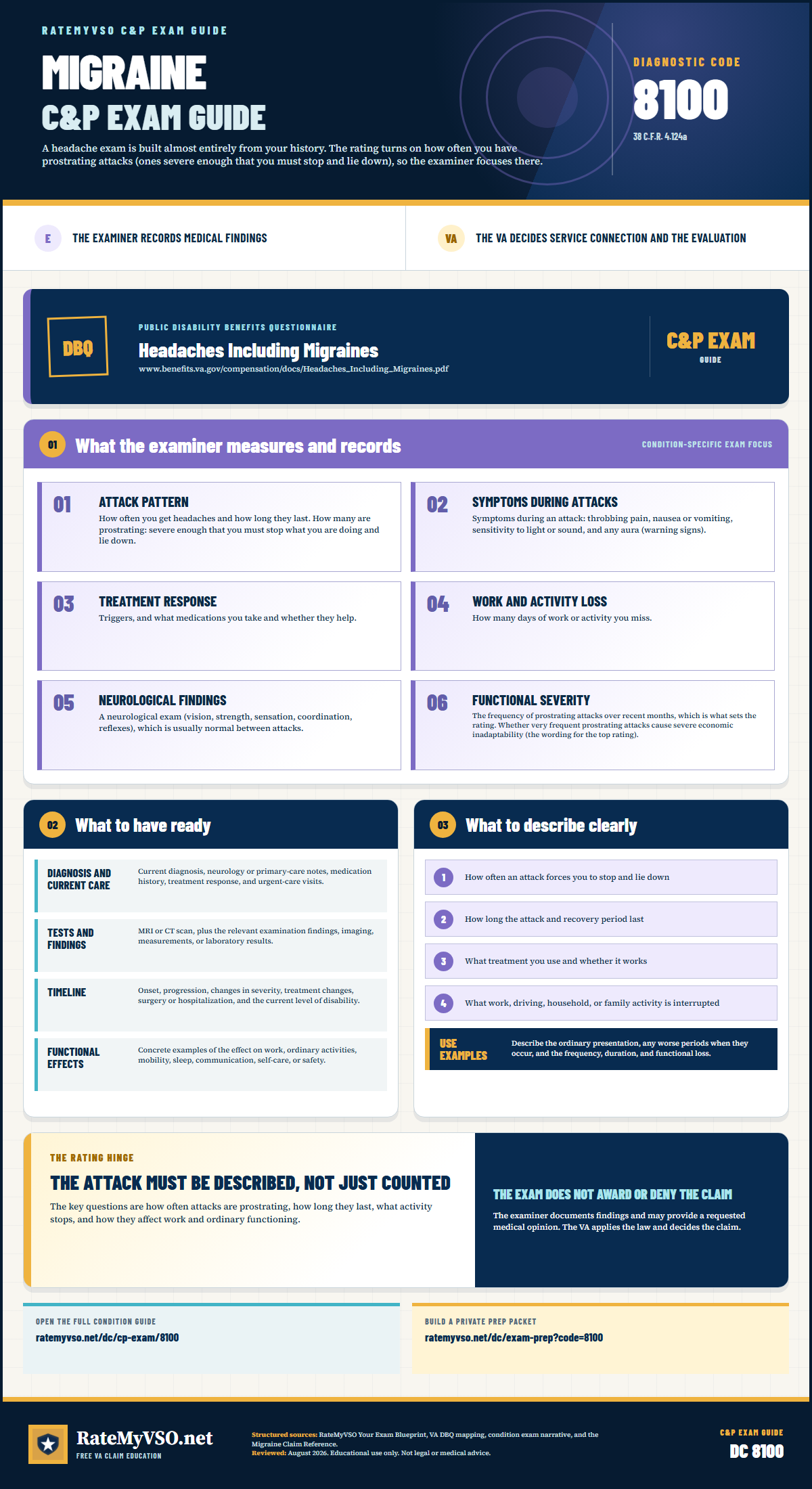
A headache exam is built almost entirely from your history. No scan or blood test confirms migraine, so the examiner asks about your attacks and records what you describe. Several things matter together: how often attacks happen, how long they last, whether they are prostrating, and how much they disrupt work and daily life.
DBQ used for this condition
- PPublic formDBQ NEURO Headaches Including MigrainesOpen the public DBQ
What the examination is likely to focus on
Functional-impact topics to describe
- How often characteristic prostrating attacks have happened over the last several months.
- Whether attacks are completely prostrating and prolonged, which the form records as a separate question with its own frequency.
- Whether your headache condition affects your ability to work, with one or more examples.
- The tiers in 38 CFR 4.124a, DC 8100 read these together rather than counting attacks alone. The top tier is worded as very frequent completely prostrating and prolonged attacks productive of severe economic inadaptability.
Which form the examiner uses
For migraine (DC 8100), the C&P examiner completes the following Disability Benefits Questionnaire (DBQ):
- DBQ NEURO Headaches Including Migraines (public PDF on VA.gov)
DBQs are Department of Veterans Affairs Form 21-0960 series documents. Public DBQs are hosted on benefits.va.gov. A handful are examiner-only and are not posted publicly.
What to expect at your C&P exam
A headache exam is built almost entirely from your history. No scan or blood test confirms migraine, so the examiner asks about your attacks and records what you describe. Several things matter together: how often attacks happen, how long they last, whether they are prostrating, and how much they disrupt work and daily life.
1Initial interview (history)
- How often you get headaches and how long a typical one lasts.
- How many attacks are prostrating. This form defines prostrating, for VA purposes, as causing extreme exhaustion, powerlessness, debilitation or incapacitation with substantial inability to engage in ordinary activities. Having to stop and lie down is one common example of that, not a required test.
- Whether any attacks are completely prostrating and prolonged, which the form asks about separately from characteristic prostrating attacks.
- Symptoms during an attack: throbbing pain, nausea or vomiting, sensitivity to light or sound, vision or sensory changes, and any aura (warning signs).
- Triggers, and what medications you take and whether they help.
- How many days of work or activity you miss.
2Physical examination
- This form has no headache-specific physical examination section, and an examination between attacks is often normal.
- The examiner records any other pertinent physical findings, complications, signs or symptoms related to the diagnosed headache condition, and any related scars.
3Diagnostic tests the examiner may rely on
The Headaches DBQ states that diagnostic testing is not required for this examination report. If studies have already been done, the examiner reports the most recent results. Imaging cannot confirm migraine and is used to rule out other causes.
4Functional assessment
- How often characteristic prostrating attacks have happened over the last several months.
- Whether attacks are completely prostrating and prolonged, which the form records as a separate question with its own frequency.
- Whether your headache condition affects your ability to work, with one or more examples.
- The tiers in 38 CFR 4.124a, DC 8100 read these together rather than counting attacks alone. The top tier is worded as very frequent completely prostrating and prolonged attacks productive of severe economic inadaptability.
Test explainers open MedlinePlus (NIH National Library of Medicine), or Wikipedia where MedlinePlus has no matching page. This describes what happens and what is measured, not how to influence a result.
What the examiner records (full DBQ form)
The fields below are reproduced from the DBQ form the examiner completes for this diagnostic code. This is the structural map of the form, showing what the examiner is asked to measure, observe, and record. It is a factual reproduction of the public DBQ, not advice on how to answer.
This DBQ evaluates headache conditions including migraines, tension, and cluster headaches, focusing on prostrating attacks and functional impact.
How DC 8100 maps to this DBQ: for this diagnostic code specifically, the examiner typically completes sections I-VIII of this form. Sections III-IV are the condition-specific sections for this code.
DIAGNOSIS (Section I)
- DOES THE VETERAN NOW HAVE OR HAS HE OR SHE EVER BEEN DIAGNOSED WITH A HEADACHE CONDITION?
- Migraine including migraine variants - ICD code / Date of diagnosis
- Tension - ICD code / Date of diagnosis
- Cluster - ICD code / Date of diagnosis
- Other (specify type of headache) - ICD code / Date of diagnosis
- Other diagnosis #1 - ICD code / Date of diagnosis
- Other diagnosis #2 - ICD code / Date of diagnosis
- IF THERE ARE ADDITIONAL DIAGNOSES THAT PERTAIN TO A HEADACHE CONDITION, LIST USING ABOVE FORMAT
MEDICAL HISTORY (Section II)
- DESCRIBE THE HISTORY (including onset and course) OF THE VETERAN'S HEADACHE CONDITIONS (brief summary)
- Does the Veteran's treatment plan include taking continuous medication for the diagnosed condition?
- IF YES, DESCRIBE TREATMENT (list only those medications used for the diagnosed condition)
SYMPTOMS (Section III)
- DOES THE VETERAN EXPERIENCE HEADACHE PAIN?
- Constant head pain
- Pulsating or throbbing head pain
- Pain localized to one side of the head
- Pain on both sides of the head
- Pain worsens with physical activity
- Other, describe (headache pain)
- DOES THE VETERAN EXPERIENCE NON-HEADACHE SYMPTOMS ASSOCIATED WITH HEADACHES? (Including symptoms associated with an aura prior to headache pain)
- Nausea
- Vomiting
- Sensitivity to light
- Sensitivity to sound
- Changes in vision (such as scotoma, flashes of light, tunnel vision)
- Sensory changes (such as feeling of pins and needles in extremities)
- Other, describe (non-headache symptoms)
- INDICATE DURATION OF TYPICAL HEAD PAIN - Less than 1 day / 1-2 days / More than 2 days / Other, describe
- INDICATE LOCATION OF TYPICAL HEAD PAIN - Right side of head / Left side of head / Both sides of head / Other, describe
PROSTRATING ATTACKS OF HEADACHE PAIN (Section IV)
- MIGRANE / NON-MIGRAINE- DOES THE VETERAN HAVE CHARACTERISTIC PROSTRATING ATTACKS OF MIGRAINE / NON-MIGRAINE HEADACHE PAIN?
- Frequency of prostrating attacks over the last several months - With less frequent attacks / Once in 2 months / Once every month / Greater than once per month
- DOES THE VETERAN HAVE COMPLETELY PROSTRATING AND PROLONGED ATTACKS OF MIGRAINES/NON-MIGRAINE PAIN?
- Frequency of completely prostrating attacks over the last several months - With less frequent attacks / Once in 2 months / Once every month / Greater than once per month
OTHER PERTINENT PHYSICAL FINDINGS, COMPLICATIONS, CONDITIONS, SIGNS, SYMPTOMS, AND SCARS (Section V)
- DOES THE VETERAN HAVE ANY OTHER PERTINENT PHYSICAL FINDINGS, COMPLICATIONS, CONDITIONS, SIGNS OR SYMPTOMS RELATED TO THE CONDITIONS LISTED IN THE DIAGNOSIS SECTION ABOVE?
- IF YES, DESCRIBE (brief summary)
- DOES THE VETERAN HAVE ANY SCARS (surgical or otherwise) RELATED TO ANY CONDITIONS OR TO THE TREATMENT OF ANY CONDITIONS LISTED IN THE DIAGNOSIS SECTION ABOVE?
- IF YES, ARE ANY OF THESE SCARS PAINFUL OR UNSTABLE; HAVE A TOTAL AREA EQUAL TO OR GREATER THAN 39 SQUARE CM (6 square inches); OR ARE LOCATED ON THE HEAD, FACE OR NECK?
- LOCATION (scar)
- MEASUREMENTS: length cm X width cm
- 5C. COMMENTS, IF ANY
DIAGNOSTIC TESTING (Section VI)
- ARE THERE ANY OTHER SIGNIFICANT DIAGNOSTIC TEST FINDINGS AND/OR RESULTS?
- IF YES, PROVIDE TYPE OF TEST OR PROCEDURE, DATE AND RESULTS (brief summary)
FUNCTIONAL IMPACT (Section VII)
- DOES THE VETERAN'S HEADACHE CONDITION IMPACT HIS OR HER ABILITY TO WORK?
- If Yes, describe impact of the veteran's headache condition, providing one or more examples
REMARKS (Section VIII)
- Remarks (if any) – please identify the section to which the remark pertains when appropriate
Rating Levels for DC 8100
The following tiers are reproduced from 38 CFR Part 4, the VA Schedule for Rating Disabilities. Toggle between the official VA criteria and a Plain English explanation.
Plain-English summaries are AI-generated to explain the official criteria. The official 38 CFR language is the binding legal standard. When in doubt, ask a VSO.
Evidence cited in published BVA decisions for DC 8100
The counts below are aggregated from published Board of Veterans Appeals decisions for this diagnostic code, among issues the Board granted or denied (remanded issues are not included). Each row reports how often a given evidence type was discussed in the decision text, broken down by outcome. This is a factual aggregate of the public record, not a prediction or recommendation about any specific claim.
- Service treatment records: appeared in 8684 granted decisions (11289 denied; 19973 decided total)
- Buddy / lay statements: appeared in 7735 granted decisions (7897 denied; 15632 decided total)
- Medical literature: appeared in 953 granted decisions (576 denied; 1529 decided total)
What the Board discussed in granted decisions for DC 8100
The themes below were extracted by clustering 500 grant-factor sentences from published Board of Veterans Appeals decisions for this diagnostic code. Frequencies indicate how often each theme appeared in the sample. This is a factual aggregate of the public record, not advice or strategy for any specific claim.
- 27% Benefit of the doubt standard defined or citedThe Board or decision cited the legal standard that when positive and negative evidence is in approximate balance, the claimant is entitled to the benefit of the doubt.134 of 500 sample sentences
- 16% Benefit of the doubt resolved in veteran's favor, claim grantedThe Board applied the benefit of the doubt doctrine and resolved it in the veteran's favor, resulting in a grant of service connection or an increased rating.82 of 500 sample sentences
- 14% Evidence persuasively against claim, benefit of the doubt inapplicableThe Board found the preponderance of evidence against the claim, rendering the benefit of the doubt doctrine inapplicable and resulting in denial.72 of 500 sample sentences
- 14% Evidence found at least in equipoise on nexus or service connectionThe Board found the medical and lay evidence to be at least in relative equipoise regarding whether the veteran's disability, including headaches or migraines, was related to service or a service-connected condition.68 of 500 sample sentences
- 13% VA or private examiner nexus opinion cited as at least as likely as notA VA or private medical examiner opined that the veteran's disability, including migraine or headache conditions, was at least as likely as not caused by, related to, or aggravated by service or a service-connected condition.67 of 500 sample sentences
- 5% Prostrating headache frequency and severity findings documentedThe Board noted findings that the veteran's migraine or headache attacks were characteristic, prostrating, occurring at least monthly, and capable of producing severe economic inadaptability, supporting a specific rating percentage.23 of 500 sample sentences
- 5% Migraine headaches secondary to service-connected condition notedThe Board or an examiner found that the veteran's migraine headaches were at least as likely as not secondary to or aggravated by a service-connected condition such as PTSD, tinnitus, sinusitis, or OSA.23 of 500 sample sentences
- 3% Remand instruction for nexus or addendum opinion documentedThe Board documented a remand instruction directing an examiner to provide an opinion on whether the veteran's headache or migraine disability was at least as likely as not related to service or a service-connected condition.17 of 500 sample sentences
- 1% Negative or unfavorable nexus opinion cited in the recordAn examiner's opinion finding that the veteran's headache or other disability was not at least as likely as not related to service or a service-connected event was noted in the record.7 of 500 sample sentences
- 1% Veteran's credible lay statements supporting equipoise notedThe Board noted that the veteran's competent and credible lay statements about symptom onset and continuity placed the evidence at least in equipoise on the service connection question.5 of 500 sample sentences
- 0% TDIU or total occupational impairment findings documentedThe Board documented findings that the veteran's service-connected disabilities, including migraines, precluded substantially gainful employment, supporting a grant of TDIU.2 of 500 sample sentences
When the Board found the exam inadequate (DC 8100)
In 10,785 published Board of Veterans' Appeals decisions involving this condition, the Board found a C&P examination or medical opinion inadequate. Where the defect could be read from the decision, it was most often one of the following (counts are a floor from the decisions on file, not a total):
- 3,260 Failed to address a contention or part of the condition
- 2,588 Conclusion given without a supporting rationale
- 2,113 Veteran's lay statements not considered
- 843 Opinion relied on the absence of records instead of the evidence
- 477 Claims file or records not reviewed
- 402 Flare-ups or functional loss not addressed
- 299 Examiner said an opinion would require speculation
- 149 Exam too old to reflect current severity
- 117 Wrong legal standard or question applied
An inadequate exam is usually sent back for a new one rather than decided against the veteran. This is a factual report of published decisions, not advice about any exam or claim; whether an exam is adequate is decided case by case.
Disclaimer: This page reproduces public Department of Veterans Affairs forms (DBQs) and verbatim text from 38 CFR Part 4 (the VA Schedule for Rating Disabilities). It is informational only and is not legal or medical advice. For guidance on a specific claim, contact a VA-accredited representative.