C&P Exam Prep Guide for Unspecified anxiety disorder (DC 9413)
YOUR EXAM BLUEPRINT
Unspecified anxiety disorder
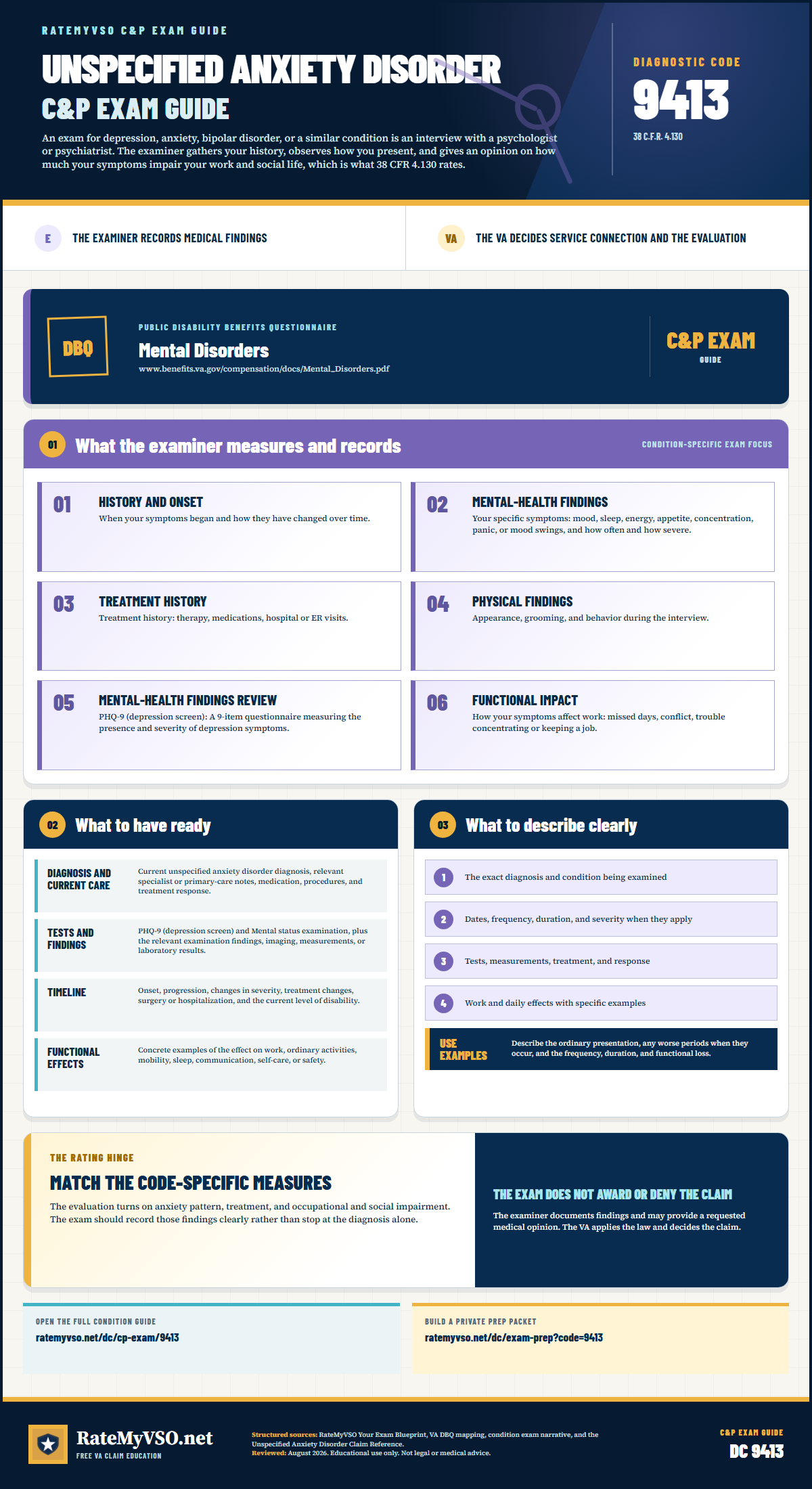
An exam for depression, anxiety, bipolar disorder, or a similar condition is an interview with a psychologist or psychiatrist. The examiner gathers your history, observes how you present, and gives an opinion on how much your symptoms impair your work and social life, which is what 38 CFR 4.130 rates.
DBQ used for this condition
- PPublic formDBQ PSYCH Mental DisordersOpen the public DBQ
What the examination is likely to focus on
Functional-impact topics to describe
- How your symptoms affect work: missed days, conflict, trouble concentrating or keeping a job.
- How they affect relationships, family, and social activities.
- Your ability to handle daily routines and self-care.
- The examiner gives an overall opinion on your level of occupational and social impairment, the scale 38 CFR 4.130 uses to set the rating from 0 to 100 percent.
Which form the examiner uses
For unspecified anxiety disorder (DC 9413), the C&P examiner completes the following Disability Benefits Questionnaire (DBQ):
- DBQ PSYCH Mental Disorders (public PDF on VA.gov)
DBQs are Department of Veterans Affairs Form 21-0960 series documents. Public DBQs are hosted on benefits.va.gov. A handful are examiner-only and are not posted publicly.
What to expect at your C&P exam
An exam for depression, anxiety, bipolar disorder, or a similar condition is an interview with a psychologist or psychiatrist. The examiner gathers your history, observes how you present, and gives an opinion on how much your symptoms impair your work and social life, which is what 38 CFR 4.130 rates.
1Initial interview (history)
- When your symptoms began and how they have changed over time.
- Your specific symptoms: mood, sleep, energy, appetite, concentration, panic, or mood swings, and how often and how severe.
- Treatment history: therapy, medications, hospital or ER visits.
- Alcohol or substance use.
- Relationships, family, and social life.
- Work history and how symptoms affect your job.
- Any thoughts of self-harm or suicide.
2Mental status examination
- Appearance, grooming, and behavior during the interview.
- Speech, mood, and affect (emotional expression).
- Thought process and content, and any delusions or hallucinations.
- Orientation, memory, and concentration.
- Insight, judgment, and impulse control.
- Whether you report thoughts of harming yourself or others.
3Diagnostic tests the examiner may rely on
The examiner may use a validated questionnaire or a structured interview. These are scored tools, not pass/fail tests.
4Functional assessment
- How your symptoms affect work: missed days, conflict, trouble concentrating or keeping a job.
- How they affect relationships, family, and social activities.
- Your ability to handle daily routines and self-care.
- The examiner gives an overall opinion on your level of occupational and social impairment, the scale 38 CFR 4.130 uses to set the rating from 0 to 100 percent.
If you are in crisis or thinking about suicide, call the Veterans Crisis Line at 988 and press 1, or text 838255. It is free, confidential, and available 24/7.
Test explainers open MedlinePlus (NIH National Library of Medicine), or Wikipedia where MedlinePlus has no matching page. This describes what happens and what is measured, not how to influence a result.
What the examiner records (full DBQ form)
The fields below are reproduced from the DBQ form the examiner completes for this diagnostic code. This is the structural map of the form, showing what the examiner is asked to measure, observe, and record. It is a factual reproduction of the public DBQ, not advice on how to answer.
This DBQ evaluates mental disorders (other than PTSD and eating disorders) for VA disability rating, documenting diagnosis, clinical findings, symptoms, behavioral observations, and competency.
How DC 9413 maps to this DBQ: for this diagnostic code specifically, the examiner typically completes sections I-VII of this form. Section I is the condition-specific section for this code.
DIAGNOSIS (Section I)
- A1. Does the Veteran now have or has he or she ever been diagnosed with a mental disorder(s)? NOTE: If the Veteran has a diagnosis of an eating disorder, complete the Eating Disorders Questionnaire, in lieu of this questionnaire. NOTE: If the Veteran has a diagnosis of PTSD, the Initial PTSD Questio
CLINICAL FINDINGS (Section II)
- 2A. Relevant social/marital/family history (pre-military, military, and post-military) Mental Disorders (Other Than PTSD and Eating Disorders)
- 2B. Relevant occupational and educational history (pre-military, military, and post-military)
- 2C. Relevant mental health history, to include prescribed medications and family mental health (pre-military, military, and postmilitary)
- 2D. Relevant legal and behavioral history (pre-military, military, and post-military)
- 2E. Relevant substance abuse history (pre-military, military, and post-military)
- 2F. Other, if any:
SYMPTOMS (Section III)
- 3A. For VA rating purposes, check all symptoms that apply to the Veteran's diagnoses Depressed Mood Anxiety Suspiciousness Panic attacks that occur weekly or less often Panic attacks more than once a week Mental Disorders (Other Than PTSD and Eating Disorders)
BEHAVIORAL OBSERVATIONS (Section IV)
- 4A. Behavioral Observations Mental Disorders (Other Than PTSD and Eating Disorders)
OTHER SYMPTOMS (Section V)
- 5A. Does the Veteran have any other symptoms attributable to mental disorders that are not listed above? Yes No If "Yes," describe
COMPETENCY (Section VI)
- 6A. Is the Veteran capable of managing his or her financial affairs? Yes No If "No," specify each injury or disease resulting in incompetency and provide a rationale to support this finding: Mental Disorders (Other Than PTSD and Eating Disorders)
REMARKS (Section VII)
- 7A. Remarks (Including any testing results), if any:
Rating Levels for DC 9413
The following tiers are reproduced from 38 CFR Part 4, the VA Schedule for Rating Disabilities. Toggle between the official VA criteria and a Plain English explanation.
Plain-English summaries are AI-generated to explain the official criteria. The official 38 CFR language is the binding legal standard. When in doubt, ask a VSO.
Evidence cited in published BVA decisions for DC 9413
The counts below are aggregated from published Board of Veterans Appeals decisions for this diagnostic code, among issues the Board granted or denied (remanded issues are not included). Each row reports how often a given evidence type was discussed in the decision text, broken down by outcome. This is a factual aggregate of the public record, not a prediction or recommendation about any specific claim.
- Service treatment records: appeared in 405 granted decisions (382 denied; 787 decided total)
- Buddy / lay statements: appeared in 376 granted decisions (324 denied; 700 decided total)
- Medical literature: appeared in 40 granted decisions (17 denied; 57 decided total)
Standardized screening instruments at the C&P exam
The following standardized screens are administered at the C&P exam for this diagnostic code. Questions and scoring are reproduced verbatim from VA's General Medical Separation Health Assessment DBQ (the same instruments are used at compensation and pension exams).
Patient Health Questionnaire-2 (PHQ-2) Depression Screen
Two-item depression screen. Each item scored 0-3 (0 = Not at all, 1 = Several days, 2 = More than half the days, 3 = Nearly every day). Total range 0-6.
- Over the past two weeks, how often have you been bothered by little interest or pleasure in doing things?
- Over the past two weeks, how often have you been bothered by feeling down, depressed, or hopeless?
Scoring: Positive screen if total score is 3 or greater.
Suicide Risk Secondary Screen (Columbia-style)
Eight-item secondary screen administered when the primary suicide-risk question elicits any response above 'Not at all'. Positive screen = 'yes' to questions 3, 4, 5, or 8.
- Over the past month, have you wished you were dead or wished you could go to sleep and not wake up?
- Have you actually had any thoughts of killing yourself?
- Over the past month, have you been thinking about how you might do this?
- Over the past month, have you had these thoughts and had some intention of acting on them?
- Over the past month, have you started to work out or worked out the details of how to kill yourself?
- If yes to question 5: At any time in the past month, did you intend to carry out this plan?
- In your lifetime, have you ever done anything, started to do anything, or prepared to do anything to end your life?
- If yes to question 7: Was this within the past three months?
Scoring: Positive screen if 'yes' to question 3, 4, 5, or 8. Immediate emergency response procedures apply when there is concern about an immediate threat.
Alcohol Use Disorders Identification Test - Consumption (AUDIT-C)
Three-item alcohol-use screen. Items scored 0-4 each. Mental-health screening commonly includes AUDIT-C because substance use frequently co-occurs with PTSD, depression, and anxiety.
- How often did you have a drink containing alcohol? (Never / Monthly or less / 2-4 times per month / 2-3 times per week / 4 or more times per week)
- How many drinks containing alcohol did you have on a typical day when you were drinking? (1 or 2 / 3 or 4 / 5 or 6 / 7 to 9 / 10 or more)
- How often did you have six or more drinks on one occasion in the past year? (Never / Less than monthly / Monthly / Weekly / Daily, or almost daily)
Scoring: Positive screen if total score is 5 or more (men). Women's threshold uses a four-or-more-drinks variant of question 3.
What the Board discussed in granted decisions for DC 9413
The themes below were extracted by clustering 500 grant-factor sentences from published Board of Veterans Appeals decisions for this diagnostic code. Frequencies indicate how often each theme appeared in the sample. This is a factual aggregate of the public record, not advice or strategy for any specific claim.
- 24% Benefit of the doubt doctrine legal standard citedThe Board or decision cited the legal standard that when positive and negative evidence is in approximate balance or nearly equal on a material issue, the claimant receives the benefit of the doubt.118 of 500 sample sentences
- 19% VA or private examiner nexus opinion noted as at least as likely as notA VA or private examiner provided a positive nexus opinion finding the Veteran's disability was at least as likely as not incurred in, caused by, or related to active military service.97 of 500 sample sentences
- 17% Board applied benefit of the doubt to assign or affirm a disability ratingThe Board resolved the benefit of the doubt in the Veteran's favor and found that a specific disability rating percentage was warranted for a service-connected condition during the period on appeal.87 of 500 sample sentences
- 14% Evidence found in equipoise on service connection or rating elementThe Board found the lay and medical evidence was at least in relative equipoise on a material element of the claim, such as nexus, onset in service, or whether a higher rating criteria were met.72 of 500 sample sentences
- 11% Benefit of the doubt found inapplicable due to preponderance against claimThe Board found the preponderance or weight of the evidence was persuasively against the claim or higher rating, rendering the benefit of the doubt doctrine inapplicable.55 of 500 sample sentences
- 6% Examiner or vocational expert opinion on unemployability citedA VA examiner, private examiner, or vocational expert opined that the Veteran's service-connected disabilities at least as likely as not precluded substantially gainful employment or rendered the Veteran unemployable.28 of 500 sample sentences
- 4% Finding of fact recorded that anxiety disorder related to serviceThe Board recorded a formal finding of fact that the Veteran's unspecified anxiety disorder was at least as likely as not incurred in or related to active duty military service.18 of 500 sample sentences
- 3% Secondary service connection nexus opinion recordedAn examiner opined that a claimed disability was at least as likely as not proximately due to, the result of, or aggravated by an already service-connected disability.16 of 500 sample sentences
- 2% Benefit of the doubt applied to TDIU effective date or grantThe Board applied the benefit of the doubt doctrine to find the Veteran entitled to a total disability rating based on individual unemployability (TDIU) or to establish an earlier effective date for TDIU.9 of 500 sample sentences
When the Board found the exam inadequate (DC 9413)
In 351 published Board of Veterans' Appeals decisions involving this condition, the Board found a C&P examination or medical opinion inadequate. Where the defect could be read from the decision, it was most often one of the following (counts are a floor from the decisions on file, not a total):
- 99 Failed to address a contention or part of the condition
- 75 Conclusion given without a supporting rationale
- 46 Veteran's lay statements not considered
- 23 Opinion relied on the absence of records instead of the evidence
- 16 Flare-ups or functional loss not addressed
- 14 Claims file or records not reviewed
- 7 Examiner said an opinion would require speculation
- 7 Exam too old to reflect current severity
- 6 Wrong legal standard or question applied
An inadequate exam is usually sent back for a new one rather than decided against the veteran. This is a factual report of published decisions, not advice about any exam or claim; whether an exam is adequate is decided case by case.
Disclaimer: This page reproduces public Department of Veterans Affairs forms (DBQs) and verbatim text from 38 CFR Part 4 (the VA Schedule for Rating Disabilities). It is informational only and is not legal or medical advice. For guidance on a specific claim, contact a VA-accredited representative.