VA Future Reexaminations
Most veterans assume the VA reviews every rating every few years. Most ratings are never reexamined. The exceptions are narrow and rule-driven, and the rules tell you in advance which ratings can be revisited and which cannot.

The four situations where VA can schedule a future reexamination
1. The rating schedule itself requires it Per-condition rule
Some diagnostic codes have built-in reexamination requirements written into the rating criteria. The most common: active cancers, conditions in remission with a mandatory wait-and-watch period, organ transplants, and certain blood and infectious disease ratings.
2. Temporary 100 percent rating after hospitalization Paragraph 29
A veteran hospitalized for more than 21 days for a service-connected condition can receive a temporary 100 percent rating during the hospital stay. A reexamination is scheduled to determine the ongoing rating once the temporary 100 percent period ends. (see 38 CFR § 4.29)
3. Temporary 100 percent rating after surgery / convalescence Paragraph 30
A temporary 100 percent convalescence rating can be granted after surgery requiring at least one month of recovery, or after immobilization by cast of one or more major joints. A reexamination is scheduled at the end of the convalescence period. (see 38 CFR § 4.30)
4. Prestabilization rating Paragraph 28
The VA can issue a prestabilization rating of 50 or 100 percent immediately after separation when the condition is severe and unstable. A reexamination is mandatory within 6 to 12 months to assign a permanent rating. (see 38 CFR § 4.28)
Where VA is prohibited from scheduling a reexamination
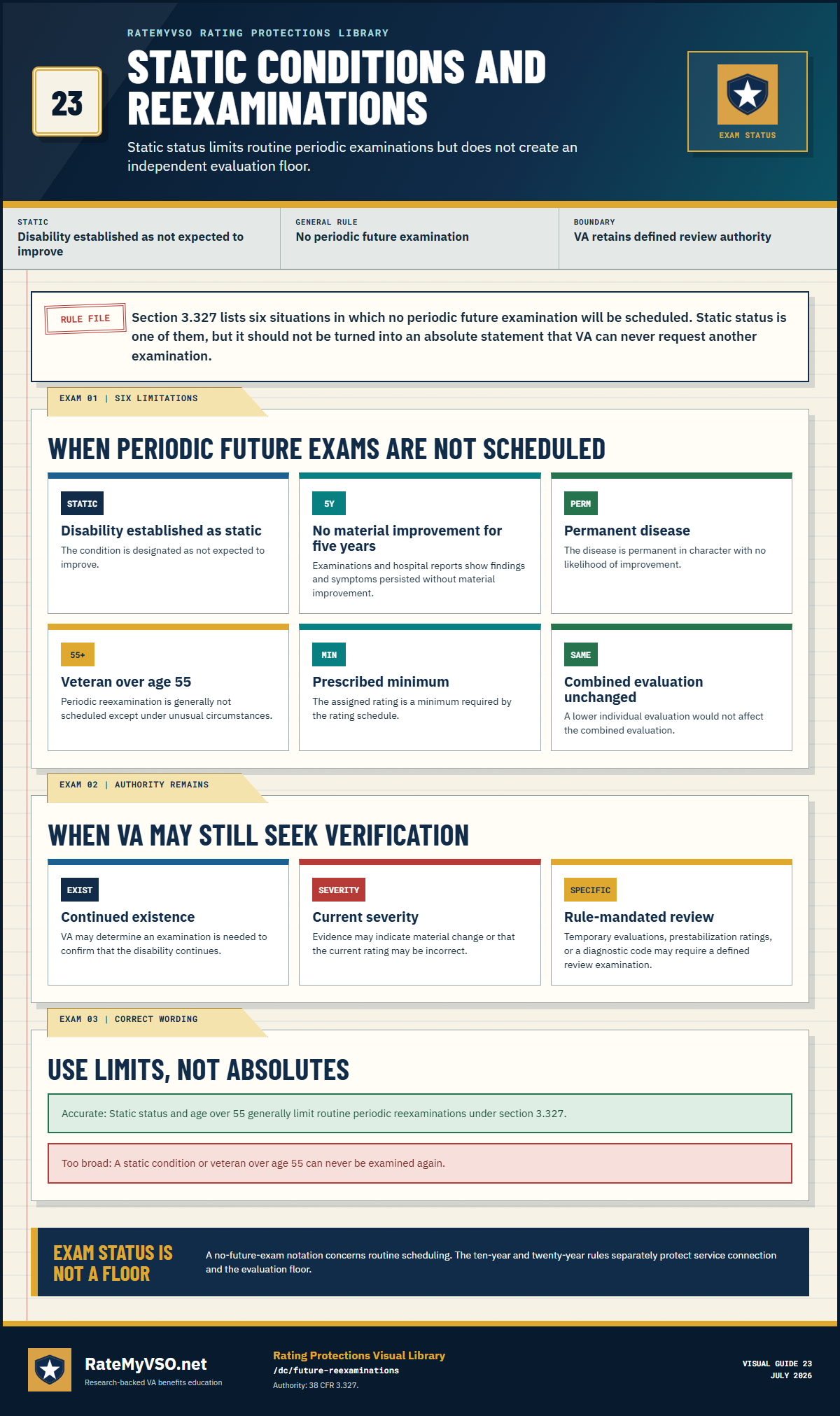
The VA is specifically prohibited from scheduling a reexamination when any one of the following applies (see 38 CFR § 3.327(b)(2)):
- Static disability. The condition is unlikely to improve (for example, complete amputation, total blindness, anatomical loss).
- Stable for 5+ years. Symptoms have persisted at the same level for at least 5 years and the disability is not likely to improve.
- Veteran is over 55. Other than for unusual circumstances or where the rating schedule explicitly requires it.
- Minimum rating. The current rating is at the minimum rating provided for the condition.
- Combined rating wouldn't change. A future change in the individual rating would not change the combined rating.
- Rating is 10 percent or less. Except in rare cases.
Conditions where the rating schedule itself requires reexamination
The following conditions have a built-in reexamination requirement written into their rating criteria, grouped by body system. Select a category to see its conditions and the reexamination timing. This list is not exhaustive; the diagnostic-code text controls in each case.
Cancer (active malignancies)20
- Breast cancer6 months after treatment / remission
- Chronic myelogenous leukemia6 months after treatment
- Digestive-system cancer6 months after treatment / remission
- Ear cancer6 months after treatment / remission
- Endocrine cancer6 months after treatment / remission
- Eye cancer6 months after treatment / remission
- Genitourinary cancer6 months after treatment / remission
- Gynecological cancer6 months after treatment / remission
- Hodgkin’s lymphoma6 months after treatment / remission
- Leukemia6 months after treatment
- Malignant melanoma6 months after treatment / remission
- Multiple myeloma5 years after treatment / remission
- Muscle cancer6 months after treatment / remission
- Non-Hodgkin’s lymphoma2 years after treatment / remission
- Oral cancer6 months after treatment / remission
- Respiratory-system cancer6 months after treatment / remission
- Skin cancer6 months after treatment / remission
- Soft-tissue sarcoma (non-vascular)6 months after treatment / remission
- Soft-tissue sarcoma (vascular)6 months after treatment / remission
- Solitary plasmacytoma6 months after treatment / remission
Blood & bone-marrow disorders9
- Acquired hemolytic anemia6 months after release
- Agranulocytosis6 months after release
- Aplastic anemia6 months after treatment / release
- Essential thrombocythemia6 months after treatment / release
- Immune thrombocytopenia6 months after treatment
- Myelodysplastic syndromes6 months after treatment / release
- Pernicious anemia6 months after treatment / release
- Polycythemia vera6 months after treatment / release
- Primary myelofibrosis6 months after treatment / release
Organ transplants4
- Heart transplant1 year after release
- Kidney transplant1 year after release
- Liver transplant1 year after release
- Pancreas transplant1 year after release
Cardiovascular4
- Aortic aneurysm6 months after release
- Heart valve replacement6 months after release
- Large-artery aneurysm6 months after release
- Ventricular arrhythmias6 months after release
Infectious disease6
- Hyperinfection syndromeImmediately after going inactive
- Leprosy6 months after treatment / remission
- Liver abscess6 months after original diagnosis
- Non-TB mycobacterium infectionImmediately after going inactive
- TuberculosisImmediately after going inactive
- Visceral leishmaniasis6 months after treatment / remission
Digestive3
- Chronic liver disease6 months after treatment
- Peptic ulcer3 months after surgery / release
- Rectal prolapse2 months after repair
Endocrine2
- Hyperparathyroidism6 months after release / treatment
- Hypothyroidism6 months after release
Mental health & temporary ratings3
- Hospitalization ≥ 21 days (mental)6 months after release
- Medical board, mental (trauma)Within 6 months of separation
- Prestabilized medical-board conditions6–12 months after separation
How the reexamination process works
- Scheduling notice. VA mails a notice that a reexamination has been scheduled, with the date, time, location (or telehealth instructions), and the conditions being reexamined.
- The exam. Conducted by a VA examiner or a VA-contracted examiner (LHI, QTC, VES, MSLA). Same DBQ format as the original C&P exam.
- Proposed rating. If the examiner finds the condition improved, the VA issues a rating decision proposing a reduction. This is a proposal, not a final decision.
- 60-day predetermination period. You have 60 days to submit additional evidence and 30 days to request a predetermination hearing before any reduction becomes final.
- Final decision and effective date. If the reduction is finalized, it becomes effective the first day of the month following 60 days after the final notice.
If you miss a scheduled reexamination
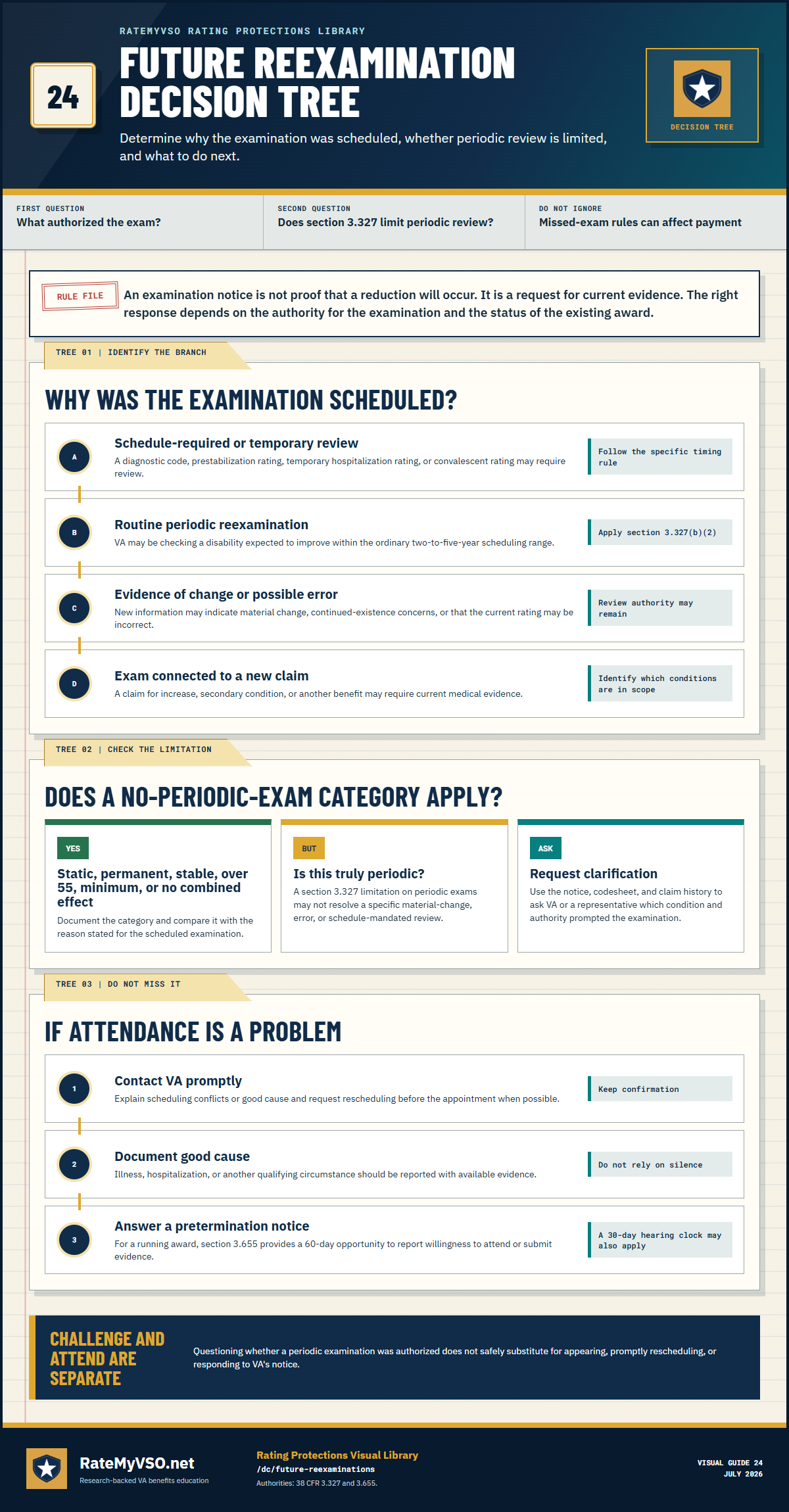
Failure to report for a scheduled VA examination without good cause leads to specific automatic consequences depending on the type of claim (see 38 CFR § 3.655):
- Original claim: rated on the evidence of record (often resulting in a denial if no medical evidence exists).
- Reopened or supplemental claim: denied for failure to report.
- Reexamination of an existing rating: rating reduced to 0 percent (unless the condition has 5-year stabilization or other protection in place).
How to challenge an unauthorized reexamination notice
If you receive a notice and believe the reexamination is prohibited under one of the bars listed above (over 55, stable 5+ years, static disability, minimum rating, etc.):
- Do not skip the exam. Failure to report has automatic consequences regardless of whether the notice was procedurally proper.
- File VA Form 21-4138 (Statement in Support of Claim) before the exam, identifying the specific bar in 38 CFR § 3.327(b)(2) that applies and asking for the exam to be cancelled.
- If the VA proceeds with the exam anyway, attend, then preserve the procedural argument in any subsequent response to a proposed reduction.
- If a reduction is proposed despite the procedural bar, raise both the procedural argument and the substantive evidence (that the condition has not improved) in your predetermination response.
Sources and authority
- 38 CFR § 3.326 - Examination requested in connection with claims
- 38 CFR § 3.327 - Reexaminations
- 38 CFR § 3.344 - Stabilization of disability evaluations
- 38 CFR § 3.655 - Failure to report for examination
- 38 CFR § 4.28 - Prestabilization rating
- 38 CFR § 4.29 - Hospital ratings
- 38 CFR § 4.30 - Convalescent ratings
- VA Policy Letter 21-01 - Future Examinations (VBA internal policy guidance)
Frequently asked questions
Is the VA "watching" my rating year by year?
No. Most ratings are issued and never revisited unless a specific reexamination was scheduled in the rating decision or the veteran files a new claim. Routine VA healthcare visits are not tied to rating reviews.
I am over 55 and got a reexamination notice. Is that legal?
It can be. Age 55 limits ROUTINE periodic reexaminations under 38 CFR § 3.327(b)(2); it does not make you immune from every future exam. VA retains authority to schedule one at any age to verify the disability still exists, confirm its current severity, address a material change, or correct a possible rating error, and it can do so when the diagnostic code itself requires reexamination (cancers, transplants, etc.). If your case does not fit one of those, raise the bar in writing on VA Form 21-4138 before the exam date.
The notice says my rating "may be reduced." Does that mean it will be?
No. The notice language is boilerplate. The actual reduction can happen only after the examination, a proposed rating decision, a 60-day predetermination period, and a final rating decision. You have multiple chances to submit evidence before a reduction takes effect.
If I have been at 100 percent for 20 years, can the VA reduce me?
Evaluations that have been continuously in effect for 5 or more years are protected by the "stabilization" rule: VA must show "material improvement" demonstrable in ordinary conditions of life (see 38 CFR § 3.344(a)). After 20 years at the same rating, the rating becomes effectively permanent and cannot be reduced absent fraud (see 38 USC § 110). See the rating protections guide.
I missed the exam because I never got the notice. What now?
File VA Form 21-4138 immediately with the explanation, request that the rating be restored, and ask the VA to reschedule the exam. Good cause for non-receipt (wrong address, mail not delivered, on travel) is recognized under 38 CFR § 3.655. Provide whatever evidence supports the non-receipt (move date, USPS hold, etc.).
The VA scheduled a reexamination for my PTSD that has been at 70 percent for 8 years. Can they?
Subject to the 5-year stabilization rule under 38 CFR § 3.344(a) and the procedural bars in 3.327(b)(2). A reexamination is not automatically barred, but a reduction after the exam must be supported by evidence of material improvement, not just one examiner's snapshot. Mental-health ratings are a frequent area of disputed reductions. Representation is recommended.
If the reexamination is for a cancer that the schedule requires, what should I expect?
The reexamination is typically scheduled at the end of the post-treatment window built into the diagnostic code (commonly 6 months after treatment ends). The post-treatment rating is based on residual symptoms or organ damage. If the cancer is in stable remission with no residuals, the rating may drop to 0 percent for that diagnostic code. If residuals exist (scarring, organ dysfunction, etc.), the rating reflects those.
RateMyVSO. Educational resource. Not affiliated with the U.S. Department of Veterans Affairs. Not legal advice. All RateMyVSO tools are free. Find a VSO representative for personalized guidance.