Proposed Rating Reduction: Your Due Process Rights
When VA proposes to reduce your service-connected disability rating, federal regulations give you a 60-day window to submit evidence and a separate right to a predetermination hearing. Authority: 38 CFR § 3.105(e) for the proposal procedure and § 3.105(i) for the hearing right.
What Is a Proposed Reduction?
A proposed rating reduction is VA's preliminary determination that your disability has improved enough to warrant a lower rating. It is NOT a final decision. The proposal starts a procedural window during which you can submit evidence, request a hearing, and persuade VA to abandon the proposal.
Proposals usually arise after:
- A scheduled "future exam" (Reexamination Code 31) showing improvement.
- A C&P exam tied to an unrelated claim that incidentally documented improvement.
- VA's review of medical records during a different claim.
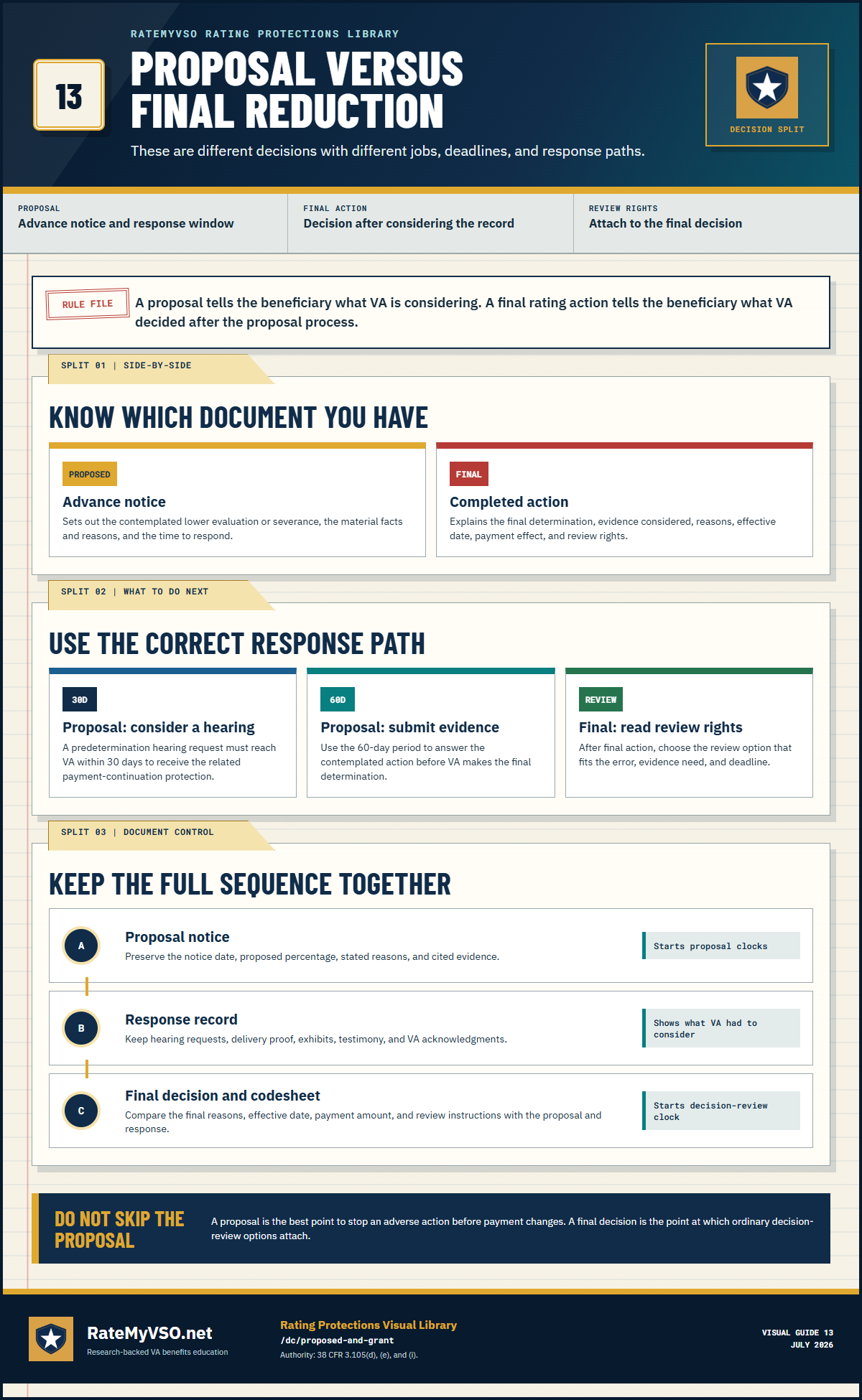
Proposal vs Final Reduction
Proposal
Reg: § 3.105(e)
Effect: Notice only. Your current rating stays in place. Pay continues at current level.
Your right: 60 days to submit evidence + 30 days to request a hearing.
Final Reduction
Reg: § 3.105(e) implementation
Effect: Issued after the 60-day evidence window closes. The reduction itself does not take effect immediately, it becomes effective the last day of the month in which a further 60-day period, counted from the date of notice of this final action, expires. That is a separate clock from the original proposal notice.
Your right: Higher-Level Review, Supplemental Claim, or Board appeal under AMA.
Most veterans confuse the proposal with the final decision. The proposal is the warning, the moment to act.
The 60-Day Notice Window
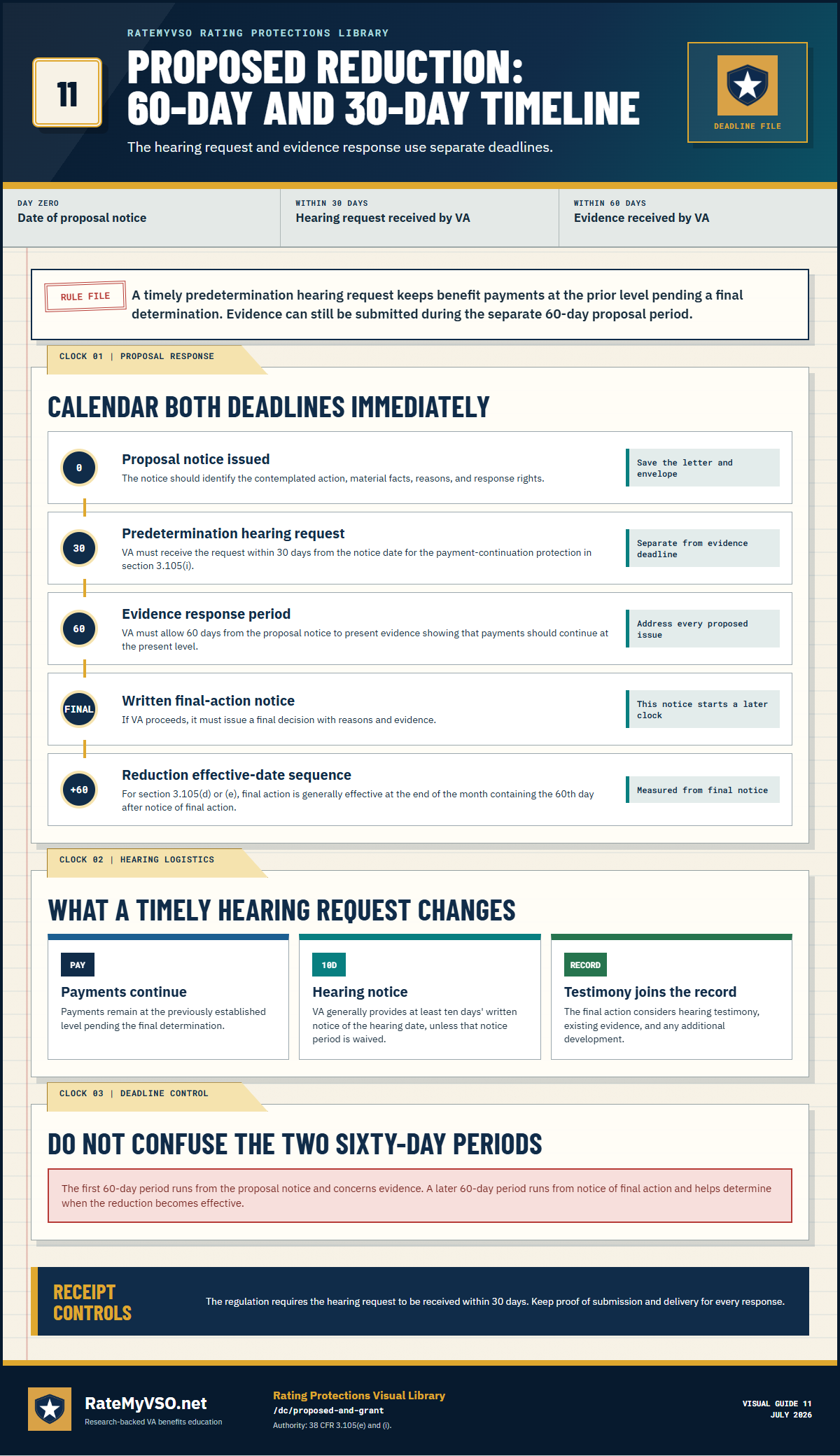
When VA proposes to reduce a rating that would result in lower compensation, VA must (see 38 CFR § 3.105(e)):
- Notify you in writing of the proposed action and the reasons.
- Give you 60 days from the date of notice to present evidence showing the reduction should not be made.
- Give you 30 days from the date of notice to request a predetermination hearing.
- Continue paying at the current rate during the 60-day window.
The 60-day window is a hard deadline. Evidence submitted after the window is considered as part of any subsequent appeal but does not delay the final reduction.
Predetermination Hearing Right
You have a right to request a predetermination hearing within 30 days of the proposal notice (see 38 CFR § 3.105(i)). The hearing is informal, you (and your representative) appear before a VA decision-maker and present evidence and argument.
If you request a hearing, the proposal cannot become final until the hearing is held and the hearing officer considers the evidence presented. This effectively extends the procedural window.
Hearings can be conducted in person at the regional office, by telephone, or by video. The format does not affect the substantive consideration.
What Stops the Reduction
The legal standard for reducing a rating is exacting. Under Brown v. Brown, 5 Vet. App. 413 (1993) and 38 CFR § 3.344, VA must show:
- Sustained improvement, not a temporary fluctuation, but lasting change.
- Improvement is reflected in actual physical or mental improvement, not just lower exam findings.
- Improvement under the ordinary conditions of life and work, meaning the veteran can function in everyday life and employment, not just during a controlled exam.
- Examination at least as full and complete as the exam that established the higher rating.
If any of these is not met, the reduction is improper and the proposal should be withdrawn. Many proposals fail because the underlying C&P exam is shorter, less detailed, or conducted by a less-qualified examiner than the original.
Evidence That Wins
- Treatment records from the past year showing the disability has not improved (or has worsened).
- Treating physician statement directly contradicting the C&P examiner's findings, with specific reference to the symptoms and limitations the examiner overlooked.
- Functional impact statements describing how the disability affects work and daily life, directly addressing the "ordinary conditions of life and work" standard.
- Medication records showing the same or higher dose of medications used to manage the condition (improvement that requires the same medication isn't really improvement).
- Witness statements from family, employers, or coworkers describing functional limitations as observed.
- Expert critique of the C&P exam identifying methodological flaws (shorter than the original exam, examiner not properly qualified, exam conducted under unusual conditions).
Protected Ratings (5 / 10 / 20-Year Rules)
Some ratings are protected from reduction by federal regulation regardless of medical improvement:
- 5-year stabilization rule (38 CFR § 3.344(a)(b)(c)): ratings in effect for 5+ years require evidence of sustained improvement under § 3.344(a) standards.
- 10-year stabilization rule (38 CFR § 3.957): service connection itself cannot be severed after 10 years except in cases of fraud, or where military records show you did not have the requisite service or a qualifying discharge for the period the rating was based on.
- 20-year continuous total rating (38 CFR § 3.951(b)): a rating that has been in effect at any level for 20+ continuous years cannot be reduced below the lowest level it held during that period, except in fraud cases.
These protections apply automatically, VA must consider them before issuing a proposal. If you have a 5+ year rating, the § 3.344 standards apply. If you have a 20+ year continuous rating, reduction below that level is essentially blocked.
See the Rating Reductions Guide for the full protection framework.
After the Final Reduction
If VA issues a final reduction despite your evidence:
- Higher-Level Review (HLR): file VA Form 20-0996. A senior reviewer reexamines the same evidence under a "difference of opinion" standard. Often successful when the original adjudicator misapplied § 3.344.
- Supplemental Claim: file VA Form 20-0995 with new evidence (additional treatment records, expert opinions) within 1 year to preserve the effective date.
- Board appeal: file VA Form 10182 to request Direct Review (no new evidence), Evidence docket (new evidence allowed), or Hearing docket (testimony before a Veterans Law Judge).
An HLR reviewer looks at whether the original decision correctly applied § 3.344 and Brown v. Brown. Briefing those standards precisely gives the reviewer a specific legal error to correct.
Common Mistakes
- Treating the proposal as a final decision. The proposal is a window to act, not a verdict. Use the 60 days.
- Not requesting the predetermination hearing. The 30-day hearing-request window is separate from the 60-day evidence window. File both.
- Missing the protection rules. A 5+ year rating triggers § 3.344 protections. A 20+ year continuous rating is essentially un-reducible. Cite the rule explicitly.
- Submitting only treatment records without commentary. Records alone may not contradict the C&P exam. Pair them with a treating physician statement that explicitly addresses the examiner's findings.
- Not appealing if the reduction goes through. HLR gives a senior reviewer a fresh look at whether § 3.344 and Brown v. Brown were followed. Don't give up after the final decision.
Related Tools and Guides
This page is educational and is not legal advice. Reduction proposals are time-sensitive and procedurally complex, work with a VA-accredited representative.