Radiation-Exposed Veterans Presumption
VA presumptively service-connects 21 diseases for veterans who participated in specific radiation-risk activities, atmospheric nuclear tests, the Hiroshima/Nagasaki occupation, Enewetak cleanup, Palomares and Thule response efforts, and more (see 38 CFR §3.309(d)). This page reproduces the regulation with plain-English context.

How §3.309(d) works
If a veteran participated in one of the "radiation-risk activities" listed in the regulation and later develops one of the 21 listed diseases, the VA presumes the disease is connected to service (see 38 CFR §3.309(d)). The presumption is rebuttable, meaning the VA can in principle rebut it with affirmative evidence, but the veteran does not need to prove in-service exposure or a medical nexus (see 38 CFR §3.307).
What service connection still requires: Even when the presumption applies, a veteran must have a current diagnosis of the listed disease. The presumption relieves the burden of proving the in-service exposure and the medical nexus linking it to the condition, it does not eliminate the need for a current diagnosis.
Radiation-risk activities (§3.309(d)(3)(ii))
The regulation defines "radiation-risk activity" as one of the following. The list is exclusive, if the activity is not on this list, the §3.309(d) presumption does not apply, though §3.311 (the dose-based pathway) may still apply.
(A)Atmospheric nuclear test participation
Onsite participation in a test involving the atmospheric detonation of a nuclear device. "Atmospheric detonation" includes underwater nuclear detonations. See the list of covered atmospheric test operations below.
(B)Occupation of Hiroshima or Nagasaki (Aug 6, 1945 – Jul 1, 1946)
The occupation of Hiroshima or Nagasaki, Japan, by United States forces during the period beginning on August 6, 1945, and ending on July 1, 1946. "Occupation" means official military duties within 10 miles of the city limits of either Hiroshima or Nagasaki.
(C)POW in Japan (WWII) with Hiroshima/Nagasaki-comparable exposure
Internment as a prisoner of war in Japan (or service on active duty in Japan immediately following such internment) during World War II which resulted in an opportunity for exposure to ionizing radiation comparable to that of the United States occupation forces in Hiroshima or Nagasaki during the period beginning on August 6, 1945, and ending on July 1, 1946.
(D)Gaseous diffusion plants (Paducah, Portsmouth, Oak Ridge K-25) or Amchitka Island
Service of at least 250 days before February 1, 1992, on the grounds of a gaseous diffusion plant located in Paducah, Kentucky; Portsmouth, Ohio; or the K-25 area at Oak Ridge, Tennessee, provided the veteran was monitored through dosimetry badges or served in a position with comparable exposures. Also: service before January 1, 1974, on Amchitka Island, Alaska, in connection with the Long Shot, Milrow, or Cannikin underground nuclear tests.
(E)Department of Energy Special Exposure Cohort-equivalent service
Service in a capacity which, if performed as an employee of the Department of Energy, would qualify the individual for inclusion as a member of the Special Exposure Cohort under section 3621(14) of the Energy Employees Occupational Illness Compensation Program Act of 2000 (42 U.S.C. 7384l(14)).
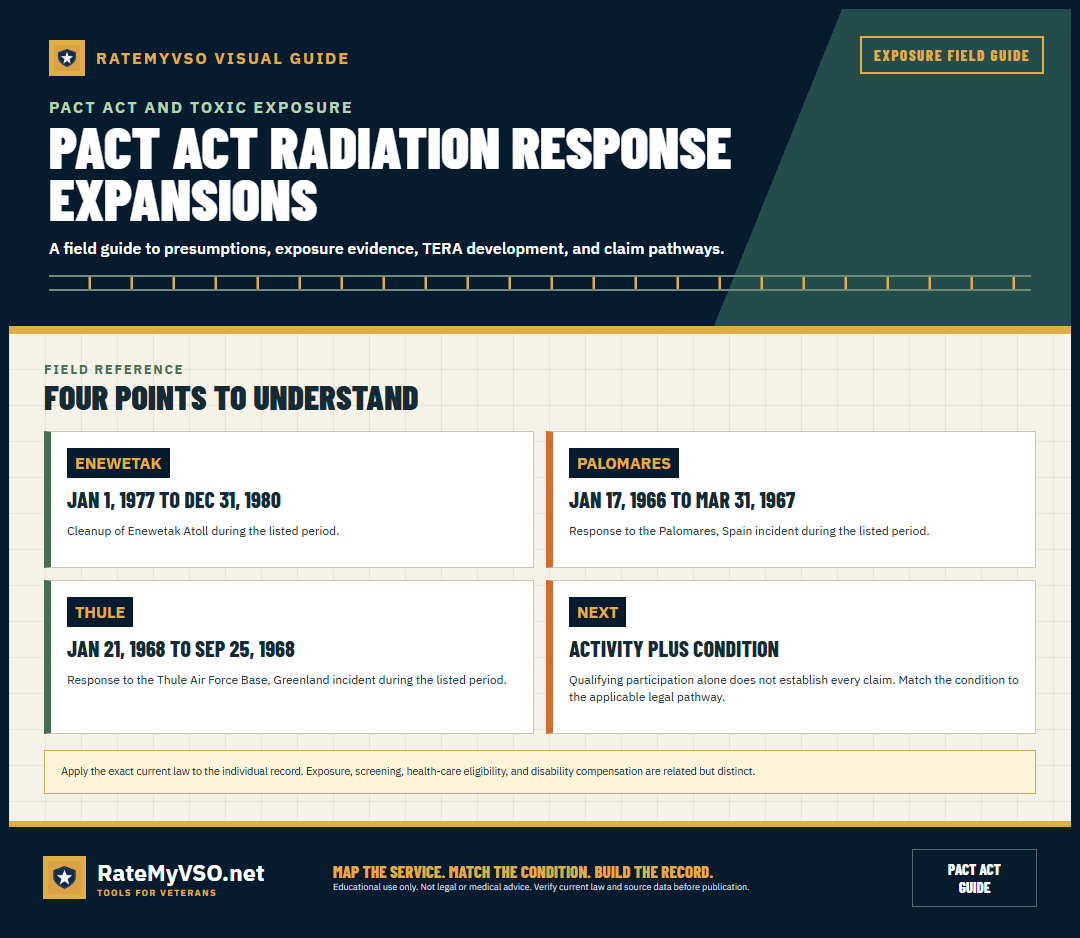
(F)Enewetak Atoll cleanup (Jan 1, 1977 – Dec 31, 1980)
Cleanup of Enewetak Atoll during the period beginning on January 1, 1977, and ending on December 31, 1980.
(G)Palomares, Spain response (Jan 17, 1966 – Mar 31, 1967)
Onsite participation in the response effort following the collision of a United States Air Force B-52 bomber and refueling plane that caused the release of four thermonuclear weapons in the vicinity of Palomares, Spain, during the period beginning January 17, 1966, and ending March 31, 1967.
(H)Thule Air Force Base, Greenland response (Jan 21 – Sep 25, 1968)
Onsite participation in the response effort following the on-board fire and crash of a United States Air Force B-52 bomber that caused the release of four thermonuclear weapons in the vicinity of Thule Air Force Base, Greenland, during the period beginning January 21, 1968, and ending September 25, 1968.
Presumptive conditions (§3.309(d)(2))
If a veteran participated in one of the radiation-risk activities above, the following 21 diseases are presumptively service-connected when they become manifest:
- Leukemia (other than chronic lymphocytic leukemia)
- Cancer of the thyroid
- Cancer of the breast
- Cancer of the pharynx
- Cancer of the esophagus
- Cancer of the stomach
- Cancer of the small intestine
- Cancer of the pancreas
- Multiple myeloma
- Lymphomas (except Hodgkin's disease)
- Cancer of the bile ducts
- Cancer of the gall bladder
- Primary liver cancer (except if cirrhosis or hepatitis B is indicated)
- Cancer of the salivary gland
- Cancer of the urinary tract
- Bronchiolo-alveolar carcinoma
- Cancer of the bone
- Cancer of the brain
- Cancer of the colon
- Cancer of the lung
- Cancer of the ovary
Defined terms (§3.309(d)(3)(i) – (vii))
Radiation-exposed veteran
A veteran who while serving on active duty, or an individual who while a member of a reserve component of the Armed Forces during a period of active duty for training or inactive duty training, participated in a radiation-risk activity.
Atmospheric detonation
Includes underwater nuclear detonations.
Onsite participation
(A) During the official operational period of an atmospheric nuclear test, presence at the test site, or performance of official military duties in connection with ships, aircraft or other equipment used in direct support of the nuclear test.
(B) During the six-month period following the official operational period, presence at the test site or other test staging area to perform official military duties in connection with completion of projects related to the nuclear test, including decontamination of equipment.
(C) Service as a member of the garrison or maintenance forces on Eniwetok during the periods June 21, 1951 – July 1, 1952; August 7, 1956 – August 7, 1957; or November 1, 1958 – April 30, 1959.
(D) Assignment to official military duties at Naval Shipyards involving the decontamination of ships that participated in Operation Crossroads.
Occupation of Hiroshima or Nagasaki
Official military duties within 10 miles of the city limits of either Hiroshima or Nagasaki, Japan, which were required to perform or support military occupation functions such as occupation of territory, control of the population, stabilization of the government, demilitarization of the Japanese military, rehabilitation of the infrastructure, or deactivation and conversion of war plants or materials.
Atmospheric nuclear test operations covered
The regulation defines the "operational period" for each of the following United States atmospheric tests. "Onsite participation" during the operational period, or within six months after, qualifies as a radiation-risk activity under §3.309(d)(3)(ii)(A).
| Operation | Operational period |
|---|---|
| TRINITY | July 16, 1945 – August 6, 1945 |
| CROSSROADS | July 1, 1946 – August 31, 1946 |
| SANDSTONE | April 15, 1948 – May 20, 1948 |
| RANGER | January 27, 1951 – February 6, 1951 |
| GREENHOUSE | April 8, 1951 – June 20, 1951 |
| BUSTER-JANGLE | October 22, 1951 – December 20, 1951 |
| TUMBLER-SNAPPER | April 1, 1952 – June 20, 1952 |
| IVY | November 1, 1952 – December 31, 1952 |
| UPSHOT-KNOTHOLE | March 17, 1953 – June 20, 1953 |
| CASTLE | March 1, 1954 – May 31, 1954 |
| TEAPOT | February 18, 1955 – June 10, 1955 |
| WIGWAM | May 14, 1955 – May 15, 1955 |
| REDWING | May 5, 1956 – August 6, 1956 |
| PLUMBBOB | May 28, 1957 – October 22, 1957 |
| HARDTACK I | April 28, 1958 – October 31, 1958 |
| ARGUS | August 27, 1958 – September 10, 1958 |
| HARDTACK II | September 19, 1958 – October 31, 1958 |
| DOMINIC I | April 25, 1962 – December 31, 1962 |
| DOMINIC II / PLOWSHARE | July 6, 1962 – August 15, 1962 |
Other pathways if §3.309(d) does not apply
The §3.309(d) presumption is not the exclusive pathway for radiation-related claims. Other pathways include:
- Dose-based pathway: If a radiogenic disease first became manifest after service and the veteran was exposed to ionizing radiation in service (but the activity is not on the §3.309(d) list), the VA performs a dose assessment and may still grant service connection (see 38 CFR §3.311). See the §3.311 reference page →
- Direct service connection. A veteran may always attempt to establish direct service connection by showing a current diagnosis, an in-service event or exposure, and a medical nexus linking the two. See the three elements of service connection →
Source and currency
Authority: 38 U.S.C. 1110, 1112, 1131. Originally codified at 41 FR 55873 (Dec. 23, 1976), with subsequent amendments.
Regulation text: 38 CFR §3.309 on eCFR.gov (official text, always current).
Data on this page: Reproduced from the eCFR Title 38 snapshot dated 2026-04-20. The eCFR link above is authoritative if it differs.
Scope and limitations
Not the exclusive pathway. This page describes one specific presumption (§3.309(d)). Other regulations, direct service connection, and §3.311 dose-based claims may apply separately.
Not legal advice, not a claim filing. This page provides factual reference only. It is not legal advice, does not establish representation, and does not constitute the filing of any claim. For case-specific guidance, find an accredited VSO representative.
Data vintage. Regulatory text pulled from eCFR on 2026-04-22. Regulations are amended periodically; always verify against the eCFR link above.
Current diagnosis still required. The presumption eliminates the need to prove in-service exposure and medical nexus for listed activity + disease combinations. It does not eliminate the need for a current diagnosis or the rebuttable-presumption provisions of §3.307.