The VA's Duty to Assist: What the VA Must Do for Your Claim
The VA is required by federal law to help veterans develop their disability claims. This is not a favor or a courtesy. It is a statutory obligation under 38 U.S.C. 5103A and 38 CFR 3.159, and missing it is one of the most common errors that gets a denial reversed on appeal. Knowing what the Duty to Assist covers, and what it does not, lets you spot when the VA owes you action.

What the Duty to Assist actually is
The Duty to Assist (DTA) is a statutory obligation, codified at 38 U.S.C. 5103A and implemented at 38 CFR 3.159. It requires the VA to make reasonable efforts to help a claimant obtain the evidence needed to substantiate the claim, and to provide a medical examination or opinion when the record meets a specific three-part trigger.
The two halves
- Records. Request records the VA has identified as relevant, in five categories.
- Medical evidence. Order a C&P exam or obtain a medical opinion when the three-part test is satisfied.
The foundation
- 5103 notice. A written explanation to the claimant of what evidence is needed and who is responsible for getting it.
- Reasonable efforts standard. Two documented attempts is the usual benchmark for non-federal sources.
The 5103 notice: where the duty starts
The VA must tell a claimant what evidence is needed to substantiate the claim, what evidence the VA will try to obtain, and what evidence the claimant is responsible for providing (see 38 U.S.C. 5103). This notice is the foundation of the entire Duty to Assist.
- For claims filed on or after March 24, 2015, the 5103 notice is built into VA Form 21-526EZ and the VA.gov online claim form. No separate transmission is required.
- For older legacy claims, a separate Veterans Claims Assistance Act (VCAA) notice letter was issued.
- A missing or defective 5103 notice can be grounds for remand on appeal at the Board of Veterans' Appeals.
Records the VA must request
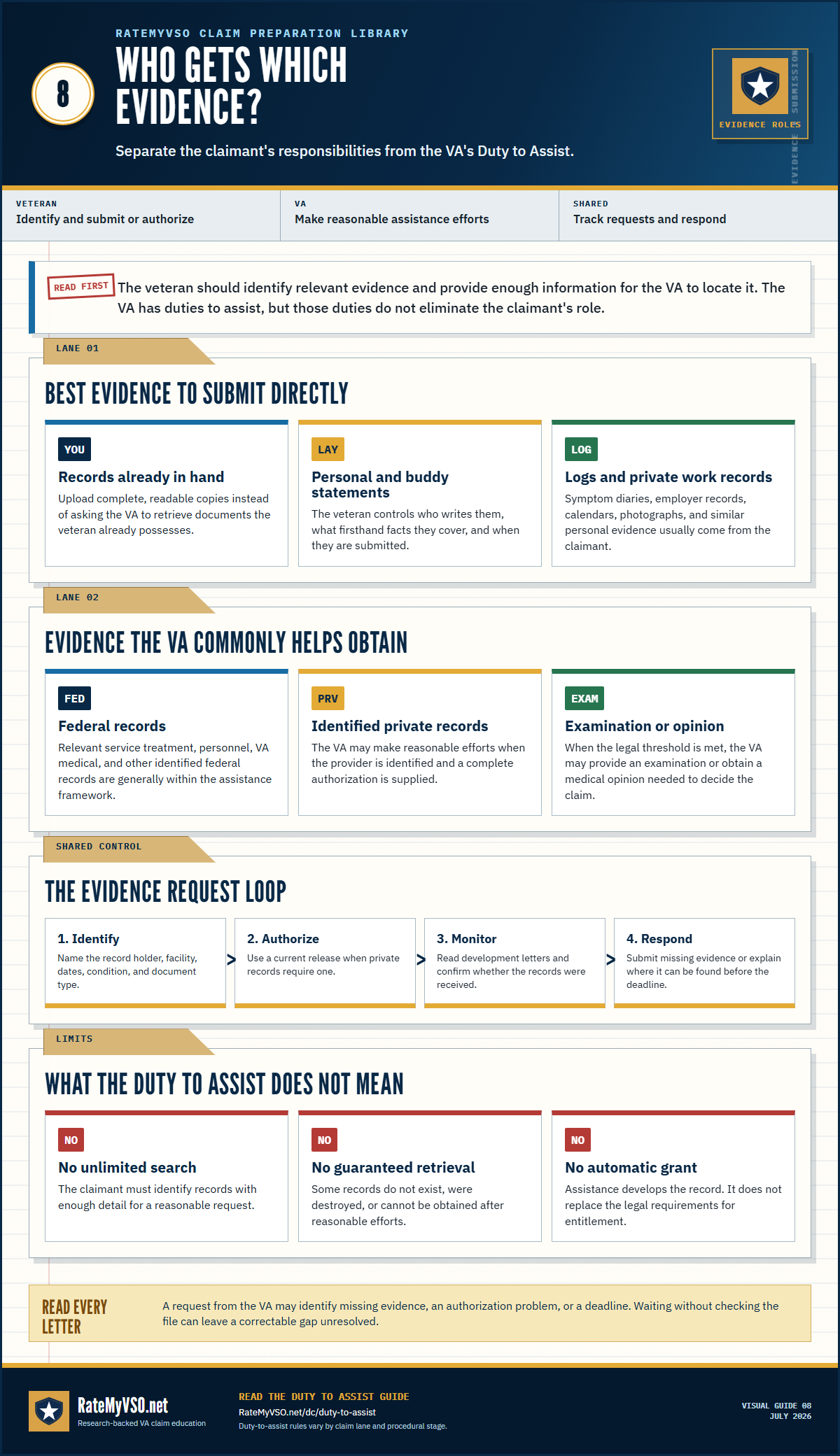
The VA's obligation to obtain records breaks into five categories. Some are pulled automatically. Others require a release authorization (typically VA Form 21-4142) before the VA can act.
Military records (medical and personnel) Auto-requested
Service treatment records (STRs), military personnel records, and post-separation military medical files are pulled automatically once the claim is logged. Personnel records are often pulled specifically when the claim involves PTSD, toxic exposure, or in-service stressors that need verification. National Guard and Reserve records are sometimes overlooked. Veterans with that service history should confirm those records are in the claim file.
Federal non-military records, medical Auto-requested
VA Medical Center (VAMC) records, VA contract medical files, and Social Security Administration disability records are obtained by the VA on its own initiative. Vet Center records are an exception: they require a separate written release because of stricter confidentiality rules for Vet Center counseling.
Federal non-military records, non-medical Auto-requested
Prior federal employment records (Office of Personnel Management, federal HR files) are pulled when a claim involves Total Disability Individual Unemployability (TDIU) and the veteran's work history is at issue.
Private medical records Release required
The VA can request private medical records on the veteran's behalf, but only after the veteran identifies the provider and signs VA Form 21-4142 (or the VA.gov equivalent). If the veteran mentions private treatment but does not provide records or a release, the VA's duty is to request both the records and the release authorization, not to drop the issue.
Employment (non-federal) Release required
For TDIU claims, the VA contacts former civilian employers using VA Form 21-4192 (Request for Employment Information). The veteran identifies the employers. The VA does the outreach. Two reasonable attempts is the standard before the VA can proceed without a response.
Other identified sources Mixed
When the veteran names someone with personal knowledge of the condition (a former squadmate, a spouse, a coworker), the VA is required to inform the veteran that a lay or "buddy" statement can be submitted from that person. The VA does not contact the third party directly. It tells the veteran how to gather the statement.
When the VA must order a C&P exam
The Duty to Assist requires the VA to order a Compensation and Pension exam, or obtain a medical opinion, only when all three of the following are present in the record. This is the "McLendon test," named after the Court of Appeals for Veterans Claims decision that codified the standard (McLendon v. Nicholson, 20 Vet. App. 79 (2006)).
| Element | What is required |
|---|---|
| 1 | Competent evidence of a current diagnosed disability or persistent or recurrent symptoms of a disability. |
| 2 | Evidence establishing an in-service event, injury, or disease, or a service-connected disability that may have caused or aggravated the claimed condition. |
| 3 | An indication that the disability or symptoms may be associated with service or with a service-connected disability. This is a low bar, often called the "low threshold" McLendon prong. |
Duty triggered
- All three elements above are present, even minimally.
- A supplemental claim adds new and relevant evidence that completes the three-part test.
- An ambiguous or insufficient C&P exam was already done and the rater needs a clarification or addendum.
Duty not triggered
- No current diagnosis and no symptoms in the record.
- No in-service event documented and no service-connected primary condition.
- Supplemental claim with no new and relevant evidence beyond what was already considered.
- The condition can be granted at the maximum schedular rating without an exam.
Limits on the Duty to Assist
The duty is not unlimited. The VA can stop or decline development when one of the following applies.
- No reasonable possibility of substantiation. If the requested evidence could not, by its nature, change the outcome of the claim, the VA need not pursue it (38 CFR 3.159(d)).
- Inherently incredible or clearly lacking merit. A claim with no plausible basis under the law does not invoke the duty.
- Lack of legal eligibility. If the claimant is not a veteran, not eligible by service character, or is filing for a benefit they cannot legally receive, the duty does not apply.
- Veteran non-response. If the VA requests information (a release, identifying details for a provider) and the veteran does not respond within 30 days, the VA may decide the claim on the available record.
- No fee payment. The VA will not pay private providers to release records. The veteran remains ultimately responsible for cost.
- No court orders. The VA will not seek subpoenas or court orders against third parties to obtain records.
Four situations where the VA stops assisting
- The evidence would not advance the claim. Documented in the file with the rater's reasoning.
- The claim is inherently incredible. Rare and high bar. Not the same as "weak."
- The claimant lacks veteran status, qualifying service, or legal eligibility. A character-of-discharge issue can trigger this. See the discharge upgrade pathway if applicable.
- The benefit has no legal basis. Filing for a benefit category that does not exist under Title 38 cannot invoke the duty.
What you still have to do
The Duty to Assist is real, but it is not a substitute for participation. The veteran has independent obligations:
- Identify the evidence. The VA cannot pull records it does not know about. Name providers, employers, and time periods on the claim form or VA Form 21-4142.
- Respond within 30 days. When the VA writes asking for a release or clarification, missing the 30-day window can let the VA decide without that evidence.
- Attend C&P exams. A no-show without good cause results in the claim being decided on the existing record, which usually means denial of the conditions that needed exam findings (38 CFR 3.655).
- Update your address. If the VA cannot reach you, exam notices and decision letters do not arrive, and missed-exam consequences still apply.
- Track your file. The VA's claim status page on VA.gov shows open "requests." Each open request is an action item that, if unanswered, stalls the claim.
Primary authorities
- 38 U.S.C. 5103 (notice of information and evidence). law.cornell.edu/uscode/text/38/5103
- 38 U.S.C. 5103A (duty to assist claimants). law.cornell.edu/uscode/text/38/5103A
- 38 CFR 3.159 (VA assistance in developing claims). law.cornell.edu/cfr/text/38/3.159
- 38 CFR 3.655 (consequences of failure to report for examination).
- McLendon v. Nicholson, 20 Vet. App. 79 (2006) (three-part test for VA's duty to provide a medical exam).
- M21-1, Part I (VA adjudication procedures manual, notification and development).
Frequently Asked Questions
How many times must the VA try to get a private medical record?
Two documented attempts is the usual benchmark for non-federal sources. For federal records (VAMC, military, SSA), the VA must keep trying until the records are obtained or it is reasonably certain they do not exist. The VA must notify the veteran in writing if records cannot be obtained.
The VA didn't schedule a C&P exam for one of my claimed conditions. Is that a violation?
Not automatically. The VA only owes an exam when all three elements of the McLendon test are present: a current diagnosis or symptoms, an in-service event or service-connected primary, and at least an indication the two may be related. If any element is missing on the face of the record, the VA can deny without ordering an exam. If you believe all three were present, raise it on appeal.
The VA asked me to sign a release and I missed the 30-day window. What now?
The VA may decide the claim on the existing record, which often means denial of the condition that needed the missing records. The fix is usually to file a Supplemental Claim with the records (or a new release) once you obtain them. The Supplemental Claim restarts development on that condition. See the appeals guide.
Will the VA pay my private doctor to release my records?
No. The VA does not pay record retrieval or copying fees to private providers. The veteran is responsible for any fees the provider charges. Some providers waive the fee for VA disability claims, but the policy is not uniform.
Are my Vet Center counseling records automatically pulled?
No. Vet Center records have stricter confidentiality rules than VAMC records and require a separate written release. If you want them considered, identify the Vet Center and sign the specific release the Vet Center provides.
What is a "5103 notice" and how do I know I got one?
The 5103 notice is the VA's written explanation of what evidence is needed for your specific claim and who is responsible for getting each piece. For claims filed on or after March 24, 2015, the notice is built into the VA Form 21-526EZ and VA.gov filing flow. For older legacy claims, it was a separate letter sometimes called a "VCAA letter." If you cannot find one in your file and your claim was filed before 2015, this can be a remand issue on appeal.
If the VA misses its Duty to Assist, what happens?
On appeal, the Board of Veterans' Appeals can remand the claim back to the Regional Office to cure the defect (order the missing exam, request the missing record, send a corrected notice). A DTA violation does not by itself win a claim, but it usually buys another development cycle. The Veterans Appeals Improvement and Modernization Act lanes (Supplemental Claim, Higher-Level Review, Board appeal) each have their own rules for raising DTA issues.
RateMyVSO. Educational resource. Not affiliated with the U.S. Department of Veterans Affairs. Not legal advice. All RateMyVSO tools are free. Find a VSO representative for personalized guidance.