DIC: Dependency and Indemnity Compensation
Tax-free monthly payments from VA to surviving spouses, children, and dependent parents of veterans who died from a service-connected condition. In some cases, survivors also qualify if the veteran was rated 100% for 10+ years before death. This guide explains who qualifies, current 2026 rates, and how to file.

Looking at the bigger picture? DIC sits next to VA Pension, military retirement, CRDP, and CRSC. The pension guide explains how all the survivor and retiree income streams interact.
What DIC Is
DIC stands for Dependency and Indemnity Compensation. It is a tax-free monthly payment from the Department of Veterans Affairs to eligible survivors of a deceased veteran or servicemember. DIC is different from VA Survivors Pension, which is income-based. DIC for spouses and children is not income-based. Parents' DIC is income-based and is a separate program.
Authority: 38 U.S.C. Chapter 13 (§§ 1310–1322). Regulations at 38 CFR § 3.5.
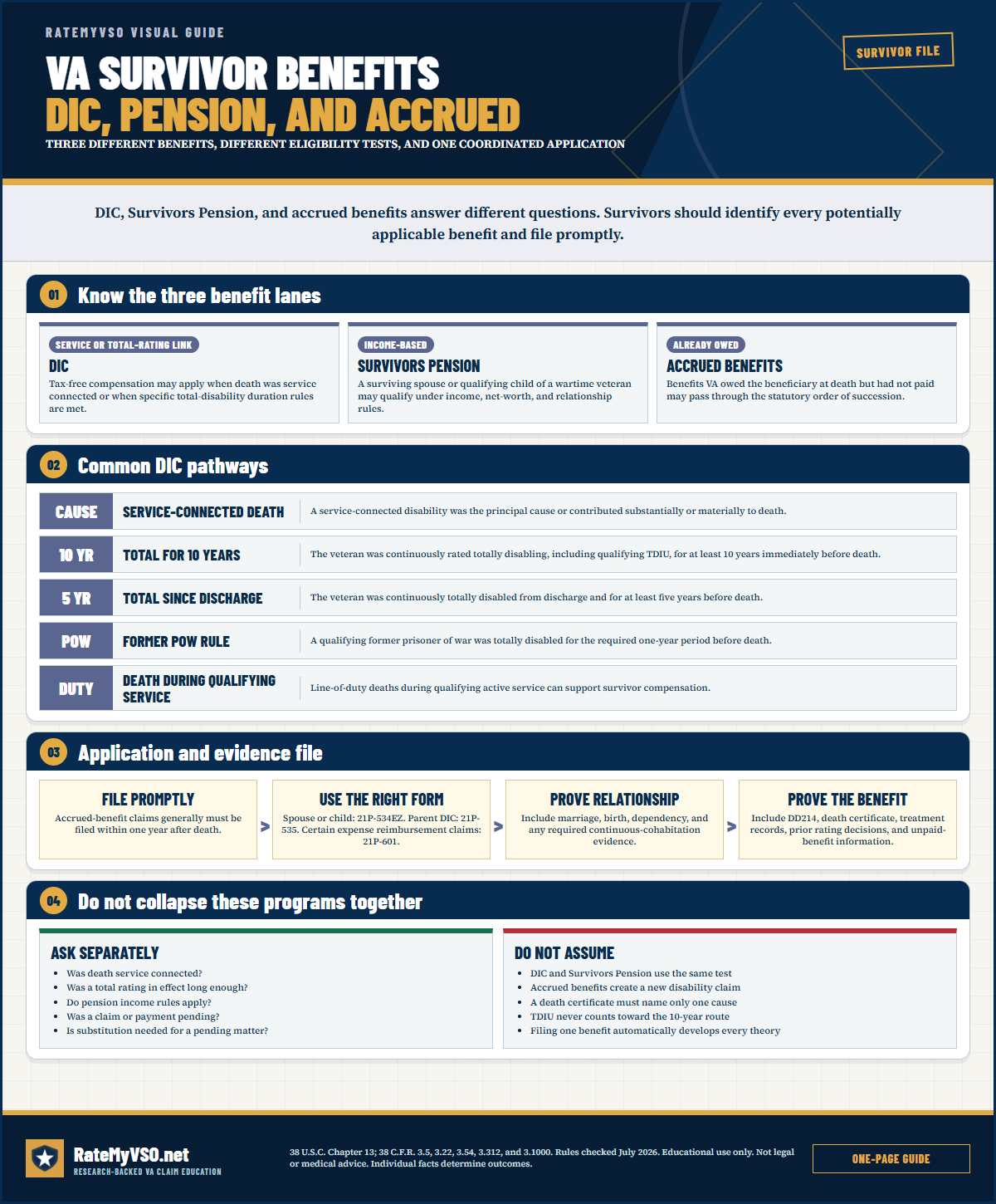 One-page guide: VA Survivor Benefits: DIC, Pension, and Accrued
Separate DIC, Survivors Pension, and accrued benefits, then match the application and evidence. Opens the full-size chart, free to save or print.
One-page guide: VA Survivor Benefits: DIC, Pension, and Accrued
Separate DIC, Survivors Pension, and accrued benefits, then match the application and evidence. Opens the full-size chart, free to save or print.
Do I Qualify? (Surviving Spouse)
There are three main pathways to DIC for a surviving spouse. You only need to meet one.
| Pathway | What it Requires |
|---|---|
| Service-Connected Death (§ 1310) | Veteran died from a service-connected disability, either as the principal cause or a contributory cause of death. The veteran did not have to be rated for that condition during life. |
| 10-Year Rule (§ 1318) | Veteran was continuously rated 100% (schedular or TDIU) for at least 10 years immediately before death. Death does not need to be service-connected. Variants: 5 years if rated since discharge; 1 year if a former POW who died after Sept 30, 1999. |
| Active-Duty Death | Servicemember died in the line of duty on active duty, active duty for training, or inactive-duty training. DIC is paid as if the death were service-connected. |
Marriage duration rules (§ 3.54)
To be considered a surviving spouse, you must have lived with the veteran continuously until death (a separation that was not your fault still counts) and meet at least one of these marriage tests:
- Married to a service member who died on active duty, active duty for training, or inactive duty training, OR
- Married for at least 1 year before the veteran's death, OR
- Married within 15 years of the end of the period of service in which the fatal condition was incurred or aggravated, OR
- Married before January 1, 1957, OR
- A child was born of the marriage (any duration).
Authority: 38 CFR § 3.50 (surviving spouse definition) | 38 CFR § 3.54 (marriage dates)
Remarriage Rules (The Biggest Misconception)
What the rule actually says
- Remarried at age 55 or older (on or after Jan 5, 2021): DIC continues.
- Lost DIC by remarrying between ages 55 and 57 before that change: you can now have DIC reinstated, effective January 5, 2021.
- Remarried below 55: DIC is terminated as of the date of remarriage.
- If your later marriage ends (through death, divorce, or annulment): you may reapply and DIC can resume.
What about "Love Lives On"?
The Love Lives On Act has been introduced in multiple sessions of Congress. It would remove the age restriction entirely so that remarriage at any age would preserve DIC. It is not law as of 2026. Track its status on Congress.gov if this affects you.
The 10-Year Rule (§ 1318 DIC)
This is one of the most overlooked pathways to DIC. Even if the veteran died of something unrelated to service (a heart attack, cancer not on a presumptive list, an accident), the surviving spouse and children may still qualify if the veteran was rated totally disabling for the required length of time before death.
The three variants
- 10 years: Veteran was continuously rated 100% (schedular) or TDIU for at least 10 years immediately preceding death.
- 5 years: Veteran was rated totally disabling continuously from the date of discharge and for at least 5 years immediately preceding death.
- 1 year (POW): Veteran was a former Prisoner of War who died after September 30, 1999, and was rated totally disabling for at least 1 year immediately preceding death.
The "hypothetical entitlement" bar
Under Rudd v. Nicholson, 20 Vet. App. 296 (2006), the VA will not retroactively say "the veteran would have been rated 100% for 10 years if he had filed." The rating must have actually been in place. There are narrow exceptions: clear and unmistakable error (CUE) in a prior final VA decision, newly-discovered service-department records, or rare "entitled to receive but not actually receiving" cases (e.g., waived for retirement pay). If a prior rating decision looks clearly wrong, a VSO or accredited attorney can evaluate a CUE theory. Find a VSO near you.
Authority: 38 U.S.C. § 1318 | 38 CFR § 3.22
Children and Dependent Parents
Dependent children (§ 3.57)
An unmarried child of the deceased veteran may qualify if they are:
- Under age 18, OR
- Ages 18–23 and attending an approved school full-time, OR
- A "helpless child" (permanently incapable of self-support due to a disability that arose before age 18). This designation has no age cap. A helpless child who has been receiving DIC can continue to receive it for life.
If a child marries and that marriage later ends after October 31, 1990, DIC entitlement is permanently lost unless the marriage was annulled or void.
A child adopted out of the veteran's family may still be eligible for DIC if all other eligibility rules are met.
Parents' DIC (§ 1315)
Biological, adoptive, and foster parents of the deceased veteran may qualify for Parents' DIC, a separate, income-based program from spouse/child DIC. The payment uses a sliding scale that decreases as countable income rises.
Key points:
- The income limits are published annually on the VA's Parents' DIC rates page.
- If you live with a spouse, your spouse's income counts too.
- When countable income is over the limit set by law, no Parents' DIC is payable.
- Many income sources are excluded from the count: Supplemental Security Income (SSI), life insurance proceeds, state bonuses, and a portion of retirement income. A parent who thinks they "make too much" often still qualifies after exclusions.
- Aid & Attendance add-on is available if the parent is bedridden, in a nursing home, blind, or needs help with daily activities.
- Receiving Parents' DIC may disqualify a parent from SSI going forward. This is worth discussing with a VSO or benefits counselor.
Authority: 38 U.S.C. § 1315 | 38 CFR § 3.57
2026 Monthly Rates (Effective December 1, 2025)
DIC rates adjust annually each December with the Social Security COLA. The figures below are the current rates for veterans who died on or after January 1, 1993.
Surviving spouse: base and add-ons
| Amount | Condition | Monthly |
|---|---|---|
| Base rate | Surviving spouse, flat rate (regardless of veteran's rank) | $1,699.36 |
| 8-year kicker | Veteran was rated totally disabled (a 100% rating or individual unemployability, TDIU) continuously for at least the 8 full years immediately before death, and you were married to the veteran for all 8 of those years | +$360.85 |
| Aid & Attendance | You are bedridden, in a nursing home, blind, or need help with daily activities | +$421.00 |
| Housebound | You are substantially confined to your home by a permanent disability. Cannot be combined with A&A. | +$197.22 |
| Transitional benefit | First 2 years only, if you have a child under 18 in your household | +$359.00 |
| Per dependent child | Each dependent child under 18 in your household | +$421.00 |
| Medal of Honor spouse | Special statutory rate for surviving spouse of a Medal of Honor recipient | $5,780.00 |
Parents' DIC
Parents' DIC rates depend on whether you are the veteran's only surviving parent, whether you are remarried and living with a spouse, and whether you live with the veteran's other surviving parent, plus countable income. Starting rates for 2026 range from about $576–$842/month and decrease as income rises. Because there are many variables, check the official table: Parents' DIC rates on VA.gov. Aid & Attendance adds about $458/month.
Children's DIC (when no eligible spouse)
When there is no eligible surviving spouse, DIC is paid directly to eligible children. The current sole-child rate is published on the VA survivor rates page. It does not rise by a flat amount per child: as of December 1, 2025, one eligible child receives $717.50 a month, two receive $1,032.18 in total, and three receive $1,346.92 in total. Check the official table for larger families.
DIC and SBP: The "Widow's Tax" Is Gone
For decades, surviving spouses who received both the Survivor Benefit Plan (SBP) annuity from the Department of Defense and DIC from the VA had their SBP reduced dollar-for-dollar by DIC. This cost many widows roughly $925 per month. It was known as the "Widow's Tax" or the SBP-DIC offset.
Who SBP covers
The Survivor Benefit Plan is a Department of Defense program that pays an eligible beneficiary up to 55% of a service member's retired pay after the member's death. Coverage is automatic and costs nothing for members who die on active duty, and for reserve component members who die of a service-connected cause while performing inactive duty training. Active-duty members can buy coverage when they retire, and reserve component members can elect coverage once they have 20 years of qualifying service for reserve retired pay. Details: DoD Survivor Benefit Plan.
Why many survivors still don't know
SBP is administered by DFAS (the Defense Finance and Accounting Service). DIC is administered by the VA. The two agencies do not cross-reference each other's databases. If you were previously told your SBP would be reduced by DIC, that guidance is out of date. Check your DFAS statement to confirm you are receiving the full SBP amount.
Reference: DFAS SBP-DIC Offset FAQ (PDF)
How to File for DIC
-
Choose the right form
Surviving spouse or child: VA Form 21P-534EZ, Application for DIC, Survivors Pension, and/or Accrued Benefits. Parents: VA Form 21P-535. Surviving spouse or child, active-duty death: VA Form 21P-534a, typically completed with your military casualty assistance officer. A surviving parent uses 21P-535 whether the death was on active duty or later.
Filing by mail: Department of Veterans Affairs, Pension Intake Center, PO Box 5365, Janesville, WI 53547-5365. VA requires direct deposit to receive VA benefit payments. -
File an Intent to File immediately
Call the VA at 1-800-827-1000 or submit VA Form 21-0966 to lock in your effective date while you gather documents. This preserves up to 1 year of potential retroactive pay. -
Gather supporting documents
VA may ask for the veteran's marriage certificate, the veteran's death certificate if the veteran did not die in a VA health care facility, children's birth certificates or adoption papers, and the veteran's birth certificate. Also gather the veteran's DD-214 and final medical records. For service-connected-death claims, also gather evidence linking the cause of death to the service-connected condition. A treating-physician letter or an independent medical opinion is often decisive. -
Submit through a VSO
An accredited Veterans Service Officer files DIC claims free of charge. They know which supporting forms are needed for A&A (VA Form 21-2680) or nursing-home status (VA Form 21-0779). Find a VSO near you. -
If denied, appeal
Under the AMA framework you have three lanes: Higher-Level Review, a Supplemental Claim with new evidence, or a Notice of Disagreement to the Board of Veterans' Appeals. You have 1 year from the decision date to file. -
Denied for cause of death before July 2026? New grounds may apply.
VA updated its adjudication manual (M21-1, Part XII, Subpart i, 1.B.1.h) in July 2026 to require examiners to evaluate every condition listed on the death certificate as a contributing cause of death, not just the primary one, when requesting a medical opinion. If a DIC claim was denied and the medical opinion only addressed the death certificate's primary cause, this manual update may support a Supplemental Claim. A VSO can help evaluate whether it applies to your case.
Other Benefits That Come With DIC Eligibility
DIC eligibility leads to several additional survivor benefits. If you qualify for DIC, you likely qualify for one or more of these:
CHAMPVA health insurance
Health coverage for survivors when the veteran died of a service-connected condition or was rated permanently and totally disabled at death.
CHAMPVA details ↗Chapter 35 / DEA education benefits
Education and training benefits for surviving spouses and dependent children when the veteran died from an SC condition or was rated P&T.
DEA details ↗Home Loan Guaranty
The unmarried surviving spouse of a veteran who died from a service-connected cause can get a VA home loan. So can a spouse who remarried at 57 or older (on or after Dec 16, 2003), and some spouses of veterans who died of other causes after being rated totally disabled for 10 years before death, from discharge for at least 5 years, or 1 year for a former POW. The spouse of an active-duty service member listed as missing in action (MIA) or a prisoner of war (POW) for at least 90 days can also qualify, one time only. Unmarried surviving spouses receiving DIC may be exempt from the funding fee.
VA home loans ↗Burial and plot allowance
VA contributes toward burial and plot costs. Higher amounts for SC-death cases.
Burial benefits ↗Commissary & exchange access
Surviving spouses of SC-death or P&T-at-death veterans retain commissary and exchange shopping privileges.
Access program ↗State-level survivor benefits
Many states offer property-tax exemptions, tuition waivers, and other benefits for surviving spouses. Coverage varies widely by state.
Search your state →DoD death gratuity
A one-time, tax-free payment of $100,000 to eligible survivors of service members who die on active duty or while serving in certain reserve statuses. The amount is the same whatever the cause of death. It is meant to help in the period right after the death, before other survivor benefits begin.
Death gratuity details ↗Restored Entitlement Program for Survivors
An added special benefit may be payable to certain survivors of a service member who died on active duty before August 13, 1981, or of a veteran who died from a service-connected disability incurred or aggravated before August 13, 1981. The amount is based on information from the Social Security Administration.
VA survivor compensation ↗8 Common DIC Mistakes Survivors Make
1. Assuming the death certificate has to name the SC condition
It doesn't. Under 38 CFR § 3.312, a service-connected condition that contributed substantially or materially to death qualifies, even if the death cert lists only a non-SC cause. A treating-physician letter linking the two is often all it takes.
2. "We weren't married long enough"
There are several marriage tests and you only have to pass one: married to a service member who died on active duty, 1-year marriage, the 15-year service-period window, married before 1957, or a child born of the marriage. Many spouses who assume they're ineligible actually aren't.
3. "He wasn't 100% rated, so we can't get DIC"
DIC for a service-connected death has no rating-percentage prerequisite. If death was caused by an SC condition at any rating, DIC is payable (see 38 USC § 1310). The 100% rule only applies to the 10-year pathway under 38 USC § 1318.
4. "Remarriage means I lose everything forever"
Not since 2021. Remarriage at age 55 or older preserves DIC and CHAMPVA. The home loan needs remarriage at 57 or older, and DEA education ends on remarriage before 57. If a later marriage ends, you may reapply.
5. "My SBP will be reduced by DIC"
Outdated information. The SBP-DIC offset was fully eliminated on January 1, 2023. You now receive both SBP and DIC in full. If your DFAS statement still shows a reduction, contact DFAS.
6. "TDIU doesn't count for the 10-year rule"
TDIU (Individual Unemployability paid at the 100% rate) counts as "totally disabling" for both § 1310 and § 1318 purposes. See our TDIU guide.
7. "My adult disabled son can't get anything because he's over 18"
Wrong if he meets the "helpless child" standard: permanently incapable of self-support due to a disability that arose before age 18. Helpless-child DIC has no age cap.
8. "We make too much for Parents' DIC"
The income calculation excludes SSI, life insurance proceeds, state bonuses, and a portion of retirement income. Many parents who assume they're over the limit actually qualify once exclusions are applied. A VSO can run the numbers for you at no charge.
Related Tools and Guides
This guide is for educational purposes only and is not legal or medical advice. DIC rules, rates, and forms change. Verify current information at va.gov. For personalized help filing a DIC claim, find an accredited VSO near you. VSO services are always free.