How to Add or Remove a VA Dependent
If your VA disability rating is 30% or higher, a spouse, child, or dependent parent adds money to your monthly check. This guide shows you which form to file, what evidence VA needs for each type of dependent, how far back the pay can reach, and how to remove a dependent after a divorce or when a child ages out, so you avoid a debt notice later.

- Got married, had a baby, or adopted? Go to Section 3 (How to Add). File within one year of the event to protect your back pay (Section 4).
- Divorced, or a child turned 18 or left school? Go to Section 5 (How to Remove). Report it fast to avoid an overpayment.
- Just want to know what it pays? Section 6 explains how dependents change the monthly amount.
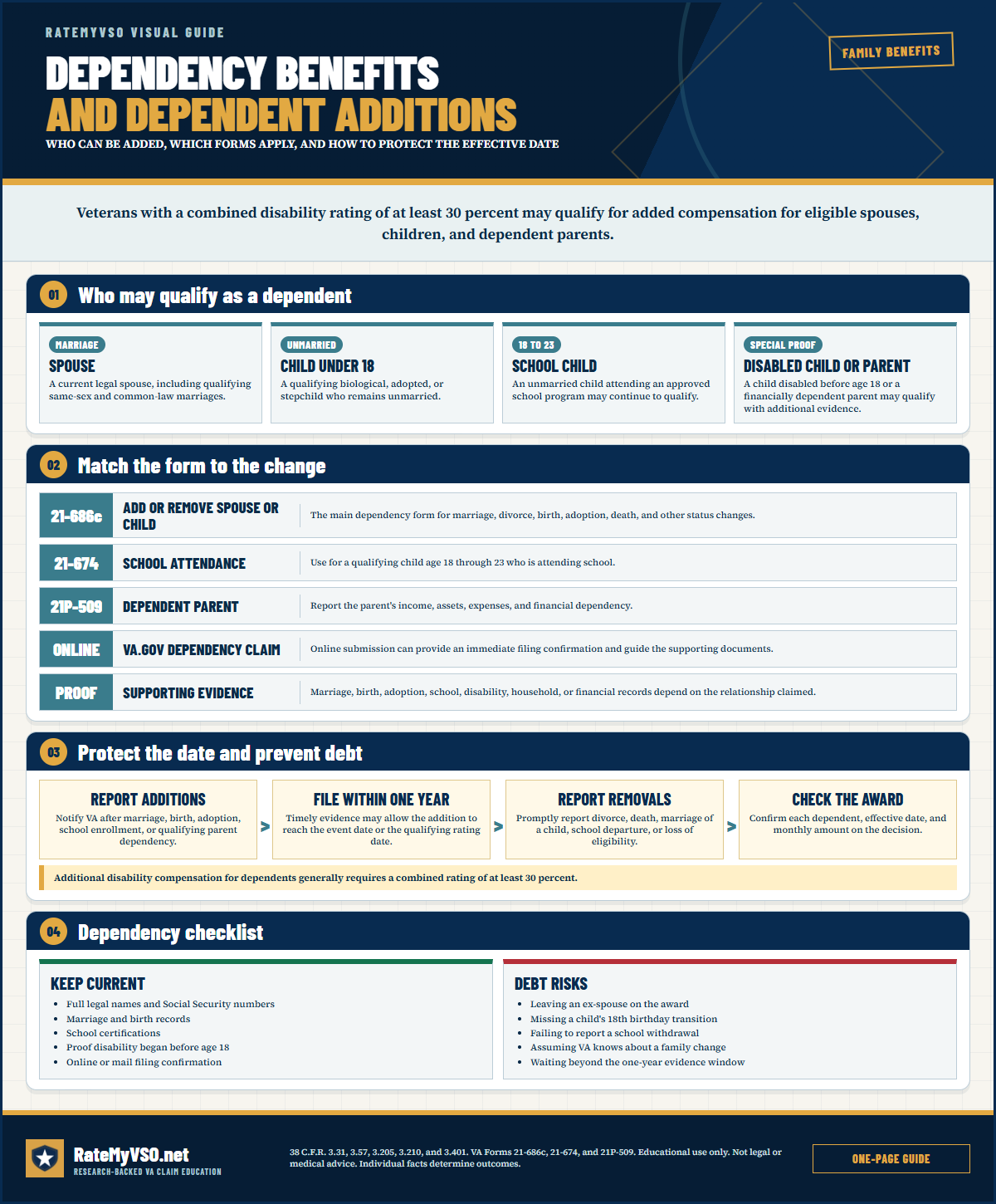 One-page guide: Dependency Benefits And Dependent Additions
Match each dependent type to the correct form, proof, effective-date rule, and removal duty. Opens the full-size chart, free to save or print.
One-page guide: Dependency Benefits And Dependent Additions
Match each dependent type to the correct form, proof, effective-date rule, and removal duty. Opens the full-size chart, free to save or print.
1. Who Counts as a Dependent
VA recognizes four kinds of dependents for extra disability compensation. Each one has its own proof requirements, covered in Section 3.
| Dependent | Who qualifies | Key requirement |
|---|---|---|
| Spouse | A current legal husband or wife. VA recognizes same-sex and common-law marriages. | Proof of a valid marriage. (see 38 CFR § 3.205) |
| Child under 18 | An unmarried biological child, stepchild, or legally adopted child under 18. | Proof of birth or adoption. A stepchild must be a member of your household. (see 38 CFR § 3.210) |
| School child 18-23 | An unmarried child age 18 to 23 enrolled full time at an approved school. | VA Form 21-674, re-certified each term. (see 38 CFR § 3.57) |
| Helpless child | An unmarried child who became permanently unable to support themselves before turning 18. | Medical proof the disability began before age 18. (see 38 CFR § 3.356) |
| Dependent parent | A biological, adoptive, or in-loco-parentis parent whose income and net worth fall below the VA limit. | VA Form 21P-509 and the income test. (see 38 CFR § 3.250) |
2. The Forms You Will Need
The online flow at VA.gov fills most of these in for you. If you file on paper, here is what each form does.
| Form | Title | When you use it |
|---|---|---|
| 21-686c | Application Request to Add and/or Remove Dependents | The main form. Add or remove a spouse or child. |
| 21-674 | Request for Approval of School Attendance | For a child age 18 to 23 in school. File it with the 21-686c. |
| 21P-509 | Statement of Dependency of Parent(s) | To add a dependent parent and report their income. |
3. How to Add a Dependent
You can file online, which is the fastest route, or by mail. Online filing also sets your claim date the moment you submit, and that date drives your back pay (Section 4).
Step by step
- Sign in at VA.gov and open "Add or remove dependents."
- Pick the dependent you are adding: spouse, child, school child, or parent. VA pre-fills the matching form for you.
- Enter the dependent's full legal name, date of birth, and Social Security number. SSNs are required for every dependent.
- Upload the supporting evidence for that dependent type (listed below).
- Review and submit. Save the confirmation, that is your proof of the filing date.
Online Fastest
File at va.gov/disability/add-remove-dependent. Free account, instant date stamp, saved progress.
Department of Veterans Affairs
Evidence Intake Center
PO Box 4444
Janesville, WI 53547-4444
Adding a spouse
You prove a marriage with a copy of the public or church marriage record, the certificate, a report from your service branch if you married on active duty, or a statement from the officiant. (see 38 CFR § 3.205)
- Common-law marriage: VA asks for a Statement of Marital Relationship (VA Form 21-4170) plus two Supporting Statements Regarding Marriage (VA Form 21P-4171) from two different people, along with birth records of any children of the marriage.
- Same-sex marriage: recognized the same as any other valid marriage.
- Spouse living abroad: a marriage certificate or equivalent public record.
Adding a child
- Biological child: a copy of the birth certificate naming you as parent.
- Adopted child: the final adoption decree, the placement agreement, or the revised birth certificate.
- Stepchild: the child's birth record, proof of your marriage to the child's parent, and proof the child lives in your household. (see 38 CFR § 3.210)
- Child 18-23 in school: add VA Form 21-674 and re-certify enrollment each term.
- Helpless child: medical records and a doctor's statement showing the disability left the child unable to self-support before age 18. (see 38 CFR § 3.356)
Adding a parent
A dependent parent is a biological, adoptive, or in-loco-parentis parent who relies on you financially. The in-loco-parentis path means someone who acted as your parent for at least one year before you entered service. VA recognizes only one father and one mother. (see 38 CFR § 3.59)
Parent dependency turns on a strict income and net-worth test, not just the relationship. You report the parent's finances on VA Form 21P-509. A parent goes on your award by mail: send the 21P-509 to the Evidence Intake Center. The online add-dependents tool and VA Form 21-686c cover a spouse or a child, not a parent. If you are adding a parent at the same time as a spouse or child, the current 21-686c tells you to send the 21P-509 along with it.
The income limit
VA treats a parent as dependent automatically when monthly income stays at or below these amounts. (see 38 CFR § 3.250)
| Situation | Monthly income limit |
|---|---|
| One parent, living alone | $400 |
| Two parents living together, or a parent and spouse | $660 |
| Each additional family member | Add $185 |
Above these limits VA does not deny automatically. It decides dependency case by case, asking whether the parent's income covers reasonable maintenance: housing, food, clothing, medical care, plus the ordinary comforts that fit the parent's way of life. (see 38 CFR § 3.250)
Is there a net-worth limit?
There is no fixed dollar net-worth cap for a dependent parent. This is different from VA Pension, which uses a single numeric net-worth limit. For a parent, VA weighs the estate against a reasonableness test: it asks whether the parent should spend down part of their savings and property for their own support before VA pays the dependent add-on. (see 38 CFR § 3.263)
- Excluded from the estate: the parent's home on a reasonable lot, and personal effects that fit their normal way of life.
- Weighed in the test: how easily the property converts to cash, the parent's life expectancy, the number of people they support, and the rate the estate would deplete, including unusual medical expenses.
What counts as the parent's income
- Counts: wages and salary before deductions for everyone in the household, Social Security and SSDI, retirement and private pension pay, annuities and insurance payments, rental and investment income, and regular contributions from other adults.
- Does not count: any VA benefit the parent already receives, such as the parent's own VA pension or DIC. Report it on the form, but VA excludes it from the income test.
- Business or rental income is figured net: gross receipts minus operating costs.
4. Back Pay and When the Money Starts
Two separate rules decide your retroactive pay. The first sets the effective date. The second decides when the higher check actually lands.
The one-year rule sets how far back VA reaches
The extra compensation takes the latest of several dates, but the key one for most veterans is the date of the event itself: your marriage, your child's birth, or an adoption, as long as VA receives the evidence within one year of that event. File later than a year and the date generally moves up to when you actually notified VA. (see 38 CFR § 3.401(b))
There is a parallel path tied to your rating: if your rating decision itself puts you at 30% or higher, the dependent pay can reach back to that rating's effective date, as long as VA gets the dependency evidence within one year of the rating notice. (see 38 CFR § 3.401(b))
When the higher check arrives
An increased award, which includes adding a dependent, is not paid for any period before the first day of the month after the month the increase took effect. So an effective date of June 15 means the larger payment runs from July 1. (see 38 CFR § 3.31)
After VA approves the change, monthly payments at the new rate begin within about two weeks, with any back pay included. (Source: VA.gov)
5. How to Remove a Dependent
Use the same VA Form 21-686c, or the same online flow, to take a dependent off your award. Reporting a change late is the single most common cause of a VA debt notice, so file as soon as the event happens.
Events that remove a dependent
- Divorce or annulment of a spouse.
- Death of a dependent.
- A child turns 18 and is not continuing in an approved school. VA removes the child automatically at 18.
- A school child turns 23 or stops attending school.
- A child marries at any age.
6. How Dependents Change Your Payment
At 30% and above, VA publishes one base rate for each dependent setup, a veteran with a spouse, with a spouse and one child, with one child only, and so on. On top of the base rate, VA adds a fixed amount for each extra child, for a school child over 18, and for a spouse who needs Aid and Attendance.
The exact dollars change every December with the cost-of-living adjustment, the same percentage Social Security uses. Look up the current figures on the official VA table rather than relying on a number that may be a year out of date.
See the current rates
VA's official, COLA-adjusted table: va.gov/disability/compensation-rates.
Estimate a combined rating
Use the free Combined Rating Estimator to see which percentage tier you land in.
Common Pitfalls (Read Before You File)
1. Not removing an ex-spouse after a divorce
This is the top cause of VA debt. The with-spouse rate keeps paying, then VA claws it back from future checks. File the removal the same month the divorce is final.
2. Forgetting the school child re-certification
VA drops a child at 18 automatically. To keep an 18-to-23 student on your award, you must file VA Form 21-674 and re-certify enrollment. A lapse stops the add-on and can create an overpayment if school ends early.
3. Missing the one-year window
Report a marriage, birth, or adoption within one year and your back pay can reach the event date. Wait longer and you usually only get paid from the date you finally told VA.
4. Thin helpless-child evidence
A child disabled after 18 does not qualify. You must show medical proof the incapacity began before age 18, with records and a physician's statement.
5. Stepchild household proof
A stepchild only counts while a member of your household, on top of proof of your marriage to the child's parent. Drop the household tie and the dependency can end.
6. Filing the add-on while rated under 30%
No dependent money flows below 30%. The claim is not wasted, the effective date can still tie to your rating date, but plan your timing around the 30% threshold.
7. Letting SSNs or signatures slip
Every dependent needs a Social Security number on the form, and paper forms need a signature. A missing field bounces the request and restarts the clock.
Frequently Asked Questions
Do I get more money for a dependent at 20%?
How far back will VA pay when I add a dependent?
What happens if I forget to remove my ex-spouse?
My child just turned 18 and started college. Do I lose the dependent pay?
Can I add my parent as a dependent?
Does VA recognize common-law or same-sex marriage?
This guide is for educational purposes only and is not legal advice. Forms, addresses, dollar amounts, and processing times can change, verify current details at va.gov and in 38 CFR Part 3. For personalized help with your dependency claim, find a VSO representative near you.