Stages of a VA Disability Claim: From Filing to Decision
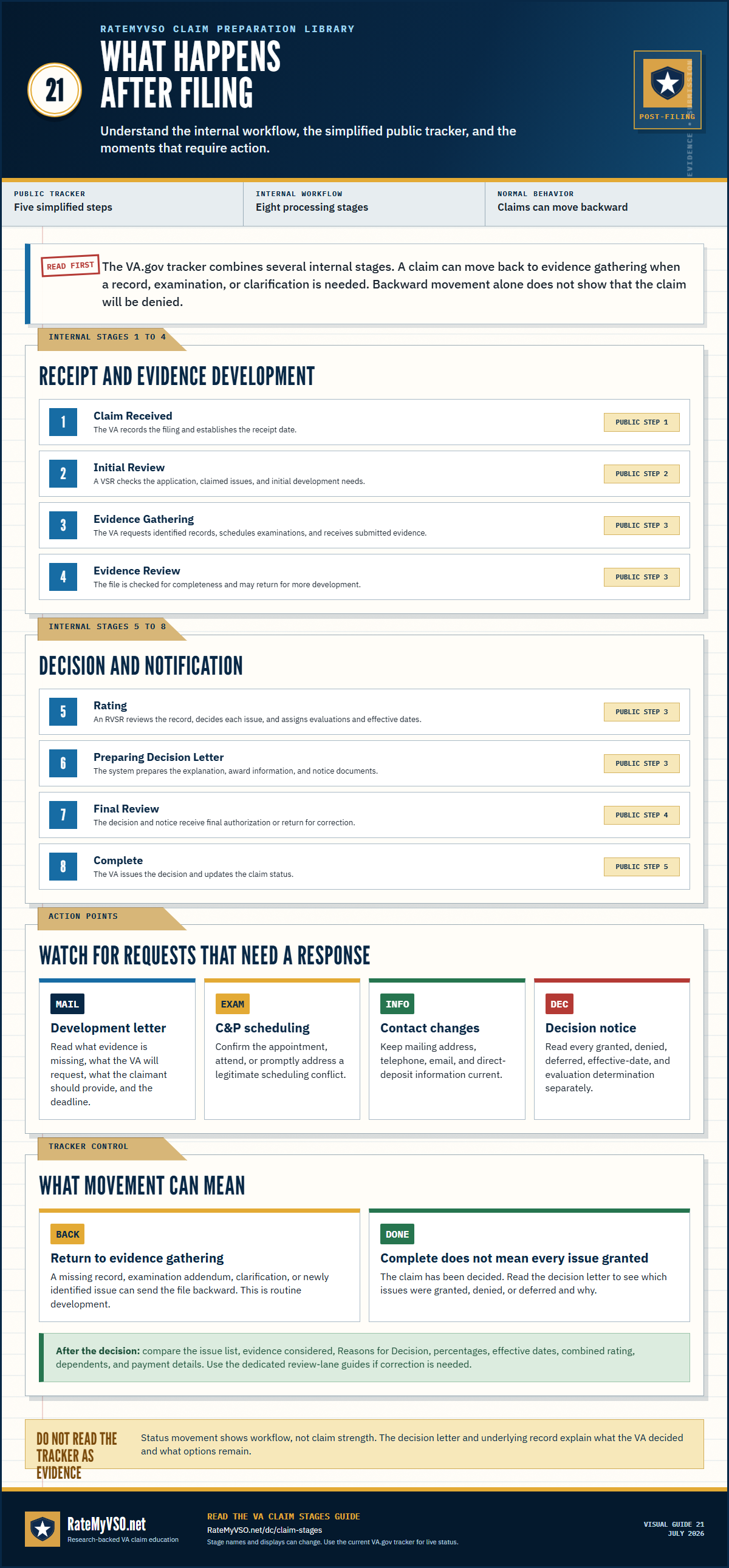
A VA disability claim moves through eight internal stages from receipt to decision. The public status tracker on VA.gov collapses several of those into a five-step display, which is why many veterans see a claim "skip" steps or appear to move backward. This guide walks through what each stage actually means, who handles it, and what to expect.

0 Intent to File
Before a claim is formally submitted, a veteran can file an Intent to File (ITF) to lock in an effective date for back pay. The ITF is not a claim, but it preserves the date as long as a formal claim is filed within twelve months.
1 Claim Received
The VA acknowledges receipt of the formal claim package. The claim is logged into the system and assigned an internal tracking number. The veteran usually receives a written confirmation.
2 Initial Review
A Veteran Service Representative (VSR) reviews the claim to determine whether it is complete enough to proceed. The VSR identifies what evidence is needed, which records the VA must request under its Duty to Assist, and whether any Compensation and Pension (C&P) exams will be scheduled.
3 Evidence Gathering
The longest and most variable stage. The VA requests service treatment records, military personnel records, identified private medical records, and any C&P exams it has determined are needed. The veteran is expected to respond promptly to any direct requests from the VA.
4 Evidence Review
Typically about thirty days after Evidence Gathering begins, the VA checks whether everything it requested has been received. If anything is missing or unclear, the claim cycles back to Stage 3 for further development.
5 Rating
The claim is assigned to a Rating Veterans Service Representative (RVSR), the rater. The rater reviews the entire evidence record, applies the 38 CFR Part 4 rating schedule to each claimed condition, and writes the reasoning that will appear in the decision letter.
6 Preparing Decision Letter
The rater's draft is converted into a formal decision letter. Each claimed condition is listed with the granted or denied outcome, the rating percentage if granted, the effective date, and a brief narrative explaining the reasoning.
7 Final Review
A senior reviewer audits the rating decision and the draft letter for accuracy, regulatory citation, and completeness. If the rater deferred one condition while deciding others, that deferred portion returns to Stage 3 while the decided portion proceeds.
8 Complete (Claim Decided)
The decision letter is released. The decision usually appears on the veteran's VA.gov account within a few days. The paper copy typically arrives within two weeks. Back pay and the new monthly amount follow on the next available payment cycle.
Why the VA.gov tracker only shows 5 steps
The VA's public claim status page on VA.gov displays a simplified five-step view. Internally, the claim moves through eight stages. The mapping is straightforward once you see it side by side.
| Internal stage | VA.gov tracker step | What you see on VA.gov |
|---|---|---|
| 1. Claim Received | Step 1 | "Claim received" |
| 2. Initial Review | Step 2 | "Initial review" |
| 3. Evidence Gathering 4. Evidence Review 5. Rating 6. Preparing Decision Letter | Step 3 | "Evidence gathering, review, and decision" (consolidated) |
| 7. Final Review | Step 4 | "Preparation for notification" |
| 8. Complete | Step 5 | "Complete" |
Priority processing and special requests
The VA processes claims in roughly the order received, with several categories of priority. A veteran who qualifies can request priority processing in writing as part of the claim or as a separate statement.
- Terminal illness. Documented terminal diagnosis (life expectancy under six months by most VA practice).
- Homelessness. Documented homelessness or imminent risk of homelessness.
- Age 85 or older. Automatic priority category.
- Former POW status. Confirmed Prisoner of War record.
- Extreme financial hardship. Documented hardship affecting basic necessities.
- Medal of Honor recipient. Automatic priority.
- Purple Heart recipient. Priority category since 2017.
- Seriously injured post-9/11 veterans. Through the Office of Seriously Injured Service Members.
What "Requests" and "Supplemental Claim status" mean on the tracker
Requests
If the VA needs something from the veteran, the claim status page lists open "requests." Each one is an action item that, if unanswered, can stall the claim. Typical examples include a signed VA Form 21-4142 to release private records, a missed C&P exam needing reschedule, or a clarification on a specific symptom.
Supplemental Claim status
A Supplemental Claim is an appeal lane, not a new claim. Its tracker status is sparser than a new claim's. The two states typically shown are:
- "We don't know your status." The claim has been received and is queued, but has not yet been assigned for review.
- "A reviewer is examining your new evidence." Active review. This status remains until the supplemental decision is issued.
Claim Quest: Quick Check
Five questions based only on this guide.
This checks what you understood from this guide. It is not a claim-readiness score, a prediction, an official test, or a record on your account.
Frequently Asked Questions
How long does a VA disability claim take from start to finish?
Anywhere from a few weeks to over a year. The variability is driven mostly by Stage 3 (Evidence Gathering): how quickly records arrive, whether C&P exams are needed and how soon they can be scheduled, and whether private providers respond to record requests. Check current average processing time at VA's MMWR claims report.
Why does my claim keep moving backward in the tracker?
Backward movement on the tracker usually means the file returned to Evidence Gathering for one more piece (a missing record, a C&P addendum, or a clarification). This is routine and not a sign of trouble. Claims commonly cycle through Stages 3 to 5 more than once.
I filed before separating. Why is my claim showing a future decision date?
The VA cannot formally decide a claim until the day after service separation, even if the paperwork is in. For Benefits Delivery at Discharge (BDD) and similar pre-separation programs, the system shows the earliest decisionable date, not a delay. See the BDD guide.
Should I keep checking the tracker every day?
Checking once or twice a week is plenty. The tracker only updates when an internal stage transition is logged, and constant refreshing will not speed anything up. The two events worth watching for are C&P exam scheduling letters and the appearance of a decision on the disability rating page.
The tracker shows my claim is "Complete" but I haven't received a paper letter yet. What now?
The electronic decision typically posts on VA.gov within a few days of completion. The paper letter usually arrives within two weeks. View the decision online at the View Your Disability Rating page. If two weeks have passed and no paper letter has arrived, call 1-800-827-1000.
What is "Temporary Jurisdiction" if I see it on my claim?
"Temporary Jurisdiction" indicates which Regional Office or Center currently holds the file for processing. The VA shifts files between offices to balance workload. The label does not affect the decision and the claim is not "lost" when this status appears.
If I disagree with the decision, how do I appeal?
To keep your effective date, file one of three review lanes within one year of the decision date: Supplemental Claim (new evidence), Higher-Level Review (senior re-review of the same evidence), or Board appeal (judge review). See the appeals guide for which lane fits which situation. After one year you can still file a Supplemental Claim with new and relevant evidence, but the effective date is usually the date of that new filing.
Related Tools and Guides
RateMyVSO. Educational resource. Not affiliated with the U.S. Department of Veterans Affairs. Not legal advice. All RateMyVSO tools are free. Find a VSO representative for personalized guidance.