Benefits Delivery at Discharge (BDD)
The BDD program lets you file a VA disability claim before you leave the military, so your decision can land soon after separation. This guide covers who qualifies, the documents you need, the filing timeline, and the forms to complete. It walks you through preparing your service treatment records and working with your transition team or VA representative. File it right and you can get your rating and benefits without the usual months-long wait.

BDD Countdown Calculator and Clock
Enter a separation date to see the 180-day, 90-day and separation milestones. Calculate without an account. Sign in to save dates and receive Monday updates.
Today: loading | Eastern Time
0 in this draft. Not saved to an account.
| Name | BDD window opens | Last BDD-window day | Separation | Status | Actions |
|---|
Add a service member above to build a temporary roster.
Names and dates you save are stored with your account and included in your email report. Use a nickname if you prefer. Only add people whose information you have permission to manage.
Your saved dates and Monday updates
One combined report per Monday at 11:00 a.m. Eastern Time, only to the verified email on your account, and only while you have an active saved date. A person is included in one final report the Monday after their separation date, then moves to Completed. Turning Monday updates off in Email Notifications does not change your other email settings or delete any saved date.
BDD requires full-time active duty, including qualifying Guard and Reserve service. A known separation date and exam availability are also required. This tool checks dates, not eligibility.
Milestone rules and requirements: VA pre-discharge (BDD) claim requirements (checked September 5, 2026) and VA disability filing guidance (checked September 5, 2026). The official page carries the form instructions.
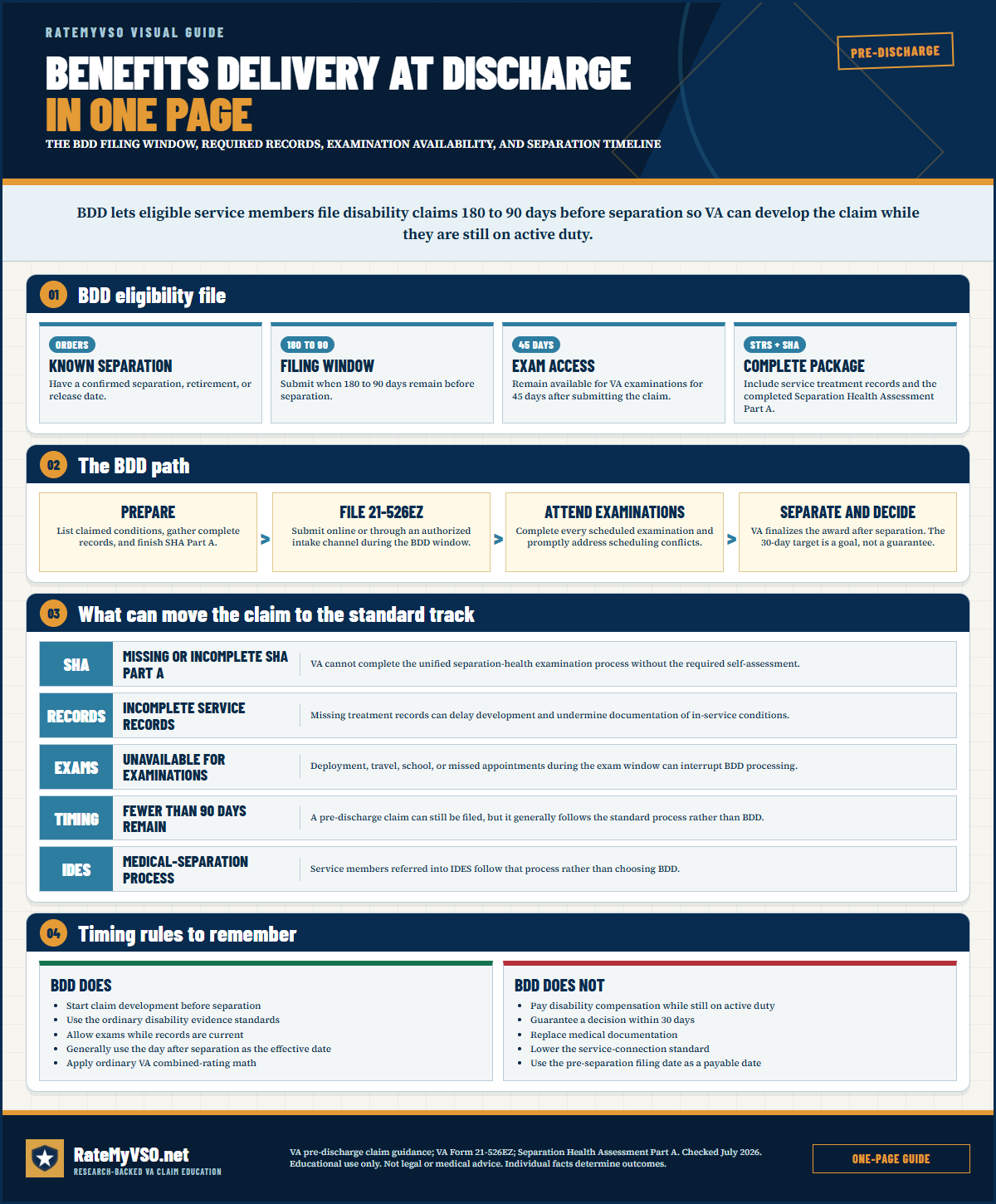 One-page guide: Benefits Delivery at Discharge In One Page
See the 180-to-90-day window, required records, examination availability, and post-separation path. Opens the full-size chart, free to save or print.
One-page guide: Benefits Delivery at Discharge In One Page
See the 180-to-90-day window, required records, examination availability, and post-separation path. Opens the full-size chart, free to save or print.
What Is BDD?
Benefits Delivery at Discharge (BDD) is a VA program that lets a service member file a disability compensation claim while still on active duty, between 180 and 90 days before their separation date. The point is to compress the timeline. By filing pre-separation, the VA reviews service treatment records, schedules the Compensation and Pension (C&P) examinations, and has most of the work done before the service member walks out the gate. VA's stated goal is a rating decision within 30 days of separation, compared to the months-long wait that follows a typical post-service claim.
Legal basis: 38 U.S.C. § 5103A (VA's duty to assist); 38 U.S.C. § 5110 (effective dates); 38 CFR § 3.400 (general effective date rules); M21-1, Part III, Subpart i, Chapter 2 (Pre-Discharge Claims processing).
Eligibility
You may be eligible for BDD if you meet all five of these criteria:
Active Duty Status
Full-time active duty, including National Guard, Reserve, or Coast Guard activated under Title 10 or full-time Title 32 orders. Drilling reservists not on active orders are not eligible.
Known Separation Date
A confirmed separation date: ETS, retirement, or scheduled release from active duty. Tentative or projected dates without orders do not qualify.
180 to 90 Days Out
At submission, between 180 and 90 days remain until separation. Terminal leave does not count toward this window. With more than 180 days, the claim must wait. With fewer than 90 days, the pre-discharge claim is processed on the standard track instead.
45-Day Exam Availability
Available for 45 days from claim submission to attend any VA-ordered medical examination. Deployments, schools, or extended TDY during this window can drop the claim from the BDD track.
Complete Documentation
The application must include a copy of the Service Treatment Records (STRs) and a completed Separation Health Assessment (SHA) Part A Self-Assessment. The VA cannot schedule the C&P exam without the SHA Part A.
Exclusions
Per VA program documentation, the following situations remove a service member from BDD eligibility regardless of the timeline:
- Claims requiring a VA exam in a foreign country, except those that can be processed through Landstuhl Regional Medical Center (Germany) or Camp Humphreys (Korea)
- Service members awaiting discharge while hospitalized in a VA facility or military treatment facility
- Claims requiring a Character of Discharge determination under 38 CFR § 3.12
- Cases serious enough to require referral to the Integrated Disability Evaluation System (IDES) instead of BDD, see below
- Cases where the service member is terminally ill or needs case management for a serious injury or illness
If any of these apply, the standard claim process or IDES applies instead.
The SHA Part A: What It Is and Why It Gates Everything
The Separation Health Assessment (SHA) Part A Self-Assessment is a medical history questionnaire that became a mandatory part of BDD applications on April 1, 2023. It is the self-reported portion of DD Form 3146 (Separation Health Assessment), the unified DoD/VA medical separation form that consolidates what used to be two separate medical exams (one for DoD separation, one for VA disability) into a single examination process serving both agencies.
Part A is the self-assessment portion the service member completes. Part B is the clinical assessment performed by a contracted VA examiner or VA medical center.
Why Part A matters
- Without a completed SHA Part A, the VA cannot schedule the C&P exam under BDD.
- Without a C&P exam, the BDD claim cannot be developed and falls off the BDD track.
- A claim that drops off the BDD track does not get the 30-day post-separation decision goal.
What Part A covers
- Identification, contact, and demographic information
- Most recent military medical assessment date and any significant changes since
- Current illnesses, injuries, and conditions
- Medications and assistive devices
- Mental health screening questionnaires
- Pregnancy history (if applicable)
- Cancer screening history
- Optional enrollment information for the Airborne Hazards and Open Burn Pit Registry
The form
The Day-After-Separation Effective Date Trap
This is the single most-misunderstood aspect of BDD, and it costs filers real money when they get it wrong.
The rule: The effective date for any benefit granted under a BDD claim is the day after separation from active duty. Not the date the claim was filed. Not the date of any Intent to File. Not the date the VA received the STRs. The day after separation.
Compare this to a standard post-service claim, where the effective date is the date the VA received the claim (or, for increased ratings, up to one year earlier if the increase is factually ascertainable). For BDD, no such retroactivity is possible, because compensation cannot be paid for periods when the service member is still receiving active-duty pay.
Example
A service member files a BDD claim 175 days before separation. VA grants a 50% rating after separation. Back pay accrues from the day after separation, not from the filing date. The 175 days the claim sat in the pipeline produced no back pay.
What this means in practice
- Filing earlier in the 180-90 window does not produce earlier back pay. It produces a faster first payment.
- Intents to File (VA Form 21-0966) are effectively useless for BDD purposes. The mechanism that makes ITFs valuable for post-service filing (preserving an earlier effective date) does not apply when active-duty pay is active.
- Adding a condition mid-claim, after the 90-day mark, creates a separate post-service claim for that condition with its own effective date tied to the date of the new claim.
Why the rule exists: 38 U.S.C. § 5304 prohibits concurrent receipt of active-duty pay and VA disability compensation. The day-after-separation effective date is the mechanism that enforces this. RateMyVSO's Effective Dates Guide walks through the general rules for non-BDD claims.
BDD vs IDES vs Standard Pre-Discharge Claim
Service members hear three different terms in TAP briefings and sometimes confuse them. Here is how they differ:
| BDD | IDES | Standard Pre-Discharge | |
|---|---|---|---|
| What it is | A faster track for filing a normal disability compensation claim before separation | A combined DoD/VA process for service members being medically separated | A pre-discharge claim filed when BDD is not available |
| Triggered by | Voluntary, you file VA Form 21-526EZ | Mandatory referral by your branch when the Medical Retention Determination Point (MRDP) is reached | Voluntary, when fewer than 90 days remain or BDD eligibility fails |
| Who's eligible | Active duty, 180-90 days out, normal separation expected | Service member found unfit for duty by Medical Evaluation Board (MEB) | Anyone separating who does not qualify for BDD or IDES |
| Effective date | Day after separation | Day after separation | Day after separation if filed before discharge; otherwise date of claim |
| Documentation | STRs + SHA Part A | PEBLO and VA Military Services Coordinator (MSC) handle development | STRs + supporting evidence |
| Goal timeline | Decision within 30 days of separation | ~230 days from MEB referral | Variable; typically months post-separation |
A service member referred to IDES is not filing a BDD claim. Both result in VA disability ratings, but the procedural mechanics are different. IDES is mandatory if the MEB determines the service member may be unfit for duty, there is no opt-in. A Physical Evaluation Board Liaison Officer (PEBLO) and a VA Military Services Coordinator (MSC) handle the process. The unfitting condition determined by the Physical Evaluation Board (PEB) drives DoD disability benefits. Other claimed conditions can still be developed for VA compensation purposes.
Reference: VA's IDES page, VA's BDD page.
How It Works: The Path
What the program does over the timeline. This is descriptive, not a checklist of what to do. Specific filing decisions belong with an accredited representative.
- Preparation and Submission (180 to 90 days out) The service member gathers a complete copy of their STRs (medical, dental, mental health, behavioral health), obtains the SHA Part A Self-Assessment form, and identifies the conditions to be claimed. Most STRs are now electronic and accessible through the Defense Health Agency or via milConnect. The application is filed using VA Form 21-526EZ, online via VA.gov (fastest), in person at a BDD intake site, or by mail to the Compensation Intake Center (P.O. Box 4444, Janesville, WI 53547). Online filings let VA pull STRs automatically; paper filings require physical inclusion.
- VA Schedules and Conducts C&P Exams After receiving the application, STRs, and SHA Part A, VA schedules Compensation and Pension exams for the claimed conditions. Exams are performed by contracted disability examiners (Loyal Source Government Services, QTC Medical Services, MSLA, VetFed Services) or VA medical center examiners. The SHA Part B clinical assessment runs during this phase. The 45-day exam availability requirement begins on the date the claim is submitted; missed exams without rescheduling can drop the claim from the BDD track.
- Separation, Decision, and First Payment The service member completes separation processing through DoD. VA cannot finalize the rating decision before the separation date itself per 38 CFR § 3.400, the rating waits until the day after separation. After separation, VA finalizes the rating decision (stated goal: within 30 days of the separation date). The decision letter is mailed and posted to the veteran's VA.gov account with the rating, effective date, monthly compensation, and appeal rights under the Appeals Modernization Act. First payment typically arrives within 7 to 10 days of the decision letter.
How Your BDD Claim Actually Gets Decided
Once a BDD claim reaches a rater, it is evaluated the same way any VA disability claim is evaluated. There is no separate BDD rating table and no different burden of proof. For each condition claimed, VA checks for the same three things: a current diagnosis, an in-service event or injury, and a medical nexus connecting the two. See the Service Connection Guide for the full breakdown of this three-part test.
The Same VA Math Applies
Ratings for multiple conditions do not add together. A 50% rating and a 20% rating do not combine to 70%. VA runs each additional rating through the Combined Ratings Table against whatever percentage of the whole person remains, so 50% plus 20% typically lands at 60%, not 70%. This applies identically whether the claim was filed under BDD or after separation. Use the VA Math Calculator to combine your own claimed conditions.
Why BDD Claims Drop to the Standard Track
A claim filed under BDD can lose its BDD status mid-process. When this happens, the claim continues to be developed but on the standard track, which means no 30-day post-separation decision goal and a longer wait. Common reasons:
- SHA Part A missing or incomplete, the most common cause of BDD-to-standard conversion. Without it, the C&P exam cannot be scheduled.
- STRs not received by 90 days out, filing online avoids this for most service members because VA pulls STRs automatically. Paper filers are at higher risk.
- Service member unavailable for C&P, deployments, schools, extended TDY, or PCS during the 45-day window.
- New conditions added after day 90, a separate post-service claim is created for the new conditions. The original BDD claim continues for the original conditions.
- Character of Discharge issue, claim requires a separate determination under 38 CFR § 3.12.
- Foreign exam required, cannot use BDD unless processed through Landstuhl or Camp Humphreys.
- Hospitalization for serious illness, often triggers IDES referral instead.
- Special handling cases, severe injuries, multiple complex conditions, or conditions requiring specialized exams.
After Separation: What Happens Next
In the 30 days following separation, several things happen in parallel:
- VA finalizes the rating decision. The decision letter is mailed and posted to the veteran's online account.
- First payment is processed. Typically arriving 7 to 10 days after the decision letter, via direct deposit.
- VA healthcare enrollment becomes available. Register at any VA medical center or online at VA.gov/health-care. RateMyVSO has a VA Healthcare overview covering priority groups and enrollment.
- Appeal rights begin. Under the Appeals Modernization Act, the veteran has one year from the date of the decision letter to select a review option (Supplemental Claim, Higher-Level Review, or Board Appeal) for any decision they disagree with. See the Appeals Overview.
- Dependency benefits engage. Veterans rated 30% or higher can add dependents (spouse, children, parents) for additional compensation. Dependency claims filed within one year of the rating decision are retroactive.
- Ancillary benefits become available. Including VA home loan benefits, VALife (Veterans Affairs Life Insurance) up to $40,000 in guaranteed-acceptance whole life, commissary and exchange privileges, and state-level benefits that vary by state of residence.
If the rating decision is unfavorable, the same three review options apply as for any VA decision. See the Appeals Overview for the full breakdown.
If You Missed the BDD Window
Falling outside BDD eligibility does not eliminate the option to file pre-discharge. It changes the track.
- Fewer than 90 days remaining: a standard pre-discharge claim or a Fully Developed Claim (FDC) can still be filed. The FDC track is faster than the standard claim because the service member certifies that all evidence has been submitted, eliminating the VA's evidence-gathering phase. Reference: VA's Fully Developed Claim program.
- Already separated: a standard claim is the route. An Intent to File preserves the effective date for one year while evidence is gathered. Unlike with BDD, the ITF mechanism actually works for post-service claims because there is no active-duty pay to coordinate against.
- Medically complex situations: the service member may already be on the IDES track without realizing it. Service members referred to a Medical Evaluation Board are in IDES. The BDD program does not apply.
In every case, an accredited representative can help identify which track applies. RateMyVSO maintains a free accredited representative directory.
Related Tools and Guides
Official VA resources
- VA Pre-Discharge Claim page, VA's official BDD documentation
- BDD Program at VBA, program overview from the Veterans Benefits Administration
- Integrated Disability Evaluation System (IDES), for service members being medically separated
- VA Form 21-526EZ, Application for Disability Compensation
- SHA Part A Self-Assessment Form (PDF), required for all BDD applications
- SHA Part A Guidance (PDF)
- Find a VA Location, BDD intake sites and VA medical centers
- VA OGC Accredited Representative Directory
Legal references
- 38 U.S.C. § 5103A, VA's duty to assist
- 38 U.S.C. § 5110, effective dates of awards
- 38 U.S.C. § 5304, prohibition against duplication of benefits
- 38 U.S.C. § 1168, Toxic Exposure Risk Activity (TERA)
- 38 CFR § 3.12, character of discharge determinations
- 38 CFR § 3.155, how to file a claim (Intent to File)
- 38 CFR § 3.400, general effective date rules
This guide is a plain-English explanation of the BDD program for educational purposes only. It is not legal advice and does not establish an attorney-client or representative-claimant relationship. Strategic decisions about specific claims, including which conditions to claim, what evidence supports them, and which filing path is most appropriate, belong with an accredited representative. Find a free VSO representative or consult with a VA-accredited attorney. VA programs, forms, and procedures change. Verify current requirements at VA.gov before filing. Last updated July 2026.