C&P Exam Prep Guide for Ankle, limited motion of (DC 5271)
YOUR EXAM BLUEPRINT
Ankle, limited motion of
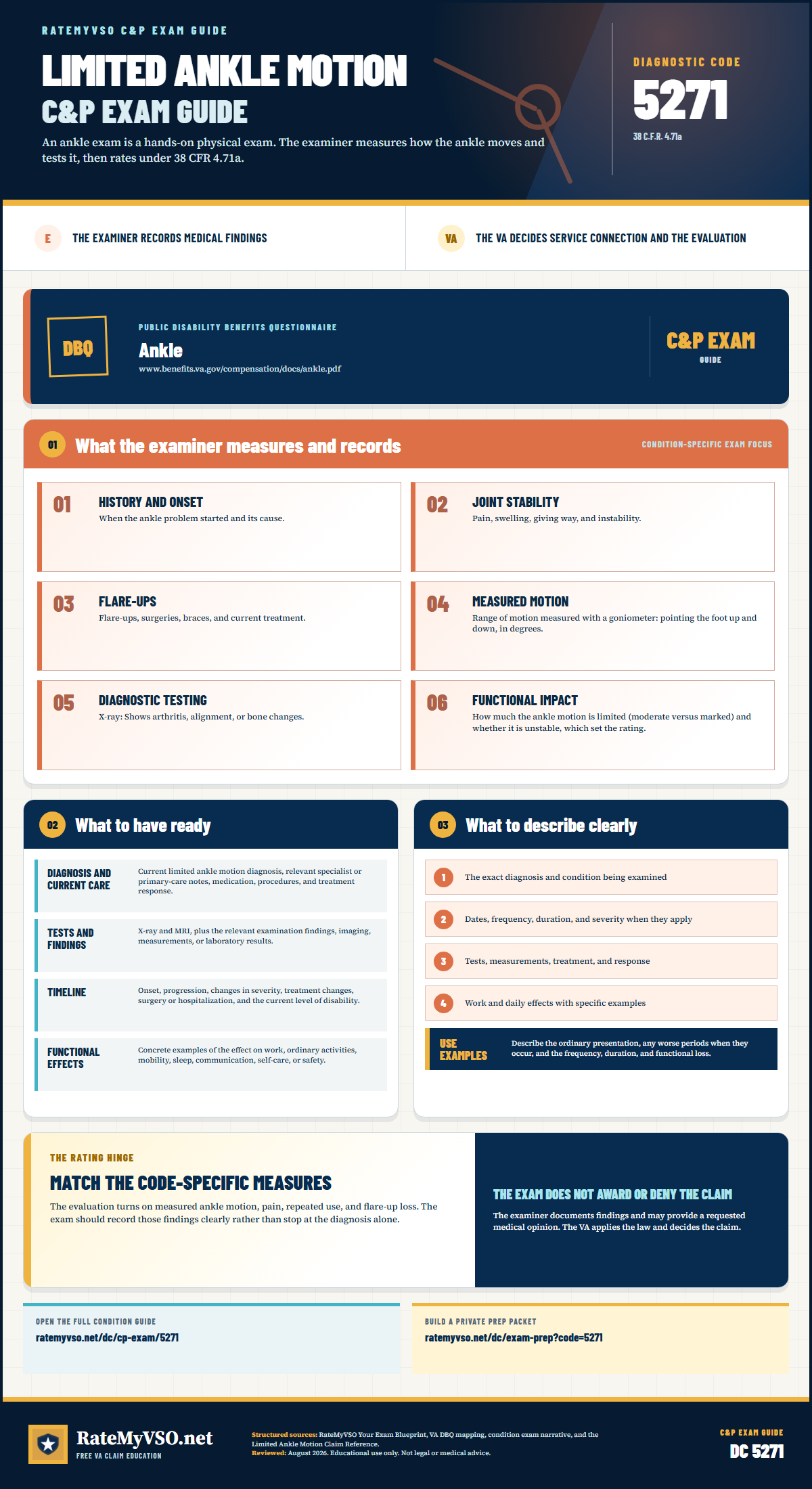
An ankle exam is a hands-on physical exam. The examiner measures how the ankle moves and tests it, then rates under 38 CFR 4.71a.
DBQ used for this condition
- PPublic formDBQ MUSC AnkleOpen the public DBQ
What the examination is likely to focus on
Functional-impact topics to describe
- How much the ankle motion is limited (moderate versus marked) and whether it is unstable, which set the rating.
- Findings map to the tiers in 38 CFR 4.71a, DC 5271.
Which form the examiner uses
For ankle, limited motion of (DC 5271), the C&P examiner completes the following Disability Benefits Questionnaire (DBQ):
- DBQ MUSC Ankle (public PDF on VA.gov)
DBQs are Department of Veterans Affairs Form 21-0960 series documents. Public DBQs are hosted on benefits.va.gov. A handful are examiner-only and are not posted publicly.
What to expect at your C&P exam
An ankle exam is a hands-on physical exam. The examiner measures how the ankle moves and tests it, then rates under 38 CFR 4.71a.
1Initial interview (history)
- When the ankle problem started and its cause.
- Pain, swelling, giving way, and instability.
- Flare-ups, surgeries, braces, and current treatment.
- Effect on standing, walking, and work.
2Physical examination
- Range of motion measured with a goniometer: pointing the foot up and down, in degrees.
- The point where pain begins, and repetitive-use testing.
- Stability and strength testing.
- Watching you walk.
3Diagnostic tests the examiner may rely on
Imaging is usually already in your records.
4Functional assessment
- How much the ankle motion is limited (moderate versus marked) and whether it is unstable, which set the rating.
- Findings map to the tiers in 38 CFR 4.71a, DC 5271.
Test explainers open MedlinePlus (NIH National Library of Medicine), or Wikipedia where MedlinePlus has no matching page. This describes what happens and what is measured, not how to influence a result.
What the examiner records (full DBQ form)
The fields below are reproduced from the DBQ form the examiner completes for this diagnostic code. This is the structural map of the form, showing what the examiner is asked to measure, observe, and record. It is a factual reproduction of the public DBQ, not advice on how to answer.
This DBQ evaluates ankle conditions including range of motion, ankylosis, joint stability, surgical procedures, and functional impact.
How DC 5271 maps to this DBQ: for this diagnostic code specifically, the examiner typically completes sections I-IV, IX, and XII-XIV of this form. Section III is the condition-specific section for this code. Sections V-VIII and X-XI cover unrelated conditions on this DBQ and are skipped.
DIAGNOSIS (Section I)
- 1A. List the claimed condition(s) that pertain to this questionnaire
- 1B. Select diagnoses associated with the claimed condition(s) (check all that apply)
- The Veteran does not have a current diagnosis associated with any claimed condition(s) listed above.
- Lateral collateral ligament sprain (chronic/recurrent) - Side affected / ICD code / Date of diagnosis
- Deltoid ligament sprain (chronic/recurrent) - Side affected / ICD code / Date of diagnosis
- Osteochondritis dissecans to include osteochondral fracture - Side affected / ICD code / Date of diagnosis
- Impingement (anterior/posterior (or trigonum syndrome)/anterolateral) - Side affected / ICD code / Date of diagnosis
- Tendonitis (Achilles/peroneal/posterior tibial) - Side affected / ICD code / Date of diagnosis
- Retrocalcaneal bursitis - Side affected / ICD code / Date of diagnosis
- Achilles' tendon rupture - Side affected / ICD code / Date of diagnosis
- Avascular necrosis, talus - Side affected / ICD code / Date of diagnosis
- Ankle joint replacement - Side affected / ICD code / Date of diagnosis
- Ankylosis of ankle, subtalar or tarsal joint - Side affected / ICD code / Date of diagnosis
- Shin splints/medial tibial stress syndrome - MTSS (including post-surgery or treatment) - Side affected / ICD code / Date of diagnosis
- Degenerative arthritis, other than post-traumatic - Side affected / ICD code / Date of diagnosis
- Arthritis, gonorrheal - Side affected / ICD code / Date of diagnosis
- Arthritis, pneumococcic - Side affected / ICD code / Date of diagnosis
- Arthritis, streptococcic - Side affected / ICD code / Date of diagnosis
- Arthritis, syphilitic - Side affected / ICD code / Date of diagnosis
- Arthritis, rheumatoid (multi-joints) - Side affected / ICD code / Date of diagnosis
- Arthritis, post-traumatic - Side affected / ICD code / Date of diagnosis
- Arthritis, typhoid - Side affected / ICD code / Date of diagnosis
- Other specified forms of arthropathy (excluding gout) - Side affected / ICD code / Date of diagnosis
- Osteoporosis, residuals of - Side affected / ICD code / Date of diagnosis
- Osteomalacia, residuals of - Side affected / ICD code / Date of diagnosis
- Bones, neoplasm, benign - Side affected / ICD code / Date of diagnosis
- Bones, neoplasm, malignant, primary or secondary - Side affected / ICD code / Date of diagnosis
- Osteitis deformans - Side affected / ICD code / Date of diagnosis
- Gout - Side affected / ICD code / Date of diagnosis
- Bursitis - Side affected / ICD code / Date of diagnosis
- Myositis - Side affected / ICD code / Date of diagnosis
- Heterotopic ossification - Side affected / ICD code / Date of diagnosis
- Tendinopathy (select one if known): Tendinitis / Tendinosis / Tenosynovitis - Side affected / ICD code / Date of diagnosis
- Other diagnosis #1 - Side affected / ICD code / Date of diagnosis
- Other diagnosis #2 - Side affected / ICD code / Date of diagnosis
- Other diagnosis #3 - Side affected / ICD code / Date of diagnosis
- 1C. If there are additional diagnoses that pertain to ankle conditions, list using above format
MEDICAL HISTORY (Section II)
- 2A. Describe the history, including onset and course, of the Veteran's ankle condition(s). Brief summary
- 2B. Does the Veteran report flare-ups of the ankle?
- If yes, document the Veteran's description of the flare-ups he/she experiences, including the frequency, duration, characteristics, precipitating and alleviating factors, severity, and/or extent of functional impairment he/she experiences during a flare-up of symptoms
- 2C. Does the Veteran report having any functional loss or functional impairment of the joint or extremity being evaluated on this questionnaire, including but not limited to after repeated use over time?
- If yes, document the Veteran's description of functional loss or functional impairment in his/her own words
- 2D. Does the Veteran report or have a history of instability of the ankle?
- If yes, document the Veteran's description of instability in his/her own words
RANGE OF MOTION (ROM) AND FUNCTIONAL LIMITATION (Section III)
- 3A. Initial ROM measurements: All Normal / Abnormal or outside of normal range / Unable to test / Not indicated
- If 'Unable to test' or 'Not indicated', please explain
- If ROM is outside of 'normal' range, but is normal for the Veteran (for reasons other than an ankle condition, such as age, body habitus, neurologic disease), please describe
- If abnormal, does the range of motion itself contribute to a functional loss?
- Can testing be performed?
- If this is the unclaimed joint, is it: Damaged / Undamaged
- Active Range of Motion (ROM) - Plantar flexion endpoint (45 degrees): degrees
- Active Range of Motion (ROM) - Dorsiflexion endpoint (20 degrees): degrees
- If noted on examination, which ROM exhibited pain (select all that apply): Plantar flexion / Dorsiflexion
- If any limitation of motion is specifically attributable to pain, weakness, fatigability, incoordination, or other; please note the degree(s) in which limitation of motion is specifically attributable to the factors identified and describe
- Plantar flexion degree endpoint (if different than above)
- Dorsiflexion degree endpoint (if different than above)
- Passive Range of Motion - Plantar flexion endpoint (45 degrees): degrees / Same as active ROM
- Passive Range of Motion - Dorsiflexion endpoint (20 degrees): degrees / Same as active ROM
- If noted on examination, which passive ROM exhibited pain (select all that apply): Plantar flexion / Dorsiflexion
- Is there evidence of pain? Weight-bearing / Nonweight-bearing / Active motion / Passive motion / On rest/nonmovement / Causes functional loss / Does not result in/cause functional loss
- Comments
- Is there objective evidence of crepitus?
- Is there objective evidence of localized tenderness or pain on palpation of the joint or associated soft tissue? If yes, please explain. Include location, severity, and relationship to condition(s).
- 3B. Observed repetitive use ROM - Is the Veteran able to perform repetitive-use testing with at least three repetitions?
- Is there additional loss of function or range of motion after three repetitions?
- After three repetitions - Plantar flexion endpoint (45 degrees): degrees
- After three repetitions - Dorsiflexion endpoint (20 degrees): degrees
- Select factors that cause this functional loss. Check all that apply: Pain / Fatigability / Weakness / Lack of endurance / Incoordination / Other
- 3C. Repeated use over time - Is the Veteran being examined immediately after repeated use over time?
- Does procured evidence (statements from the Veteran) suggest pain, fatigability, weakness, lack of endurance, or incoordination which significantly limits functional ability with repeated use over time?
- Select factors that cause this functional loss (repeated use over time): Pain / Fatigability / Weakness / Lack of endurance / Incoordination / Other
- Estimate range of motion in degrees for this joint immediately after repeated use over time - Plantar flexion endpoint (45 degrees): degrees
- Estimate range of motion in degrees for this joint immediately after repeated use over time - Dorsiflexion endpoint (20 degrees): degrees
- Please cite and discuss evidence. (Must be specific to the case and based on all procurable evidence.)
- 3D. Flare-ups - Is the examination being conducted during a flare-up?
- Does procured evidence (statements from the Veteran) suggest pain, fatigability, weakness, lack of endurance, or incoordination which significantly limits functional ability with flare-ups?
- Select factors that cause this functional loss (flare-ups): Pain / Fatigability / Weakness / Lack of endurance / Incoordination / Other
- Estimate range of motion in degrees for this joint during flare-ups - Plantar flexion endpoint (45 degrees): degrees
- Estimate range of motion in degrees for this joint during flare-ups - Dorsiflexion endpoint (20 degrees): degrees
- 3E. Additional factors contributing to disability: None / Interference with sitting / Interference with standing / Swelling / Disturbance of locomotion / Deformity / Less movement than normal / More movement than normal / Weakened movement / Atrophy of disuse / Instability of station / Other
- Please describe additional contributing factors of disability
MUSCLE ATROPHY (Section IV)
- 4A. Does the Veteran have muscle atrophy?
- 4B. If yes, is the muscle atrophy due to the claimed condition in the diagnosis section? If no, provide rationale
- 4C. Right lower extremity - specify location of measurement such as '1cm above or below ankle'
- Circumference of more normal side: cm
- Circumference of atrophied side: cm
- 4C. Left lower extremity - specify location of measurement such as '1cm above or below ankle'
- Circumference of more normal side: cm (left)
- Circumference of atrophied side: cm (left)
ANKYLOSIS (Section V)
- 5A. Is there ankylosis of the ankle?
- If yes, indicate the severity of ankle ankylosis: In plantar flexion, less than 30 degrees / In plantar flexion, between 30 degrees and 40 degrees / In plantar flexion at more than 40 degrees / In dorsiflexion, between 0 degrees and 10 degree / In dorsiflexion at more than 10 degrees / With an abduction deformity / With an adduction deformity / With an inversion deformity / With an eversion deformity
- 5B. Indicate angle of ankle ankylosis in degrees: N/A no ankle ankylosis of joint / Plantar flexion / Dorsiflexion
- 5C. Is there ankylosis of the subastragalar or tarsal joint? If yes, indicate severity: In good weight-bearing position / In poor weight-bearing position
JOINT STABILITY (Section VI)
- 6A. Anterior Drawer Test: Is there absence of firm end point with asymmetric or excessive motion?
- Talar Tilt Test: Is there asymmetric or excessive motion?
- If unable to test, please explain why
- 6B. If unable to test, is ankle instability suspected? If yes, please describe
ADDITIONAL COMMENTS (Section VII)
- 7A. Does the Veteran now have or has he or she ever had shin splints (medial tibial stress syndrome), stress fractures, Achilles tendonitis, Achilles tendon rupture, malunion of calcaneus (os calcis) or talus (astragalus), or has the Veteran had a talectomy (astragalectomy)?
- Stress fracture of the lower leg - Describe current symptoms
- Achilles tendonitis or Achilles tendon rupture - Describe current symptoms
- Malunion of calcaneus (os calcis) or talus (astragalus) - Indicate severity: Moderate deformity / Marked deformity
- 'Shin Splints' (medial tibial stress syndrome - MTSS) - Indicate length of treatment: no treatment received / treatment for less than 12 consecutive months / requiring treatment for 12 consecutive months or more
- If Veteran underwent treatment, indicate response to treatment: responsive to surgery and/or treatment / unresponsive to either shoe orthotics or other conservative treatment / unresponsive to surgery and either shoe orthotics or other conservative treatment
- Does this condition affect ROM of knee?
- Talectomy - Describe current symptoms
SURGICAL PROCEDURES (Section VIII)
- 8A. Indicate any surgical procedures that the Veteran has had performed: No surgery / Total ankle joint replacement / Arthroscopic or other ankle surgery
- Total ankle joint replacement - Date of surgery
- Total ankle joint replacement - Residuals: None / Intermediate degrees of residual weakness, pain or limitation of motion / Chronic residuals consisting of severe painful motion or weakness / Other, describe
- Arthroscopic or other ankle surgery - Type of surgery
- Arthroscopic or other ankle surgery - Date of surgery
- Residuals of arthroscopic or other ankle surgery - Describe residuals
OTHER PERTINENT PHYSICAL FINDINGS, COMPLICATIONS, CONDITIONS, SIGNS, SYMPTOMS, AND SCARS (Section IX)
- 9A. Does the Veteran have any other pertinent physical findings, complications, conditions, signs or symptoms related to any conditions listed in the diagnosis section above? If yes, describe (brief summary)
- 9B. Does the Veteran have any scars or other disfigurement (of the skin) related to any conditions or to the treatment of any conditions listed in the diagnosis section?
ASSISTIVE DEVICES (Section X)
- 10A. Does the Veteran use any assistive devices as a normal mode of locomotion, although occasional locomotion by other methods may be possible?
- Wheelchair - Frequency of use: Occasional / Regular / Constant
- Brace(s) - Frequency of use: Occasional / Regular / Constant
- Crutch(es) - Frequency of use: Occasional / Regular / Constant
- Cane(s) - Frequency of use: Occasional / Regular / Constant
- Walker - Frequency of use: Occasional / Regular / Constant
- Other - Frequency of use: Occasional / Regular / Constant
- 10B. If the Veteran uses any assistive devices, specify the condition, indicate the side, and identify the assistive device used for each condition.
REMAINING EFFECTIVE FUNCTION OF THE EXTREMITIES (Section XI)
- 11A. Due to the Veterans ankle condition(s), is there functional impairment of an extremity such that no effective function remains other than that which would be equally well served by an amputation with prosthesis?
- If yes, indicate extremities for which this applies: Right lower / Left lower
- 11B. For each checked extremity, identify the condition causing loss of function, describe loss of effective function and provide specific examples (brief summary)
DIAGNOSTIC TESTING (Section XII)
- 12A. Have clinically relevant diagnostic imaging studies or other diagnostic procedures been performed or reviewed in conjunction with this examination?
- 12B. If yes, is degenerative or post-traumatic arthritis documented? If yes, indicate side: Right / Left / Both
- 12C. If yes, provide type of test or procedure, date and results (brief summary)
- 12D. Are there any other clinically relevant diagnostic test findings or results related to the claimed condition(s) and/or diagnosis(es), that were reviewed in conjunction with this examination? If yes, provide type of test or procedure, date and results (brief summary)
- 12E. If any test results are other than normal, indicate relationship of abnormal findings to diagnosed conditions
FUNCTIONAL IMPACT (Section XIII)
- 13A. Regardless of the Veteran's current employment status, do the conditions listed in the diagnosis section impact his/her ability to perform any type of occupational task (such as standing, walking, lifting, sitting, etc.)?
- If yes, describe the functional impact of each condition, providing one or more examples
REMARKS (Section XIV)
- 14A. Remarks (if any - please identify the section to which the remark pertains when appropriate)
Rating Levels for DC 5271
The following tiers are reproduced from 38 CFR Part 4, the VA Schedule for Rating Disabilities. Toggle between the official VA criteria and a Plain English explanation.
Plain-English summaries are AI-generated to explain the official criteria. The official 38 CFR language is the binding legal standard. When in doubt, ask a VSO.
Evidence cited in published BVA decisions for DC 5271
The counts below are aggregated from published Board of Veterans Appeals decisions for this diagnostic code, among issues the Board granted or denied (remanded issues are not included). Each row reports how often a given evidence type was discussed in the decision text, broken down by outcome. This is a factual aggregate of the public record, not a prediction or recommendation about any specific claim.
- Service treatment records: appeared in 366 granted decisions (793 denied; 1159 decided total)
- Buddy / lay statements: appeared in 278 granted decisions (515 denied; 793 decided total)
- Medical literature: appeared in 10 granted decisions (13 denied; 23 decided total)
What the Board discussed in granted decisions for DC 5271
The themes below were extracted by clustering 500 grant-factor sentences from published Board of Veterans Appeals decisions for this diagnostic code. Frequencies indicate how often each theme appeared in the sample. This is a factual aggregate of the public record, not advice or strategy for any specific claim.
- 32% Benefit of the doubt doctrine cited, applied, or consideredThe Board noted consideration or application of the benefit of the doubt doctrine, including statutory recitations, legal standards, and general acknowledgments that the doctrine was weighed in reaching a decision.162 of 500 sample sentences
- 16% Preponderance of evidence against claim, benefit of doubt inapplicableThe Board determined that the weight of the evidence persuasively favored denial of the claim, making the benefit of the doubt doctrine inapplicable and resulting in denial.82 of 500 sample sentences
- 15% Medical examiner nexus opinion of 'at least as likely as not' recordedA VA or private medical examiner's opinion that a current disability was at least as likely as not related to service, an in-service event, or a service-connected condition was noted in the record.73 of 500 sample sentences
- 14% Evidence found in equipoise, Veteran prevailedThe Board found the positive and negative evidence in approximate balance or relative equipoise on a material issue, resulting in a grant of the benefit of the doubt in the Veteran's favor.72 of 500 sample sentences
- 6% Specific ankle rating percentage granted under DC 5271The Board awarded a specific disability rating percentage for an ankle disability under Diagnostic Code 5271, citing limited motion findings, functional loss, or pain, often with benefit of the doubt applied.29 of 500 sample sentences
- 4% Secondary service connection nexus opinion recordedA medical examiner's opinion linking a secondary disability to a service-connected condition, including altered gait or mechanical effects from ankle or other orthopedic disabilities, was noted in the record.22 of 500 sample sentences
- 4% Examiner opinion request for nexus or rating determination notedThe Board or remand order documented a request to a VA examiner for an opinion on whether a disability was at least as likely as not related to service or a service-connected condition.22 of 500 sample sentences
- 3% Evidence supports specific rating criteria findingThe Board found that the overall weight of evidence, including lay and medical sources, supported a finding that disability symptoms more nearly approximated a particular rating level under the applicable diagnostic code.16 of 500 sample sentences
- 3% Limitation of motion findings documented at examinationExamination or review findings of marked, moderate, or severe limitation of ankle or joint motion were recorded, including effects of pain, fatigue, and flare-ups on range of motion.14 of 500 sample sentences
- 2% Lay credibility and continuity of symptomatology found sufficientThe Board found the Veteran's lay statements credible and determined that reported continuity of symptoms since service or in-service incurrence was supported by the record.8 of 500 sample sentences
When the Board found the exam inadequate (DC 5271)
In 8,479 published Board of Veterans' Appeals decisions involving this condition, the Board found a C&P examination or medical opinion inadequate. Where the defect could be read from the decision, it was most often one of the following (counts are a floor from the decisions on file, not a total):
- 2,415 Failed to address a contention or part of the condition
- 1,796 Conclusion given without a supporting rationale
- 1,691 Veteran's lay statements not considered
- 710 Opinion relied on the absence of records instead of the evidence
- 652 Flare-ups or functional loss not addressed
- 415 Claims file or records not reviewed
- 272 Examiner said an opinion would require speculation
- 145 Exam too old to reflect current severity
- 69 Wrong legal standard or question applied
An inadequate exam is usually sent back for a new one rather than decided against the veteran. This is a factual report of published decisions, not advice about any exam or claim; whether an exam is adequate is decided case by case.
Disclaimer: This page reproduces public Department of Veterans Affairs forms (DBQs) and verbatim text from 38 CFR Part 4 (the VA Schedule for Rating Disabilities). It is informational only and is not legal or medical advice. For guidance on a specific claim, contact a VA-accredited representative.