C&P Exam Prep Guide for Flatfoot, acquired (DC 5276)
YOUR EXAM BLUEPRINT
Flatfoot, acquired
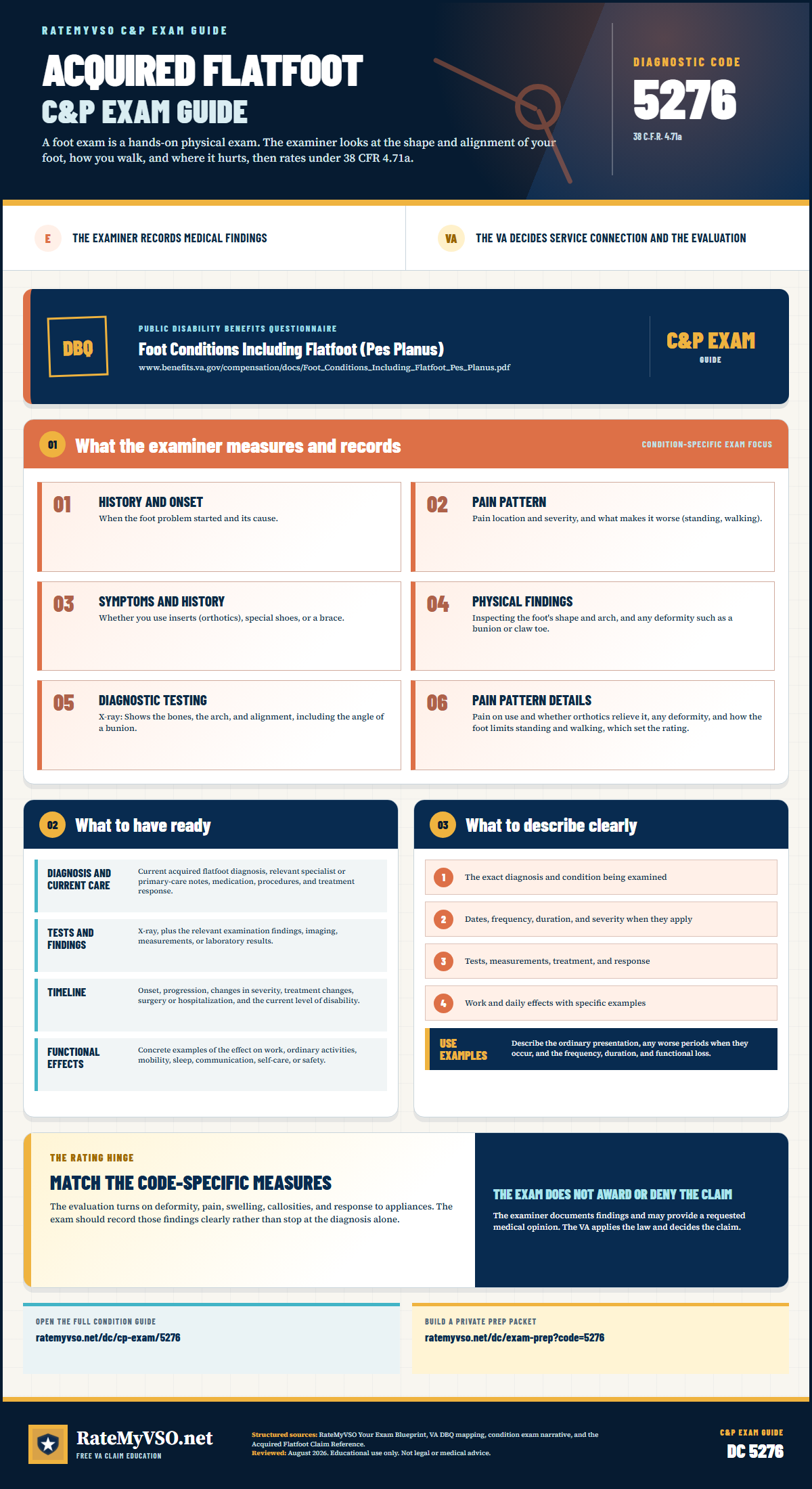
A foot exam is a hands-on physical exam. The examiner looks at the shape and alignment of your foot, how you walk, and where it hurts, then rates under 38 CFR 4.71a.
DBQ used for this condition
- PPublic formDBQ MUSC Foot Conditions Including Flatfoot (Pes Planus)Open the public DBQ
What the examination is likely to focus on
Functional-impact topics to describe
- Pain on use and whether orthotics relieve it, any deformity, and how the foot limits standing and walking, which set the rating.
- Findings map to the tiers in 38 CFR 4.71a (flatfoot DC 5276; plantar fasciitis DC 5269; hallux valgus or bunion DC 5280).
Which form the examiner uses
For flatfoot, acquired (DC 5276), the C&P examiner completes the following Disability Benefits Questionnaire (DBQ):
- DBQ MUSC Foot Conditions Including Flatfoot (Pes Planus) (public PDF on VA.gov)
DBQs are Department of Veterans Affairs Form 21-0960 series documents. Public DBQs are hosted on benefits.va.gov. A handful are examiner-only and are not posted publicly.
What to expect at your C&P exam
A foot exam is a hands-on physical exam. The examiner looks at the shape and alignment of your foot, how you walk, and where it hurts, then rates under 38 CFR 4.71a.
1Initial interview (history)
- When the foot problem started and its cause.
- Pain location and severity, and what makes it worse (standing, walking).
- Whether you use inserts (orthotics), special shoes, or a brace.
- Surgeries and current treatment.
- Effect on standing, walking, and work.
2Physical examination
- Inspecting the foot's shape and arch, and any deformity such as a bunion or claw toe.
- Watching you stand and walk (gait).
- Checking alignment, swelling, calluses, and tender areas.
- Whether symptoms improve with orthotics, and for flatfoot whether the arch corrects.
3Diagnostic tests the examiner may rely on
Used to confirm alignment or bone problems.
4Functional assessment
- Pain on use and whether orthotics relieve it, any deformity, and how the foot limits standing and walking, which set the rating.
- Findings map to the tiers in 38 CFR 4.71a (flatfoot DC 5276; plantar fasciitis DC 5269; hallux valgus or bunion DC 5280).
Test explainers open MedlinePlus (NIH National Library of Medicine), or Wikipedia where MedlinePlus has no matching page. This describes what happens and what is measured, not how to influence a result.
What the examiner records (full DBQ form)
The fields below are reproduced from the DBQ form the examiner completes for this diagnostic code. This is the structural map of the form, showing what the examiner is asked to measure, observe, and record. It is a factual reproduction of the public DBQ, not advice on how to answer.
This DBQ evaluates foot conditions including flatfoot (pes planus), plantar fasciitis, hallux valgus, hallux rigidus, claw foot, hammer toe, Morton's neuroma, and foot injuries.
How DC 5276 maps to this DBQ: for this diagnostic code specifically, the examiner typically completes sections I-III, XV, and XVIII-XX of this form. Section III is the condition-specific section for this code. Sections IV-XIV and XVI-XVII cover unrelated conditions on this DBQ and are skipped.
DIAGNOSIS (Section I)
- 1A. List the claimed condition(s) that pertain to this questionnaire:
- 1B. Select diagnoses associated with the claimed condition(s) (check all that apply): Flat foot (pes planus) - Side affected: Right / Left / Both; ICD Code; Date of diagnosis
- 1B. Plantar fasciitis - Side affected: Right / Left / Both; ICD Code; Date of diagnosis
- 1B. Morton's neuroma - Side affected: Right / Left / Both; ICD Code; Date of diagnosis
- 1B. Metatarsalgia - Side affected: Right / Left / Both; ICD Code; Date of diagnosis
- 1B. Hammer toes - Side affected: Right / Left / Both; ICD Code; Date of diagnosis
- 1B. Hallux valgus - Side affected: Right / Left / Both; ICD Code; Date of diagnosis
- 1B. Hallux rigidus - Side affected: Right / Left / Both; ICD Code; Date of diagnosis
- 1B. Acquired pes cavus (claw foot) - Side affected: Right / Left / Both; ICD Code; Date of diagnosis
- 1B. Malunion/nonunion of tarsal/ metatarsal bones - Side affected: Right / Left / Both; ICD Code; Date of diagnosis
- 1B. Foot injury(ies), specify - Side affected: Right / Left / Both; ICD Code; Date of diagnosis
- 1B. Arthritic conditions (degenerative, gonorrheal, pneumococcic, streptococcic, syphilitic, multi-joint, post-traumatic, typhoid, other) - Side affected: Right / Left / Both; ICD Code; Date of diagnosis
- 1B. Inflammatory conditions (Osteoporosis residuals, Osteomalacia residuals, Bones neoplasm benign, Bones neoplasm malignant, Osteitis deformans, Gout, Bursitis, Myositis, Myositis ossificans, Other specified forms) - Side affected: Right / Left / Both; ICD Code; Date of diagnosis
- 1B. Tendinopathy (Tendinitis, Tendinosis, Tenosynovitis) - Side affected: Right / Left / Both; ICD Code; Date of diagnosis
- 1B. Other, specify (Diagnosis #1, #2, #3) - Side affected: Right / Left / Both; ICD Code; Date of diagnosis
- 1C. If there are additional diagnoses that pertain to foot conditions, list using above format:
MEDICAL HISTORY (Section II)
- 2A. Describe the history (including onset and course) of the Veteran's foot condition (brief summary):
- 2B. Does the Veteran report pain of the foot being evaluated on this questionnaire? Yes / No
- If yes, document the Veteran's description of pain in his or her own words:
- 2C. Does the Veteran report that flare-ups impact the function of the foot? Yes / No
- If so, ask the Veteran to describe the flare-ups he or she experiences, including the frequency, duration, characteristics, precipitating and alleviating factors, severity and/or extent of functional impairment he or she experiences during a flare-up of symptoms.
- 2D. Does the Veteran report having any functional loss, or functional impairment, of the joint or extremity being evaluated on this questionnaire, including but not limited to repeated use over time? Yes / No
- If yes, document the Veteran's description of functional loss or functional impairment in his/her own words:
FLATFOOT (PES PLANUS) (Section III)
- 3A. Does the Veteran have pain on use of the feet? Yes / No; If yes, indicate side affected: Right / Left / Both; If yes, is the pain accentuated on use? Yes / No; If yes, indicate side affected: Right / Left / Both
- 3B. Does the Veteran have pain on manipulation of the feet? Yes / No; If yes, indicate side affected: Right / Left / Both; If yes, is the pain accentuated on manipulation? Yes / No; If yes, indicate side affected: Right / Left / Both
- 3C. Is there indication of swelling on use? Yes / No; If yes, indicate side affected: Right / Left / Both
- 3D. Does the Veteran have characteristic calluses? Yes / No; If yes, indicate side affected: Right / Left / Both
- 3E. Effects of use of arch supports or built-up shoes - Effecting Complete Relief of Symptoms: Arch Supports (Side Relieved: Right / Left / Both); Built-up Shoes (Side Relieved: Right / Left / Both); Tried But Remains Symptomatic: Arch Supports (Side Not Relieved: Right / Left / Both); Built-up Shoes (Side Not Relieved: Right / Left / Both)
- 3F. Does the Veteran have extreme tenderness of plantar surfaces on one or both feet? Yes / No; If yes, indicate side affected: Right / Left / Both; Is the tenderness improved by orthopedic shoes or appliances? Right: Yes / No / N/A; Left: Yes / No / N/A
- 3G. Does the Veteran have decreased longitudinal arch height of one or both feet on weight-bearing? Yes / No; If yes, indicate side affected: Right / Left / Both
- 3H. Is there objective evidence of marked deformity of one or both feet (pronation, abduction, etc.)? Yes / No; If yes, indicate side affected: Right / Left / Both
- 3I. Is there marked pronation of one foot or both feet? Yes / No; If yes, indicate side affected: Right / Left / Both; Is the condition improved by orthopedic shoes or appliances? Right: Yes / No / N/A; Left: Yes / No / N/A
- 3J. For one or both feet, is the weight-bearing line over or medial to the great toe? Yes / No; If yes, indicate side affected: Right / Left / Both
- 3K. Is there a lower extremity deformity other than pes planus, causing alteration of the weight-bearing line? Yes / No; If yes, indicate side affected: Right / Left / Both; Describe lower extremity deformity other than pes planus causing alteration of the weight-bearing line:
- 3L. Does the Veteran have "inward" bowing of the Achilles' tendon (i.e., hindfoot valgus, with lateral deviation of the heel) of one or both feet? Yes / No; If yes, indicate side affected: Right / Left / Both
- 3M. Does the Veteran have marked inward displacement and severe spasm of the Achilles' tendon (rigid hindfoot) on manipulation of one or both feet? Yes / No; If yes, indicate side affected: Right / Left / Both; Is the marked inward displacement and severe spasm of the Achilles' tendon improved by orthopedic shoes or appliances? Right: Yes / No / N/A; Left: Yes / No / N/A
- 3N. Comments, if any:
PLANTAR FASCIITIS (Section IV)
- 4A. Has the Veteran undergone non-surgical treatment for plantar fasciitis? Yes / No; If yes, indicate side: Right / Left / Both
- 4B. If yes, did the non-surgical treatment relieve the symptoms? Yes / No; If no, indicate side not relieved: Right / Left / Both
- 4C. Has the Veteran undergone surgical treatment for plantar fasciitis? Yes / No; If yes, indicate side: Right / Left / Both
- 4D. If yes, did the surgical treatment relieve the symptoms? Yes / No; If no, indicate side not relieved: Right / Left / Both
- 4E. If the Veteran has not undergone surgical treatment, was the Veteran recommended for surgical intervention, but was not a surgical candidate? Yes / No; If yes, indicate side: Right / Left / Both
- 4F. Does the Veteran have any functional loss of the foot/feet due to plantar fasciitis? Yes / No; If yes, indicate side affected: Right / Left / Both; Describe the functional loss of the foot/feet due to plantar fasciitis:
- 4G. Comments, if any:
MORTON'S NEUROMA (MORTON'S DISEASE) AND METATARSALGIA (Section V)
- 5A. Does the Veteran have Morton's neuroma? Yes / No; If yes, indicate side affected: Right / Left / Both
- 5B. Does the Veteran have metatarsalgia? Yes / No; If yes, indicate side affected: Right / Left / Both
- 5C. Comments, if any:
HAMMER TOE (Section VI)
- 6A. If the Veteran has hammer toes, which toes are affected? Right: None / Great toe / Second toe / Third toe / Fourth toe / Little toe
- 6A. Left: None / Great toe / Second toe / Third toe / Fourth toe / Little toe
- 6B. Comments, if any:
HALLUX VALGUS (Section VII)
- 7A. Does the Veteran have symptoms due to a hallux valgus condition? Yes / No
- If yes, indicate severity: Mild or moderate symptoms - Side affected: Right / Left / Both
- If yes, indicate severity: Severe symptoms, with function equivalent to amputation of great toe - Side affected: Right / Left / Both
- 7B. Has the Veteran had surgery for hallux valgus? Yes / No
- If yes: Resection of metatarsal head - Date of surgery; Side affected: Right / Left / Both
- If yes: Tarsal osteotomy/metatarsal head osteotomy (equivalent to metatarsal head resection) - Date of surgery; Side affected: Right / Left / Both
- If yes: Other surgery for hallux valgus, describe - Date of surgery; Side affected: Right / Left / Both
- 7C. Comments, if any:
HALLUX RIGIDUS (Section VIII)
- 8A. Does the Veteran have symptoms due to hallux rigidus? Yes / No
- If yes, indicate severity: Mild or moderate symptoms - Side affected: Right / Left / Both
- If yes, indicate severity: Severe symptoms, with function equivalent to amputation of great toe - Side affected: Right / Left / Both
- 8B. Comments, if any:
ACQUIRED PES CAVUS (CLAW FOOT) (Section IX)
- 9A. Effect on toes due to pes cavus (check all that apply): None / Great toe dorsiflexed / All toes tending to dorsiflexion / All toes hammer toes / Other, describe - Side affected: Right / Left / Both
- 9B. Pain and tenderness due to pes cavus (check all that apply): None / Definite tenderness under metatarsal heads / Marked tenderness under metatarsal heads / Very painful callosities / Other, describe - Side affected: Right / Left / Both
- 9C. Effect on plantar fascia due to pes cavus (check all that apply): None / Shortened plantar fascia / Marked contraction of plantar fascia with dropped forefoot / Other, describe - Side affected: Right / Left / Both
- 9D. Dorsiflexion and varus deformity due to pes cavus (check all that apply): None / Some limitation of dorsiflexion at ankle / Limitation of dorsiflexion at ankle to right angle / Marked varus deformity / Other, describe - Side affected: Right / Left / Both
- 9E. Comments, if any:
MALUNION OR NONUNION OF TARSAL OR METATARSAL BONES (Section X)
- 10A. Indicate severity and side affected for malunion or nonunion of tarsal or metatarsal bones: Moderate - Right / Left / Both
- 10A. Moderately severe - Right / Left / Both
- 10A. Severe - Right / Left / Both
- 10B. Comments, if any:
FOOT INJURIES AND OTHER CONDITIONS (Section XI)
- 11A. Does the Veteran have any foot injuries or other foot conditions not already described? Yes / No; If yes, describe the foot injury or other foot conditions (including frequency and physical exam findings):
- 11B. Indicate severity and side affected: Not affected / Mild / Moderate / Moderately severe / Severe - Right / Left / Both
- 11C. Does the foot condition chronically compromise weight-bearing? Yes / No
- 11D. Does the foot condition require arch supports, custom orthotic inserts or shoe modifications? Yes / No
- 11E. Comments, if any:
SURGICAL PROCEDURES (Section XII)
- 12A. Has the Veteran had foot surgery (arthroscopic or open)? Yes / No; If yes, indicate side affected, type of procedure and date of surgery: Right foot procedure; Date of surgery
- 12A. Left foot procedure; Date of surgery
- 12B. Does the Veteran have any residual signs or symptoms due to arthroscopic or other foot surgery? Yes / No; If yes, describe residuals:
PAIN (Section XIII)
- Right Foot - Is there pain on physical exam? Yes / No
- Right Foot - If no, but the Veteran reported pain in his/her medical history, please provide rationale below.
- Right Foot - If yes (there is pain on physical exam), does the pain contribute to functional loss? Yes / No; If no, explain why:
- Left Foot - Is there pain on physical exam? Yes / No
- Left Foot - If no, but the Veteran reported pain in his/her medical history, please provide rationale below.
- Left Foot - If yes (there is pain on physical exam), does the pain contribute to functional loss? Yes / No; If no, explain why:
FUNCTIONAL LOSS (Section XIV)
- 14A. Contributing factors of disability (check all that apply and indicate side affected): No functional loss for left lower extremity attributable to claimed condition
- 14A. No functional loss for right lower extremity attributable to claimed condition
- 14A. Less movement than normal - Right / Left / Both
- 14A. More movement than normal - Right / Left / Both
- 14A. Weakened movement - Right / Left / Both
- 14A. Swelling - Right / Left / Both
- 14A. Deformity - Right / Left / Both
- 14A. Atrophy of disuse - Right / Left / Both
- 14A. Instability of station - Right / Left / Both
- 14A. Disturbance of locomotion - Right / Left / Both
- 14A. Interference with sitting - Right / Left / Both
- 14A. Interference with standing - Right / Left / Both
- 14A. Pain - Right / Left / Both
- 14A. Fatigue - Right / Left / Both
- 14A. Weakness - Right / Left / Both
- 14A. Lack of endurance - Right / Left / Both
- 14A. Incoordination - Right / Left / Both
- 14A. Other, describe - Right / Left / Both
- 14B. Does procured evidence (statements from the Veteran) suggest pain, fatigability, weakness, lack of endurance, or incoordination which significantly limits functional ability during flare-ups and/or after repeated use over time? Yes / No; If yes, indicate side affected: Right / Left / Both; If yes, please describe the functional loss as well as cite and discuss evidence:
- 14C. Is there any other functional loss during flare-ups and/or after repeated use over time? Yes / No; If yes, indicate side affected: Right / Left / Both; If yes, describe:
- 14D. Is there evidence of pain on any of the following? Passive motion - Right / Left / Both
- 14D. Active motion - Right / Left / Both
- 14D. Weight-bearing - Right / Left / Both
- 14D. Nonweight-bearing - Right / Left / Both
- 14D. On rest/non-movement - Right / Left / Both
- If yes, describe:
- If unable to assess, a rationale is required:
OTHER PERTINENT PHYSICAL FINDINGS, COMPLICATIONS, CONDITIONS, SIGNS, SYMPTOMS AND SCARS (Section XV)
- 15A. Does the Veteran have any other pertinent physical findings, complications, conditions, signs or symptoms related to any conditions listed in the diagnosis section above? Yes / No; If yes, describe (brief summary):
- 15B. Does the Veteran have any scars or other disfigurement (of the skin) related to any conditions or to the treatment of any conditions listed in the diagnosis section? Yes / No
ASSISTIVE DEVICES (Section XVI)
- 16A. Does the Veteran use any assistive devices (other than those identified above) as a normal mode of locomotion? Yes / No
- Wheelchair - Frequency of use: Occasional / Regular / Constant
- Brace - Frequency of use: Occasional / Regular / Constant
- Crutches - Frequency of use: Occasional / Regular / Constant
- Cane - Frequency of use: Occasional / Regular / Constant
- Walker - Frequency of use: Occasional / Regular / Constant
- Other - Frequency of use: Occasional / Regular / Constant
- 16B. If the Veteran uses any assistive devices, specify the condition, indicate the side, and identify the assistive device used for each condition:
REMAINING EFFECTIVE FUNCTION OF THE EXTREMITIES (Section XVII)
- 17A. Due to the Veteran's foot condition(s), is there functional impairment of an extremity such that no effective functions remain other than that which would be equally well served by an amputation with prosthesis? Yes, functioning is so diminished that amputation with prosthesis would equally serve the Veteran. / No
- If yes, indicate extremities for which this applies: Right lower / Left lower
- For each checked extremity, identify the condition causing loss of function, describe loss of effective function and provide specific examples (brief summary):
DIAGNOSTIC TESTING (Section XVIII)
- 18A. Have imaging studies been performed in conjunction with this examination? Yes / No
- 18B. If yes, is degenerative or post-traumatic arthritis documented? Yes / No; If yes, indicate foot: Right / Left / Both
- 18C. If yes, provide type of test or procedure, date and results (brief summary):
- 18D. Are there any other significant diagnostic test findings or results related to the claimed condition(s) and/or diagnosis(es), that were reviewed in conjunction with this examination? Yes / No; If yes, provide type of test or procedure, date and results (brief summary):
- 18E. If any test results are other than normal, indicate relationship of abnormal findings to diagnosed conditions:
FUNCTIONAL IMPACT (Section XIX)
- 19A. Regardless of the Veteran's current employment status, do the condition(s) listed in the diagnosis section impact his or her ability to perform any type of occupational task (such as standing, walking, lifting, sitting, etc.)? Yes / No
- If yes, describe the functional impact of each condition, providing one or more examples:
REMARKS (Section XX)
- 20A. Remarks (if any - please identify the section to which the remark pertains when appropriate).
Rating Levels for DC 5276
The following tiers are reproduced from 38 CFR Part 4, the VA Schedule for Rating Disabilities. Toggle between the official VA criteria and a Plain English explanation.
Plain-English summaries are AI-generated to explain the official criteria. The official 38 CFR language is the binding legal standard. When in doubt, ask a VSO.
Evidence cited in published BVA decisions for DC 5276
The counts below are aggregated from published Board of Veterans Appeals decisions for this diagnostic code, among issues the Board granted or denied (remanded issues are not included). Each row reports how often a given evidence type was discussed in the decision text, broken down by outcome. This is a factual aggregate of the public record, not a prediction or recommendation about any specific claim.
- Service treatment records: appeared in 2912 granted decisions (5155 denied; 8067 decided total)
- Buddy / lay statements: appeared in 2022 granted decisions (3203 denied; 5225 decided total)
- Medical literature: appeared in 129 granted decisions (176 denied; 305 decided total)
What the Board discussed in granted decisions for DC 5276
The themes below were extracted by clustering 500 grant-factor sentences from published Board of Veterans Appeals decisions for this diagnostic code. Frequencies indicate how often each theme appeared in the sample. This is a factual aggregate of the public record, not advice or strategy for any specific claim.
- 40% Benefit of the doubt standard cited or appliedThe Board cited the legal standard requiring that benefit of the doubt be given to the claimant when evidence is in approximate balance, or noted the doctrine was applied, inapplicable, or considered in reaching its decision.198 of 500 sample sentences
- 23% Medical nexus opinion noted as at least as likely as notA VA or private examiner's opinion was recorded stating that a claimed disability was at least as likely as not incurred in, caused by, or aggravated by active service or a service-connected condition.117 of 500 sample sentences
- 12% Evidence found in equipoise supporting grantThe Board found the evidence was at least in relative equipoise or approximate balance on a material issue, resulting in a finding favorable to the Veteran.62 of 500 sample sentences
- 6% Pes planus or flatfoot disability rating level determinedThe Board made a specific finding regarding the appropriate disability rating percentage for pes planus or flatfoot under Diagnostic Code 5276 or by analogy, based on the symptom criteria met.30 of 500 sample sentences
- 6% Preponderance of evidence against claim notedThe Board found that the preponderance of evidence weighed against the claim, rendering the benefit of the doubt doctrine inapplicable and requiring denial.30 of 500 sample sentences
- 4% Secondary service connection nexus to pes planus documentedAn examiner or the Board recorded a finding that a secondary disability such as knee, hip, back, or psychiatric disorder was caused or aggravated by service-connected bilateral pes planus.22 of 500 sample sentences
- 4% Remand examination requested for nexus opinionThe Board recorded a remand order directing that a VA or private examiner provide an opinion as to whether a claimed disability was at least as likely as not related to service or a service-connected condition.20 of 500 sample sentences
- 2% Service connection for pes planus granted on evidenceThe Board recorded a conclusion that the evidence supported or was in equipoise regarding direct or aggravation-based service connection for bilateral or unilateral pes planus.12 of 500 sample sentences
- 1% Continuity of symptomatology or lay evidence creditedThe Board recorded that the Veteran's lay statements regarding continuous symptoms since service, or in-service incurrence, were found credible and sufficient to support a finding.7 of 500 sample sentences
- 0% Increased rating for related disability awarded with benefit of doubtThe Board recorded that an increased disability rating for a condition such as lumbar spine, radiculopathy, or foot disability was warranted after affording the Veteran the benefit of the doubt based on reported functional impairment.2 of 500 sample sentences
When the Board found the exam inadequate (DC 5276)
In 2,879 published Board of Veterans' Appeals decisions involving this condition, the Board found a C&P examination or medical opinion inadequate. Where the defect could be read from the decision, it was most often one of the following (counts are a floor from the decisions on file, not a total):
- 834 Failed to address a contention or part of the condition
- 634 Conclusion given without a supporting rationale
- 546 Veteran's lay statements not considered
- 231 Opinion relied on the absence of records instead of the evidence
- 139 Flare-ups or functional loss not addressed
- 133 Claims file or records not reviewed
- 84 Examiner said an opinion would require speculation
- 53 Wrong legal standard or question applied
- 36 Exam too old to reflect current severity
An inadequate exam is usually sent back for a new one rather than decided against the veteran. This is a factual report of published decisions, not advice about any exam or claim; whether an exam is adequate is decided case by case.
Disclaimer: This page reproduces public Department of Veterans Affairs forms (DBQs) and verbatim text from 38 CFR Part 4 (the VA Schedule for Rating Disabilities). It is informational only and is not legal or medical advice. For guidance on a specific claim, contact a VA-accredited representative.