C&P Exam Prep Guide for Hearing loss (DC 6100)
YOUR EXAM BLUEPRINT
Hearing loss
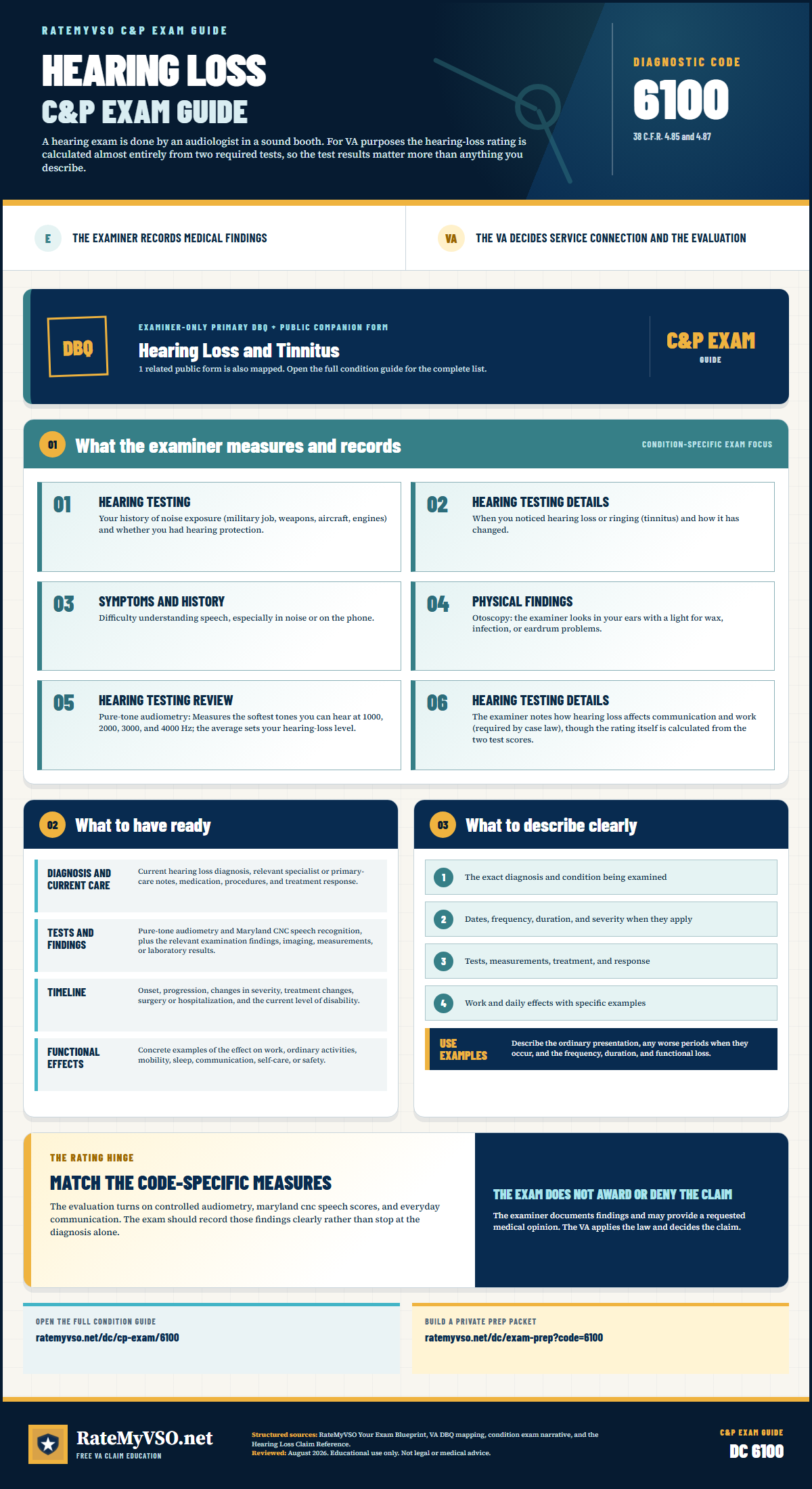
A hearing exam is done by an audiologist in a sound booth. For VA purposes the hearing-loss rating is calculated almost entirely from two required tests, so the test results matter more than anything you describe.
DBQ used for this condition
- PPublic formDBQ AUDIO Hearing Loss and TinnitusOpen the public DBQ
- PPublic formDBQ ENT Ear Conditions Including Vestibular and InfectiousOpen the public DBQ
What the examination is likely to focus on
Functional-impact topics to describe
- The examiner notes how hearing loss affects communication and work (required by case law), though the rating itself is calculated from the two test scores.
- Tinnitus (ringing) is rated separately under DC 6260 and is capped at 10 percent, whether one or both ears are affected.
Which form the examiner uses
For hearing loss (DC 6100), the C&P examiner completes the following Disability Benefits Questionnaire (DBQ):
- DBQ AUDIO Hearing Loss and Tinnitus (public PDF on VA.gov. Public Ear (vestibular and infectious) DBQ. The Hearing Loss and Tinnitus DBQ itself is examiner-only and uses audiogram + speech-discrimination testing not covered by the Ear DBQ; the Ear DBQ is the closest public form.)
- DBQ ENT Ear Conditions Including Vestibular and Infectious (public PDF on VA.gov)
DBQs are Department of Veterans Affairs Form 21-0960 series documents. Public DBQs are hosted on benefits.va.gov. A handful are examiner-only and are not posted publicly.
What to expect at your C&P exam
A hearing exam is done by an audiologist in a sound booth. For VA purposes the hearing-loss rating is calculated almost entirely from two required tests, so the test results matter more than anything you describe.
1Initial interview (history)
- Your history of noise exposure (military job, weapons, aircraft, engines) and whether you had hearing protection.
- When you noticed hearing loss or ringing (tinnitus) and how it has changed.
- Difficulty understanding speech, especially in noise or on the phone.
- Ear infections, surgeries, or other ear problems.
- Effect on communication, work, and daily life.
2Physical examination
- Otoscopy: the examiner looks in your ears with a light for wax, infection, or eardrum problems.
3Diagnostic tests the examiner may rely on
Two tests drive the VA hearing rating and are required under 38 CFR 4.85. The scores, not your description, set most ratings.
4Functional assessment
- The examiner notes how hearing loss affects communication and work (required by case law), though the rating itself is calculated from the two test scores.
- Tinnitus (ringing) is rated separately under DC 6260 and is capped at 10 percent, whether one or both ears are affected.
A vestibular (balance) exam checks for dizziness and balance problems. The rating depends on how often you have dizziness and staggering, under 38 CFR 4.87.
1Initial interview (history)
- Dizziness or spinning (vertigo) episodes: how often and how long they last.
- Balance problems, staggering, nausea, and any hearing changes or ringing.
- Triggers and effect on walking, driving, and work.
2Physical examination
- Balance and coordination testing, such as the Romberg test and watching you walk.
- Checking eye movements for nystagmus.
- Looking in the ears.
3Diagnostic tests the examiner may rely on
Used to confirm the cause of the dizziness.
4Functional assessment
- How often you have dizziness, and whether it comes with staggering, which set the rating.
- Findings map to the tiers in 38 CFR 4.87, DC 6204.
Test explainers open MedlinePlus (NIH National Library of Medicine), or Wikipedia where MedlinePlus has no matching page. This describes what happens and what is measured, not how to influence a result.
What the examiner records (full DBQ form)
The fields below are reproduced from the DBQ form the examiner completes for this diagnostic code. This is the structural map of the form, showing what the examiner is asked to measure, observe, and record. It is a factual reproduction of the public DBQ, not advice on how to answer.
DBQ AUDIO Hearing Loss and Tinnitus
This DBQ evaluates ear conditions including vestibular and infectious conditions such as Meniere's syndrome, peripheral vestibular disorders, BPPV, otitis media, cholesteatoma, and related neoplasms, documenting symptoms, physical exam findings, surgical history, diagnostic test results, and functional impact.
DIAGNOSIS (Section I)
- 1A. List the claimed condition(s) that pertain to this questionnaire:
- 1B. Select diagnoses associated with the claimed condition(s) (check all that apply): The Veteran does not have a current diagnosis associated with any claimed condition(s) listed above.
- Meniere's syndrome or endolymphatic hydrops ICD Code: Date of diagnosis:
- Peripheral vestibular disorder ICD Code: Date of diagnosis:
- Benign Paroxysmal Positional Vertigo (BPPV) ICD Code: Date of diagnosis:
- Chronic otitis externa ICD Code: Date of diagnosis:
- Chronic suppurative otitis media ICD Code: Date of diagnosis:
- Chronic nonsuppurative otitis media (serous otitis media) ICD Code: Date of diagnosis:
- Mastoiditis ICD Code: Date of diagnosis:
- Cholesteatoma ICD Code: Date of diagnosis:
- Otosclerosis ICD Code: Date of diagnosis:
- Benign neoplasm of the ear (other than skin only) ICD Code: Date of diagnosis:
- Malignant neoplasm of the ear (other than skin only) ICD Code: Date of diagnosis:
- Other, diagnosis #1: ICD Code: Date of diagnosis:
- Other, diagnosis #2: ICD Code: Date of diagnosis:
- Other, diagnosis #3: ICD Code: Date of diagnosis:
- 1C. If there are additional diagnoses that pertain to ear or peripheral vestibular conditions, list using above format
MEDICAL HISTORY (Section II)
- 2A. Describe the history (including onset, course, and treatment) of the Veteran's ear or peripheral vestibular conditions (brief summary):
- 2B. Does the Veteran's treatment plan include taking continuous medication for the diagnosed condition?
- If yes, list only those medications used for the diagnosed condition:
VESTIBULAR CONDITIONS (Section III)
- 3A. Does the Veteran have any of the following findings, signs, or symptoms attributable to Meniere's Syndrome (Endolymphatic Hydrops), a peripheral vestibular condition or another diagnosed condition from Section I?
- Hearing impairment with vertigo - If checked, indicate frequency: Less than once a month / 1 to 4 times per month / More than once weekly
- Hearing impairment with vertigo - Indicate duration of episodes: < 1 hour / 1 to 24 hours / > 24 hours
- Hearing impairment with attacks of vertigo and cerebellar gait - If checked, indicate frequency: Less than once a month / 1 to 4 times per month / More than once weekly
- Hearing impairment with attacks of vertigo and cerebellar gait - Indicate duration of episodes: < 1 hour / 1 to 24 hours / > 24 hours
- Tinnitus, unilateral or bilateral - If checked, indicate frequency: Less than once a month / 1 to 4 times per month / More than once weekly
- Tinnitus, unilateral or bilateral - Indicate duration of episodes: < 1 hour / 1 to 24 hours / > 24 hours
- Vertigo - If checked, indicate frequency: Less than once a month / 1 to 4 times per month / More than once weekly
- Vertigo - Indicate duration of episodes: < 1 hour / 1 to 24 hours / > 24 hours
- Staggering - If checked, indicate frequency: Less than once a month / 1 to 4 times per month / More than once weekly
- Staggering - Indicate duration of episodes: < 1 hour / 1 to 24 hours / > 24 hours
- Hearing impairment and/or tinnitus
- Other, describe:
INFECTIOUS, INFLAMMATORY AND OTHER EAR CONDITIONS (Section IV)
- 4A. Does the Veteran have any of the following findings, signs or symptoms attributable to chronic ear infection, inflammation, cholesteatoma or any of the diagnoses listed in Section I?
- Swelling (external ear canal) - If checked, describe:
- Dry and scaly (external ear canal)
- Serous discharge (external ear canal)
- Itching (external ear canal)
- Effusion
- Active suppuration
- Aural polyps
- Hearing impairment and/or tinnitus
- Facial nerve paralysis
- Bone loss of skull - If checked, indicate severity: Area lost smaller than an American quarter (4.619 cm2) / Area lost larger than an American quarter but smaller than a 50-cent piece / Area lost larger than an American 50-cent piece (7.355 cm2)
- Requiring frequent and prolonged treatment - If checked, describe type and durations of treatment:
- Other, describe:
- 4B. Does the Veteran have a benign neoplasm of the ear (other than skin only, such as keloid) that causes any impairment of function?
- If yes, describe impairment of function caused by this condition:
SURGICAL TREATMENT (Section V)
- 5A. Has the Veteran had surgical treatment for any ear condition?
- Type of surgery:
- Date of surgery:
- Side affected: Right / Left / Both
- 5B. Does the Veteran have any residuals as a result of the surgery?
- If yes, describe:
PHYSICAL EXAM (Section VI)
- 6A. External ear: Exam of external ear not indicated / Normal / Deformity of auricle, with loss of less than one-third of the substance (specify side: Right / Left) / Deformity of auricle, with loss of one-third or more of the substance (specify side: Right / Left) / Complete loss of auricle (specify side: Right / Left) / Other abnormality, describe:
- 6B. Ear canal: Exam of ear canal not indicated / Normal / Abnormal, describe:
- 6C. Tympanic membrane: Exam of tympanic membrane not indicated / Normal / Perforated tympanic membrane (specify side affected: Right / Left) / Evidence of a healed tympanic membrane perforation (specify side affected: Right / Left) / Other abnormality, describe:
- 6D. Gait: Exam of gait not indicated / Normal / Unsteady, describe: / Other abnormality, describe:
- 6E. Romberg Test: Exam using this test not indicated / Normal or negative / Abnormal or positive for unsteadiness
- 6F. Dix Hallpike test (Nylen-Barany test) for vertigo: Exam using this test not indicated / Normal, no vertigo or nystagmus during test / Abnormal, vertigo or nystagmus during test, describe:
- 6G. Limb coordination test (finger-nose-finger): Exam using this test not indicated / Normal / Abnormal, describe:
TUMORS AND NEOPLASMS (Section VII)
- 7A. Does the Veteran have a benign or malignant neoplasm or metastases related to any of the diagnoses in the diagnosis section?
- 7B. Is the neoplasm: Benign / Malignant - Active / In remission - Primary / Secondary (metastatic) (if secondary, indicate the primary site, if known):
- 7C. Has the Veteran completed treatment or is the Veteran currently undergoing treatment for a benign or malignant neoplasm or metastases?
- Treatment completed; currently in watchful waiting status
- Surgery - If checked, describe: / Date(s) of surgery:
- Radiation therapy - Date of most recent treatment: / Date of completion of treatment or anticipated date of completion:
- Antineoplastic chemotherapy - Date of most recent treatment: / Date of completion of treatment or anticipated date of completion:
- Other therapeutic procedure - If checked, describe procedure: / Date of most recent procedure:
- Other therapeutic treatment - If checked, describe treatment: / Date of completion of treatment or anticipated date of completion:
- 7D. Does the Veteran currently have any residual conditions or complications due to the neoplasm (including metastases) or its treatment, other than those already documented in the report above? - If yes, list residual conditions and complications (brief summary):
- 7E. If there are additional benign or malignant neoplasms or metastases related to any of the diagnoses in the diagnosis section, describe using the above format:
OTHER PERTINENT PHYSICAL FINDINGS, COMPLICATIONS, CONDITIONS, SIGNS, SYMPTOMS, AND SCARS (Section VIII)
- 8A. Does the Veteran have any other pertinent physical findings, complications, conditions, signs or symptoms related to the conditions listed in the diagnosis section above? - If yes, describe (brief summary):
- 8B. Does the Veteran have any scars or other disfigurement (of the skin) related to any conditions or to the treatment of any conditions listed in the diagnosis section?
- 8C. Comments, if any:
DIAGNOSTIC TESTING (Section IX)
- 9A. Have diagnostic imaging studies or other diagnostic procedures been performed?
- Magnetic resonance imaging (MRI) - Date: / Results:
- Computerized axial tomography (CT) - Date: / Results:
- Electronystagmography (ENG) - Date: / Results:
- Other, specify: - Date: / Results:
- 9B. Has the Veteran had an audiogram? - If yes, attach or provide results:
- 9C. Are there any other significant diagnostic test findings and/or results? - If yes, provide type of test or procedure, date and results (brief summary):
FUNCTIONAL IMPACT (Section X)
- 10A. Do any of the Veteran's ear or peripheral vestibular conditions impact his or her ability to work?
- If yes, describe impact of each of the Veteran's ear or peripheral vestibular conditions, providing one or more examples:
REMARKS (Section XI)
- 11A. Remarks (if any)
DBQ ENT Ear Conditions Including Vestibular and Infectious
This DBQ evaluates ear conditions including vestibular conditions (Meniere's, peripheral vestibular disorders), infectious/inflammatory ear conditions, and surgical treatments. Hearing loss and tinnitus are evaluated on a separate examiner-only Audio DBQ.
How DC 6100 maps to this DBQ: for this diagnostic code specifically, the examiner typically completes sections I-II and VIII-XI of this form. Sections III-VII cover unrelated conditions on this DBQ and are skipped.
DIAGNOSIS (Section I)
- 1A. List the claimed condition(s) that pertain to this questionnaire: Note: These are the diagnoses determined during this current evaluation of the claimed condition(s) listed above. If there is no diagnosis, if the diagnosis is different from a previous diagnosis for this condition, or if there is a diagnosis of a complication due to the claimed condition(s), explain your findings and reasons…
- 1B. Select diagnoses associated with the claimed condition(s) (check all that apply): The Veteran does not have a current diagnosis associated with any claimed condition(s) listed above. (Explain your findings and reasons in the comments section) Meniere's syndrome or endolymphatic hydrops ICD Code: Date of diagnosis: Peripheral vestibular disorder ICD Code: Date of diagnosis: Benign Paroxysmal…
- 1C. If there are additional diagnoses that pertain to ear or peripheral vestibular conditions, list using above format Note: If the Veteran has hearing loss or tinnitus attributable to any ear condition listed above, a Hearing Loss and Tinnitus Questionnaire must ALSO be completed.
MEDICAL HISTORY (Section II)
- 2A. Describe the history (including onset, course, and treatment) of the Veteran's ear or peripheral vestibular conditions (brief summary):
- 2B. Does the Veteran's treatment plan include taking continuous medication for the diagnosed condition? Yes No If yes, list only those medications used for the diagnosed condition:
VESTIBULAR CONDITIONS (Section III)
- 3A. Does the Veteran have any of the following findings, signs, or symptoms attributable to Meniere's Syndrome (Endolymphatic Hydrops), a peripheral vestibular condition or another diagnosed condition from Section I? Yes No If yes, check all that apply: Hearing impairment with vertigo If checked, indicate frequency: Less than once a month
INFECTIOUS, INFLAMMATORY AND OTHER EAR CONDITIONS (Section IV)
- 4A. Does the Veteran have any of the following findings, signs or symptoms attributable to chronic ear infection, inflammation, cholesteatoma or any of the diagnoses listed in Section I? Yes No If yes, check all that apply: Swelling (external ear canal) If checked, describe: Dry and scaly (external ear canal)
- 4B. Does the Veteran have a benign neoplasm of the ear (other than skin only, such as keloid) that causes any impairment of function? Yes No If yes, describe impairment of function caused by this condition:
SURGICAL TREATMENT (Section V)
- 5A. Has the Veteran had surgical treatment for any ear condition? Yes No If yes, indicate type of surgery: Type of surgery: Date of surgery: Side affected: Right Left Both
- 5B. Does the Veteran have any residuals as a result of the surgery? Yes No If yes, describe:
PHYSICAL EXAM (Section VI)
- 6A. External ear: Exam of external ear not indicated Normal Deformity of auricle, with loss of less than one-third of the substance If checked, specify side: Right Left Deformity of auricle, with loss of one-third or more of the substance
- 6B. Ear canal: Exam of ear canal not indicated Normal Abnormal, describe:
- 6C. Tympanic membrane: Exam of tympanic membrane not indicated Normal Perforated tympanic membrane If checked, specify side affected: Right Left Evidence of a healed tympanic membrane perforation If checked, specify side affected: Right Left
- 6D. Gait: Exam of gait not indicated Normal Unsteady, describe: Other abnormality, describe:
- 6E. Romberg Test: Exam using this test not indicated Normal or negative Abnormal or positive for unsteadiness
- 6F. Dix Hallpike test (Nylen-Barany test) for vertigo: Exam using this test not indicated Normal, no vertigo or nystagmus during test Abnormal, vertigo or nystagmus during test, describe:
- 6G. Limb coordination test (finger-nose-finger): Exam using this test not indicated Normal Abnormal, describe:
TUMORS AND NEOPLASMS (Section VII)
- 7A. Does the Veteran have a benign or malignant neoplasm or metastases related to any of the diagnoses in the diagnosis section? Yes No If yes, complete the following:
- 7B. Is the neoplasm: Benign Malignant Active In remission Primary Secondary (metastatic) (if secondary, indicate the primary site, if known):
- 7C. Has the Veteran completed treatment or is the Veteran currently undergoing treatment for a benign or malignant neoplasm or metastases? Yes No; watchful waiting If yes, indicate type of treatment the Veteran is currently undergoing or has completed (check all that apply): Treatment completed; currently in watchful waiting status Surgery If checked, describe: Date(s) of surgery:
- 7D. Does the Veteran currently have any residual conditions or complications due to the neoplasm (including metastases) or its treatment, other than those already documented in the report above? Yes No If yes, list residual conditions and complications (brief summary):
- 7E. If there are additional benign or malignant neoplasms or metastases related to any of the diagnoses in the diagnosis section, describe using the above format:
OTHER PERTINENT PHYSICAL FINDINGS, COMPLICATIONS, CONDITIONS, SIGNS, SYMPTOMS, AND SCARS (Section VIII)
- 8A. Does the Veteran have any other pertinent physical findings, complications, conditions, signs or symptoms related to the conditions listed in the diagnosis section above? Yes No If yes, describe (brief summary):
- 8B. Does the Veteran have any scars or other disfigurement (of the skin) related to any conditions or to the treatment of any conditions listed in the diagnosis section? Yes No If yes, also complete the appropriate dermatological questionnaire.
- 8C. Comments, if any:
DIAGNOSTIC TESTING (Section IX)
- 9A. Have diagnostic imaging studies or other diagnostic procedures been performed? Yes No If yes, check all that apply: Magnetic resonance imaging (MRI) Date: Results: Computerized axial tomography
- 9B. Has the Veteran had an audiogram? Yes No If yes, attach or provide results: Note: If the Veteran has hearing loss or tinnitus, a hearing loss or tinnitus exam must also be completed.
- 9C. Are there any other significant diagnostic test findings and/or results? Yes No If yes, provide type of test or procedure, date and results (brief summary):
FUNCTIONAL IMPACT (Section X)
- 10A. Do any of the Veteran's ear or peripheral vestibular conditions impact his or her ability to work? Yes No If yes, describe impact of each of the Veteran's ear or peripheral vestibular conditions, providing one or more examples:
REMARKS (Section XI)
- 11A. Remarks (if any)
Rating Levels for DC 6100
The following tiers are reproduced from 38 CFR Part 4, the VA Schedule for Rating Disabilities. Toggle between the official VA criteria and a Plain English explanation.
Plain-English summaries are AI-generated to explain the official criteria. The official 38 CFR language is the binding legal standard. When in doubt, ask a VSO.
Evidence cited in published BVA decisions for DC 6100
The counts below are aggregated from published Board of Veterans Appeals decisions for this diagnostic code, among issues the Board granted or denied (remanded issues are not included). Each row reports how often a given evidence type was discussed in the decision text, broken down by outcome. This is a factual aggregate of the public record, not a prediction or recommendation about any specific claim.
- Service treatment records: appeared in 21530 granted decisions (50811 denied; 72341 decided total)
- Buddy / lay statements: appeared in 18314 granted decisions (37139 denied; 55453 decided total)
- Medical literature: appeared in 1678 granted decisions (2771 denied; 4449 decided total)
What the Board discussed in granted decisions for DC 6100
The themes below were extracted by clustering 500 grant-factor sentences from published Board of Veterans Appeals decisions for this diagnostic code. Frequencies indicate how often each theme appeared in the sample. This is a factual aggregate of the public record, not advice or strategy for any specific claim.
- 23% Benefit of the doubt doctrine cited in legal standardThe Board or decision cited the statutory or regulatory benefit of the doubt standard, explaining that when evidence is in approximate balance or relative equipoise the claimant prevails.116 of 500 sample sentences
- 22% VA or private examiner nexus opinion noted as at least as likely as notA VA or private examiner or audiologist provided a positive nexus opinion finding the Veteran's hearing loss or tinnitus was at least as likely as not related to military noise exposure or service.112 of 500 sample sentences
- 17% Evidence found in equipoise, benefit of the doubt applied to grant claimThe Board found the evidence at least in relative equipoise on the question of service connection for hearing loss or tinnitus and resolved reasonable doubt in the Veteran's favor to grant the claim.87 of 500 sample sentences
- 7% Tinnitus linked to hearing loss by examiner opinionAn examiner opined that the Veteran's tinnitus was at least as likely as not a symptom associated with diagnosed hearing loss, as tinnitus is a known symptom of hearing loss.36 of 500 sample sentences
- 7% Preponderance of evidence against claim, benefit of doubt inapplicableThe Board found the preponderance or persuasive weight of the evidence against the claim, rendering the benefit of the doubt doctrine inapplicable and resulting in denial.35 of 500 sample sentences
- 4% Negative VA examiner nexus opinion recordedA VA examiner concluded that the Veteran's bilateral hearing loss or tinnitus was not at least as likely as not caused by or the result of an event in military service.18 of 500 sample sentences
- 2% Heightened duty to consider benefit of doubt when records lostThe Board noted a heightened obligation to consider the benefit of the doubt rule and assist the Veteran when service treatment records were lost, destroyed, or otherwise unavailable.12 of 500 sample sentences
- 2% In-service noise exposure documented as established factThe Board recorded that the evidence supported a finding of confirmed in-service hazardous noise exposure as an established predicate for the hearing loss or tinnitus claim.8 of 500 sample sentences
- 1% Veteran lay statements credited as competent and credible evidenceThe Board found the Veteran's lay statements regarding onset and continuity of hearing loss or tinnitus symptoms to be competent, credible, and sufficient to support a finding of service incurrence.7 of 500 sample sentences
- 1% Audiometric test data recorded to establish compensable hearing lossPure tone threshold and speech recognition score data from VA audiology examinations were recorded to establish a hearing loss disability for VA rating purposes.5 of 500 sample sentences
- 1% Remand directed for new examiner opinion on hearing loss nexusThe Board or decision directed that the Veteran be scheduled for a VA audiology examination or that an examiner provide a new opinion addressing whether hearing loss or tinnitus was at least as likely as not related to service.4 of 500 sample sentences
When the Board found the exam inadequate (DC 6100)
In 22,603 published Board of Veterans' Appeals decisions involving this condition, the Board found a C&P examination or medical opinion inadequate. Where the defect could be read from the decision, it was most often one of the following (counts are a floor from the decisions on file, not a total):
- 5,701 Failed to address a contention or part of the condition
- 4,577 Conclusion given without a supporting rationale
- 4,007 Veteran's lay statements not considered
- 2,547 Opinion relied on the absence of records instead of the evidence
- 1,006 Claims file or records not reviewed
- 650 Examiner said an opinion would require speculation
- 379 Flare-ups or functional loss not addressed
- 261 Exam too old to reflect current severity
- 163 Wrong legal standard or question applied
An inadequate exam is usually sent back for a new one rather than decided against the veteran. This is a factual report of published decisions, not advice about any exam or claim; whether an exam is adequate is decided case by case.
Disclaimer: This page reproduces public Department of Veterans Affairs forms (DBQs) and verbatim text from 38 CFR Part 4 (the VA Schedule for Rating Disabilities). It is informational only and is not legal or medical advice. For guidance on a specific claim, contact a VA-accredited representative.