C&P Exam Prep Guide for Arteriosclerotic heart disease (DC 7005)
YOUR EXAM BLUEPRINT
Arteriosclerotic heart disease
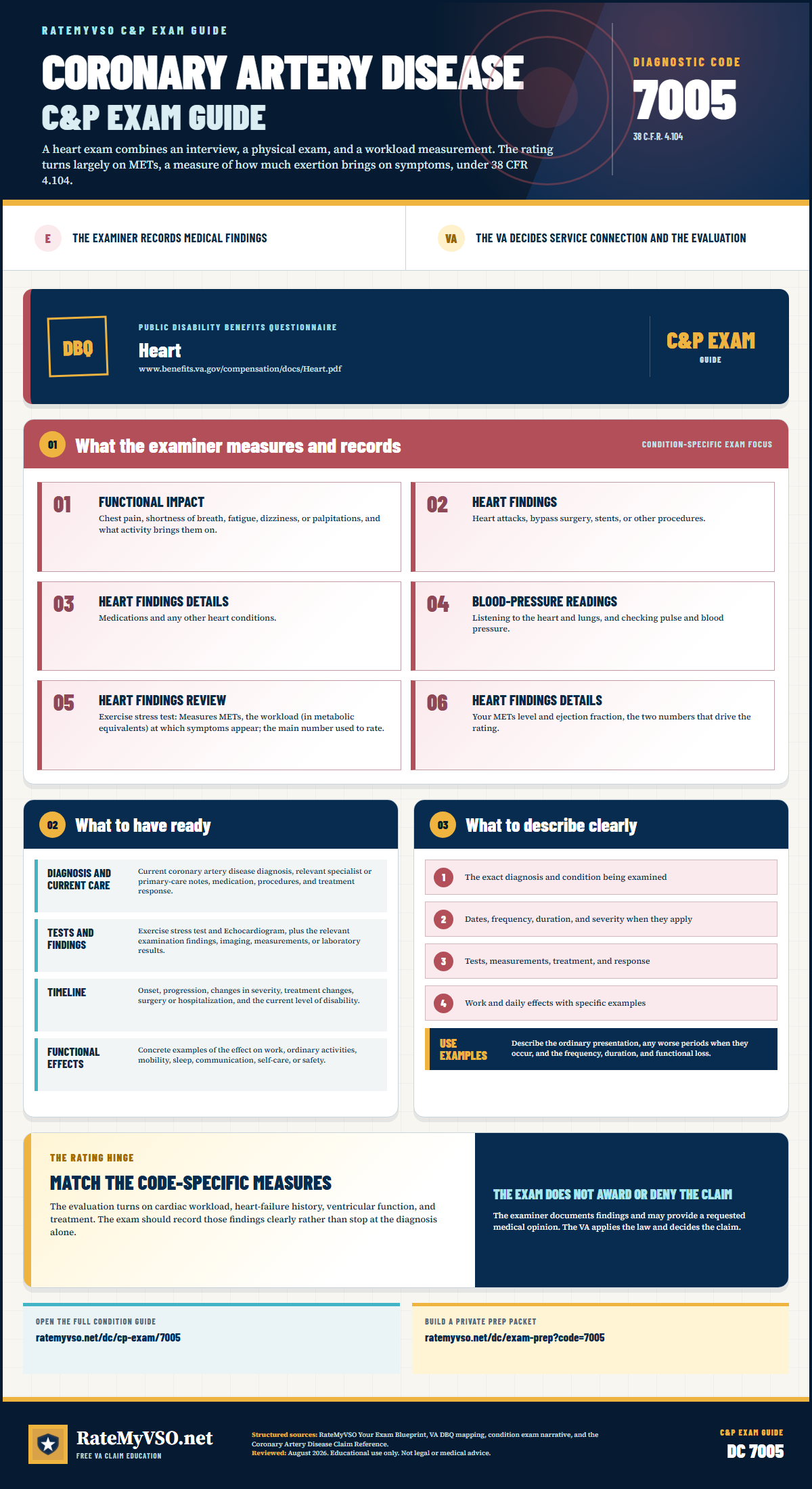
A heart exam combines an interview, a physical exam, and a workload measurement. The rating turns largely on METs, a measure of how much exertion brings on symptoms, under 38 CFR 4.104.
DBQ used for this condition
- PPublic formDBQ CARDIO HeartOpen the public DBQ
What the examination is likely to focus on
Functional-impact topics to describe
- Your METs level and ejection fraction, the two numbers that drive the rating.
- Symptoms during activity and the effect on work.
- Findings map to the tiers in 38 CFR 4.104, DC 7005.
Which form the examiner uses
For arteriosclerotic heart disease (DC 7005), the C&P examiner completes the following Disability Benefits Questionnaire (DBQ):
- DBQ CARDIO Heart (public PDF on VA.gov)
DBQs are Department of Veterans Affairs Form 21-0960 series documents. Public DBQs are hosted on benefits.va.gov. A handful are examiner-only and are not posted publicly.
What to expect at your C&P exam
A heart exam combines an interview, a physical exam, and a workload measurement. The rating turns largely on METs, a measure of how much exertion brings on symptoms, under 38 CFR 4.104.
1Initial interview (history)
- Chest pain, shortness of breath, fatigue, dizziness, or palpitations, and what activity brings them on.
- Heart attacks, bypass surgery, stents, or other procedures.
- Medications and any other heart conditions.
- Effect on activity and work.
2Physical examination
- Listening to the heart and lungs, and checking pulse and blood pressure.
- Checking for swelling (edema) and other signs of heart strain.
3Diagnostic tests the examiner may rely on
Used to measure heart function and the workload level that brings on symptoms.
4Functional assessment
- Your METs level and ejection fraction, the two numbers that drive the rating.
- Symptoms during activity and the effect on work.
- Findings map to the tiers in 38 CFR 4.104, DC 7005.
Test explainers open MedlinePlus (NIH National Library of Medicine), or Wikipedia where MedlinePlus has no matching page. This describes what happens and what is measured, not how to influence a result.
What the examiner records (full DBQ form)
The fields below are reproduced from the DBQ form the examiner completes for this diagnostic code. This is the structural map of the form, showing what the examiner is asked to measure, observe, and record. It is a factual reproduction of the public DBQ, not advice on how to answer.
This DBQ evaluates heart conditions including ischemic and non-ischemic heart disease, arrhythmias, valvular disease, pericardial conditions, and cardiac surgery.
How DC 7005 maps to this DBQ: for this diagnostic code specifically, the examiner typically completes sections I-III, XI-XII, and XIV-XV of this form. Section III is the condition-specific section for this code. Sections IV-X and XIII cover unrelated conditions on this DBQ and are skipped.
DIAGNOSIS (Section I)
- 1A. List the claimed condition(s) that pertain to this questionnaire:
- 1B. Select diagnoses associated with the claimed condition(s) (check all that apply):
- The Veteran does not have a current diagnosis associated with any claimed condition(s) listed above.
- Acute, subacute, or old myocardial infarction ICD Code: Date of diagnosis:
- Atherosclerotic cardiovascular disease ICD Code: Date of diagnosis:
- Unstable angina ICD Code: Date of diagnosis:
- Stable angina ICD Code: Date of diagnosis:
- Arteriosclerotic heart disease (Coronary artery disease) ICD Code: Date of diagnosis:
- Coronary spasm, including Prinzmetal's angina ICD Code: Date of diagnosis:
- Congestive heart failure ICD Code: Date of diagnosis:
- Bradycardia (bradyarrhythmia) ICD Code: Date of diagnosis:
- Ventricular arrhythmia ICD Code: Date of diagnosis:
- Supraventricular arrhythmia (supraventricular tachycardia) ICD Code: Date of diagnosis:
- Automatic implantable cardioverter defibrillator (AICD) ICD Code: Date of diagnosis:
- Implanted cardiac pacemaker ICD Code: Date of diagnosis:
- Cardiac/Heart transplant ICD Code: Date of diagnosis:
- Valvular heart disease ICD Code: Date of diagnosis:
- Heart block ICD Code: Date of diagnosis:
- Other infectious heart conditions ICD Code: Date of diagnosis:
- Hyperthyroid heart disease ICD Code: Date of diagnosis:
- Syphilitic heart disease ICD Code: Date of diagnosis:
- Pericarditis ICD Code: Date of diagnosis:
- Endocarditis ICD Code: Date of diagnosis:
- Rheumatic heart disease ICD Code: Date of diagnosis:
- Active valvular infection ICD Code: Date of diagnosis:
- Coronary artery bypass graft ICD Code: Date of diagnosis:
- Heart valve replacement (prosthesis) ICD Code: Date of diagnosis:
- Cardiomyopathy ICD Code: Date of diagnosis:
- Hypertensive heart disease ICD Code: Date of diagnosis:
- Pericardial adhesions ICD Code: Date of diagnosis:
- Other diagnosis #1: ICD Code: Date of diagnosis:
- Other diagnosis #2: ICD Code: Date of diagnosis:
- Other diagnosis #3: ICD Code: Date of diagnosis:
MEDICAL HISTORY (Section II)
- 2A. Describe the history (including onset and course) of the Veteran's heart condition (brief summary):
- 2B. Do any of the Veteran's heart conditions qualify within the generally accepted medical definition of Ischemic Heart Disease (IHD)?
- If yes, list the conditions that qualify:
- 2C. Provide the etiology, if known, of each of the Veteran's heart conditions, including the relationship/causality to other heart conditions, particularly the relationship/causality to the Veteran's IHD conditions, if any:
- Heart condition #1 (provide etiology):
- Heart condition #2 (provide etiology):
- 2D. Is continuous medication required for control of the Veteran's heart condition?
- If yes, list the medications required for the Veteran's heart condition (include name of medication and heart condition it is used for)
MYOCARDIAL INFARCTION (MI) (Section III)
- 3A. Has the Veteran had an MI?
- MI #1 Date and treatment facility:
- MI #2 Date and treatment facility:
ARRHYTHMIA (Section IV)
- 4A. Has the Veteran had a cardiac arrhythmia?
- Asymptomatic bradycardia (bradyarrhythmia)
- Bradycardia (bradyarrhythmia), symptomatic, requiring permanent pacemaker implantation
- Supraventricular tachycardia documented by electrocardiogram (ECG) (if checked, indicate type of treatment)
- Treatment intervention (specify the type and number of treatment interventions per year): Intravenous pharmacologic adjustment / Cardioversion / Ablation for symptom relief
- Number of treatment interventions per year: 0 / 1-4 / 5 or more
- Continuous use of oral medications to control
- Use of vagal maneuvers to control
- No treatment
- Atrioventricular block (if checked, select type): First degree / Second degree (type I) / Second degree (type II) / Third degree
- Ventricular arrhythmia (sustained)
- Other cardiac arrhythmia, specify:
HEART VALVE CONDITIONS (Section V)
- 5A. Has the Veteran had a heart valve condition?
- Heart valves affected. Check all that apply: Mitral / Tricuspid / Aortic / Pulmonary
- Describe the type of valve condition for each checked valve.
INFECTIOUS HEART CONDITIONS (Section VI)
- 6A. Has the Veteran had any infectious cardiac conditions, including active valvular infection (which includes rheumatic heart disease), endocarditis, pericarditis, or syphilitic heart disease?
- 6B. Has the Veteran undergone or is the Veteran currently undergoing treatment for any active infection?
- If yes, describe treatment and site of infection being treated. Also provide date or expected date of completion
- Date completed:
- Expected date of completion:
- 6C. Has the Veteran had a syphilitic aortic aneurysm?
PERICARDIAL ADHESIONS (Section VII)
- 7A. Has the Veteran had pericardial adhesions?
- Etiology of pericardial adhesions: Pericarditis / Cardiac surgery/bypass / Other, describe:
PROCEDURES (Section VIII)
- 8A. Has the Veteran had any non-surgical or surgical procedures for the treatment of a heart condition?
- Percutaneous coronary intervention (PCI) (angioplasty) Date of treatment: Date of admission: Indicate treatment facility: Indicate the condition that resulted in the need for the procedure/treatment:
- Coronary artery bypass surgery Date of treatment: Date of admission: Indicate treatment facility: Indicate the condition that resulted in the need for the procedure/treatment:
- Cardiac/Heart transplants Date of treatment: Date of admission: Date of discharge: Indicate treatment facility: Indicate the condition that resulted in the need for the procedure/treatment:
- Implanted cardiac pacemaker Date of treatment: Date of admission: Date of discharge: Indicate treatment facility: Indicate the condition that resulted in the need for the procedure/treatment:
- Automatic implantable cardioverter defibrillator (AICD) Date of treatment: Date of admission: Indicate treatment facility: ICD Code: Date of diagnosis: Indicate the condition that resulted in the need for the procedure/treatment:
- Heart valve replacement (prosthesis) (if checked indicate valve(s) that have been replaced): Mitral / Tricuspid / Aortic / Pulmonary Date of treatment: Date of admission: Date of discharge: Indicate treatment facility: Indicate the condition that resulted in the need for the procedure/treatment:
- Ventricular aneurysmectomy Date of treatment: Date of admission: Date of discharge: Indicate treatment facility: Indicate the condition that resulted in the need for the procedure/treatment:
- Other surgical and/or non surgical procedures for the treatment of a heart condition, describe: Date of treatment: Date of admission: Date of discharge: Indicate treatment facility: Indicate the condition that resulted in the need for the procedure/treatment:
- 8B. If the Veteran has had additional non-surgical or surgical procedures for the treatment of a heart condition, list using above format:
HOSPITALIZATIONS (Section IX)
- 9A. Has the Veteran had any other hospitalizations for the treatment of a heart condition (other than for non-surgical and/or surgical procedures described above)?
- Date of admission:
- Date of discharge:
- Indicate treatment facility:
- Condition that resulted in the need for hospitalization:
PHYSICAL EXAMINATION (Section X)
- Heart rate:
- Blood pressure:
- Rhythm: Regular / Irregular
- Point of maximal impact: Not palpable / 4th intercostal space / 5th intercostal space / Other, specify:
- Heart sounds: Normal / Abnormal, specify:
- Jugular-venous distension: Yes / No
- Auscultation of the lungs: Clear / Bibasilar rales / Other, specify:
- Peripheral pulses - Dorsalis pedis: Normal / Diminished / Absent
- Peripheral pulses - Posterior tibial: Normal / Diminished / Absent
- Peripheral edema - Right lower extremity: None / Trace / 1+ / 2+ / 3+ / 4+
- Peripheral edema - Left lower extremity: None / Trace / 1+ / 2+ / 3+ / 4+
OTHER PERTINENT PHYSICAL FINDINGS, COMPLICATIONS, CONDITIONS, SIGNS AND/OR SYMPTOMS (Section XI)
- 11A. Does the Veteran have any other pertinent physical findings, complications, conditions, signs or symptoms related to any conditions listed in the diagnosis section above?
- If yes, describe (brief summary):
- 11B. Does the Veteran have any scars or other disfigurement (of the skin) related to any conditions or to the treatment of any conditions listed in the diagnosis section?
DIAGNOSTIC TESTING (Section XII)
- 12A. Is there evidence of cardiac hypertrophy? If yes, indicate how this condition was documented: ECG / Chest x-ray / Echocardiogram / Multigated Acquisition Scan (MUGA) / MRI / Date of test:
- 12B. Is there evidence of cardiac dilatation? If yes, indicate how this condition was documented: ECG / Chest x-ray / Echocardiogram / MUGA / MRI / Date of test:
- ECG - Date of ECG: Results of ECG: Normal / Arrhythmia, describe: / Ischemic, describe: / Other, describe:
- Chest x-ray - Date of Chest x-ray: Results of chest x-ray: Normal / Abnormal, describe:
- Echocardiogram - Date of echocardiogram: Wall motion: Normal / Abnormal, describe: Wall thickness: Normal / Abnormal, describe:
- MUGA - Date of MUGA: Results of MUGA: Normal / Abnormal, describe:
- Coronary artery angiogram - Date of angiogram: Results of angiogram: Normal / Abnormal, describe:
- CT angiography - Date of CT angiography: Results of CT: Normal / Abnormal, describe:
- Other test - Other test, specify: Date of test: Results of test: Normal / Abnormal, describe:
METABOLIC EQUIVALENTS (METs) TESTING (Section XIII)
- 13A. Select all testing completed (of record and/or completed during this examination): Exercise stress test / Interview-based METs test / None
- 13B. Exercise stress test - Date of most recent exercise stress test:
- Results of exercise stress test:
- METs level the Veteran performed, if provided:
- Did the test show ischemia? Yes / No
- If no, was the test terminated due to symptoms related to the cardiac condition?
- 13C. If an exercise stress test was not performed, select a reason: Veteran has a medical contraindication, describe: / Veteran's previous exercise stress test reflects current cardiac function. / Exercise stress testing is not required as part of the Veteran's current treatment plan and this test is not without significant risk. / Other, describe:
- 13D. Interview-based METs test - Date of interview-based METs test:
- Symptoms during activity (check all that apply): Breathlessness / Fatigue / Angina / Dizziness / Syncope / Other, describe:
- The Veteran denies experiencing symptoms attributable to a cardiac condition with any level of physical activity
- Results of interview-based METs test. METs level on most recent interview-based METs test: (1-3 METs) / (>3-5 METs) / (>5-7 METs) / (>7-10 METs)
- 13E. Has the Veteran had both an exercise stress test and interview-based METs test? If yes, indicate which results most accurately reflect the Veteran's current cardiac functional level: Exercise stress test / Interview-based METs test
- 13F. Is the METs level provided due solely to the heart condition(s) that the Veteran is claiming in the diagnosis section?
- 13G. What is the estimated interview-based METs level due solely to the cardiac condition(s) listed above? METs level: (1-3 METs) / (>3-5 METs) / (>5-7 METs) / (>7-10 METs)
- Rationale:
FUNCTIONAL IMPACT (Section XIV)
- 14A. Regardless of the Veteran's current employment status, do the conditions listed in the diagnosis section impact his/her ability to perform any type of occupational task (such as standing, walking, lifting, sitting, etc.)?
- If yes, describe the functional impact of each condition, providing one or more examples:
REMARKS (Section XV)
- 15A. Remarks (if any - please identify the section to which the remark pertains when appropriate).
Rating Levels for DC 7005
The following tiers are reproduced from 38 CFR Part 4, the VA Schedule for Rating Disabilities. Toggle between the official VA criteria and a Plain English explanation.
Plain-English summaries are AI-generated to explain the official criteria. The official 38 CFR language is the binding legal standard. When in doubt, ask a VSO.
Evidence cited in published BVA decisions for DC 7005
The counts below are aggregated from published Board of Veterans Appeals decisions for this diagnostic code, among issues the Board granted or denied (remanded issues are not included). Each row reports how often a given evidence type was discussed in the decision text, broken down by outcome. This is a factual aggregate of the public record, not a prediction or recommendation about any specific claim.
- Service treatment records: appeared in 2052 granted decisions (5117 denied; 7169 decided total)
- Buddy / lay statements: appeared in 1347 granted decisions (2875 denied; 4222 decided total)
- Medical literature: appeared in 308 granted decisions (423 denied; 731 decided total)
What the Board discussed in granted decisions for DC 7005
The themes below were extracted by clustering 500 grant-factor sentences from published Board of Veterans Appeals decisions for this diagnostic code. Frequencies indicate how often each theme appeared in the sample. This is a factual aggregate of the public record, not advice or strategy for any specific claim.
- 27% Benefit of the doubt doctrine cited as legal standardThe Board or decision cited the statutory benefit of the doubt rule, noting that when positive and negative evidence is in approximate balance, the claimant prevails.134 of 500 sample sentences
- 18% Evidence found in equipoise supporting grantThe Board found the evidence at least in relative equipoise on a material fact — such as nexus, in-service exposure, or disability severity — and resolved the matter in the Veteran's favor.89 of 500 sample sentences
- 16% Medical opinion noting at least as likely as not nexusA VA or private examiner opined that a current disability was at least as likely as not caused by, related to, or aggravated by military service or a service-connected condition.82 of 500 sample sentences
- 14% Preponderance against claim, benefit of doubt not appliedThe Board determined that the weight of evidence persuasively opposed the claim, rendering the benefit of the doubt doctrine inapplicable and resulting in denial.72 of 500 sample sentences
- 11% Herbicide exposure found in equipoise or establishedThe Board found the evidence at least in equipoise, or affirmatively established, that the Veteran was exposed to herbicide agents during service, including service in Thailand or Vietnam.55 of 500 sample sentences
- 4% CAD or IHD rated at specific disability percentageThe Board found the evidence supported a specific schedular rating — such as 30, 60, or 100 percent — for coronary artery disease or ischemic heart disease under DC 7005.22 of 500 sample sentences
- 4% Secondary service connection nexus noted for CADAn examiner or the Board found that CAD or ischemic heart disease was at least as likely as not caused or aggravated by a service-connected condition such as diabetes, hypertension, or PTSD.20 of 500 sample sentences
- 4% Examiner or Board remand opinion request documentedThe record noted a request for a medical opinion on remand asking whether a disability was at least as likely as not related to service, in-service exposure, or a service-connected condition.18 of 500 sample sentences
- 1% Vietnam or Thailand boots-on-ground finding recordedThe Board found the evidence at least in equipoise or affirmatively established that the Veteran set foot in Vietnam or served near a Royal Thai Air Force Base perimeter during the Vietnam era.5 of 500 sample sentences
- 1% TDIU or unemployability finding supported by evidenceThe Board found the evidence at least in equipoise that the Veteran's service-connected disabilities, including CAD, rendered him unable to secure or follow substantially gainful employment.3 of 500 sample sentences
When the Board found the exam inadequate (DC 7005)
In 4,224 published Board of Veterans' Appeals decisions involving this condition, the Board found a C&P examination or medical opinion inadequate. Where the defect could be read from the decision, it was most often one of the following (counts are a floor from the decisions on file, not a total):
- 1,081 Conclusion given without a supporting rationale
- 1,080 Failed to address a contention or part of the condition
- 456 Veteran's lay statements not considered
- 235 Claims file or records not reviewed
- 230 Opinion relied on the absence of records instead of the evidence
- 144 Examiner said an opinion would require speculation
- 56 Flare-ups or functional loss not addressed
- 47 Exam too old to reflect current severity
- 46 Wrong legal standard or question applied
An inadequate exam is usually sent back for a new one rather than decided against the veteran. This is a factual report of published decisions, not advice about any exam or claim; whether an exam is adequate is decided case by case.
Disclaimer: This page reproduces public Department of Veterans Affairs forms (DBQs) and verbatim text from 38 CFR Part 4 (the VA Schedule for Rating Disabilities). It is informational only and is not legal or medical advice. For guidance on a specific claim, contact a VA-accredited representative.