C&P Exam Prep Guide for Hemorrhoids, external or internal (DC 7336)
YOUR EXAM BLUEPRINT
Hemorrhoids, external or internal
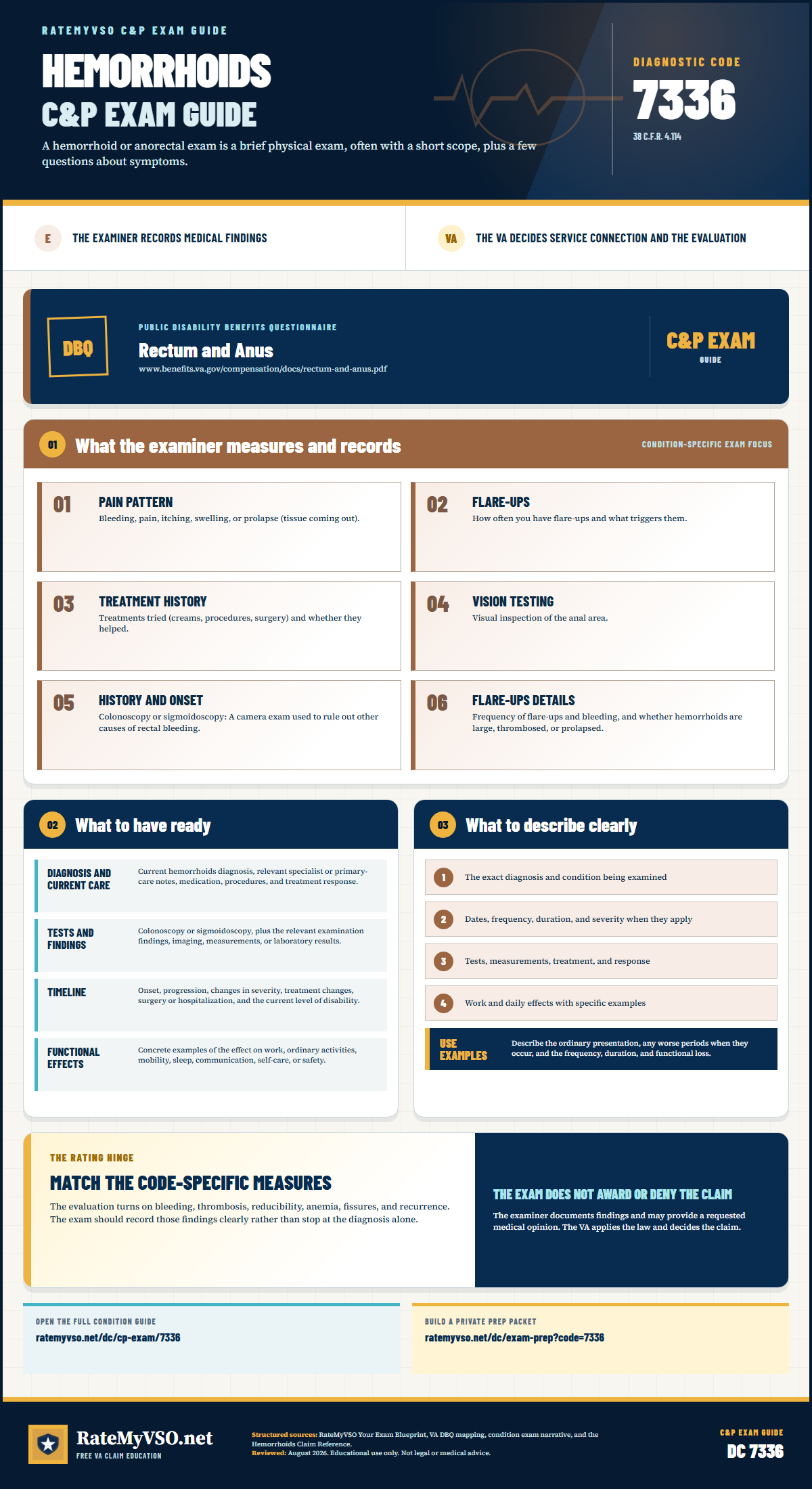
A hemorrhoid or anorectal exam is a brief physical exam, often with a short scope, plus a few questions about symptoms.
DBQ used for this condition
- PPublic formDBQ GI Rectum and AnusOpen the public DBQ
What the examination is likely to focus on
Functional-impact topics to describe
- Frequency of flare-ups and bleeding, and whether hemorrhoids are large, thrombosed, or prolapsed.
- Any anemia from chronic bleeding.
- Findings map to the tiers in 38 CFR 4.114, DC 7336.
Which form the examiner uses
For hemorrhoids, external or internal (DC 7336), the C&P examiner completes the following Disability Benefits Questionnaire (DBQ):
- DBQ GI Rectum and Anus (public PDF on VA.gov)
DBQs are Department of Veterans Affairs Form 21-0960 series documents. Public DBQs are hosted on benefits.va.gov. A handful are examiner-only and are not posted publicly.
What to expect at your C&P exam
A hemorrhoid or anorectal exam is a brief physical exam, often with a short scope, plus a few questions about symptoms.
1Initial interview (history)
- Bleeding, pain, itching, swelling, or prolapse (tissue coming out).
- How often you have flare-ups and what triggers them.
- Treatments tried (creams, procedures, surgery) and whether they helped.
- Any anemia from chronic bleeding.
2Physical examination
- Visual inspection of the anal area.
- Digital rectal exam.
- Anoscopy: a short scope to view the anal canal and internal hemorrhoids.
3Diagnostic tests the examiner may rely on
Usually only to rule out other causes of bleeding.
4Functional assessment
- Frequency of flare-ups and bleeding, and whether hemorrhoids are large, thrombosed, or prolapsed.
- Any anemia from chronic bleeding.
- Findings map to the tiers in 38 CFR 4.114, DC 7336.
Test explainers open MedlinePlus (NIH National Library of Medicine), or Wikipedia where MedlinePlus has no matching page. This describes what happens and what is measured, not how to influence a result.
What the examiner records (full DBQ form)
The fields below are reproduced from the DBQ form the examiner completes for this diagnostic code. This is the structural map of the form, showing what the examiner is asked to measure, observe, and record. It is a factual reproduction of the public DBQ, not advice on how to answer.
This DBQ evaluates rectum and anus conditions including hemorrhoids, anorectal/perianal fistula, rectal or anal stricture, impairment of sphincter control, rectal prolapse, pruritus ani, and neoplasms for VA disability rating purposes.
How DC 7336 maps to this DBQ: for this diagnostic code specifically, the examiner typically completes sections I-III and XI-XIV of this form. Section III is the condition-specific section for this code. Sections IV-X cover unrelated conditions on this DBQ and are skipped.
DIAGNOSIS (Section I)
- 1A. List the claimed condition(s) that pertain to this questionnaire:
- 1B. Select diagnoses associated with the claimed condition(s) (check all that apply): The Veteran does not have a current diagnosis associated with any claimed condition(s) listed above.
- Hemorrhoid(s), external or internal ICD code: Date of diagnosis:
- Anorectal/perianal fistula ICD code: Date of diagnosis:
- Anorectal/perianal abscess ICD code: Date of diagnosis:
- Rectal or anal stricture ICD code: Date of diagnosis:
- Dyssynergic defecation (levator ani) ICD code: Date of diagnosis:
- Anismus (functional constipation) ICD code: Date of diagnosis:
- Impairment of sphincter control ICD code: Date of diagnosis:
- Rectal prolapse ICD code: Date of diagnosis:
- Pruritus ani (anal itching) ICD code: Date of diagnosis:
- Benign neoplasm of the anorectal/perianal region ICD code: Date of diagnosis:
- Malignant neoplasm of the anorectal/perianal region ICD code: Date of diagnosis:
- Other diagnosis #1: ICD code: Date of diagnosis:
- Other diagnosis #2: ICD code: Date of diagnosis:
- Other diagnosis #3: ICD code: Date of diagnosis:
- 1C. If there are additional diagnoses that pertain to rectum or anus conditions, list using above format.
MEDICAL HISTORY (Section II)
- 2A. Describe the history, including onset and course, of the Veteran's rectum and/or anus condition(s). Brief summary:
- 2B. Does the Veteran's treatment plan include taking daily prescribed medication for the diagnosed condition(s)?
- If yes, list only those medications used for the diagnosed condition(s):
HEMORRHOIDS (Section III)
- 3A. Does the Veteran have hemorrhoid(s)?
- External
- Persistent bleeding (external)
- Anemia (external) (If checked, provide at least a hemoglobin or hematocrit value in the Diagnostic Testing Section).
- Three or more episodes per year of thrombosis (external)
- None of the above (external)
- Other (external)
- Internal
- Persistent bleeding (internal)
- Anemia (internal) (If checked, provide at least a hemoglobin or hematocrit value in the Diagnostic Testing Section).
- Continuously prolapsed internal hemorrhoids with three or more episodes per year of thrombosis
- Prolapsed internal hemorrhoids with two or less episodes per year of thrombosis
- None of the above (internal)
- Other (internal)
ANORECTAL/PERIANAL FISTULA (Section IV)
- 4A. Does the Veteran have anorectal/perianal fistula?
- One fistula - With drainage
- One fistula - With pain
- One fistula - With abscess/abscesses
- Two or more simultaneous fistulas - With drainage
- Two or more simultaneous fistulas - With pain
- Two or more simultaneous fistulas - With abscess/abscesses
- More than two constant or near-constant fistulas - With drainage
- More than two constant or near-constant fistulas - With pain
- More than two constant or near-constant fistulas - With abscess/abscesses
- 4B. Is the fistula refractory to medical and surgical treatment?
RECTAL OR ANAL STRICTURE, INCLUDING DYSSINERGIC DEFECATION (LEVATOR ANI) OR FUNCTIONAL CONSTIPATION (Section V)
- 5A. Does the Veteran have rectal or anal stricture, including dyssynergic defecation (levator ani) or functional constipation?
- Luminal narrowing - Reduction of the lumen by less than 50 percent
- Luminal narrowing - Reduction of the lumen 50 percent or more
- Managed by dietary intervention
- With straining during defecation
- With pain during defecation
- Inability to open the anus with inability to expel solid feces
IMPAIRMENT OF SPHINCTER CONTROL (Section VI)
- 6A. Does the Veteran have impairment of sphincter control?
- History of loss of sphincter control, currently asymptomatic
- Complete loss of sphincter control
- Partial loss of sphincter control
- 6B. Does the Veteran have incontinence to solids and/or liquids?
- Less than once every six months, which requires wearing a pad at least once every six months
- At least once every six months, which requires wearing a pad at least once every six months
- Two or more times per month, which requires wearing a pad two or more times per month
- Two or more times per week, which requires wearing a pad two or more times per week
- Two or more times per day, which requires changing a pad two or more times per day
- 6C. Does the Veteran have a physician-prescribed bowel program?
- Fully responsive
- Partially responsive
- Not responsive
- 6D. Indicate the bowel program requirements (Check all that apply): Special diet
- Medication - If checked, are there prescribed medication(s) beyond laxative use?
- Digital stimulation
- Surgery - If checked, provide the date of surgery or anticipated date of surgery:
- Other, please describe:
RECTAL PROLAPSE (Section VII)
- 7A. Does the Veteran have rectal prolapse?
- Spontaneously reducible prolapse
- Manually reducible prolapse
- Persistent irreducible prolapse
- Occurs only after bowel movements, exertion, or while performing the Valsalva maneuver
- Occurs at times other than bowel movements, exertion, or while performing the Valsalva maneuver
- Unrepairable or not repairable
- Repairable
- Repaired rectal prolapse - If checked provide the date of surgery:
PRURITUS ANI (ANAL ITCHING) (Section VIII)
- 8A. Does the Veteran have pruritus ani (anal itching)?
- With bleeding or excoriation
- Without bleeding or excoriation
EXAMINATION (Section IX)
- 9A. Provide results of examination of rectal/anal area. Check all that apply.
- No exam performed for this condition. Provide reason:
- Normal; no external hemorrhoids, anal fissures or other abnormalities
- Abnormal, describe:
TUMORS AND NEOPLASMS (Section X)
- 10A. Does the Veteran currently have, or has had, a benign or malignant neoplasm or metastases related to any condition in the diagnosis section?
- 10B. Is the neoplasm: Benign / Malignant
- Active / In remission
- Primary / Secondary (metastatic) (if secondary, indicate the primary site, if known):
- 10C. Has the Veteran completed treatment or is the Veteran currently undergoing treatment for a benign or malignant neoplasm or metastases?
- Treatment completed
- Surgery - If checked, describe: / Date(s) of surgery:
- Radiation therapy - Date of most recent treatment: / Date of completion of treatment or anticipated date of completion:
- Antineoplastic chemotherapy - Date of most recent treatment: / Date of completion of treatment or anticipated date of completion:
- Other therapeutic procedure - If checked, describe procedure: / Date of most recent procedure:
- Other therapeutic treatment - If checked, describe treatment: / Date of completion of treatment or anticipated date of completion:
- 10D. Does the Veteran currently have any residuals or complications due to the neoplasm (including metastases) or its treatment, other than those already documented in the report above?
- If yes, list residuals or complications (brief summary), and also complete the appropriate questionnaire:
- 10E. If there are additional benign or malignant neoplasms or metastases related to any of the diagnoses in the diagnosis section, describe using the above format:
OTHER PERTINENT PHYSICAL FINDINGS, COMPLICATIONS, CONDITIONS, SIGNS, SYMPTOMS, AND SCARS (Section XI)
- 11A. Does the Veteran have any other pertinent physical findings, complications, conditions, signs or symptoms related to any conditions listed in the diagnosis section above?
- If yes, describe (brief summary):
- 11B. Does the Veteran have any scars or other disfigurement (of the skin) related to any conditions or to the treatment of any conditions listed in the diagnosis section?
DIAGNOSTIC TESTING (Section XII)
- 12A. Have clinically relevant laboratory testing been performed or reviewed in conjunction with this examination?
- Hemoglobin: Date of test: Results:
- Hematocrit: Date of test: Results:
- White blood cell count: Date of test: Results:
- Platelets: Date of test: Results:
- Other, specify: Date of test: Results:
- 12B. Have clinically relevant imaging studies or diagnostic procedures been performed or reviewed in conjunction with this examination?
- If yes, provide type of test or procedure, date and results (brief summary):
- 12C. Are there any other clinically relevant diagnostic test findings or results related to the claimed condition(s) and/or diagnosis(es), that were reviewed in conjunction with this examination?
- If yes, provide type of test or procedure, date and results (brief summary):
- 12D. If any test results are other than normal, indicate relationship of abnormal findings to diagnosed conditions:
FUNCTIONAL IMPACT (Section XIII)
- 13A. Regardless of the Veteran's current employment status, do the conditions listed in the diagnosis section impact his/her ability to perform any type of occupational task (such as standing, walking, lifting, sitting, etc.)?
- If yes, describe the functional impact of each condition, providing one or more examples:
REMARKS (Section XIV)
- 14A. Remarks (if any - please identify the section to which the remark pertains when appropriate).
Rating Levels for DC 7336
The following tiers are reproduced from 38 CFR Part 4, the VA Schedule for Rating Disabilities. Toggle between the official VA criteria and a Plain English explanation.
Plain-English summaries are AI-generated to explain the official criteria. The official 38 CFR language is the binding legal standard. When in doubt, ask a VSO.
Evidence cited in published BVA decisions for DC 7336
The counts below are aggregated from published Board of Veterans Appeals decisions for this diagnostic code, among issues the Board granted or denied (remanded issues are not included). Each row reports how often a given evidence type was discussed in the decision text, broken down by outcome. This is a factual aggregate of the public record, not a prediction or recommendation about any specific claim.
- Service treatment records: appeared in 1070 granted decisions (3416 denied; 4486 decided total)
- Buddy / lay statements: appeared in 760 granted decisions (2145 denied; 2905 decided total)
- Medical literature: appeared in 44 granted decisions (141 denied; 185 decided total)
What the Board discussed in granted decisions for DC 7336
The themes below were extracted by clustering 500 grant-factor sentences from published Board of Veterans Appeals decisions for this diagnostic code. Frequencies indicate how often each theme appeared in the sample. This is a factual aggregate of the public record, not advice or strategy for any specific claim.
- 19% Benefit of the doubt standard cited, inapplicable due to preponderance against claimThe Board noted the benefit of the doubt doctrine but found it inapplicable because the preponderance of evidence weighed against the veteran's claim.97 of 500 sample sentences
- 18% Benefit of the doubt standard defined, approximate balance of evidenceThe Board cited the legal standard requiring VA to resolve the benefit of the doubt in the claimant's favor when there is an approximate balance of positive and negative evidence on a material issue.89 of 500 sample sentences
- 11% Evidence found in equipoise, benefit of the doubt resolved for veteranThe Board found the evidence at least in equipoise on the question of service connection or rating for hemorrhoids and resolved the benefit of the doubt in the veteran's favor.55 of 500 sample sentences
- 8% VA or private examiner nexus opinion cited for hemorrhoidsA VA or private medical examiner opined that the veteran's hemorrhoids were at least as likely as not incurred in, caused by, or related to active military service.38 of 500 sample sentences
- 4% Hemorrhoid rating criteria documented, severity findings notedThe Board recorded findings regarding the severity of the veteran's hemorrhoids, including presence of persistent bleeding, secondary anemia, fissures, large hemorrhoids, or leakage, in relation to specific rating criteria under DC 7336.18 of 500 sample sentences
- 2% Secondary service connection opinion cited for hemorrhoidsA medical examiner or the Board noted that the veteran's hemorrhoids were at least as likely as not caused or aggravated by a service-connected condition such as IBS, ulcerative colitis, or anal fissure.11 of 500 sample sentences
- 1% Examiner nexus opinion requested for hemorrhoidsThe Board directed that a VA examiner provide an opinion on whether the veteran's current hemorrhoid disability had its onset in or was otherwise related to active military service.7 of 500 sample sentences
- 1% Lay and medical evidence collectively placed record in equipoiseThe Board found that the veteran's lay statements regarding in-service onset and continuity of hemorrhoid symptoms, combined with available medical evidence, placed the overall record in at least approximate equipoise.6 of 500 sample sentences
- 1% Benefit of the doubt applied to specific rating period or staged ratingThe Board applied the benefit of the doubt doctrine to assign or continue a specific disability rating for hemorrhoids for a defined appellate period.5 of 500 sample sentences
- 1% Anemia documented as secondary to service-connected hemorrhoidsThe Board or a medical examiner recorded that the veteran's anemia was at least as likely as not secondary to his or her service-connected hemorrhoid disability, including findings of persistent bleeding.4 of 500 sample sentences
When the Board found the exam inadequate (DC 7336)
In 1,247 published Board of Veterans' Appeals decisions involving this condition, the Board found a C&P examination or medical opinion inadequate. Where the defect could be read from the decision, it was most often one of the following (counts are a floor from the decisions on file, not a total):
- 326 Failed to address a contention or part of the condition
- 251 Conclusion given without a supporting rationale
- 212 Veteran's lay statements not considered
- 84 Opinion relied on the absence of records instead of the evidence
- 68 Flare-ups or functional loss not addressed
- 68 Claims file or records not reviewed
- 31 Exam too old to reflect current severity
- 30 Examiner said an opinion would require speculation
- 6 Wrong legal standard or question applied
An inadequate exam is usually sent back for a new one rather than decided against the veteran. This is a factual report of published decisions, not advice about any exam or claim; whether an exam is adequate is decided case by case.
Disclaimer: This page reproduces public Department of Veterans Affairs forms (DBQs) and verbatim text from 38 CFR Part 4 (the VA Schedule for Rating Disabilities). It is informational only and is not legal or medical advice. For guidance on a specific claim, contact a VA-accredited representative.