C&P Exam Prep Guide for Dermatitis or eczema (DC 7806)
YOUR EXAM BLUEPRINT
Dermatitis or eczema
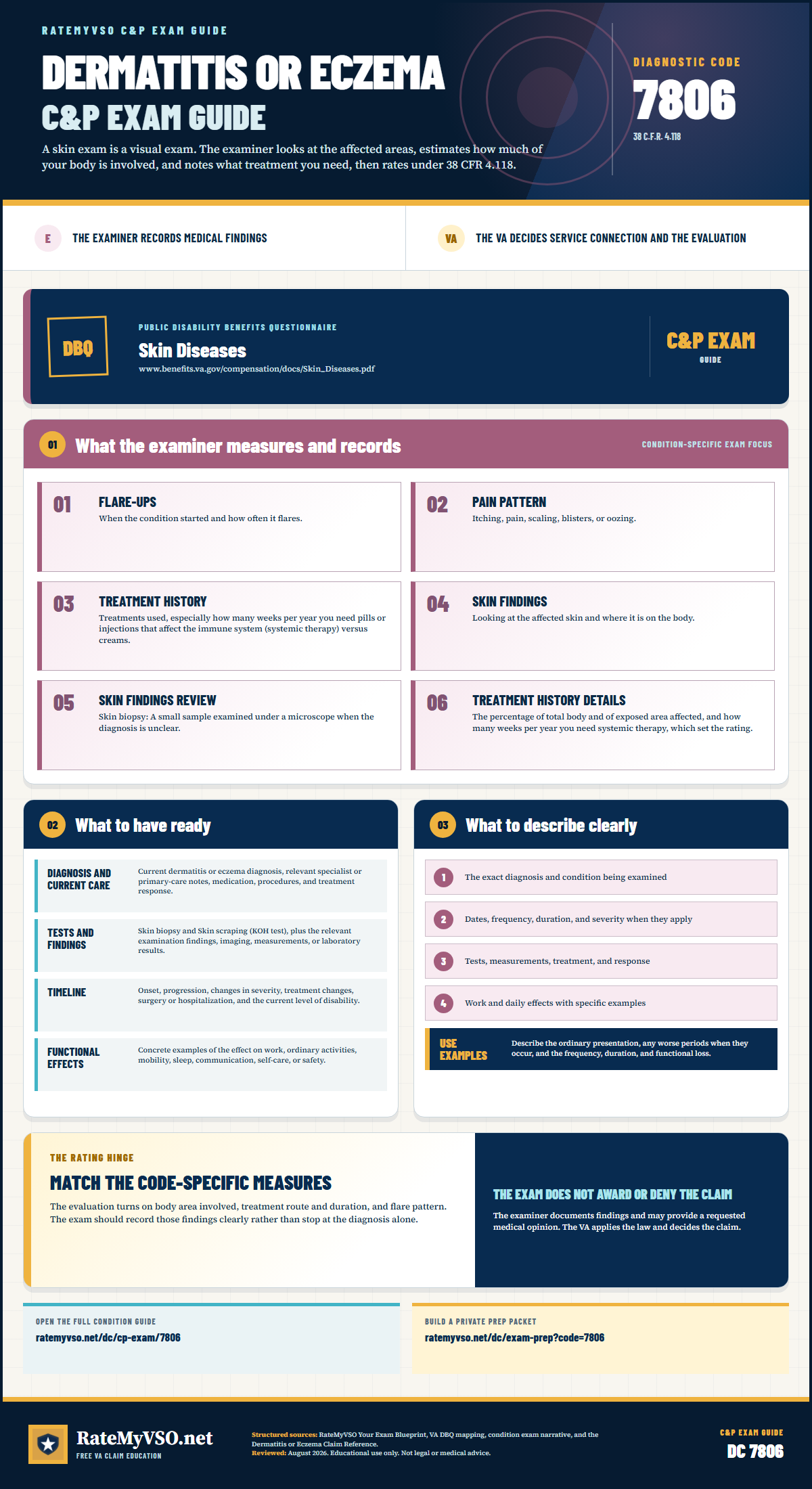
A skin exam is a visual exam. The examiner looks at the affected areas, estimates how much of your body is involved, and notes what treatment you need, then rates under 38 CFR 4.118.
DBQ used for this condition
- PPublic formDBQ DERM Skin DiseasesOpen the public DBQ
What the examination is likely to focus on
Functional-impact topics to describe
- The percentage of total body and of exposed area affected, and how many weeks per year you need systemic therapy, which set the rating.
- Effect on daily life and work.
- Findings map to the General Rating Formula for the skin in 38 CFR 4.118 (dermatitis or eczema DC 7806; dermatophytosis DC 7813; psoriasis DC 7816).
Which form the examiner uses
For dermatitis or eczema (DC 7806), the C&P examiner completes the following Disability Benefits Questionnaire (DBQ):
- DBQ DERM Skin Diseases (public PDF on VA.gov)
DBQs are Department of Veterans Affairs Form 21-0960 series documents. Public DBQs are hosted on benefits.va.gov. A handful are examiner-only and are not posted publicly.
What to expect at your C&P exam
A skin exam is a visual exam. The examiner looks at the affected areas, estimates how much of your body is involved, and notes what treatment you need, then rates under 38 CFR 4.118.
1Initial interview (history)
- When the condition started and how often it flares.
- Itching, pain, scaling, blisters, or oozing.
- Treatments used, especially how many weeks per year you need pills or injections that affect the immune system (systemic therapy) versus creams.
- Triggers and effect on daily life and work.
2Physical examination
- Looking at the affected skin and where it is on the body.
- Estimating the percentage of your total body affected, and the percentage of exposed areas (face, hands, neck).
- Noting the type of treatment you require.
- Photographing the affected skin.
3Diagnostic tests the examiner may rely on
Usually only to confirm the diagnosis.
4Functional assessment
- The percentage of total body and of exposed area affected, and how many weeks per year you need systemic therapy, which set the rating.
- Effect on daily life and work.
- Findings map to the General Rating Formula for the skin in 38 CFR 4.118 (dermatitis or eczema DC 7806; dermatophytosis DC 7813; psoriasis DC 7816).
Test explainers open MedlinePlus (NIH National Library of Medicine), or Wikipedia where MedlinePlus has no matching page. This describes what happens and what is measured, not how to influence a result.
What the examiner records (full DBQ form)
The fields below are reproduced from the DBQ form the examiner completes for this diagnostic code. This is the structural map of the form, showing what the examiner is asked to measure, observe, and record. It is a factual reproduction of the public DBQ, not advice on how to answer.
This DBQ evaluates the diagnosis, history, treatment, physical findings, and functional impact of skin diseases including dermatitis, eczema, psoriasis, infections, and skin neoplasms.
How DC 7806 maps to this DBQ: for this diagnostic code specifically, the examiner typically completes sections I-V and VIII-X of this form. Section V is the condition-specific section for this code. Sections VI-VII cover unrelated conditions on this DBQ and are skipped.
DIAGNOSIS (Section I)
- 1A. DOES THE VETERAN HAVE A CURRENT SKIN CONDITION?
- Dermatitis or eczema - Diagnosis / ICD Code / Date of diagnosis
- Tumors and neoplasms of the skin, including malignant melanoma - Diagnosis / ICD Code / Date of diagnosis
- Dermatophytosis (ringworm: of body, tinea corporis; of head, tinea capitis; of feet, tinea pedis; of beard area, tinea barbae; of nails, tinea unguium (onychomycosis); of inguinal area (jock itch), tinea cruris; tinea versicolor) - Diagnosis / ICD Code / Date of diagnosis
- Acne - ICD Code / Date of diagnosis
- Psoriasis - ICD Code / Date of diagnosis
- Infectious skin conditions not listed elsewhere (including bacterial, fungal, viral, treponemal and parasitic skin conditions) - Diagnosis / ICD Code / Date of diagnosis
- Chronic Urticaria - ICD Code / Date of diagnosis
- Alopecia - Diagnosis / ICD Code / Date of diagnosis
- Keratinization skin disorders (including icthyoses, Darier's disease, and palmoplantar keratoderma) - Diagnosis / ICD Code / Date of diagnosis
- Erythroderma (exfoliative dermatitis) - ICD Code / Date of diagnosis
- Papulosquamous skin disorders not listed elsewhere (including lichen planus, large or small plaque parapsoriasis, pityriasis lichenoides et varioliformis acuta (PLEVA), lymphomatoid papulosus, mycosis fungoides and pityriasis rubra pilaris (PRP)) - Diagnosis / ICD Code / Date of diagnosis
- Hyperhidrosis - ICD Code / Date of diagnosis
- Vitiligo - ICD Code / Date of diagnosis
- Bullous disorders (including pemphigus vulgaris, pemphigus foliaceous, bullous pemphigoid, dermatitis herpetiformis, epidermolysis bullosa acquisita, benign chronic familial pemphigus (Hailey-Hailey), and porphyria cutanea tarda) - Diagnosis / ICD Code / Date of diagnosis
- Cutaneous manifestations of collagen-vascular diseases not listed elsewhere (including scleroderma, calcinosis cutis, and dermatomyositis) - Diagnosis / ICD Code / Date of diagnosis
- Chloracne - ICD Code / Date of diagnosis
- Discoid lupus or subacute cutaneous lupus erythematosus - ICD Code / Date of diagnosis
- Erythema multiforme (toxic epidermal necrolysis) - ICD Code / Date of diagnosis
- Primary cutaneous vasculitis - ICD Code / Date of diagnosis
- Other diagnosis #1 - ICD Code / Date of diagnosis
- Other diagnosis #2 - ICD Code / Date of diagnosis
- Other diagnosis #3 - ICD Code / Date of diagnosis
MEDICAL HISTORY (Section II)
- 2A. DESCRIBE THE HISTORY (including onset and course) OF THE VETERAN'S CURRENT SKIN CONDITIONS (brief summary)
- 2B. RESOLVED SKIN CONDITIONS - DID THE VETERAN PREVIOUSLY HAVE A SKIN CONDITION THAT IS NOW COMPLETELY RESOLVED AND NO LONGER REQUIRES TREATMENT OF ANY TYPE? (brief summary)
- 2C. COMMENTS, IF ANY
TREATMENT (Section III)
- 3A. HAS THE VETERAN BEEN TREATED WITH MEDICATION IN THE PAST 12 MONTHS FOR ANY SKIN CONDITION?
- Corticosteroids or other immunosuppressive medications - list medication(s) / condition / route of administration / total duration of use in past 12 months
- Antihistamines - list medication(s) / condition / route of administration / total duration of use in past 12 months
- Retinoids - list medication(s) / condition / route of administration / total duration of use in past 12 months
- Sympathomimetics - list medication(s) / condition / route of administration / total duration of use in past 12 months
- Biologics - list medication(s) / condition / route of administration / total duration of use in past 12 months
- Other medication - list medication(s) / condition / route of administration / total duration of use in past 12 months
- NOTE: If a medication is used for more than one condition, provide names of all conditions, name of medication used for each condition, and frequency of use for each condition
- 3B. HAS THE VETERAN HAD ANY TREATMENTS OR PROCEDURES OTHER THAN SYSTEMIC OR TOPICAL MEDICATIONS IN THE PAST 12 MONTHS FOR ANY SKIN CONDITION?
- Phototherapy such as ultraviolet-B light (UVB) treatment - date of most recent treatment / condition treated / total duration in past 12 months
- Photochemotherapy (to include PUVA (psoralen with long wave ultraviolet A light)) treatment - date of most recent treatment / condition treated / total duration in past 12 months
- Electron beam therapy - date of most recent treatment / condition treated / total duration in past 12 months
- Intensive light therapy - date of most recent treatment / condition treated / total duration in past 12 months
- Other treatment (Specify treatment) - date of most recent treatment / condition treated / total duration in past 12 months
PHYSICAL EXAM (Section IV)
- 4A. INDICATE THE VETERAN'S VISIBLE CHARACTERISTIC LESIONS DUE TO THE SKIN CONDITION(S); INDICATE THE APPROXIMATE TOTAL BODY AREA AND APPROXIMATE TOTAL EXPOSED BODY AREA (face, neck and hands) AFFECTED ON CURRENT EXAMINATION
- Dermatitis - Total body area (None / <5% / 5% to <20% / 20% to 40% / >40%) / EXPOSED area (None / <5% / 5% to <20% / 20% to 40% / >40%)
- Eczema - Total body area / EXPOSED area
- Dermatophytosis - Total body area / EXPOSED area
- Bullous disorders - Total body area / EXPOSED area
- Cutaneous manifestations of collagen vascular disorders not listed elsewhere - Total body area / EXPOSED area
- Psoriasis - Total body area / EXPOSED area
- Infections of the skin not listed elsewhere - Total body area / EXPOSED area
- Papulosquamous disorders not listed elsewhere - Total body area / EXPOSED area
- Diseases of keratinization - Total body area / EXPOSED area
- Discoid lupus erythematosus - Total body area / EXPOSED area
- Other (Indicate diagnosis) - Total body area / EXPOSED area
- Does the Veteran have a skin condition currently without any visible characteristic lesions at the time of the examination?
- 4B. FOR EACH SKIN CONDITION CHECKED IN ITEM 4A, GIVE SPECIFIC DIAGNOSIS AND DESCRIBE APPEARANCE AND LOCATION
SPECIFIC SKIN CONDITIONS (Section V)
- 5A. INDICATE THE VETERAN'S SPECIFIC SKIN CONDITIONS AND COMPLETE ALL APPLICABLE SUBSEQUENT QUESTIONS
- Acne - Superficial acne (comedones, papules, pustules) of any extent / Deep acne (deep inflamed nodules and pus-filled cysts) / Affects less than 40% of face and neck / Affects 40% or more of face and neck / Affects body areas other than face and neck
- Chloracne - Superficial acne / Deep acne / Affects less than 40% of face and neck / Affects 40% or more of face and neck / Affects intertriginous areas / Affects non-intertriginous body areas other than face and neck
- Vitiligo - (If checked, indicate areas affected by vitiligo): Exposed areas affected / No exposed areas affected
- Scarring alopecia - (If checked, indicate percent of scalp affected): <20% / 20% to 40% / >40%
- Alopecia areata - (If checked, indicate amount of hair loss): Hair loss limited to scalp and face / Loss of all body hair / Other, describe
- Hyperhidrosis - (If checked, indicate severity): Able to handle paper or tools after treatment / Unresponsive to treatment; unable to handle paper or tools
- Urticaria, chronic - Has the Veteran ever had a break in treatment? / If 'Yes,' did he/she experience symptoms at least twice a week for six weeks or more?
- Urticaria, chronic - Indicate the type of treatment the Veteran is currently receiving: First line treatment (Antihistamines / Other) / Second line treatment (Corticosteroids / Sympathomimetics / Leukotriene inhibitors / Neutrophil inhibitors / Thyroid hormone / Other) / Third line treatment (Plasmapheresis / Immunotherapy / Immunosuppressives / Other)
- Vasculitis, primary cutaneous - Frequency of documented, vasculitis episodes occurring over the past 12 months: None / 1 to 3 / 4 or more
- Vasculitis, primary cutaneous - Has the Veteran required the use of systemic immunosuppressive therapy over the past 12 months? / If 'Yes,' check the applicable frequency: Intermittent / Continuous
- Vasculitis, primary cutaneous - Has the Veteran continued to have vasculitis episodes despite continuous systemic immunosuppressive therapy over the past 12 months?
- Erythroderma (exfoliative dermatitis) - Is there erythroderma/exfoliative dermatitis with any extent of involvement of the skin? / Generalized involvement with systemic manifestations / Generalized involvement without systemic manifestations / No current treatment due to documented history of treatment failure with 2 or more treatment regimens / No current treatment due to documented history of treatment failure with 1 treatment regimen
- Erythema multiforme; toxic epidermal necrolysis - Mucosal involvement: Impairing mastication / Not impairing mastication / Without recurrent episodes / One to three episodes over the past 12-month period / Four or more episodes over the past 12-month period
- Erythema multiforme; toxic epidermal necrolysis - Palmar involvement: Impairing use of hands / Not impairing use of hands / Without recurrent episodes / One to three episodes over the past 12-month period / Four or more episodes over the past 12-month period
- Erythema multiforme; toxic epidermal necrolysis - Plantar involvement: Impairing ambulation / Not impairing ambulation / Without recurrent episodes / One to three episodes over the past 12-month period / Four or more episodes over the past 12-month period
- Erythema multiforme; toxic epidermal necrolysis - Indicate the type of treatment the Veteran is currently receiving: Ongoing immunosuppressive therapy / Intermittent systemic therapy (immunosuppressives, antihistamines, or sympathomimetics) / Continuous systemic medication for control
- Veteran does not have any of the specific skin conditions listed above
TUMORS AND NEOPLASMS (Section VI)
- 6A. Does the Veteran currently have, or has had, a benign or malignant neoplasm or metastases related to any condition in the diagnosis section?
- 6B. Is the neoplasm: Benign / Malignant
- Active / In remission
- Primary / Secondary (metastatic) (if secondary, indicate the primary site, if known)
- 6C. Has the Veteran completed treatment or is the Veteran currently undergoing treatment for a benign or malignant neoplasm or metastases?
- Treatment completed
- Surgery - If checked, describe / Date(s) of surgery
- Radiation therapy - Date of most recent treatment / Date of completion of treatment or anticipated date of completion
- Antineoplastic chemotherapy - Date of most recent treatment / Date of completion of treatment or anticipated date of completion
- Other therapeutic procedure - If checked, describe procedure / Date of most recent procedure
- Other therapeutic treatment - If checked, describe treatment / Date of completion of treatment or anticipated date of completion
- 6D. Does the Veteran currently have any residuals or complications due to the neoplasm (including metastases) or its treatment, other than those already documented in the report above?
- 6E. If there are additional benign or malignant neoplasms or metastases related to any of the diagnoses in the diagnosis section, describe using the above format
SCARRING AND DISFIGUREMENT (Section VII)
- 7A. DO ANY OF THE VETERAN'S SKIN CONDITIONS CAUSE SCARRING (REGARDLESS OF LOCATION), OR DISFIGUREMENT OF THE HEAD, FACE OR NECK?
OTHER PERTINENT PHYSICAL FINDINGS, COMPLICATIONS, CONDITIONS, SIGNS AND/OR SYMPTOMS (Section VIII)
- 8A. DOES THE VETERAN HAVE ANY OTHER PERTINENT PHYSICAL FINDINGS, COMPLICATIONS, CONDITIONS, SIGNS AND/OR SYMPTOMS RELATED TO ANY CONDITIONS LISTED IN THE DIAGNOSIS SECTION ABOVE?
- (If 'Yes,' describe and complete the appropriate DBQ)
- 8B. COMMENTS, IF ANY
FUNCTIONAL IMPACT (Section IX)
- 9A. DO ANY OF THE VETERAN'S SKIN CONDITIONS IMPACT HIS OR HER ABILITY TO WORK?
- (If 'Yes,' describe impact of each of the Veteran's skin conditions, providing one or more examples)
REMARKS (Section X)
- 10A. REMARKS (If any)
Rating Levels for DC 7806
The following tiers are reproduced from 38 CFR Part 4, the VA Schedule for Rating Disabilities. Toggle between the official VA criteria and a Plain English explanation.
Plain-English summaries are AI-generated to explain the official criteria. The official 38 CFR language is the binding legal standard. When in doubt, ask a VSO.
Evidence cited in published BVA decisions for DC 7806
The counts below are aggregated from published Board of Veterans Appeals decisions for this diagnostic code, among issues the Board granted or denied (remanded issues are not included). Each row reports how often a given evidence type was discussed in the decision text, broken down by outcome. This is a factual aggregate of the public record, not a prediction or recommendation about any specific claim.
- Service treatment records: appeared in 1229 granted decisions (3168 denied; 4397 decided total)
- Buddy / lay statements: appeared in 958 granted decisions (2108 denied; 3066 decided total)
- Medical literature: appeared in 80 granted decisions (169 denied; 249 decided total)
What the Board discussed in granted decisions for DC 7806
The themes below were extracted by clustering 500 grant-factor sentences from published Board of Veterans Appeals decisions for this diagnostic code. Frequencies indicate how often each theme appeared in the sample. This is a factual aggregate of the public record, not advice or strategy for any specific claim.
- 28% Benefit of the doubt doctrine standard citedThe Board cited the general legal standard that when positive and negative evidence is in approximate balance on a material issue, the benefit of the doubt is resolved in the claimant's favor.142 of 500 sample sentences
- 19% Preponderance against claim, doctrine inapplicableThe Board determined that the preponderance of evidence weighed against the claim, rendering the benefit of the doubt doctrine inapplicable and requiring denial.97 of 500 sample sentences
- 17% Evidence found in equipoise, claim grantedThe Board found the evidence at least in relative equipoise on a material issue and resolved that balance in the Veteran's favor to grant or sustain the claimed benefit.87 of 500 sample sentences
- 16% VA or private examiner nexus opinion cited as at least as likely as notA VA or private medical examiner opined that a current disability was at least as likely as not incurred in, caused by, or related to the Veteran's active military service.79 of 500 sample sentences
- 8% Benefit of the doubt applied to assign specific ratingThe Board resolved doubt in the Veteran's favor to assign a specific disability rating percentage under a diagnostic code, finding that rating criteria were at least approximately met.42 of 500 sample sentences
- 4% Skin condition nexus or onset in service found in equipoiseThe Board found the evidence at least in equipoise as to whether a diagnosed skin disability had its onset during or was related to the Veteran's active service.22 of 500 sample sentences
- 4% Examiner opinion request for nexus or aggravation notedThe Board noted a request or remand for a medical examiner to opine on whether a disability was at least as likely as not related to, incurred in, or aggravated by service.22 of 500 sample sentences
- 2% Negative nexus opinion or absence of nexus recordedA VA or private examiner opined that a current disability was not at least as likely as not related to or caused by service, supporting denial of the claim.9 of 500 sample sentences
When the Board found the exam inadequate (DC 7806)
In 4,682 published Board of Veterans' Appeals decisions involving this condition, the Board found a C&P examination or medical opinion inadequate. Where the defect could be read from the decision, it was most often one of the following (counts are a floor from the decisions on file, not a total):
- 1,283 Failed to address a contention or part of the condition
- 1,076 Conclusion given without a supporting rationale
- 749 Veteran's lay statements not considered
- 318 Opinion relied on the absence of records instead of the evidence
- 223 Claims file or records not reviewed
- 163 Flare-ups or functional loss not addressed
- 141 Examiner said an opinion would require speculation
- 58 Exam too old to reflect current severity
- 35 Wrong legal standard or question applied
An inadequate exam is usually sent back for a new one rather than decided against the veteran. This is a factual report of published decisions, not advice about any exam or claim; whether an exam is adequate is decided case by case.
Disclaimer: This page reproduces public Department of Veterans Affairs forms (DBQs) and verbatim text from 38 CFR Part 4 (the VA Schedule for Rating Disabilities). It is informational only and is not legal or medical advice. For guidance on a specific claim, contact a VA-accredited representative.