Higher-Level Review (HLR) Guide
This guide explains how to request a Higher-Level Review (HLR) after you get a VA decision you believe is wrong. You will learn what an HLR is, how it differs from the other appeal lanes, and what to expect during the review. It covers how to file your request, the time limits, what evidence the reviewer can consider, and how to prepare your case. Whether you are fixing an under-rated condition or an outright denial, this guide shows you how the HLR process works.

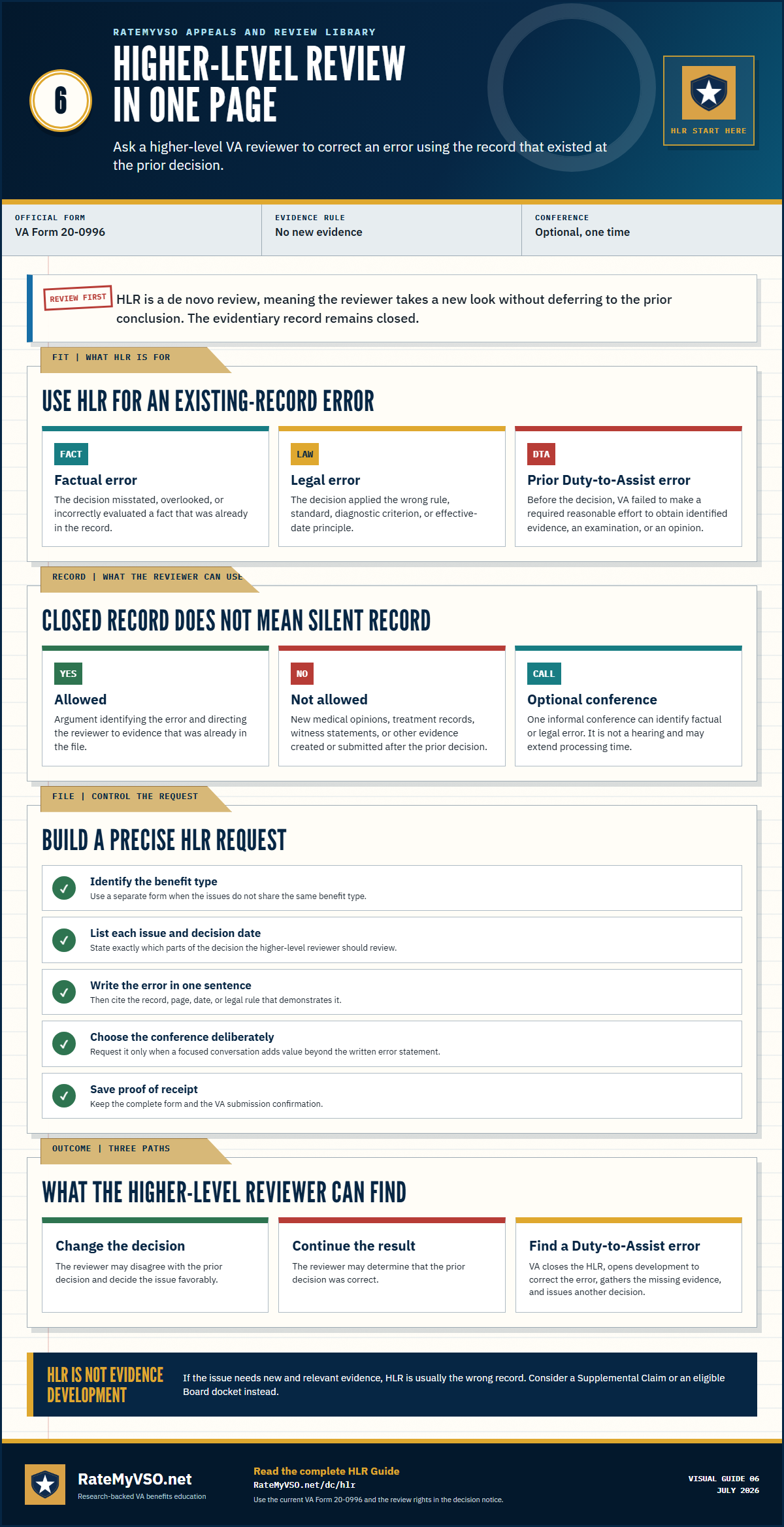 One-page guide: Higher-Level Review in One Page
Higher-Level Review in one page explaining existing-record factual and legal errors, the closed evidence record, optional conference, filing controls, and possible outcomes. Opens the full-size chart, free to save or print.
One-page guide: Higher-Level Review in One Page
Higher-Level Review in one page explaining existing-record factual and legal errors, the closed evidence record, optional conference, filing controls, and possible outcomes. Opens the full-size chart, free to save or print.
Which Appeal Lane Should You Choose?
After a denial or low rating, you have three options. Choosing the right one is the most important decision you'll make.
Supplemental Claim
Submit new and relevant evidence the VA hasn't seen: nexus letters, new medical records, buddy statements. Usually decided in about 4 to 5 months. See the full Supplemental Claim Guide for the Form 20-0995 walkthrough, the 1-year rule, and rater perspective.
Higher-Level Review
A senior rater re-reviews the same evidence. No new evidence. Looks for errors in how the VA applied the law. Often decided in about 125 days.
Board Appeal (BVA)
A Veterans Law Judge reviews your case. Can submit new evidence. Longest wait, often 1 to 2+ years. A further share of appeals are remanded (sent back for more development) rather than granted outright.
How to read these numbers: these three figures are not the same measure and should not be compared side by side. The Supplemental Claim and Higher-Level Review figures are estimates commonly cited by veterans-law firms (Hill & Ponton, CCK Law); the VA does not publish official win-rate figures for either lane, and these outside firms may define "favorable" differently and draw from a different population of cases than the Board data below. The Board figure is the grant rate from RateMyVSO's analysis of 1,897,000+ published BVA decisions that have already reached a Veterans Law Judge; remands are counted separately. None of these predicts your individual outcome.
All five AMA appeal lanes at a glance
For VA decisions dated February 19, 2019 or later. The Appeals Modernization Act created five review lanes across two VA bodies. Here is how they differ.
| VA AMA appeal lanes |
Veterans Benefits AdministrationDecision Review lanes | Board of Veterans' AppealsNotice of Disagreement (NOD) lanes | |||
|---|---|---|---|---|---|
| Higher-Level Review | Supplemental Claim | Direct Review | Evidence Submission | Hearing | |
| Will new and relevant evidence be considered? | No | Yes | No | Yes | Yes |
| Will there be a hearing? | NoOptional informal phone conference | No | No | No | Yes |
| Who makes the decision? | A senior reviewer (DRO) at a VA regional office | A claims adjudicator at a VA regional office | A Veterans Law Judge at the Board | A Veterans Law Judge at the Board | A Veterans Law Judge at the Board |
| VA processing target | 125 days | 125 days | About 1 year | About 1 year | 1 to 2 years |
| Most recent published result | See latest | See latest | See latest | See latest | See latest |
| What form is needed? | Form 20-0996 | Form 20-0995 | Form 10182 | Form 10182 | Form 10182 |
Swipe the table sideways to see all five lanes.
Source: VA Appeals Modernization Act (AMA) review options. Processing targets are VA goals, not guarantees, and actual waits vary. The Board lanes (Direct Review, Evidence Submission, Hearing) all use VA Form 10182. The "Most recent published result" row updates each month from the VA AMA compliance report; tap any figure to open the full Appeals Pulse.
What Is a Higher-Level Review?
A Higher-Level Review (HLR) is a request for a more experienced rater (a Decision Review Officer) to look at the same evidence that was already in your file. They review the original decision for errors. Did the rater apply the rating criteria correctly? Did they consider all the evidence? Did they follow VA procedures?
Key Rules
- No new evidence. You cannot submit new documents, nexus letters, or buddy statements with an HLR. The reviewer only looks at what was already in your file.
- No appeal of an appeal. You cannot file an HLR immediately following an HLR decision or a Board of Veterans' Appeals decision on the same issue (VA, 2026). If your HLR is denied, your options are a Supplemental Claim or Board appeal.
- Same effective date. If the HLR overturns the denial, your effective date is preserved from the original claim (or Intent to File).
- You can request an informal conference. This is a phone call with the reviewer, highly recommended. See below.
- Duty to Assist errors. If the reviewer finds the VA didn't properly develop your claim (e.g., never ordered a C&P exam), they'll return it for correction.
DRO Outcomes: Two Distinct Actions
When a Decision Review Officer identifies a problem with how a claim was processed, they work through one of two paths. A duty to assist error means the VA was obligated to take a specific action and didn't, such as ordering a required C&P exam, requesting service records, or following prescribed procedures. A difference of opinion means the DRO believes additional development is warranted based on their own read of the evidence, even if the prior rater wasn't technically out of bounds.
In most cases the outcome of an HLR is further development (a new exam, a records request), not an outright grant. Direct grants happen when a favorable, authentic medical opinion is already in the file and the error was that the prior rater didn't apply it correctly. Setting that expectation before filing helps veterans understand what a successful HLR actually looks like.
When HLR Is the Right Choice
File an HLR when you believe the VA made an error of law or fact with the evidence already on file:
- The C&P exam supports your claim but the rater ignored it. Example: the examiner documented 30% symptoms but the rater only awarded 10%.
- The rater applied the wrong diagnostic code or criteria. Your condition was rated under a less favorable code when a more appropriate one exists.
- The VA didn't order an exam the evidence called for. The VA orders a C&P exam case by case when the evidence in the file shows it is needed to decide the claim (this includes many MST claims, evaluated under the relaxed evidentiary standard at 38 CFR 3.304(f)(5)). Exams are not mandated wholesale for every condition of a given type. If the record needed an exam and the VA denied without ordering one, that can be a duty to assist error.
- Records are missing and the VA didn't follow procedures. If the VA denied your claim without issuing a Formal Finding of Unavailability, searching alternative sources, or advising you of your right to submit substitute evidence, that's a duty to assist error. See Missing Records Guide →
- The rater didn't consider all evidence. Your private medical opinion or buddy statements were in the file but not mentioned in the decision.
- The rater misinterpreted the rating schedule. For example, not accounting for DeLuca factors (pain, flare-ups) in a musculoskeletal rating. See Painful Motion guide →
A rater is not required to rate exactly at the level a C&P examiner's findings would suggest. A rater can rate higher, lower, or deny even when the exam is favorable, that alone is not an error. What the decision must do is explain the reasoning in the narrative. A deviation from the exam findings with no explanation given is what supports an HLR request, not the deviation by itself.
When NOT to File an HLR
- You have new evidence to submit. HLR doesn't allow new evidence. File a Supplemental Claim.
- Your C&P exam was unfavorable and you didn't get a private opinion. The reviewer will rely on the same bad exam. Get a private opinion and file Supplemental.
- You disagree with the medical opinion, not the VA's process. HLR reviews process errors, not medical judgment. A new private opinion submitted via Supplemental Claim is the fix.
- You already had an HLR on this decision. You can't HLR an HLR. Your options are Supplemental Claim or Board appeal.
- The Board already decided this issue. An HLR is not available immediately following a Board decision on the same issue (VA, 2026). A Board decision can be followed by a Supplemental Claim or an appeal to the U.S. Court of Appeals for Veterans Claims.
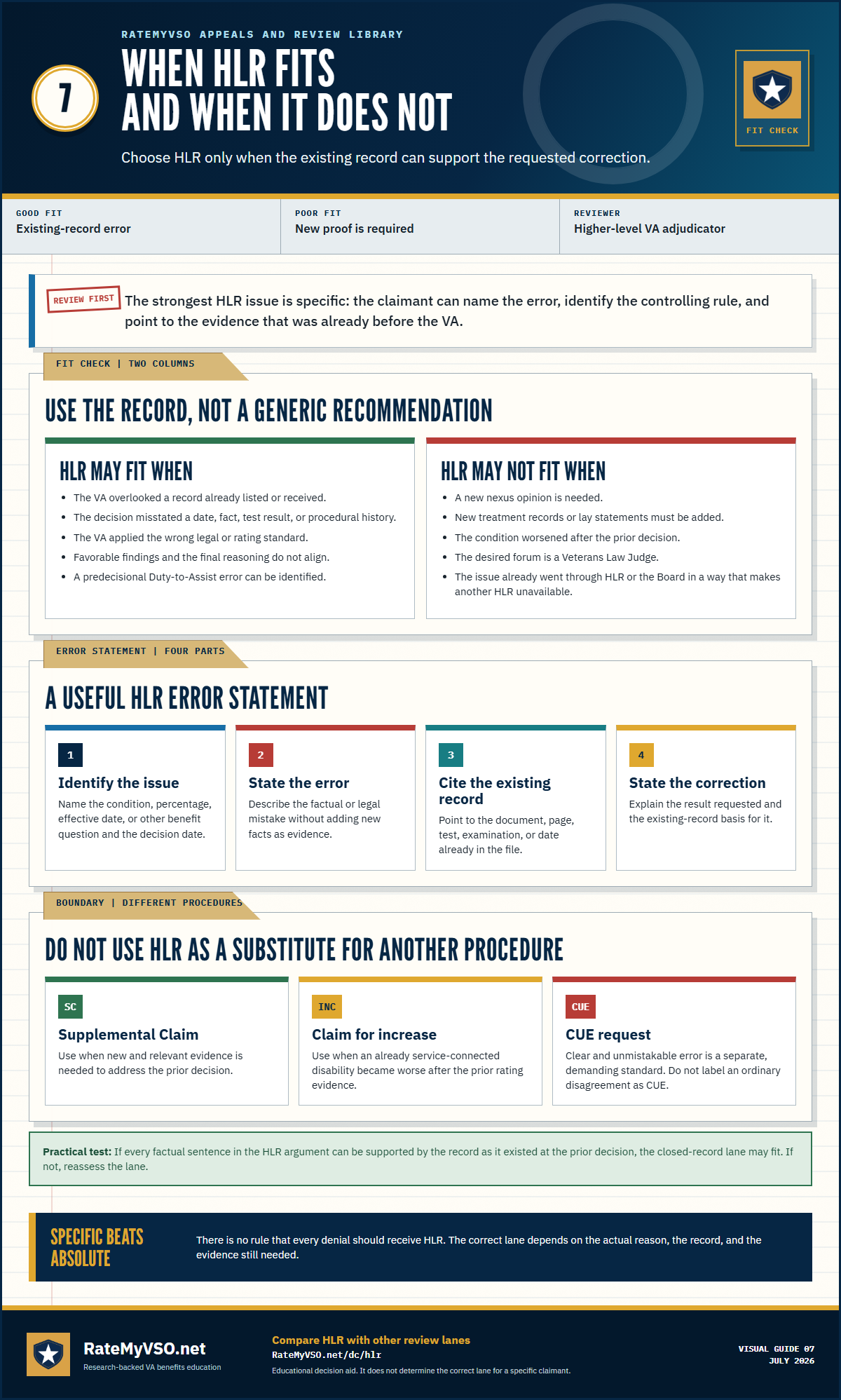
The Informal Conference
When you file the HLR, you can request an informal conference, a phone call between you (or your VSO representative) and the Decision Review Officer. The conference is optional and limited to one call per HLR. It does not accept new evidence, the same closed-record rule that governs the rest of the HLR applies. VA notes that requesting a conference can add time to the review, since the call has to be scheduled before the review finishes.
Why It Matters
The informal conference is your only opportunity to communicate directly with the Decision Review Officer reviewing your case. The conversation is two-directional. Veterans and their representatives can ask the DRO questions, not only present information.
Decision Review Officers document their development plans on an internal VA form (VA Form 20-0999) that records what they are ordering and why. This form is not accessible to veterans, but the DRO can be asked during the informal conference what examination or development they intend to order and which theory of service connection they are evaluating (direct, secondary, aggravation, or toxic exposure).
What You Can Discuss
- Specific errors in the original decision: "the rater didn't address my private medical opinion on page X"
- Rating criteria that appear to have been misapplied: "the examiner documented flare-ups but the rater didn't consider DeLuca factors"
- Evidence that was in the file but not mentioned: "my buddy statement describing daily symptoms was not addressed in the decision"
- What exam or development the DRO intends to order, and which theory of service connection is being evaluated
Veterans who know which theory of service connection is being developed before any subsequent C&P exam are better positioned to present history relevant to that theory. Veterans who go into a follow-up exam without this information sometimes present a strong account for the wrong theory, describing symptoms relevant to direct service connection, for example, when the DRO is actually developing a TERA (toxic exposure) pathway.
Who Should Be on the Call?
You can have your VSO representative conduct the informal conference on your behalf. Many veterans prefer this because VSOs know the rating criteria and can speak the VA's language. Find a VSO rep →
The HLR Process: Step by Step
File VA Form 20-0996
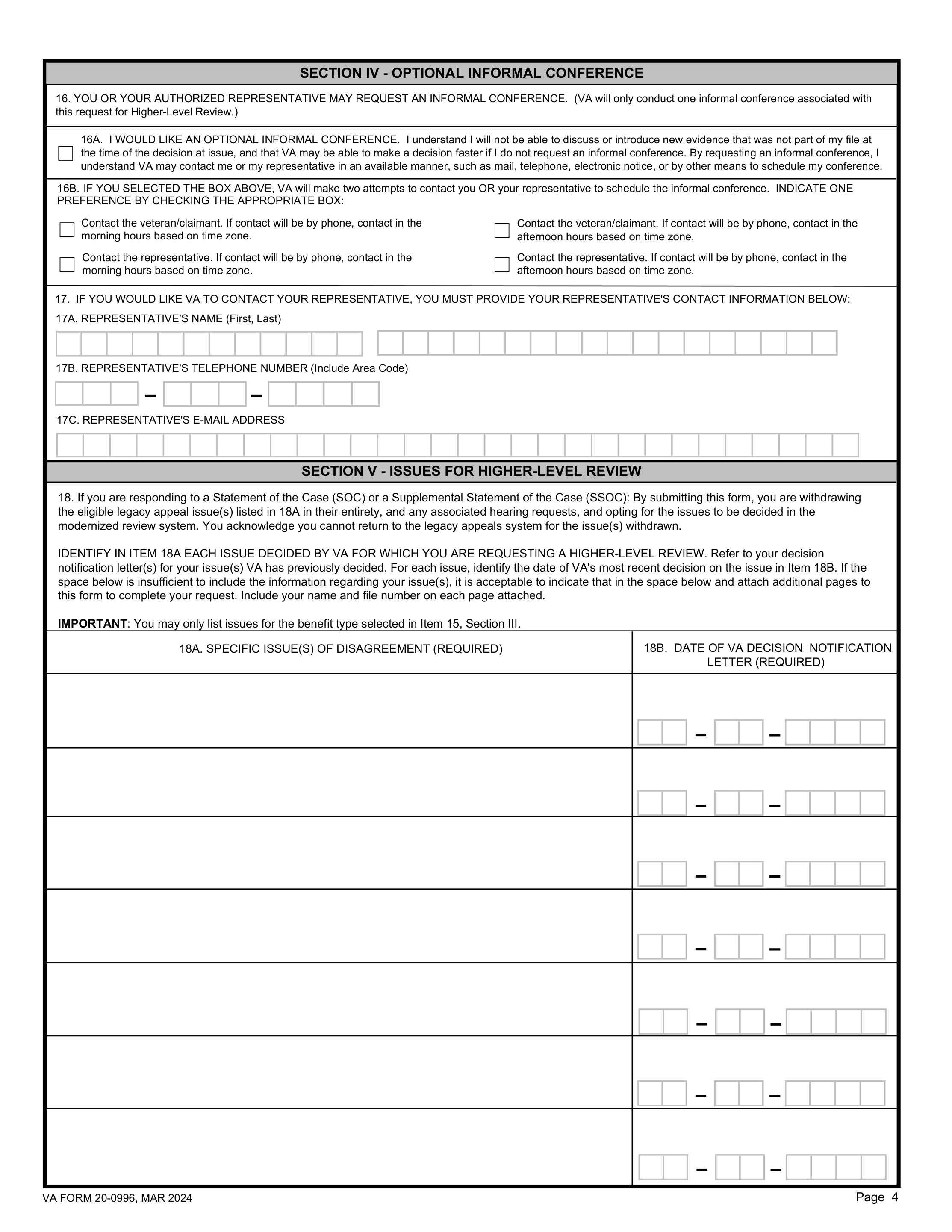
Decision Review Request: Higher-Level Review. File online at VA.gov, by mail (see where to mail it below), or through your VSO. If you want an informal conference, check the box for "informal conference." See what the informal conference is and how to prepare below.
Deadline: 1 Year
VA must receive your HLR request within 1 year of the date on the decision notice letter. After that, the HLR lane is closed for that decision. A Supplemental Claim with new and relevant evidence can be filed at any time, but filing it after the year has passed can cost you the earlier effective date.
Informal Conference (if requested)
The VA will call you or your representative. Typically 15-30 minutes. Be prepared with your specific error list. Veterans may also ask the DRO during the call what development they are ordering and which theory of service connection is being evaluated.
Senior Rater Review
A Decision Review Officer reviews the complete file. Average processing time: ~125 days (as of 2025).
Decision
Three possible outcomes: Grant (rating increased or service connection awarded), Duty to Assist error (returned for new exam or development), or Denial confirmed (original decision upheld).
Where to Mail Form 20-0996
If you file by mail, the address depends on the benefit the decision was about (VA, 2026):
- Disability compensation: Department of Veterans Affairs, Claims Intake Center, P.O. Box 4444, Janesville, WI 53547-4444
- Life insurance: Department of Veterans Affairs, Attention: Insurance Center, P.O. Box 5209, Janesville, WI 53547
- Pension and survivor benefits: Department of Veterans Affairs, Claims Intake Center, P.O. Box 5365, Janesville, WI 53547
- Caregiver program (PCAFC) eligibility decisions: follow the instructions on VA Form 10-305.
- All other benefit types: follow the instructions in the decision letter for your initial claim.
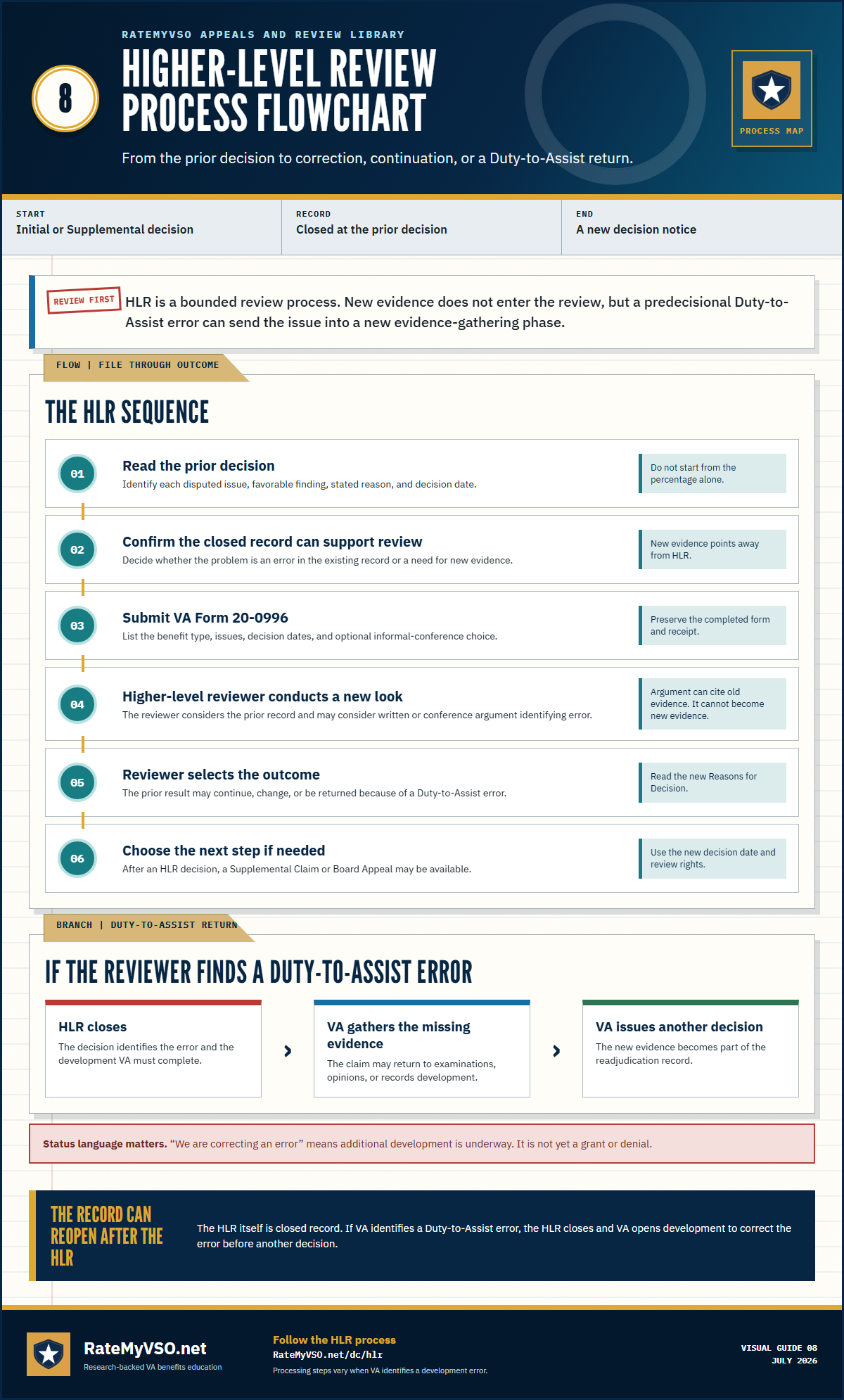
Common Errors Found in HLRs
Based on our analysis of BVA decisions that followed failed HLRs, these are the most common errors that HLR reviewers identify:
- Duty to Assist failure. The VA didn't obtain service records, didn't order a C&P exam, or didn't request relevant medical records. This is the #1 error found.
- Inadequate C&P exam. The examiner didn't test range of motion during flare-ups, didn't address DeLuca factors, or provided an opinion without adequate rationale.
- Ignored favorable evidence. A private medical opinion or buddy statement was in the file but the rater didn't address it in the decision.
- Wrong diagnostic code. The condition was rated under a less favorable code when a more appropriate one exists. See Analogous Ratings →
- Failure to consider secondary service connection. The rater didn't evaluate whether the condition could be secondary to an already service-connected disability.
- Incorrect effective date. The effective date didn't account for an earlier Intent to File or prior claim. See Effective Dates guide →
The Duty-to-Assist Error Path
A Higher-Level Review can return a claim when the reviewer identifies that the VA failed its duty to assist before the prior decision was issued (see 38 CFR 3.2601 and the duty-to-assist standard at 38 CFR 3.159). This is a separate path from a difference of opinion: the reviewer is not re-weighing the evidence, but identifying that required development never happened.
What Counts as a Duty-to-Assist Failure
- Federal records not obtained: If service treatment records (STRs) or other government-held records were never pulled and given to the examiner, any medical opinion based on that incomplete record is premature. The examiner could not have made an adequate, informed opinion without the records they were never given access to.
- Inadequate C&P exam: An exam is deficient if the examiner was not given the relevant evidence to review, if no exam was ordered at all when one was required, or if the examiner's opinion lacks adequate rationale. An opinion that simply concludes without explaining why is not substantially complete.
- Wrong examination type ordered: If you explicitly claimed a condition as secondary to another disability but the exam request only asked for a direct service connection opinion, no secondary opinion was obtained and the claim was decided without required development.
- A theory your own words raised, never developed: VA must address every theory of service connection reasonably raised by what you wrote or by the record, not only the box you checked (Robinson v. Peake, 2008). If your claim said symptoms got worse with a service-connected condition, check whether the exam request asked for a secondary opinion. If it asked only for a direct opinion, the secondary theory was never developed, even if the rating code sheet or decision letter describes the condition as denied as secondary to another disability.
- TERA or toxic-exposure pathway not developed: If a claim involved a period of service covered by the PACT Act and no toxic-exposure medical opinion was requested, that omission can be a duty-to-assist error for the pathway that was never developed.
What Happens After a Duty-to-Assist Return
When the HLR reviewer finds a duty-to-assist error but cannot grant the full benefit outright on the existing record, the claim is returned for correction and re-adjudication. The VA must then complete the missing development, which typically means ordering a new C&P exam with the correct evidence included or obtaining the missing records before deciding again. This is a do-over, not a denial. The error is now documented in the VA's own record.
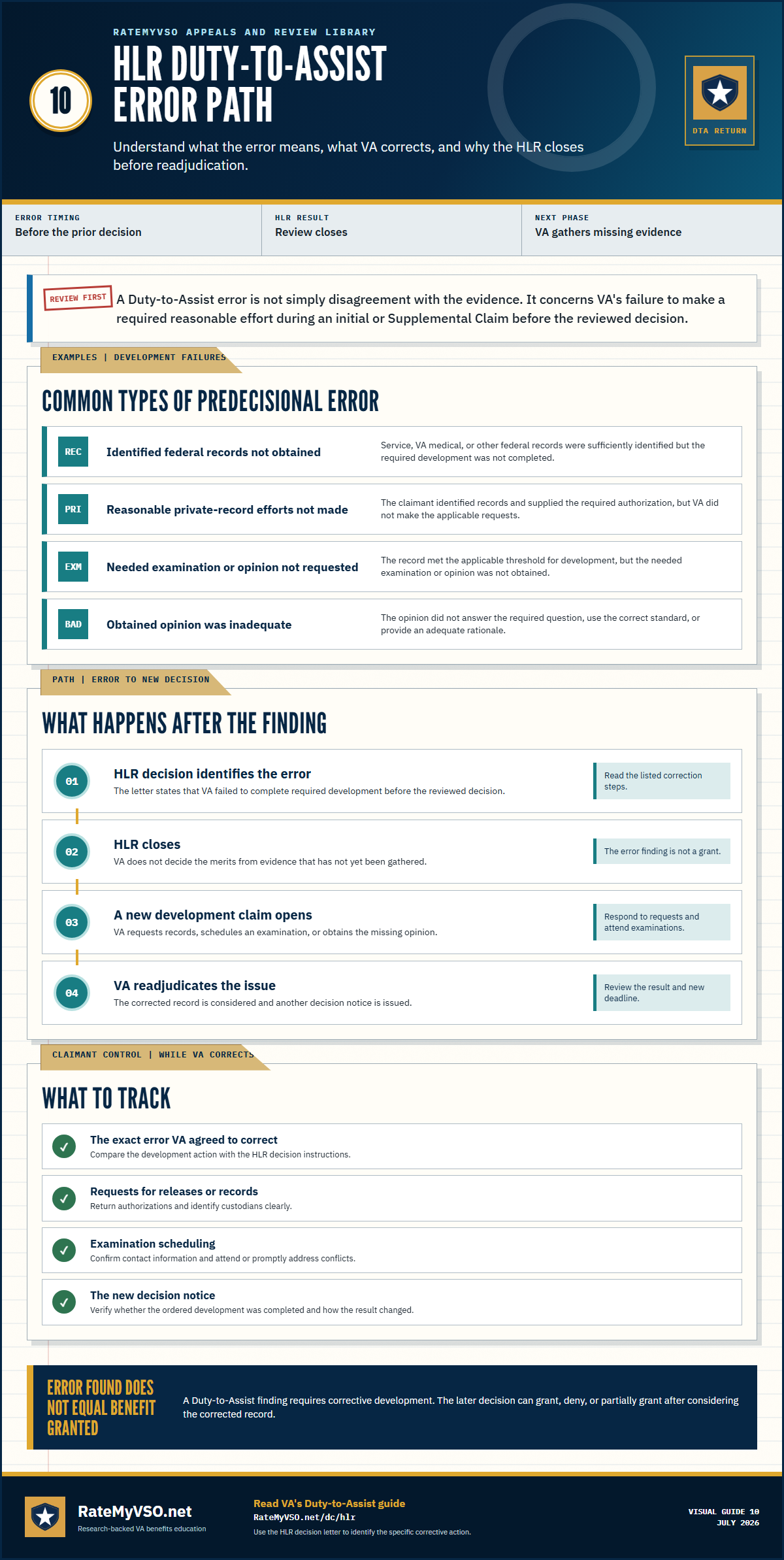 One-page guide: Higher-Level Review Duty-to-Assist Error Path
HLR Duty-to-Assist error path showing common development failures, closure of the HLR, corrective evidence gathering, and readjudication. Opens the full-size chart, free to save or print.
One-page guide: Higher-Level Review Duty-to-Assist Error Path
HLR Duty-to-Assist error path showing common development failures, closure of the HLR, corrective evidence gathering, and readjudication. Opens the full-size chart, free to save or print.
Sources: 38 CFR 3.2601 (Higher-Level Review) and 38 CFR 3.159 (Duty to Assist).
If Your HLR Is Denied
An HLR denial is not the end. You have two options, and which one fits depends on whether you have new and relevant evidence to add, whether you want a Veterans Law Judge to review the case, and where you stand on the applicable deadline.
Option 1: Supplemental Claim
If you now have new and relevant evidence, a Supplemental Claim lets you add it. Now that you've seen what the senior rater focused on, you may know exactly what evidence to get. File a Supplemental Claim with:
- A private medical opinion (nexus letter) that directly addresses the reasons for denial. Nexus Letter Guide →
- New buddy statements addressing specific gaps in your evidence
- Updated medical records showing current severity
- A personal statement addressing the denial reasons. A VSO representative can help you draft one at no charge. Find a VSO Rep →
Option 2: Board of Veterans' Appeals
If you believe the error is legal rather than evidentiary, appeal to the BVA where a Veterans Law Judge will review your case. Our BVA data shows about a 26% grant rate at the Board (grant-only, remands are separate). For some conditions, grant rates are higher among veterans who had a hearing, see the per-condition hearing-vs-no-hearing data and the Board Hearing guide.
- Appeals Overview →
- Board Hearing: What to Expect →, the three hearing formats, how to prepare, and what the day is like.
- Appeal Outcomes by Condition →
- Judge Decision Analytics →
- BVA Decision Search → (read the actual rulings on appeals like yours)
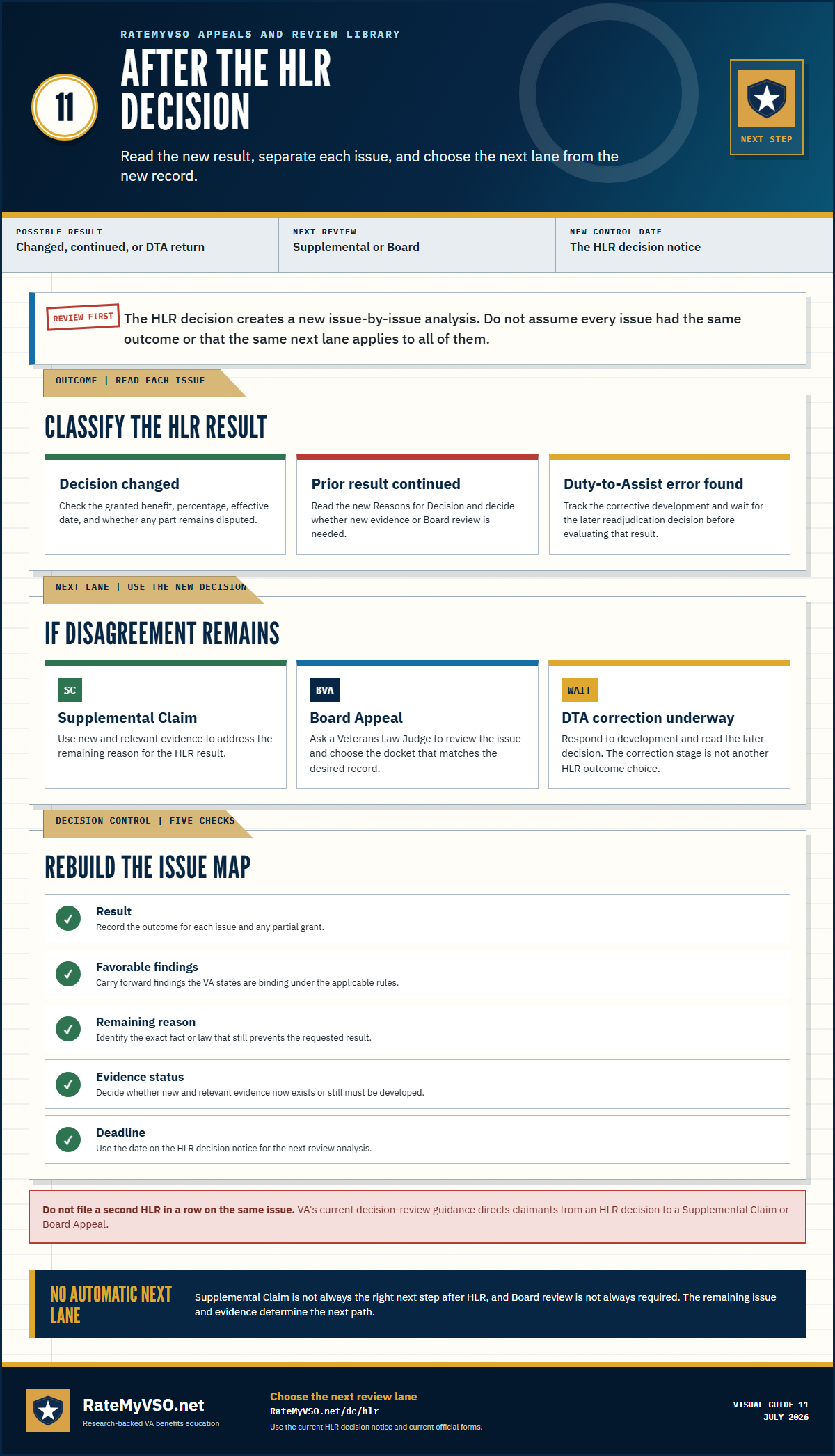 One-page guide: What Happens After a Higher-Level Review Decision
Guide to the result after HLR, including changed and continued decisions, Duty-to-Assist correction, rebuilding the issue map, and choosing Supplemental or Board review. Opens the full-size chart, free to save or print.
One-page guide: What Happens After a Higher-Level Review Decision
Guide to the result after HLR, including changed and continued decisions, Duty-to-Assist correction, rebuilding the issue map, and choosing Supplemental or Board review. Opens the full-size chart, free to save or print.
What Happens to Medical Opinions on HLR Return (May 2026 Update)
M21-1, Part IV, Subpart i, 2.A.7.a was updated 2026-05-27. The update adds an HLR-return exception to the normal "complex medical opinion" routing rule.
Under the standard rule, certain opinion types are "complex" and must be prepared by the rating activity (not the development activity). Complex types include:
- Opinions based on military sexual trauma stressors
- Compensation for VA-caused injury (38 USC 1151)
- Aggravation, including Allen aggravation
- Diagnostic variation or conflicting medical evidence
- Credibility-of-evidence questions
- Rare disorders or sensitive / high-priority claims
The new exception: when a BVA remand or HLR return directs development for an aggravation opinion (including Allen aggravation), the development activity may prepare and order the medical opinion based on the remand or HLR instructions, without referring the case back to the rating activity. If the development activity recognizes that a different complex-opinion type is also needed (MST, 1151, conflicting evidence, etc.), it must still refer to the rating activity.
What this means for veterans on HLR remand. If your HLR identified a duty-to-assist error and returned the case for a new aggravation opinion, the development activity can move forward without an extra rating-activity hand-off. That should shave time off the post-HLR development cycle. The substantive standard (Allen v. Brown for aggravation by secondary service-connected disability, the clear-and-unmistakable-evidence rebuttal rule) is unchanged.
Source: M21-1, Part IV, Subpart i, 2.A.7.a (effective 2026-05-27). Read it at KnowVA.
Common Mistakes Filing Form 20-0996
- Filing HLR with new evidence attached: HLR reviews the existing record only. New evidence submitted with an HLR is not considered, it gets returned or ignored. If you have new evidence, file a Supplemental Claim instead.
- Not checking the informal conference box: The conference is your only chance to talk to the reviewer directly. Skipping it means you lose the opportunity to point out a specific error before the decision is made.
- Listing the wrong decision date: The 1-year filing deadline runs from the date on the decision letter, not the date you received it or the date you are filing. Double-check the letter.
- Vague issue descriptions: "My back" is not specific enough. List the diagnostic code or condition name and the exact decision being reviewed.
- Missing signature or date: An unsigned form is not accepted as a valid request.
Claim Quest: Quick Check
Five questions based only on this guide.
This checks what you understood from this guide. It is not a claim-readiness score, a prediction, an official test, or a record on your account.
Related Tools and Guides
Sources: VA.gov Higher-Level Review · Hill & Ponton HLR Guide · Raider HQ After Dark (VA Rating Specialist, public commentary on HLR procedure) · VA, Federal Benefits for Veterans, Dependents, Survivors, and Caregivers, 2026 edition (Pamphlet 80-26-1), va.gov/opa/publications (cited as VA, 2026) · RateMyVSO BVA analysis of 1,897,000+ appeal decisions. This guide is for educational purposes only and is not legal advice. Find a VSO representative for personalized guidance.