What to Do When Service Records Are Missing or Destroyed
Missing records do not mean a denied claim. Start by checking what is missing, who may hold it, and what other evidence you can gather. The VA has responsibilities to help obtain relevant records for your claim.
Which situation sounds like yours?
Not sure? You may have an incomplete copy. Check where the records might be kept.
What the Data Shows
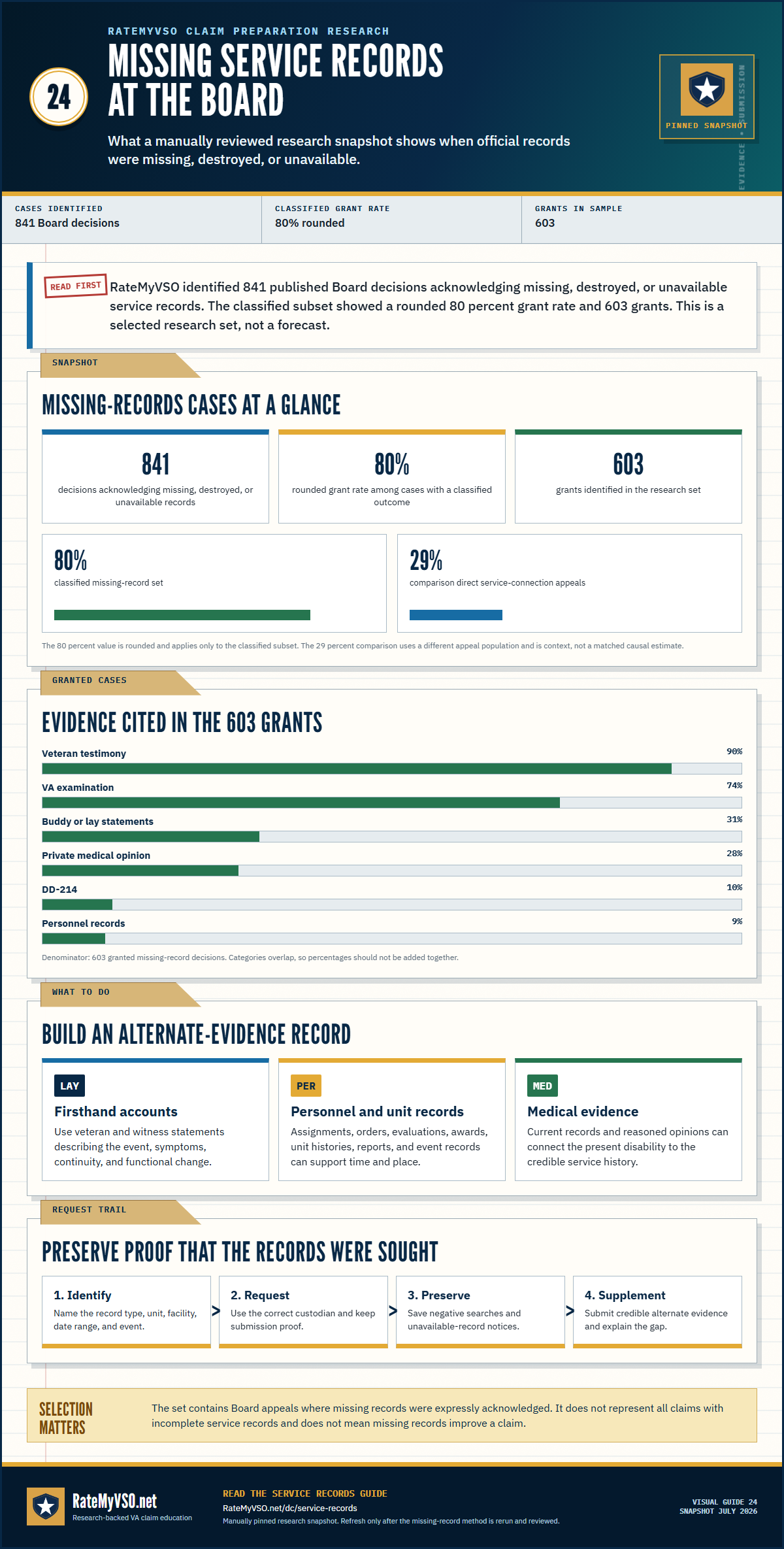
We analyzed 1,897,000+ Board of Veterans' Appeals decisions and identified 841 claims where the Board acknowledged that service records were missing, destroyed, or unavailable. The results are striking:
In our BVA data, appeals where the Board acknowledged records were missing were granted at nearly 3 times the rate of direct service-connection appeals overall. The heightened duty described below concerns assistance, careful consideration, and explanation of the decision. These are appeal-level patterns across decided cases, not a prediction for your claim, and appeals that reach the Board are already a selected group.
What Evidence Won These Cases
| Evidence Type | % of Winning Cases | Why It Works |
|---|---|---|
| Veteran's own credible testimony | 90% | When records are gone, your account of what happened becomes the primary evidence |
| VA examination | 74% | A current diagnosis linked to your described in-service event |
| Buddy/lay statements | 31% | Fellow service members corroborating your account of what happened |
| Private medical opinion | 28% | A nexus letter connecting your condition to the described event |
| DD-214 | 10% | Confirms service dates, MOS, duty stations: establishes where you were |
| Personnel records | 9% | May survive when medical records are destroyed |
Top Conditions in Missing Records Cases
The most common conditions granted when records were missing: bilateral hearing loss and tinnitus (168 combined cases), followed by hypertension, back disabilities, and PTSD. These reflect the population of veterans most affected, Korean War and Vietnam-era service members whose Army and Air Force records were destroyed in the 1973 fire.
Source: RateMyVSO analysis of 1,897,000+ BVA decisions (1992-2026). These are appeal-level outcomes at the Board of Veterans' Appeals.
The 1973 NPRC Fire
On July 12, 1973, a fire broke out at the National Personnel Records Center (NPRC) in St. Louis, Missouri. It burned for 22 hours and destroyed the entire sixth floor of the building. Approximately 16 to 18 million military personnel files were lost. No duplicate copies or microfilm backups existed.
Which Records Were Destroyed
| Branch | Records Destroyed | Estimated Loss |
|---|---|---|
| Army | Personnel discharged November 1, 1912 through January 1, 1960 | ~80% of records |
| Air Force | Personnel discharged September 25, 1947 through January 1, 1964, surnames after "Hubbard, James E." | ~75% of records |
| Navy | Not affected, stored on different floors | |
| Marine Corps | Not affected, stored on different floors | |
| Coast Guard | Not affected, stored on different floors | |
What Survived the Fire
- Morning reports for Army (1912-1959) and Air Force (1947-1959), saved before the fire spread
- Surgeon General's Office (SGO) extracts, 7.8 million individual hospital admission records salvaged between 1988-1990
- All Navy, Marine Corps, and Coast Guard records, stored on other floors
- Air Force records for surnames before "Hubbard" alphabetically
- Approximately 6.5 million partially burned records, indexed in a "B" (Burned) registry file
Source: National Archives, 1973 Fire. VA reference: benefits.va.gov/COMPENSATION/NPRC1973Fire.asp
The VA's Heightened Duty to Assist
When your service records are missing through no fault of your own, the VA has a heightened legal obligation to help you. This is not optional. It is established law from the Court of Veterans Appeals.
What "Heightened Duty" Means
Under the heightened duty standard, the VA must:
- Search relevant alternative record sources, which may include morning reports, SGO extracts, unit records, pay records, and organizational records, before concluding the relevant records cannot be obtained.
- Request reconstruction details when applicable, including NA Form 13055 for fire-related medical-record reconstruction so NPRC can search substitute sources.
- Advise you about alternative evidence and help obtain it, including buddy statements, personal documents, photographs, and other relevant records, and notify you when records cannot be obtained.
- Carefully consider your lay evidence, including your testimony and statements from family and fellow service members, and explain how that evidence was evaluated.
- Carefully apply the benefit-of-the-doubt rule, when the evidence for and against the claim is approximately balanced, the decision must favor you.
- Provide thorough explanations in the decision about the evidence, the search for missing records, and the findings.
What the Heightened Duty Does NOT Do
Per Cromer v. Nicholson (2005), the loss of records does not create a presumption of service connection. You still need evidence supporting your claim. The heightened duty increases the VA's responsibilities to assist, carefully evaluate the available evidence, and explain the decision; it does not lower the standard for proving the claim.
Legal basis: 38 U.S.C. § 5103A (duty to assist), 38 U.S.C. § 5107(b) (benefit of the doubt), 38 CFR 3.159. M21-1, Part III, Subpart i, Chapter 2, Section C. Sources: Cromer opinion, page 3, Washington opinion, page 10, and VA reconstruction guidance.
How to Request Your Service Records
Even if you suspect records may be missing, start by requesting the records you need. Identify the record type, treatment location, and dates, and keep both the request and the response.
For Your Own Records
| Method | Best For | Timing |
|---|---|---|
| eVetRecs | An online request for eligible military personnel or medical records | Varies by record and request |
| SF-180 (paper form) | A paper request sent to the custodian listed for your service and record type | Varies by record and custodian |
| VA.gov records guidance | Checking the available military-record request and access options | Varies by service |
For Private Medical Records
If you have been treated by private doctors, you can gather those records yourself or ask the VA to request them. Use VA Form 21-4142 for your authorization and VA Form 21-4142a for the providers, addresses, and treatment dates.
The VA generally makes an initial request and a follow-up request when necessary, unless another request would be futile, and must notify you if it cannot obtain relevant records. (see 38 CFR § 3.159(c)(1) and (e))
Before Deciding a Record Is Gone
A missing page in the copy you received is not always a lost record. Check whether the search covered the right kind of file, place, and dates.
Were you admitted to a hospital?
Inpatient clinical records are often stored separately from routine service treatment records. Identify the hospital and approximate dates.
Is the request going to the right place?
The destination depends on the branch, service status, separation date, and records requested. Use the Records Finder rather than guessing an address.
See an example of a more specific request
“I am requesting my service treatment records, including outpatient, dental, and entrance/separation examinations. I also received inpatient treatment at [hospital] around [month/year]. Please check for separately filed clinical records for that stay.”
Use the parts that apply and include the identifying information requested by the form or records office.
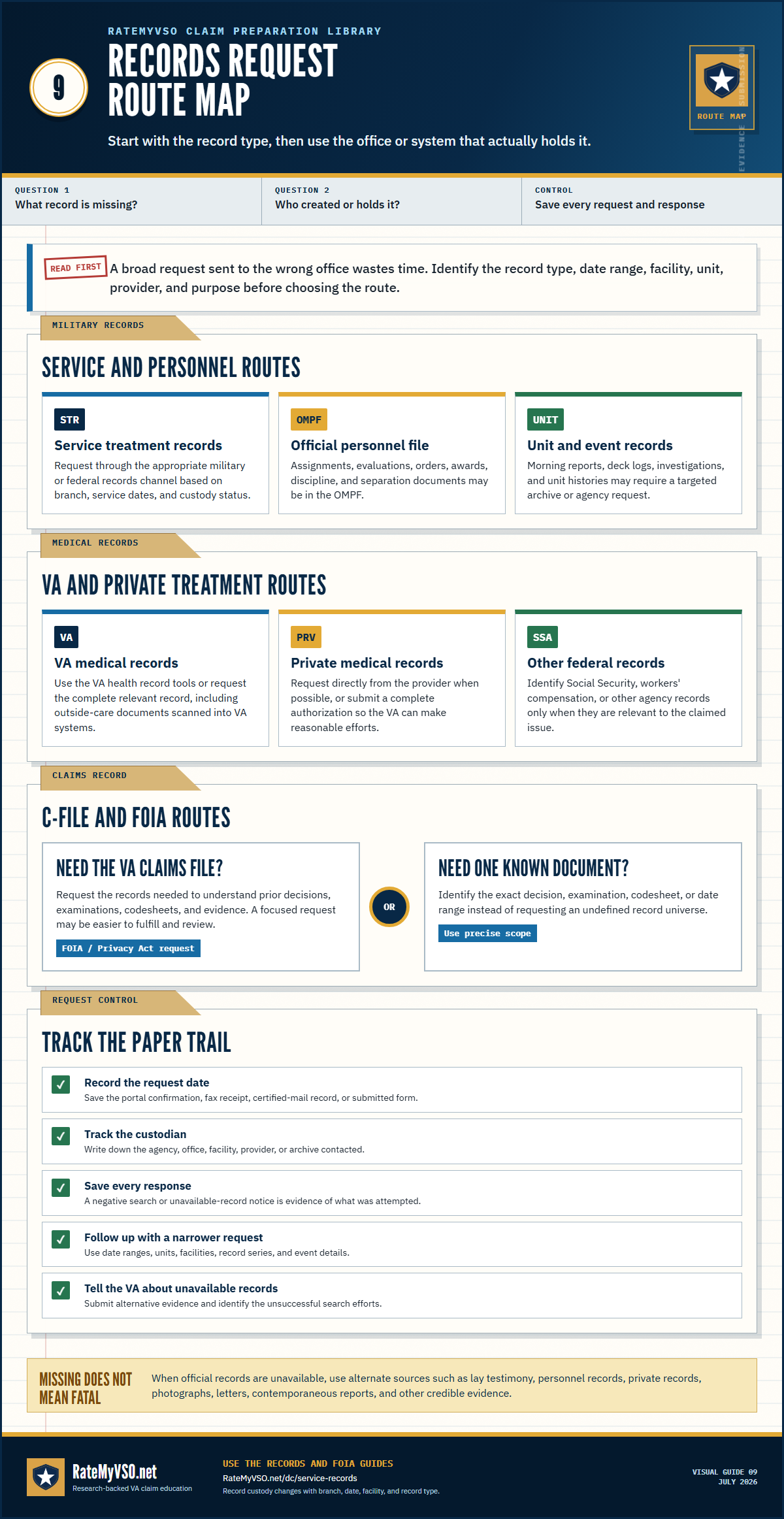
Alternative Evidence When Records Are Missing
When service treatment records are unavailable, you are not out of options. The VA and NPRC maintain many alternative record sources, and you can submit personal evidence that the Board must consider.
Government Sources the VA Can Search
- Morning reports, Daily unit records documenting personnel present, casualties, transfers. Army (1912-1959) and Air Force (1947-1959) morning reports survived the fire. Request through NA Form 13055.
- Surgeon General's Office (SGO) extracts, 7.8 million hospital admission records maintained separately. Can corroborate in-service medical events.
- Unit records and organizational histories, Document what a unit was doing, where it was deployed, and what hazards it faced.
- Personnel records, May survive when medical records are destroyed. Include duty stations, MOS assignments, and service dates.
- ILER (Individual Longitudinal Exposure Record), Electronic record tracking potential exposures to environmental and occupational hazards throughout military career. Particularly useful for PACT Act claims. Currently accessible through VA and DoD, work with your VSO to obtain it.
- Pay records, Multiple name pay vouchers from the Adjutant General's Office or Government Accounting Office.
- State Adjutant General records, National Guard discharge documents and state-level copies of federal records.
- VA hospital records, Treatment at VA facilities is recorded separately from NPRC and was not affected by the fire.
- Entrance and separation X-rays, Maintained separately from other medical records.
Evidence You Can Gather Yourself
- Your DD-214, Many veterans or their families kept personal copies. County courthouses often have copies filed at discharge. This confirms service dates, MOS, duty stations, and awards.
- Buddy/lay statements (VA Form 21-10210), Fellow service members who witnessed the in-service event or can describe your condition. Be specific: names, dates, unit, what happened, what they observed.
- Your own detailed statement, Describe the in-service event, when it happened, how your condition has affected you since. Be consistent and specific. The Board found veteran testimony decisive in 90% of winning missing-records cases.
- Private medical nexus letter, A doctor's opinion that your condition is "at least as likely as not" connected to your described in-service event.
- Personal photographs and correspondence from the service period, Can establish presence at locations or participation in events.
- Employment medical examinations, Pre-service or post-service physicals that document your health before and after military service.
- Civilian medical records from the service period or shortly after separation.
- Insurance examination reports from the relevant time period.
Key Forms You Need to Know
Pick the form that matches the job you need to do: request records, supply reconstruction details, authorize a private-record request, or provide a statement.
NA Form 13055, Request for Information Needed to Reconstruct Medical Data
The key form for fire-related medical-record reconstruction. Give your treatment dates, unit assignment, and treatment facility so NPRC can identify relevant alternative sources, including morning reports, SGO extracts, and unit records. Include your company, battalion, regiment, or other unit details you know.
NA Form 13075, Questionnaire About Military Service
Provides additional service details to help reconstruct records, including duty stations, treatment dates, and other identifying information. NPRC may request it when more information is needed to locate alternative sources.
VA Form 21-4142, Authorization to Disclose Information
Authorizes the VA to request your private, non-VA medical records. Use it with VA Form 21-4142a so the VA has both your signed authorization and the provider details needed for the request.
VA Form 21-4142a, General Release for Medical Provider Information
Lists the providers or facilities, addresses, and treatment dates for the records you want the VA to request. Send it with the signed VA Form 21-4142 authorization.
VA Form 21-10210, Lay/Witness Statement
Use this form for your statement or a buddy statement from someone with firsthand knowledge. Include dates, unit details, what happened, and what the person observed. Sign the statement as instructed. See the Buddy & Lay Statements Guide for practical writing help.
SF-180, Request Pertaining to Military Records
Identify the military records you need and use the form's instructions to locate the right custodian. eVetRecs is another request option for eligible users. The Records Finder can help identify where to send a request.
Ready to write your statement?
Use the Buddy & Lay Statements Guide for practical writing help. Keep your statement and records-request notes with your claim preparation.
When the VA Cannot Obtain Records
When the VA cannot obtain relevant records after the required efforts, it must notify you. The notice must identify the records, explain the efforts made, describe what happens next, and explain your responsibility to provide the evidence. Keep that notice with your claim records.
What to check
- The records identified: Do the record type, treatment location, and dates match what you requested?
- The search: Does the notice explain which efforts were made and why further efforts will not obtain the records?
- The next action: What will the VA do next, and what evidence or response is it asking you to provide?
- Alternative sources: Were relevant alternatives considered, and were you told how other evidence could support the claim?
Follow the response instructions and deadline in your actual notice.
Legal basis: 38 CFR 3.159(e). M21-1, Part III, Subpart ii, Chapter 2, Section F.
Step-by-Step Action Plan
Start by identifying what is missing: the branch, dates, treatment location, and whether you need personnel, outpatient, or inpatient records. Then work through the requests and supporting evidence together.
-
Request the right records
Use eVetRecs or SF-180 as appropriate, and use the Records Finder to identify the destination. Keep your request and the response.
-
Ask about alternative sources and reconstruction
For fire-related medical-record reconstruction, ask the VA about NA Form 13055. Supply your unit, treatment dates, and facility details. NPRC may also request NA Form 13075.
-
Gather your own evidence in parallel
Do not wait for the VA:
- Write a detailed personal statement describing the in-service event
- Contact fellow service members for buddy statements (VA Form 21-10210)
- Locate your DD-214 (check county courthouse if you do not have a copy)
- Gather any personal photos, letters, or documents from your service period
-
Obtain a medical nexus opinion
A doctor's opinion connecting your current condition to the in-service event you described. This is especially strong when combined with your credible testimony. Ask the provider to explain the medical reasoning using your history and available records. See the Nexus Letters guide.
-
Identify private medical records
Obtain copies yourself, or use VA Forms 21-4142 and 21-4142a to have the VA request them. See the six key forms.
-
Check the missing-records notice and your C-file
Review the documented search, the unavailable records, the next action, and any applicable Formal Finding of Unavailability. See when the VA cannot obtain records.
-
If denied, check whether the VA met its duties
An inadequate search, notice, or explanation under the heightened duty may be an issue for review or appeal. Consider a Higher-Level Review, which can catch Duty to Assist errors, or a Board appeal. A procedural error does not guarantee a grant.
-
If the VA or NPRC is unresponsive, contact your member of Congress
Every U.S. Representative and Senator has constituent services caseworkers who handle VA issues. They can submit a Congressional Inquiry to the VA or NPRC on your behalf. These get prioritized and can break through stalled records requests or claims. You do not need to choose just one. You can contact your House Representative and both of your Senators. Find yours at house.gov and senate.gov.
Keep track of the request
Note who has the record, when you requested it, what came back, and your next follow-up. Tracking a request does not send it.
Key Case Law
These cases established the legal standards that protect veterans when records are missing:
| Case | What It Established |
|---|---|
| O'Hare v. Derwinski 1 Vet. App. 365 (1991) |
The foundational case. When service records are unavailable through no fault of the veteran, the VA has a heightened obligation to assist, search alternative sources, consider benefit of the doubt, and explain its findings. |
| Washington v. Nicholson 19 Vet. App. 362 (2005) |
VA must seek relevant alternative sources, inform the veteran of other types of evidence they can submit, and consider the lay evidence the veteran submits. |
| Cromer v. Nicholson 19 Vet. App. 215 (2005) |
Important limitation: missing records do not create a presumption of service connection. The heightened duty heightens assistance, careful consideration, and explanation, without lowering the evidentiary standard. It does not eliminate the need for evidence. |
M21-1 Manual References
These are the VA's internal procedures that raters must follow when records are missing:
- M21-1, Part III, Subpart ii, Chapter 2, Section F, Fire-related records, supplementary or substitute records
- M21-1, Part III, Subpart i, Chapter 2, Section C, Duty to assist with obtaining records
- M21-1, Part III, Subpart ii, Chapter 2, Section A & Section B, General procedures for obtaining service records
- M21-1, Part III, Subpart ii, Chapter 2, Section D, Control and follow-up of requests for service records
If you are filing an appeal and the VA did not follow these procedures, cite the specific M21-1 section as a Duty to Assist failure.
Related Tools and Guides
This guide is for educational purposes only and is not legal or medical advice. All legal references are from Title 38 of the U.S. Code and the Code of Federal Regulations. Case law citations are accurate as of the dates noted. BVA statistics are from RateMyVSO analysis of 1,897,000+ published decisions. For help with your specific claim, find a free VSO representative or consult with a VA-accredited attorney. All RateMyVSO tools are free, no paywalls, no upsells.