Gulf War Illness Claims: Undiagnosed Illness and MUCMI
If you served in the Southwest Asia theater and have a chronic, unexplained symptom cluster (fatigue, pain, gut problems, headaches), 38 CFR 3.317 can presume your service caused it. You may only need to show the disability exists, is chronic, and is at least 10% disabling, not what caused it. This guide explains the two ways to qualify, the traps that sink these claims, how the C&P exam decides them, and how to file.

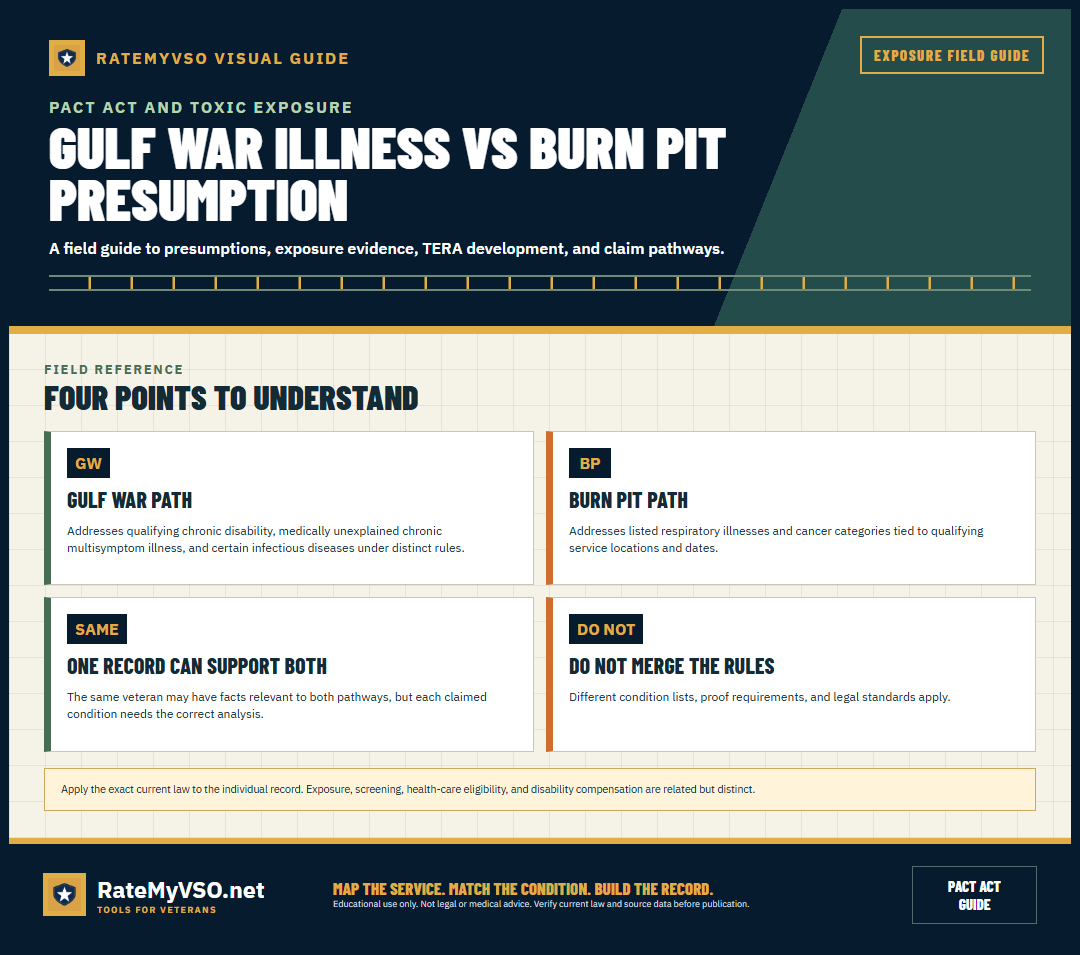
The two doors into 3.317
The regulation gives two separate ways to qualify, and they have opposite requirements. The single most common reason these claims fail is filing through the wrong door.
Undiagnosed illness door
Your symptoms cannot be tied to any known diagnosis after history, physical exam, and lab tests. There is no name for what you have. Example: persistent fatigue and joint pain that every workup returns as normal.
MUCMI door
You do have a diagnosed illness, but one without a conclusive cause (etiology) or without a conclusive disease mechanism (pathophysiology), with overlapping symptoms and disability out of proportion to physical findings. The regulation is written in the alternative: under Stewart v. Wilkie (2018) it is enough that either one is inconclusive, and the Court held the question is judged on the individual veteran's condition, not on whether the illness is generally understood. Named examples written into the rule: chronic fatigue syndrome, fibromyalgia, and functional gastrointestinal disorders such as IBS. Those are examples, not the whole list.
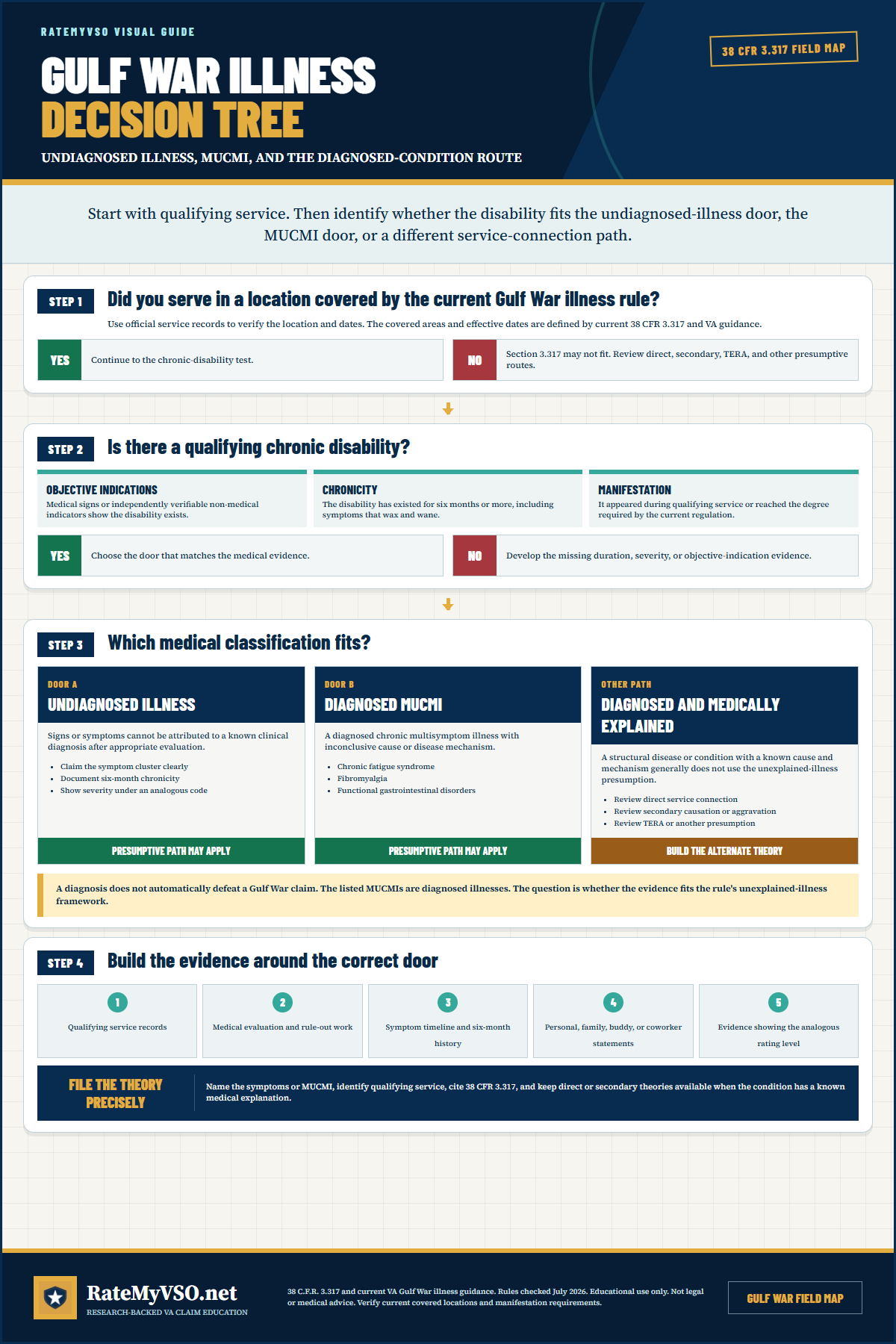
Functional vs structural: the key to the blind spot
The practical key to that blind spot is whether a condition is functional or structural.
Functional (can qualify)
No structural damage a scope or scan can find, and no conclusive mechanism. Irritable bowel syndrome, chronic fatigue syndrome, and fibromyalgia fit the medically-unexplained standard because there is no test that explains why you have them.
Structural (does not qualify)
A known physical mechanism. Crohn's disease damages the intestinal wall. Obstructive sleep apnea is a physical airway obstruction. Both are diagnosable and explained, so they do not ride the 3.317 presumption (a diagnosed structural condition is usually pursued through direct or secondary service connection instead).
Do you have qualifying service?
You must be a Persian Gulf veteran who served in the Southwest Asia theater of operations. The regulation defines that theater as Iraq, Kuwait, Saudi Arabia, the neutral zone, Bahrain, Qatar, the United Arab Emirates, Oman, the Gulf of Aden, the Gulf of Oman, the Persian Gulf, the Arabian Sea, the Red Sea, and the airspace above them.
The VA recognizes service in these locations on or after August 2, 1990. Since the PACT Act, 38 U.S.C. 1117 also covers service in Afghanistan, Egypt, Israel, Jordan, Syria, and Turkey, for both undiagnosed illnesses and diagnosed medically unexplained illnesses. VA's M21-1 manual counts the airspace above the original theater locations but not the airspace above those six countries. The current locations list is effective June 6, 2025. Even brief service counts, including flying through the airspace above the original theater locations.
The four-part test for a qualifying chronic disability
To win under either door, the evidence has to show all four of these.
- Objective indications of the disability: Here "objective" is broader than lab results. It includes both medical signs a doctor can perceive and non-medical indicators that can be independently verified. This is why lay evidence such as buddy statements and work records carries real weight here.
- It is chronic: The disability has existed 6 months or more, measured from when the symptoms first appeared. The six months do not have to be consecutive. Symptoms that come and go over the period still count.
- It became manifest: Under 38 U.S.C. 1117(a)(1) the disability qualifies if it became manifest to any degree at any time. There is no cutoff date. The chronicity requirement in the item above is the separate timing rule that still applies.
- It cannot be attributed to a known cause: For the undiagnosed-illness door, no diagnosis fits. For the MUCMI door there is a diagnosis, but its cause or its disease mechanism is not conclusively understood. The regulation's named examples are illustrative, not a closed list, and the question is decided on your own medical record rather than by the name of the condition.
The symptoms the regulation names
Section (b) lists signs and symptoms that may be manifestations of an undiagnosed illness or MUCMI. The list is "not limited to" these, but naming one helps.
- Fatigue
- Skin signs or symptoms
- Headache
- Muscle pain
- Joint pain
- Neurological signs or symptoms
- Neuropsychological signs or symptoms
- Respiratory (upper or lower) signs or symptoms
- Sleep disturbances
- Gastrointestinal signs or symptoms
- Cardiovascular signs or symptoms
- Abnormal weight loss
- Menstrual disorders
How the C&P exam decides it
Most 3.317 claims involve a C&P exam. The examiner completes a Gulf War medical opinion that sorts your disability pattern into one of four categories. The first two support a grant under 3.317. The last two mean it cannot be granted under 3.317, though the condition may still be pursued under a direct or secondary theory.
| Category | Result |
|---|---|
| 1. An undiagnosed illness | Supports a grant under 3.317 |
| 2. A diagnosable but medically unexplained chronic multisymptom illness | Supports a grant under 3.317 |
| 3. A diagnosable chronic multisymptom illness with a partially explained cause | Cannot be service-connected under 3.317 |
| 4. A disease with a clear and specific cause | Cannot be service-connected under 3.317 |
The sleep apnea trap
Lay and non-medical evidence carry unusual weight
3.317 is one of the few theories where the manual gives a veteran's own testimony unusual weight. M21-1 states that a veteran's lay statement describing their symptoms can take on greater importance than in other direct-service-connection claims, and that symptoms unsupported by clinical findings can still establish service connection here.
What counts as an objective or non-medical indicator includes:
- Third-party statements from a spouse, buddy, or coworker (these can also establish the 6-month chronicity)
- Time lost from work
- Evidence that the veteran sought medical treatment for the symptoms
- Observed changes in the veteran's appearance, physical abilities, or mental and emotional state
Evidence Cited in Published Fibromyalgia Decisions
We analyzed 9,445 published Board decisions involving fibromyalgia for condition-specific evidence, counting only case-specific mentions (boilerplate recitations excluded). "Favorable" is the share of decisions citing that evidence where every issue was granted or the outcome was mixed; the baseline across all these decisions is 54.8%. Evidence appearing in a decision does not mean it decided the case. Descriptive of the published record, not a prediction.
Bar length shows decisions citing the evidence.
Evidence Cited in Published Chronic fatigue syndrome Decisions
We analyzed 15,747 published Board decisions involving chronic fatigue syndrome for condition-specific evidence, counting only case-specific mentions (boilerplate recitations excluded). "Favorable" is the share of decisions citing that evidence where every issue was granted or the outcome was mixed; the baseline across all these decisions is 56%. Evidence appearing in a decision does not mean it decided the case. Descriptive of the published record, not a prediction.
Bar length shows decisions citing the evidence.
Evidence Cited in Published IBS Decisions
We analyzed 22,597 published Board decisions involving ibs for condition-specific evidence, counting only case-specific mentions (boilerplate recitations excluded). "Favorable" is the share of decisions citing that evidence where every issue was granted or the outcome was mixed; the baseline across all these decisions is 56.8%. Evidence appearing in a decision does not mean it decided the case. Descriptive of the published record, not a prediction.
Bar length shows decisions citing the evidence.
Detected by phrase-reading the decision text with condition-specific vocabularies. Source: Board of Veterans' Appeals decisions, RateMyVSO analysis.
How the VA rates and pays a 3.317 disability
Once granted, a qualifying chronic disability is rated under the normal Part 4 rating schedule "by analogy": the VA picks the diagnostic code for a condition with similar functions affected, anatomical location, or symptoms.
When a disability is rated by analogy, the code sheet shows a paired code (for example 7399-7319), where the trailing "99" signals an analogous rating built off the parent body system. That code sheet is not printed on your decision letter. A VSO, accredited claims agent, or attorney can review it to check the analogous code is a fair match and not a low-value one.
Two more things the regulation makes explicit: a qualifying chronic disability is treated as service-connected for purposes of all laws of the United States, and overlapping symptoms are not rated twice (the anti-pyramiding rule applies).
Symptoms Recorded in Granted Fibromyalgia Decisions
We analyzed 492 granted Board decisions involving fibromyalgia for symptoms named in sentences about the condition (rating-criteria recitations excluded). Descriptive of the published record, what the Board wrote down, not a checklist of what to report.
Bar length shows decisions. Percentages remain context.
Symptoms Recorded in Granted Chronic fatigue syndrome Decisions
We analyzed 538 granted Board decisions involving chronic fatigue syndrome for symptoms named in sentences about the condition (rating-criteria recitations excluded). Descriptive of the published record, what the Board wrote down, not a checklist of what to report.
Bar length shows decisions. Percentages remain context.
Symptoms Recorded in Granted IBS Decisions
We analyzed 1,503 granted Board decisions involving ibs for symptoms named in sentences about the condition (rating-criteria recitations excluded). Descriptive of the published record, what the Board wrote down, not a checklist of what to report.
Bar length shows decisions. Percentages remain context.
Detected by phrase-reading the decision text with condition-specific vocabularies. Source: Board of Veterans' Appeals decisions, RateMyVSO analysis.
When the VA can still say no
Even with qualifying service and symptoms, the presumption can be rebutted. Compensation will not be paid if there is affirmative evidence that the disability:
- Was not incurred during active service in the Southwest Asia theater
- Resulted from a supervening condition or event that happened between the veteran's last departure from the theater and the onset of the disability
- Resulted from the veteran's own willful misconduct or abuse of alcohol or drugs
How to file, step by step
- Use VA Form 21-526EZ: File online at VA.gov, by mail, in person, or through an accredited representative. If a prior claim was denied and your condition is now presumptive, file a Supplemental Claim (VA Form 20-0995) instead.
- Describe the chronic symptom cluster: Describe the chronic symptoms (for example "chronic fatigue," "chronic joint pain," "chronic GI symptoms") and tie them to the 3.317 symptom list.
- Build the objective-indications record: Gather medical records plus lay statements, third-party statements, employment and attendance records, and any Gulf War Health Registry exam.
- Document the 6-month chronicity: Show the earliest date the symptoms appeared and that they have persisted or recurred for at least six months.
- Prepare for the C&P exam: Most 3.317 claims involve one. Describe symptoms fully and consistently.
- Get free help if you want it: Accredited VSOs, claims agents, and attorneys can represent you at no cost for the claim itself.
Frequently asked questions
Is the December 31, 2026 deadline real?
Can I claim sleep apnea under 3.317?
Do I need a diagnosis to win?
Does my own statement count as evidence?
Is IBS an undiagnosed illness?
Can I be paid for time before I filed?
What if I already have a diagnosis with a known cause?
Related Tools and Guides
Sources: 38 CFR 3.317, the regulation · VA.gov, Gulf War illness (Southwest Asia) · VA Public Health, medically unexplained illnesses · CCK Law, sleep disturbances and 3.317. Current as of August 2026. Regulations, statutes, and M21-1 provisions change. Verify every date and requirement against the primary sources before filing. This guide is educational, not legal or benefits advice, and not a prediction of any individual claim outcome. For help with your own claim, talk to a VA-accredited representative.