How to Get a Strong VA Nexus Letter
Everything you need in one place to build and acquire a powerful nexus letter for your VA claim. A strong nexus letter is the medical evidence most likely to turn a VA denial into a grant, and a weak one gets thrown out. This guide shows you what a nexus letter is, when you need one, how to ask your doctor for it, the exact "at least as likely as not" wording the VA requires, and where to turn if your own doctor will not write it. Start with the guides below, then read the full walkthrough.

The Nexus Letter Library
What Is a Nexus Letter?
A nexus letter (also called an Independent Medical Opinion or IMO) is a medical opinion from a qualified healthcare provider stating that your current disability is connected to your military service, or to another service-connected condition.
The word "nexus" means "connection" or "link." The letter provides the medical link between your current condition and your service that the VA requires to grant your claim.
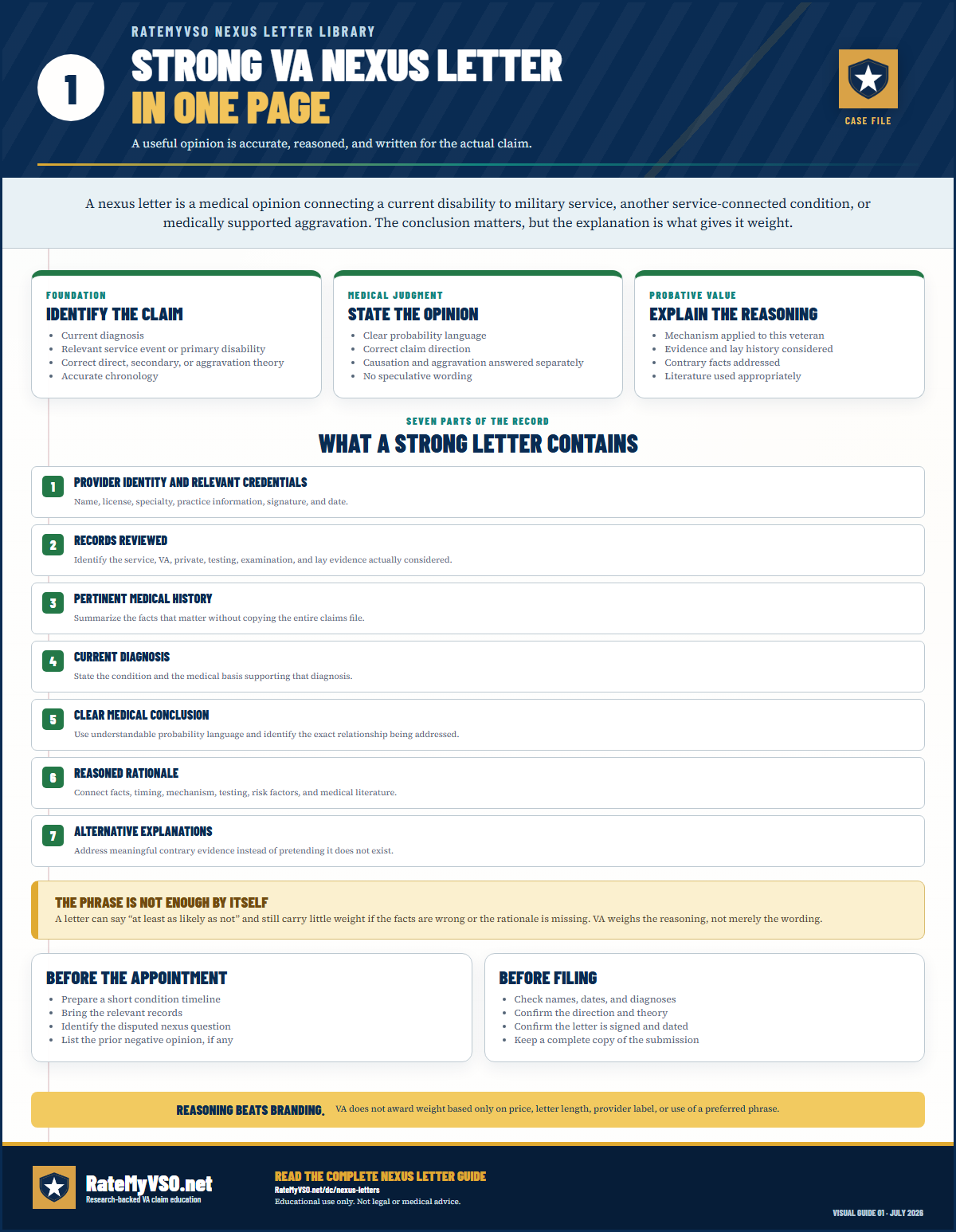 One-page guide: Strong VA Nexus Letter in One Page
One-page guide showing the building blocks of a persuasive VA nexus opinion, including the correct veteran and condition, evidence reviewed, clear probability language, medical reasoning, alternative explanations, provider credentials, and a final quality check. Opens the full-size chart, free to save or print.
One-page guide: Strong VA Nexus Letter in One Page
One-page guide showing the building blocks of a persuasive VA nexus opinion, including the correct veteran and condition, evidence reviewed, clear probability language, medical reasoning, alternative explanations, provider credentials, and a final quality check. Opens the full-size chart, free to save or print.
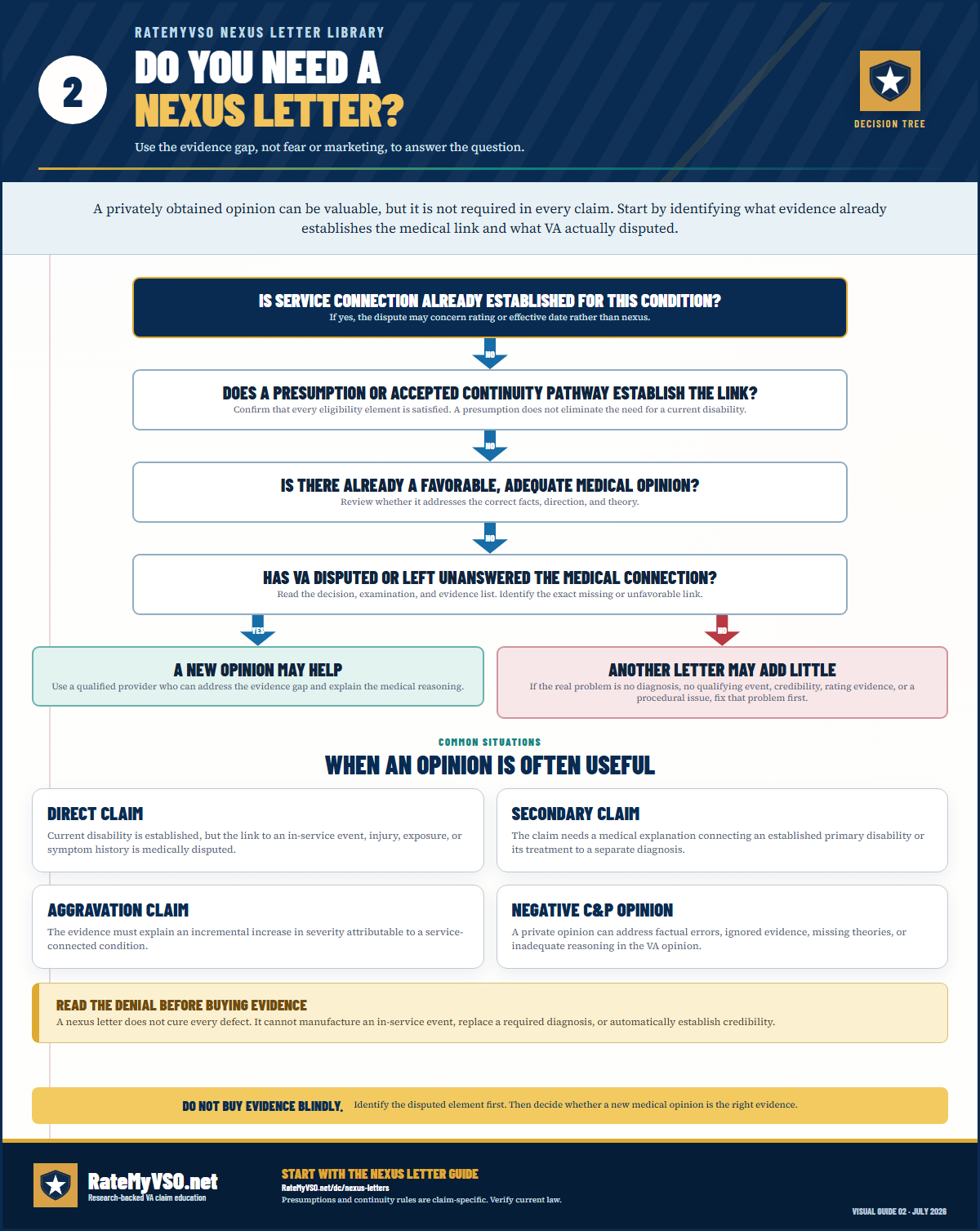
When You Need a Nexus Letter
- Direct service connection: Your condition started in service but you don't have clear documentation linking it to a specific event or injury.
- Secondary service connection: You're claiming a new condition caused or aggravated by an already service-connected condition (e.g., knee problems causing hip issues).
- Aggravation claims: A pre-existing condition was made worse by service.
- After a C&P exam denial: The VA examiner provided a negative opinion and you need a competing medical opinion.
- Gap in treatment records: You didn't seek treatment for years after service, and the VA questions whether your current condition is really related to service.
- Missing or destroyed service records: When STRs are unavailable (including 1973 NPRC fire cases), a nexus letter based on your credible account of in-service events is especially powerful.
When You May NOT Need One
- Presumptive conditions: If your condition is presumptive (e.g., PACT Act conditions, Agent Orange, Gulf War illnesses), you may not need a nexus. The law presumes the connection.
- Clear in-service diagnosis with continuity: If you were diagnosed in service and have continuous treatment records, the nexus may be self-evident.
Who Can Write a Nexus Letter
Any competent medical professional can write a nexus letter. The VA must consider it regardless of who writes it. However, the weight given to the opinion depends on:
- Medical doctors (MD/DO) - carry the most weight, especially specialists in the relevant field.
- Nurse practitioners (NP) and physician assistants (PA) - fully competent to provide nexus opinions. The VA cannot reject an opinion solely because it came from an NP or PA.
- Psychologists (PhD/PsyD) - for mental health conditions.
- Specialists vs generalists: An orthopedic surgeon's opinion on a knee condition carries more weight than a family doctor's, but both are valid.
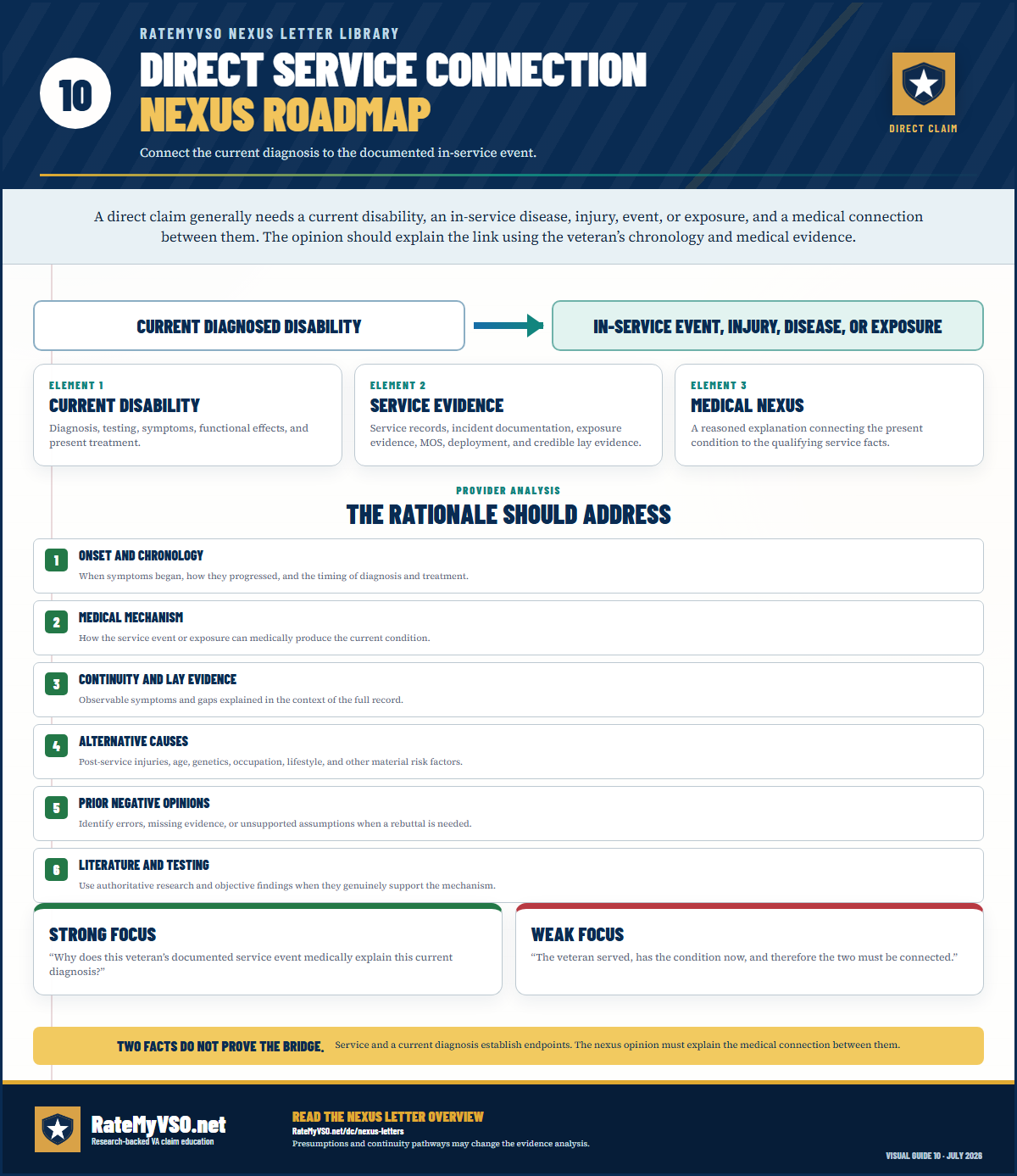 One-page guide: Direct Service Connection Nexus Roadmap
Flowchart connecting a current diagnosis, an in-service event or exposure, and a medical opinion that explains why the current condition is at least as likely as not related to service. Opens the full-size chart, free to save or print.
One-page guide: Direct Service Connection Nexus Roadmap
Flowchart connecting a current diagnosis, an in-service event or exposure, and a medical opinion that explains why the current condition is at least as likely as not related to service. Opens the full-size chart, free to save or print.
What a Strong Nexus Letter Should Include
- Provider credentials. Full name, title, license number, specialty, and years of experience. Establish why this provider is qualified to opine.
- Review of evidence. Explicitly state what was reviewed: service treatment records, VA medical records, private treatment records, lay statements, C-file, specific diagnostic studies.
- History and examination. Summary of the veteran's relevant military history, in-service events, current symptoms, and examination findings.
- Medical reasoning. This is the core, a detailed explanation of why the condition is connected to service. Cite medical literature, explain the biological mechanism, address the timeline.
- The opinion statement. Use the required standard: "It is at least as likely as not (50% or greater probability) that [condition] is caused by / related to / aggravated by [military service / service-connected condition]."
- Rationale. Explain why this conclusion was reached. This is where most nexus letters fail. A conclusion without rationale carries little weight.
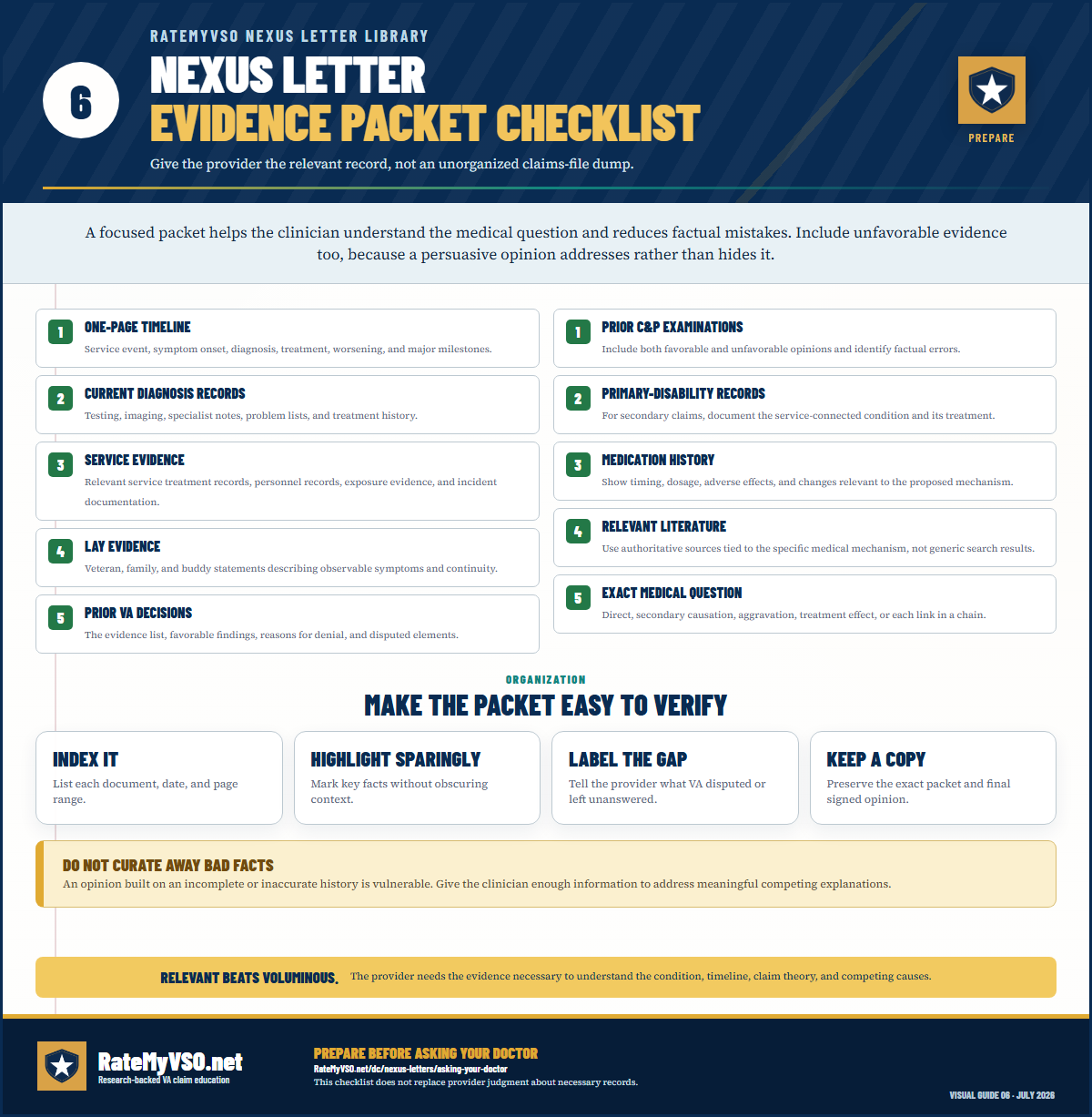 One-page guide: Nexus Evidence Packet Checklist
Checklist of records to organize for a medical nexus review, including the decision question, relevant service records, current diagnosis and treatment, timeline, lay evidence, prior examinations, favorable and unfavorable evidence, and medication or treatment effects. Opens the full-size chart, free to save or print.
One-page guide: Nexus Evidence Packet Checklist
Checklist of records to organize for a medical nexus review, including the decision question, relevant service records, current diagnosis and treatment, timeline, lay evidence, prior examinations, favorable and unfavorable evidence, and medication or treatment effects. Opens the full-size chart, free to save or print.
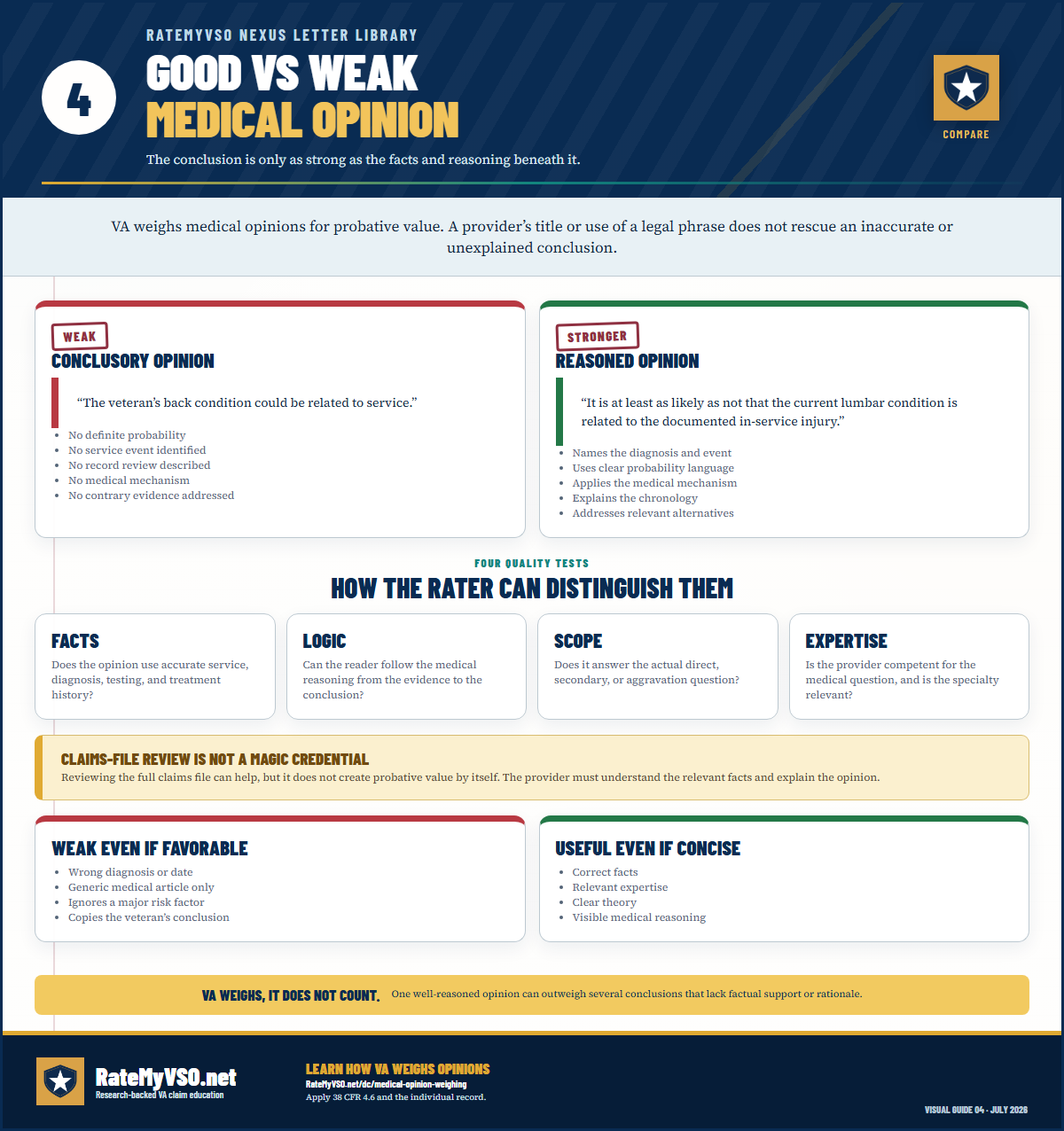
Good vs Bad Nexus Letters
Strong Nexus Letter
- Uses "at least as likely as not" language
- Reviews the full record (specifies what was reviewed)
- Provides detailed medical rationale with citations
- Explains the biological connection
- Addresses gaps in treatment or alternative causes
- Written by a relevant specialist
- 2+ pages of substantive analysis
Weak Nexus Letter
- Uses "possibly" or "could be" (too speculative)
- One paragraph with no details
- Doesn't say what records were reviewed
- Bare conclusion with no rationale
- Template language with no personalization
- Written by unrelated specialty
- Doesn't address obvious counter-arguments
The Standard of Proof: "At Least as Likely as Not"
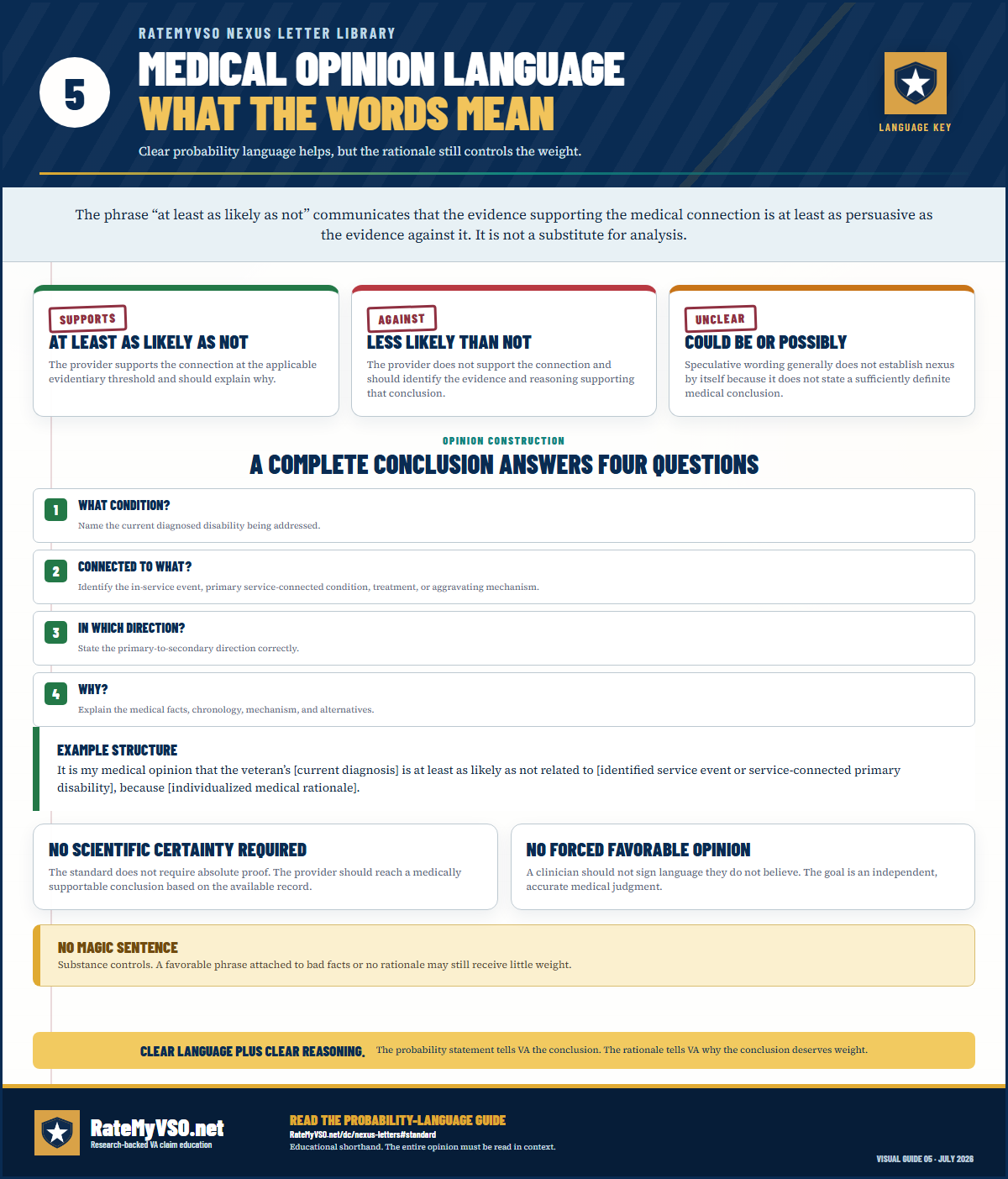
The VA uses the "at least as likely as not" standard, which means a 50% or greater probability. This is important:
- "At least as likely as not" = 50/50 or better. This is the magic language. If the odds are even, the veteran wins.
- "More likely than not" = greater than 50%. This works too, but you don't need to go this far.
- "Possible" or "could be" = too weak. The VA considers this speculative and will give it little weight.
- "Less likely than not" = against you. Below 50% probability.
 One-page guide: Medical Opinion Language Explained
Guide to VA medical-opinion probability language, distinguishing favorable at-least-as-likely-as-not language from speculative or unfavorable wording and explaining that reasoning matters more than a phrase alone. Opens the full-size chart, free to save or print.
One-page guide: Medical Opinion Language Explained
Guide to VA medical-opinion probability language, distinguishing favorable at-least-as-likely-as-not language from speculative or unfavorable wording and explaining that reasoning matters more than a phrase alone. Opens the full-size chart, free to save or print.
Where to Get One
Two Sources Cost You Nothing
- A VA C&P exam. VA orders it and the examiner writes the medical opinion as part of developing your claim.
- A VHA provider, if you are enrolled in VA health care. They already hold your full VA record.
Your Own (Non-VA) Doctor
- Cost varies and we cannot tell you what yours will charge. Some write it as part of a normal visit, some bill separately for the time, and some decline to write one at all.
- Knows your medical history best
- May not be familiar with VA-specific language. Provide guidance
A Paid Independent Medical Opinion
- A specialist you retain to review your record and write the opinion. Fees vary and we have no concrete range to give you. Ask for the price in writing before you agree to anything.
See all four sources, side by side, with the weight each tends to carry at the Board.
Tips for Getting a Strong Nexus Letter
- Give your doctor a copy of your C-file or relevant records. They can't write a thorough opinion without reviewing the evidence.
- Explain the VA's standard. Many civilian doctors don't know about "at least as likely as not." Educate them on the required language.
- Ask them to address the C&P examiner's rationale if you were previously denied. A nexus letter that directly rebuts the VA examiner's reasoning is extremely powerful.
- Include medical literature. Peer-reviewed studies supporting the connection between your service and your condition add significant credibility.
- Don't use a template without customization. The VA sees hundreds of template nexus letters. One that's clearly written for your specific case carries far more weight.
- Request it on letterhead with the provider's credentials, license number, and contact information.
 One-page guide: Nexus Letter Red Flags
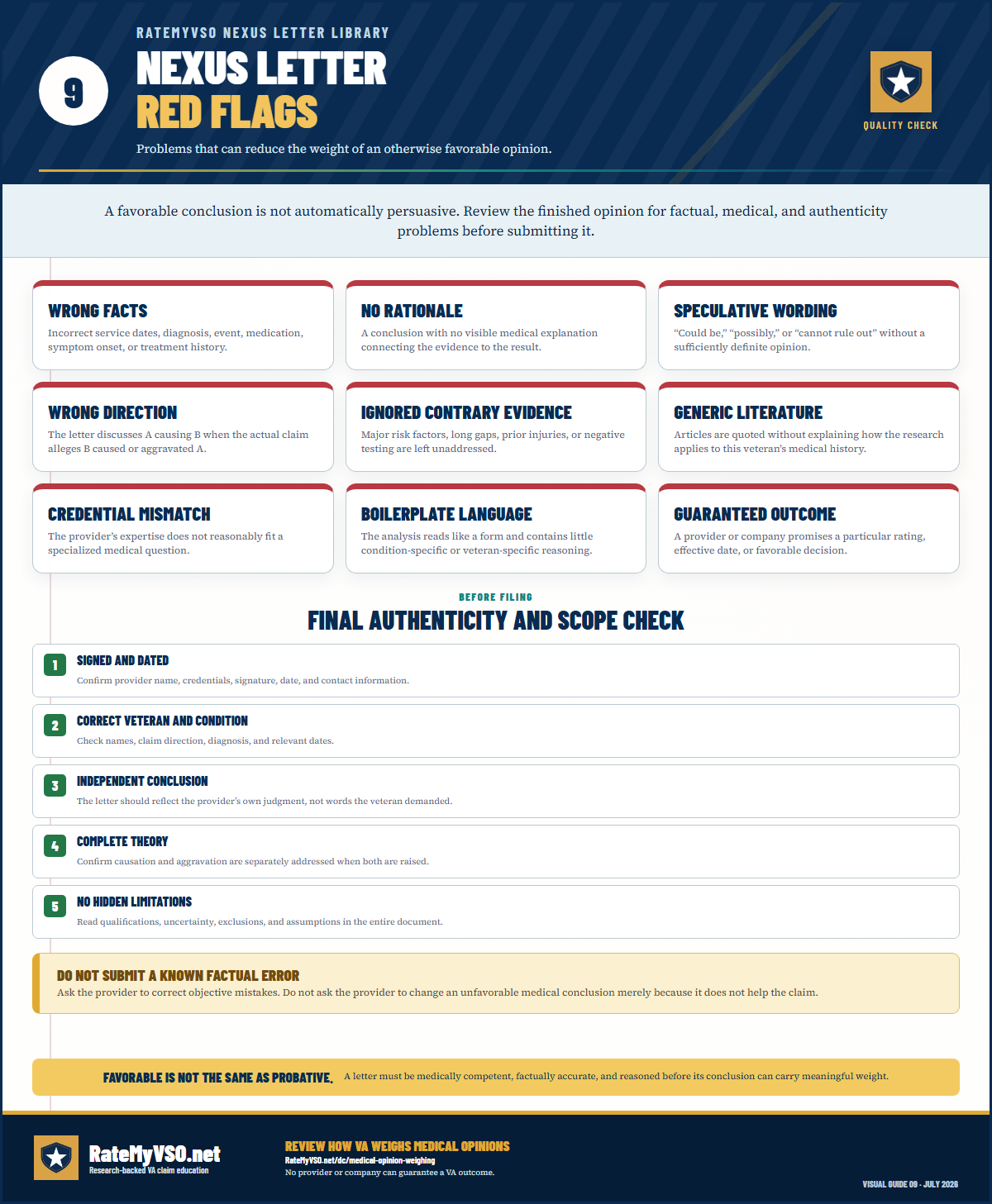
Warning guide listing common medical-opinion problems such as factual errors, conclusory language, missing rationale, unsupported certainty, ignored contrary evidence, copied boilerplate, unclear credentials, and opinions outside the provider's expertise. Opens the full-size chart, free to save or print.
One-page guide: Nexus Letter Red Flags
Warning guide listing common medical-opinion problems such as factual errors, conclusory language, missing rationale, unsupported certainty, ignored contrary evidence, copied boilerplate, unclear credentials, and opinions outside the provider's expertise. Opens the full-size chart, free to save or print.
Common Questions
What is a VA nexus letter?
When do you need a nexus letter for a VA claim?
Can a veteran write their own nexus letter?
How much does a nexus letter cost?
Related Tools and Guides
This guide is for educational purposes only and is not medical or legal advice. For help with your claim, find a VSO representative. To see what evidence wins at the Board, check our BVA appeal data. To understand how raters compare a private nexus letter against the C&P examiner's report, read How VA Raters Weigh Medical Opinions.