Nexus Letters for Secondary VA Conditions
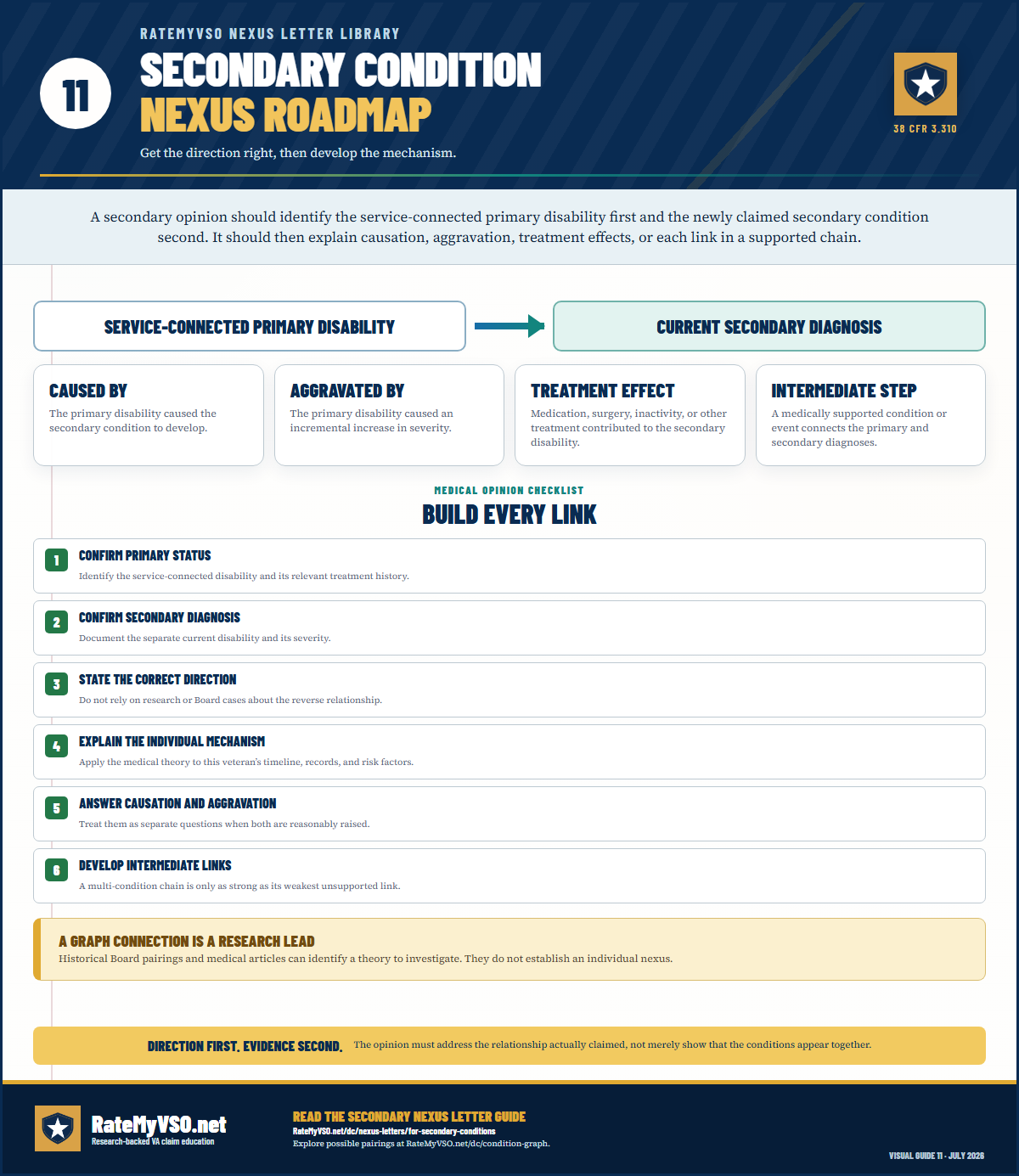
Secondary service connection under 38 CFR § 3.310 requires a medical link between a new condition and an already service-connected condition. This page is a research guide: why the causal-link evidence carries more weight than in direct claims, what patterns appear repeatedly in granted Board of Veterans' Appeals (BVA) decisions, and how aggravation claims differ from causation claims. It is reference material, not legal or medical advice.

Why the Nexus Carries Extra Weight in Secondary Claims
In a direct service-connection claim, the link is to a documented in-service event or exposure. The record itself often supplies most of the proof. In a secondary claim under § 3.310, the link is to another condition. There is rarely an in-service event for the secondary condition itself, so the medical opinion is doing the bulk of the work to prove causation or aggravation.
Reviewers reading published BVA decisions in secondary claims see this pattern repeatedly: when the opinion is detailed, cites medical literature, and explicitly addresses biological plausibility, grants follow. When the opinion is conclusory ("his sleep apnea is related to his PTSD"), it tends to get little weight.
Common Secondary Patterns in Published BVA Grants
These are anonymized pattern observations from the Board's published decisions. Each illustrates a causation theory the Board has accepted on a sufficiently developed record. None is a guarantee for any specific veteran.
Sleep Apnea ← PTSD
Theory: PTSD-driven hyperarousal, fragmented sleep architecture, and certain psychotropic medications can contribute to obstructive sleep apnea. Persuasive opinions cite sleep medicine literature, the veteran's specific PTSD treatment history, and the temporal sequence (PTSD onset preceding sleep-disorder diagnosis).
Hypertension ← PTSD
Theory: chronic sympathetic nervous-system activation and stress-related neuroendocrine dysregulation contribute to essential hypertension. Strong opinions reference Veterans Affairs studies showing PTSD and cardiovascular disease occurring together and explain why other risk factors (BMI, family history) do not fully account for the elevation.
Diabetic Neuropathy ← Diabetes Mellitus II
Theory: peripheral neuropathy is a well-established complication of chronic hyperglycemia. Grant rate is high when objective diagnostic findings (EMG, nerve conduction studies) confirm neuropathy and the diabetes record shows duration sufficient for the complication to develop.
Depression ← Chronic Pain Condition
Theory: chronic pain from a service-connected musculoskeletal or neuropathic condition is a recognized risk factor for major depressive disorder. Opinions that address pain duration, intensity, functional impairment, and absence of pre-service depression history tend to be granted.
Erectile Dysfunction ← PTSD, Diabetes, or Spine Conditions
Theory: ED is medically associated with PTSD (psychotropic medication side effects, autonomic dysregulation), diabetes (vascular and neurogenic mechanisms), and lumbar spine pathology (nerve-root involvement). ED service-connected secondarily also opens SMC-K eligibility.
GERD ← Anxiety/PTSD or NSAID Use
Theory: anxiety-related gastric motility changes, or chronic NSAID use prescribed for a service-connected orthopedic condition, contribute to gastroesophageal reflux disease. Opinions tying the GERD onset to a clear NSAID exposure period are particularly persuasive.
What the Board Looks For in Secondary-Claim Opinions
Reviewing granted secondary appeals, several attributes recur in the medical opinions that drove the grant:
- Explicit identification of the predicate condition. The opinion names the service-connected condition and confirms it is service-connected.
- Biological mechanism explained. Not just "X causes Y" but the physiological pathway, with citation to peer-reviewed sources where available.
- Temporal sequence addressed. The predicate condition predates or runs concurrent with onset of the secondary condition, with dates from the record.
- Alternative causes considered. Other potential causes (genetic factors, lifestyle, unrelated diagnoses) are acknowledged and explained.
- "At least as likely as not" language. The 50%-or-greater probability standard, in those exact words.
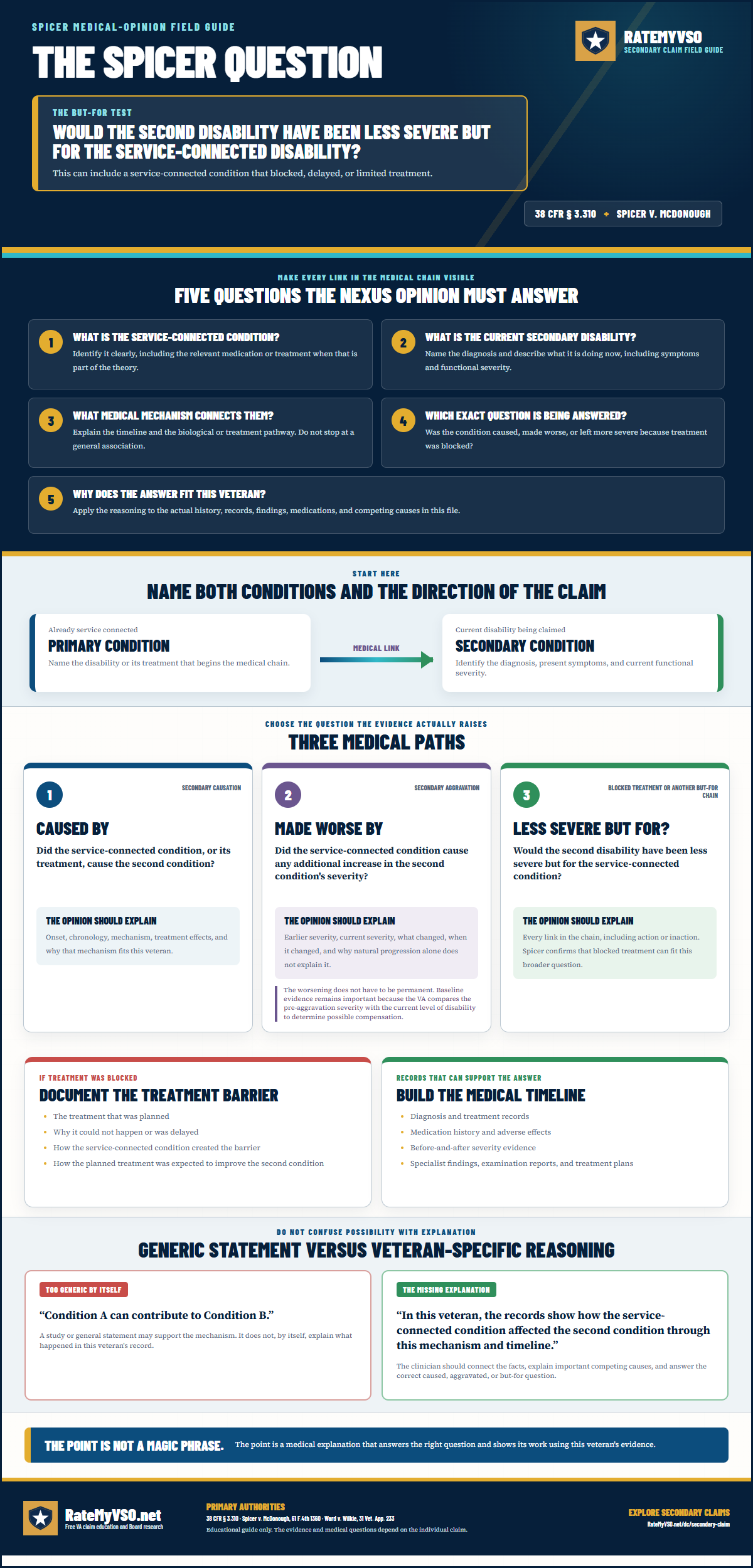
- For aggravation claims: a baseline. The opinion identifies the severity of the secondary condition before the aggravating service-connected condition appeared or worsened, so VA can compute the aggravation differential.
How Aggravation Differs From Causation
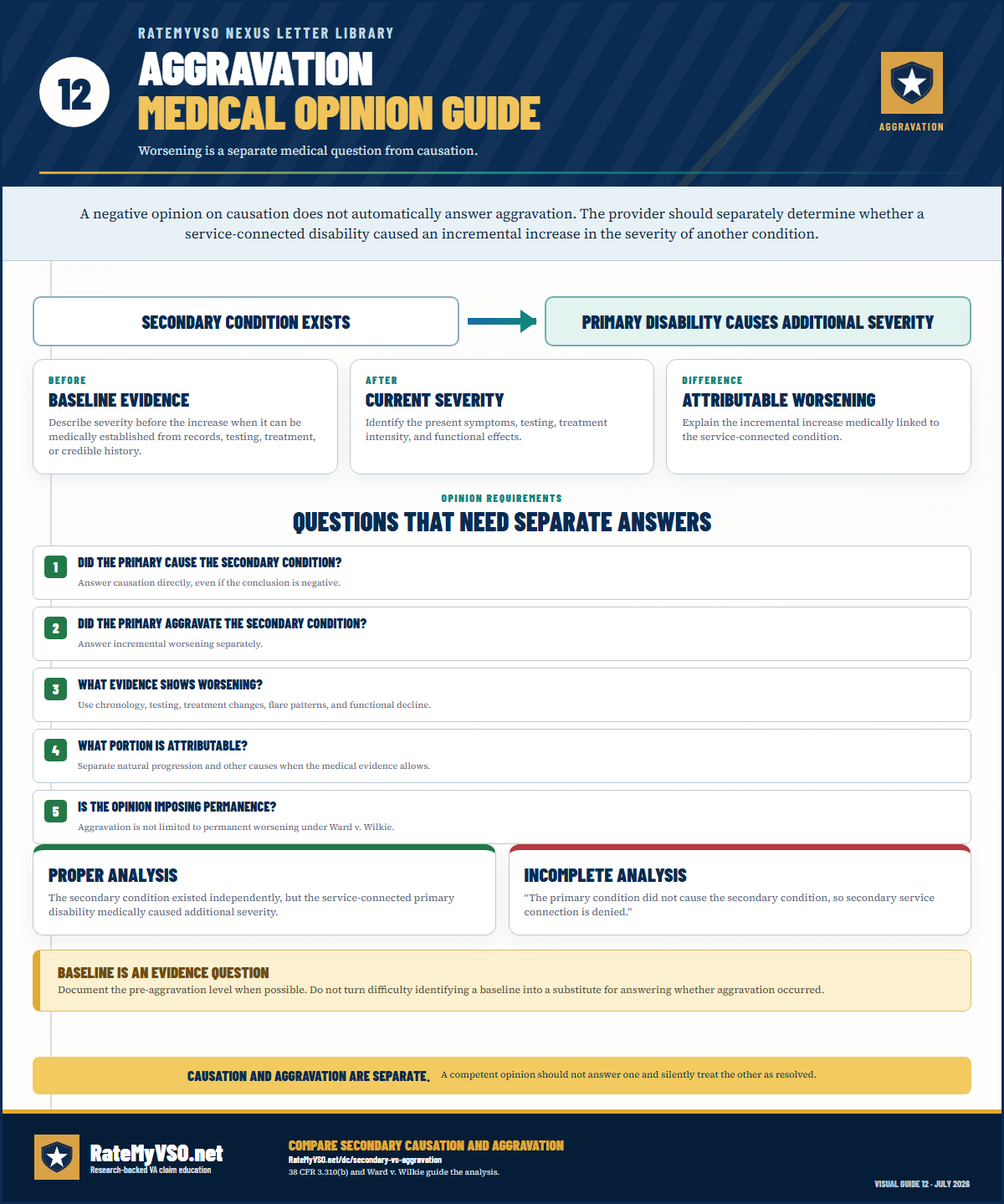
Aggravation requires showing that a non-service-connected condition was made permanently worse by a service-connected condition, beyond its natural progression (see § 3.310(b)). Two practical consequences:
- A baseline severity must be established before aggravation began. Without that baseline, VA cannot compute the rateable increase.
- The award only compensates the additional disability above the baseline, not the total current severity. A condition that was already 30% disabling before aggravation and is now 60% disabling pays only on the 30% increase.
The secondary vs aggravation page covers the regulatory distinctions in depth.
Related Tools and Guides
This is research material, not legal or medical advice. For help with your claim, find an accredited VSO representative. To search Board decisions citing § 3.310 directly, use the BVA search tool.