Secondary Service Connection vs Aggravation

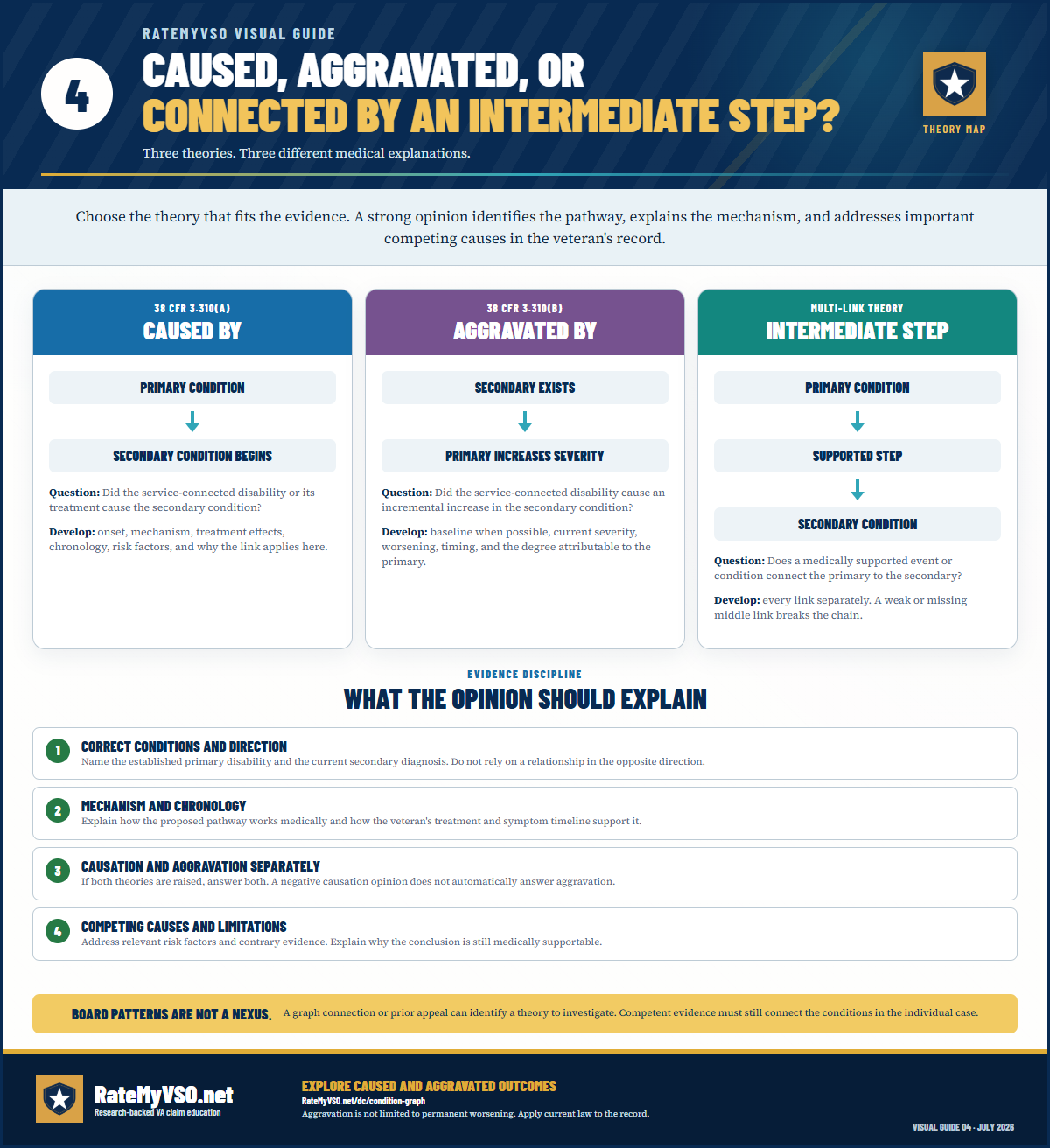
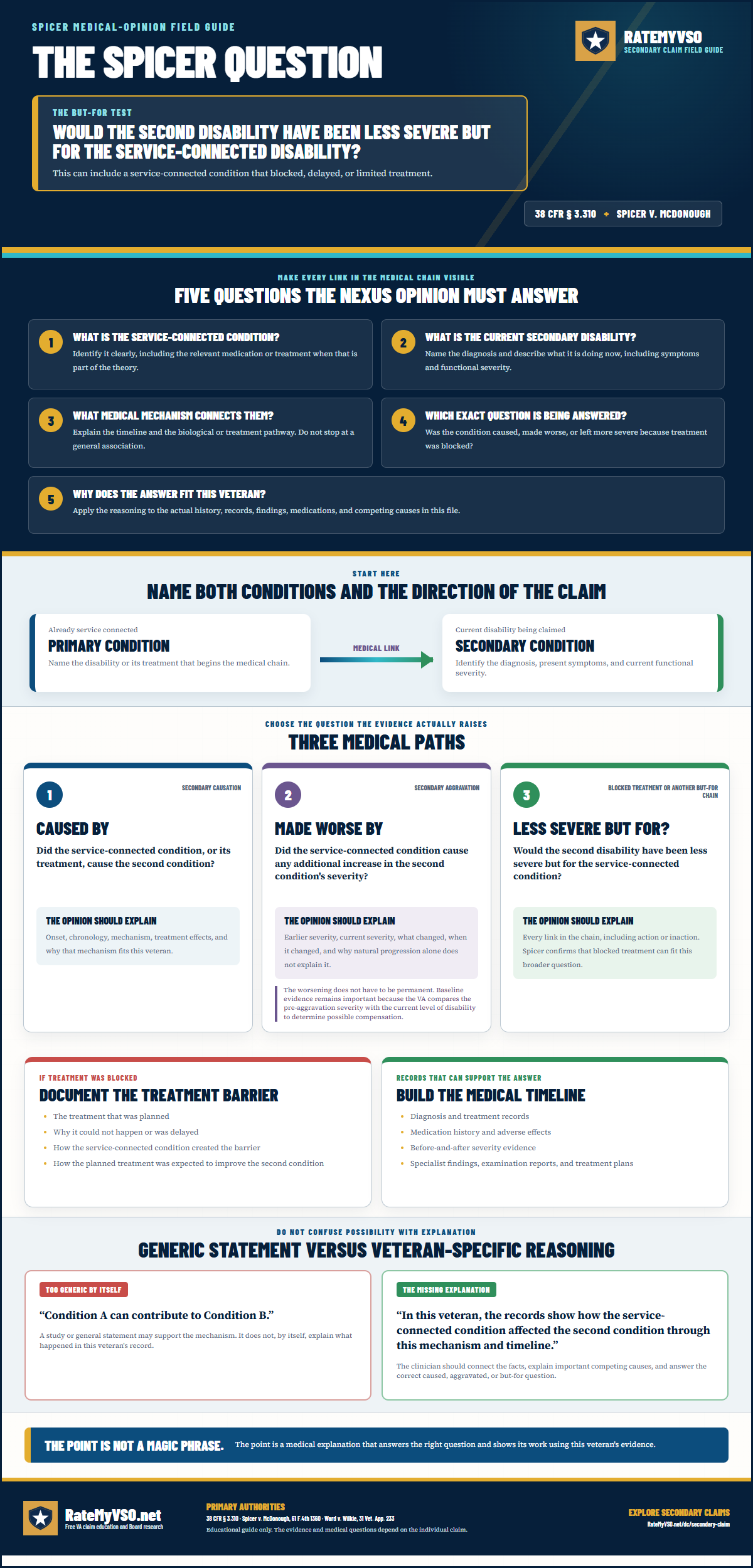
Two distinct legal pathways under 38 CFR § 3.310: a service-connected disability can either cause a new condition (secondary, § 3.310(a)) or aggravate a pre-existing non-service-connected condition (§ 3.310(b)). The two pay differently, secondary gets the full rating, aggravation gets only the increase above baseline. Knowing which applies is the difference between $1,800/month and $300/month for the same condition.
What Each Pathway Is
Secondary Service Connection
Reg: § 3.310(a)
Means: The service-connected disability caused a brand-new disability that wouldn't otherwise exist.
Pays: The full rating for the secondary condition.
Example: Service-connected diabetes → erectile dysfunction. ED would not exist without the diabetes.
Aggravation
Reg: § 3.310(b)
Means: A pre-existing non-service-connected condition was made worse by the service-connected condition.
Pays: Only the portion of the rating above the baseline level.
Example: Pre-service knee arthritis aggravated by service-connected lumbar strain altering gait. Knee gets worse, but it was pre-existing.
Do not confuse this with aggravation by service itself (38 CFR § 3.306)
Everything on this page is about § 3.310(b), where one of your service-connected conditions makes another condition worse. A different rule, 38 CFR § 3.306, covers a condition you already had when you enlisted that was made worse by service itself. There is no second condition involved in a § 3.306 claim, so it is not a secondary claim at all and it does not appear in this site's secondary-condition data.
The two get written the same way in Board decisions, which is why they are easy to mix up. The tell is what did the worsening: another service-connected disability points to § 3.310(b), military service itself points to § 3.306.
Why aggravation is compensable
Aggravation of a non-service-connected condition by a service-connected condition is itself compensable (Allen v. Brown, 7 Vet. App. 439 (1995)). Before this ruling, VA had refused to compensate aggravation when the underlying condition wasn't service-connected. After Allen, the rule is: if a service-connected condition makes a non-service-connected condition worse, you get paid for the worsening above baseline.
Allen was codified into 38 CFR § 3.310(b) in 2006. The regulation now reads:
"Any increase in severity of a nonservice-connected disease or injury that is proximately due to or the result of a service-connected disease or injury, and not due to the natural progress of the nonservice-connected disease, will be service connected."
Secondary Service Connection (§ 3.310(a))
To establish secondary service connection under § 3.310(a), three elements:
- A current diagnosis of the secondary condition.
- An established service-connected condition.
- Medical evidence of a causal nexus, the service-connected condition either directly caused or proximately contributed to the secondary condition.
Common secondary chains:
- Service-connected mental health (PTSD, depression) → sleep apnea
- Service-connected diabetes → peripheral neuropathy, retinopathy, nephropathy, erectile dysfunction
- Service-connected musculoskeletal (lumbar/cervical) → secondary radiculopathy or altered-gait knee/hip degeneration
- Service-connected hypertension → ischemic heart disease, kidney disease
- Service-connected medication side effects (NSAIDs → GERD, PPIs → vitamin B12 deficiency)
Aggravation (§ 3.310(b))
To establish aggravation, three elements:
- A pre-existing non-service-connected condition.
- An established service-connected condition.
- Medical evidence that the service-connected condition caused a chronic worsening of the pre-existing condition beyond its natural progression.
The "natural progression" requirement is significant. If the pre-existing condition would have worsened on its own at the same rate, no aggravation. If the service-connected condition accelerated or intensified the worsening, aggravation applies.
Common aggravation patterns:
- Pre-existing osteoarthritis aggravated by service-connected lumbar/cervical strain altering biomechanics
- Pre-existing depression aggravated by chronic pain from service-connected musculoskeletal conditions
- Pre-existing GERD aggravated by NSAIDs prescribed for service-connected joint pain
The Baseline Rating Math
For secondary service connection, the rating is the full schedular rating for the secondary condition.
For aggravation, the rating is the current rating minus the baseline rating the condition would have had absent the aggravation. This is the trickier calculation.
Example: A veteran with pre-existing knee osteoarthritis (baseline 10% if rated at separation) aggravated by service-connected lumbar strain. Current knee rating: 30%. Aggravation award: 30% − 10% = 20% for the knee due to aggravation.
The 20% is treated as service-connected for combined-rating purposes but is calculated by subtracting the baseline.
Aggravation Math: How the Baseline Works
VA compensates only the increase above the pre-aggravation baseline, not the total current disability level (see 38 CFR § 3.310(b)). The baseline is the level of severity the non-service-connected condition had before the service-connected condition began aggravating it.
The subtraction formula
Award = current disability level (per 38 CFR Part 4 criteria) minus the established baseline level.
- Example: Knee arthritis rated 30% now. Pre-aggravation baseline documented at 10%. Award: 20%.
- If baseline equals zero: Award equals the full current rating, same practical result as secondary service connection.
- If baseline equals current level: Award is zero percent, even with a positive medical opinion.
Why the baseline must be evidence-based
Under the regulation and VA's internal adjudication guidance, VA cannot presume a baseline of 0% without supporting evidence. If no records exist to establish the pre-aggravation severity, and development efforts cannot produce that evidence, the claim for aggravation can be denied on that basis alone, even when the examiner's opinion confirms aggravation occurred.
Evidence that can establish a baseline includes: prior medical records, imaging or lab results predating the aggravation, and lay statements that describe symptoms in terms the applicable diagnostic criteria actually measure (for example, documented frequency of prostrating migraine episodes, or range-of-motion findings for a joint condition). General lay statements describing functional difficulty are less likely to establish a Part 4 baseline unless the criteria for that diagnostic code specifically account for those functional observations.
Procedural note (verify current)
As of May 1, 2026, VA updated internal adjudication guidance (M21-1 and a related job aid) governing how aggravation under 38 CFR § 3.310(b) is developed and decided. Reports from raters indicate the change was associated with a court decision sometimes referred to informally as "Spicer." The substantive requirement, that a baseline level of disability must be established from medical evidence before service connection can be granted under § 3.310(b), is stated in the regulation itself and is unchanged. The May 2026 guidance reportedly addresses procedural routing (when development activity can order medical opinions directly). The specific case name, docket number, and official eCFR amendment text could not be independently verified from this source. Verify current M21-1 guidance and the official Federal Register notice for the effective-date details.
Medication Side Effects as a Secondary Disability
A disability caused by a medication prescribed for a service-connected condition can itself be secondarily service connected under 38 CFR § 3.310(a). The causal chain runs: service-connected condition, then medication prescribed to treat it, then documented residual disability from that medication.
Illustrative examples
- NSAIDs and gastrointestinal conditions: Long-term NSAID use prescribed for service-connected joint pain or arthritis is associated with peptic ulcer disease and other GI conditions. A documented GI diagnosis causally linked to the prescribed NSAID regimen may support secondary connection.
- Corticosteroids and weight gain or metabolic effects: Prolonged corticosteroid use can produce documented weight gain, avascular necrosis, osteoporosis, or glucose dysregulation. A permanent, documented residual causally linked to the corticosteroid prescription for a service-connected condition may qualify.
- Hormone therapy or immunosuppressants: Permanent side effects of medications that are themselves permanent and ongoing interventions (not short-term prescriptions) are more likely to meet the disability threshold.
- Certain psychotropic medications: Documented metabolic side effects (weight gain, lipid changes, or other residuals) from medications prescribed for service-connected mental health conditions, if permanent and not merely transitory, may support a secondary claim.
What the claim requires
- A current, diagnosed disability that is the residual of the medication (not just a normal, expected side effect that resolves).
- Evidence that the medication was prescribed for the service-connected condition (treatment records linking the prescription to the primary service-connected condition).
- A nexus opinion from a medical provider stating it is at least as likely as not that the residual disability was caused by the prescribed medication, and that the medication was prescribed for the service-connected condition.
Key limitations
- Normal side effects are not separately ratable. Side effects listed as typical and expected for a medication, and already factored into how the primary condition is evaluated, are not separately compensable. They are treated as non-compensable symptoms of the primary condition.
- Acute and transitory effects do not qualify. A residual that resolves when the medication is changed or stopped does not constitute a permanent disability for rating purposes. The disability must be chronic and not likely to improve upon medication adjustment.
- Pyramiding (38 CFR § 4.14) applies. If the same symptoms are already being rated under another condition (service-connected or not), VA will not assign a separate rating for the same manifestation under the medication claim.
- The nexus must be specific. The opinion must link the specific residual to the specific prescribed medication for the specific service-connected condition. A general statement that medications cause side effects is not sufficient.
Regulation cited: 38 CFR § 3.310(a) (secondary service connection); 38 CFR § 4.14 (avoidance of pyramiding).
Evidence That Wins
For BOTH pathways:
- Medical opinion (nexus letter) from a treating physician explicitly addressing the relationship: "It is at least as likely as not that the veteran's [secondary condition] is caused by [or aggravated by] the service-connected [primary condition]."
- Treatment records documenting the secondary or aggravated condition's onset and progression.
- For secondary: evidence that the secondary condition did not exist before the service-connected condition.
- For aggravation: evidence of the baseline severity (records, imaging, exam findings from before the aggravation began) AND evidence of the worsening (later records showing greater severity).
The "at least as likely as not" language is the legal standard. A 50/50 medical opinion is sufficient for service connection per 38 CFR § 3.102 (benefit of the doubt).
Worked Examples
| Scenario | Pathway | Math |
|---|---|---|
| Service-connected diabetes → new ED diagnosis post-service | Secondary (§ 3.310(a)) | Full ED rating (typically SMC-K loss of erectile function, $139.87/month add-on) |
| Service-connected PTSD → sleep apnea diagnosed 5 years post-service | Secondary (§ 3.310(a)) | Full sleep apnea rating per DC 6847 (50% if CPAP required) |
| Pre-service mild bilateral knee OA, post-service worsening due to service-connected back altering gait | Aggravation (§ 3.310(b)) | Current knee rating minus baseline (e.g., 30% current minus 10% baseline = 20% award) |
| Pre-existing depression mild, worsened by chronic pain from service-connected musculoskeletal | Aggravation (§ 3.310(b)) | Current depression rating minus baseline; if no documented baseline, defaults to full rating |
| Service-connected hypertension → ischemic heart disease | Secondary (§ 3.310(a)) | Full IHD rating per DC 7005 |
How to Claim Both
- File VA Form 21-526EZ identifying the new or aggravated condition.
- Identify the legal theory explicitly: "Secondary to service-connected [primary condition] under 38 CFR § 3.310(a)" OR "Aggravated by service-connected [primary condition] under 38 CFR § 3.310(b) and Allen v. Brown."
- Submit a nexus letter from a physician using the "at least as likely as not" language and addressing the specific causal or aggravation pathway.
- For aggravation: attach evidence of the baseline severity (pre-aggravation records, imaging, exam findings).
- If unsure which theory applies: claim BOTH as alternative theories. VA will adjudicate the more favorable one.
Common Mistakes
- Claiming aggravation when secondary is the right theory. If the condition didn't exist before the service-connected condition, it's secondary, not aggravation. Aggravation gets the lower payout.
- Failing to document the baseline for aggravation claims. Without baseline evidence, VA may deny on speculation. With baseline at zero, you effectively get full rating.
- Using vague nexus language. The required phrase is "at least as likely as not." Anything weaker (possibly, may be, could be) often fails.
- Not claiming both theories as alternatives. If the facts support either, claim both, let VA pick the more favorable.
- Forgetting Allen v. Brown for aggravation claims. Cite it explicitly in the claim statement so adjudicators apply § 3.310(b) correctly.
- On HLR remand: M21-1, Part IV, Subpart i, 2.A.7.a was updated 2026-05-27. When a BVA remand or HLR return directs development for an aggravation opinion (including Allen aggravation), the development activity can prepare and order the medical opinion directly, without an extra rating-activity referral. The substantive Allen standard is unchanged, only the routing speeds up. See the HLR guide.
- Confusing "secondary" with "presumptive." Different pathways. Presumptive = certain conditions are presumed service-connected based on exposure. Secondary = caused by an already-service-connected condition.
Related Tools and Guides
This page is educational and is not legal advice. Secondary and aggravation claims require specific medical evidence, work with a VA-accredited representative.