The top of the statutory ladder.
SMC-O: The Highest Statutory SMC Rate
SMC-O is the highest dollar amount paid under the statutory SMC-L through SMC-O ladder, and the required gating predicate for SMC-R1 / R-2. Authority: 38 USC § 1114(o), with the qualifying criteria at 38 CFR § 3.350(e) and the intermediate-rate stacking math at 38 CFR § 3.350(f).
Find the part that matters to you
Three topics. Start with yours.
Shortcuts into the guide, not an eligibility decision. The full criteria are in each chapter.

Who qualifies
The losses and combinations that meet SMC-O directly.
Read who qualifies
Reaching SMC-O by stacking
How additional disabilities can climb the ladder to SMC-O.
Read the stacking rules
The R-1/R-2 predicate
Why SMC-O matters for the higher aid-and-attendance rates.
Read the predicateThe complete reference
The details behind each topic.
All of the guidance is here. Open a section when you need it.
01What SMC-O Is
The highest statutory rate, and what it gates.
SMC-O is the highest single rate that 38 USC § 1114 sets out directly in statute below the SMC-R "higher-level aid and attendance" tier. It is reserved for catastrophic combinations of anatomical loss, loss of use, blindness, and deafness specified in 38 CFR § 3.350(e). The 2026 monthly rate is $6,877.12 for a veteran alone (effective December 1, 2025).
SMC-O can be reached two ways:
- Direct path. The veteran's service-connected losses fit one of the qualifying combinations spelled out in 38 CFR § 3.350(e) on the face of the record.
- Stacking path. The veteran qualifies for a lower rate (SMC-L through SMC-N½) and, under 38 CFR § 3.350(f), has additional independent disabilities ratable at 50% or 100% that bump the rate up the ladder to SMC-O.
Either path produces the same dollar amount and the same eligibility for SMC-R1/R-2.
02Who Qualifies for SMC-O
The criteria that meet SMC-O directly.
Any one of the following is sufficient under 38 CFR § 3.350(e):
Bilateral arm loss at the shoulder
Per 38 CFR § 3.350(e)(1)(i): anatomical loss of both arms so near the shoulder as to prevent the use of a prosthetic appliance.
Two or more SMC-L, SMC-M, or SMC-N rates stacked
Per 38 CFR § 3.350(e)(1)(ii): the veteran is entitled to two or more of the SMC rates provided for SMC-L, SMC-M, or SMC-N, with no single disability counted twice. 38 CFR § 3.350(e)(3) requires the qualifying disabilities to be separate and distinct, involving different anatomical segments or bodily systems.
Bilateral deafness 60%+ combined with bilateral blindness 20/200
Per 38 CFR § 3.350(e)(1)(iii): bilateral deafness rated at 60% or more disabling, combined with service-connected blindness with corrected visual acuity of 20/200 or less.
Total deafness in one ear with bilateral light-perception-only blindness
Per 38 CFR § 3.350(e)(1)(iv): service-connected total deafness in one ear or bilateral deafness rated at 40% or more, combined with service-connected blindness in both eyes having only light perception or less.
Paraplegia with sphincter loss
Per 38 CFR § 3.350(e)(2): paraplegia (paralysis of both lower extremities) together with loss of anal and bladder sphincter control qualifies for SMC-O independently of the combinations above.
"Helplessness" combinations
Per 38 CFR § 3.350(e)(4): loss of use of two extremities with absolute deafness and nearly total blindness can satisfy SMC-O under the "helplessness" provision.
03Reaching SMC-O via § 3.350(f) Stacking
Independent disabilities and a worked example.
Most veterans who reach SMC-O do not literally meet one of the direct 38 CFR § 3.350(e) criteria above. They reach SMC-O mathematically by stacking under 38 CFR § 3.350(f). Two provisions drive the climb:
Independent 50% disabilities
Per 38 CFR § 3.350(f)(3): a veteran entitled to a rate from SMC-L through SMC-N (or to an intermediate rate between them) who has additional service-connected disability or disabilities independently ratable at 50% or more, is entitled to the next higher intermediate rate, or, where appropriate, the next higher statutory rate, capped at SMC-O.
Independent 100% disability
Per 38 CFR § 3.350(f)(4): a single permanent service-connected disability independently ratable at 100% (separate from the disability that supports the SMC-L through SMC-N entitlement) entitles the veteran to the next higher statutory or intermediate rate, capped at SMC-O.
Worked example
Veteran A is paraplegic from a service-connected spinal cord injury. Paraplegia plus loss of sphincter control would satisfy 38 CFR § 3.350(e)(2) directly. Suppose the sphincter control is intact, however, so the direct paraplegia path is not met. Instead, the paraplegia supports SMC-L (regular aid and attendance). Veteran A also has:
- PTSD rated at 70% (independent of the paraplegia)
- Type 2 diabetes rated at 60% (independent)
Two independent 50%+ disabilities each bump the rate one step (see 38 CFR § 3.350(f)(3)). Starting at SMC-L, the climb runs SMC-L → SMC-L½ → SMC-M → SMC-M½ → SMC-N → SMC-N½ → SMC-O. With two independent 50%+ ratings on top of SMC-L, the rate reaches SMC-M½ at minimum. The regulation reads as bumping through the ladder one step per qualifying independent disability, so the precise terminal rate depends on how the Regional Office and BVA characterize each step. BVA decisions in this corpus show veterans reaching SMC-O when independent additions sum to substantial independent severity (typically 100%+ in combined separate ratings beyond the base).
04Illustrative Example
A fictional scenario to illustrate the guidance.
Fictional example, not a real claimant. Names and facts are invented to show how the criteria above could apply in a single case.
Daniel M. is a Gulf War veteran. He has anatomical loss of both feet from blast injuries (a condition that independently qualifies for SMC-L), AND he is permanently bedridden from a separate service-connected spinal cord injury (which also independently qualifies for SMC-L). Because Daniel has two distinct service-connected conditions that each, by themselves, would entitle him to SMC-L, the VA "stacks" them under 38 CFR § 3.350(f)(4) and pays him at the SMC-O rate of $6,877.12 per month.
052026 Monthly Rates
SMC-O by dependents, and why SMC-P matches it.
Effective December 1, 2025. Source: VA.gov SMC rate table.
| Dependents | Monthly |
|---|---|
| Veteran alone | $6,877.12 |
| Veteran + spouse | $7,096.71 |
| Veteran + spouse + 1 child | $7,257.53 |
| Veteran + 1 parent | $7,053.36 |
| Veteran + 2 parents | $7,229.60 |
SMC-O and SMC-P are published at identical dollar amounts on VA.gov because 38 USC § 1114(p) caps intermediate-rate awards at the SMC-O figure. See the SMC-P page for the statutory mechanism.
06Evidence in BVA Grants
Evidence types cited in Board grants, and sample cases.
Across 734 Board of Veterans' Appeals decisions in our corpus that address SMC-O (a phrase search of the decision text, May 2026), the evidence types cited in grants follow a consistent hierarchy:
| Evidence type | Cited in grants |
|---|---|
| VA C&P examination | 313 (~75%) |
| Private medical records | 149 (~36%) |
| Buddy / lay statement | 89 (~21%) |
| DBQ (Disability Benefits Questionnaire) | 51 (~12%) |
| Service treatment records | 47 (~11%) |
| SSA records | 23 (~6%) |
| Nexus letter | 7 (~2%) |
| Independent medical opinion (IMO) | 2 (<1%) |
Nexus letters are rarely cited because SMC-O turns on current severity and functional status, not the service-connection causation question. The C&P examiner's findings on aid-and-attendance need, anatomical loss, and remaining function carry the most weight.
Sample case: direct two-rate-stacking path
Sample case: direct A&A grant at SMC-O equivalent
07Why BVA Denies (recurring patterns)
Recurring reasons the Board denies SMC-O.
Filtering out boilerplate, the substantive denial themes in SMC-O cases cluster around three issues:
- Only one qualifying rate established, not two. 38 CFR § 3.350(e)(1)(ii) requires entitlement to two or more of the rates from SMC-L through SMC-N. Many appellants ask for SMC-O when the record only supports one. Six cases in this corpus use exactly the language "the evidence does not establish that the Veteran meets the criteria for an award of SMC under §§ 1114(l) through (n), as discussed above."
- No aid-and-attendance or housebound predicate. Seven cases denied with "the evidence does not establish entitlement to SMC at the (l) [SMC-L] rate based on aid and attendance." Without an underlying SMC-L entitlement the stacking ladder never starts.
- Stacking path blocked by double-counting. 38 CFR § 3.350(e)(3) bars counting the same disability twice. A veteran with paralysis cannot use it to claim both the SMC-L aid-and-attendance rate AND a separate two-rate-stacking bump from the same paralysis.
Sample case: partial intermediate-rate bump, SMC-O denied
08SMC-O as the R1/R2 Predicate
How SMC-O opens the path to R-1 and R-2.
SMC-O is the gating predicate for SMC-R1 and SMC-R2, the highest non-TBI SMC tiers, paid at $9,827 and $11,272 respectively. Per 38 CFR § 3.350(h), SMC-R1 / R-2 require either:
- Direct entitlement to SMC-O under 38 CFR § 3.350(e), OR
- An equivalent rate reached by 38 CFR § 3.350(f) intermediate stacking that hits SMC-O, OR
- One of the alternative predicates explicitly listed in 38 CFR § 3.350(h).
Without SMC-O (or equivalent), there is no path to SMC-R1 / R-2. This is the most-misunderstood requirement in the SMC ladder. A veteran who qualifies for R-level aid-and-attendance care but does not first reach SMC-O cannot receive SMC-R1 / R-2 rates regardless of the clinical severity of their care needs.
The single exception is SMC-T, which pays the SMC-R2 amount for service-connected TBI without requiring the SMC-O predicate. See the SMC-T guide for the separate criteria.
A different way to take it in
Two guides to keep close.
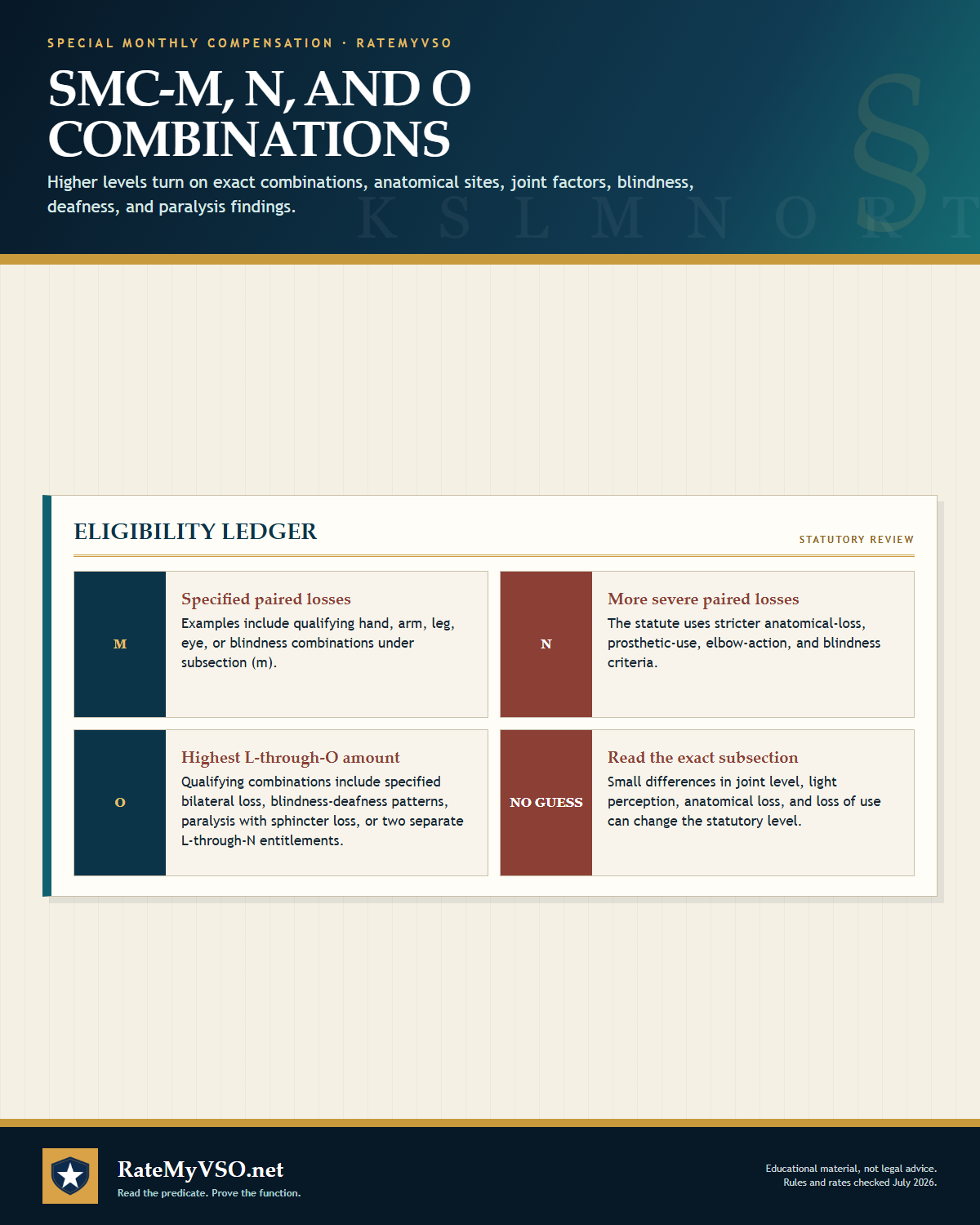
Visual guide: SMC-M, N, and O Combinations
The paired-loss and functional combinations for each level.
View full size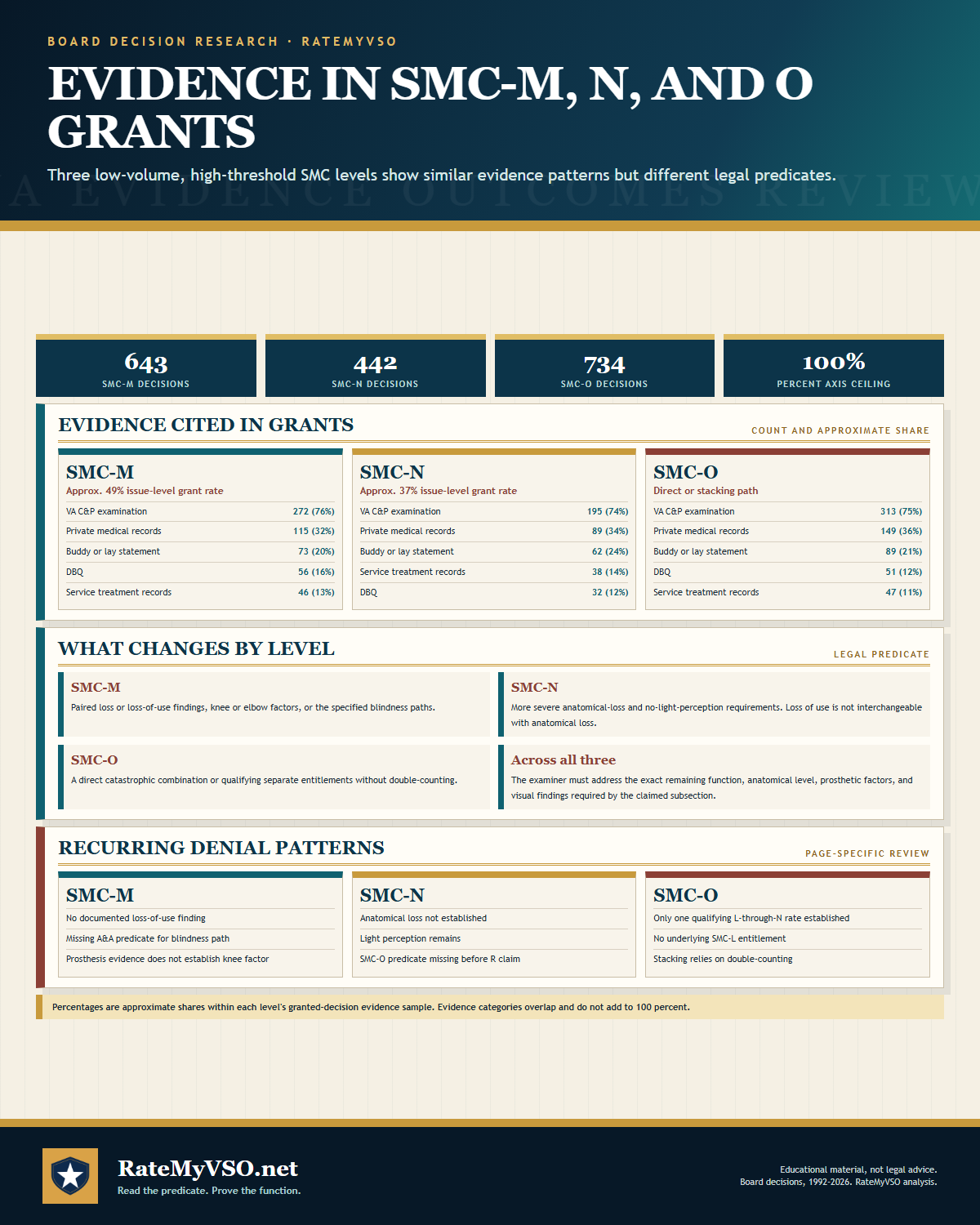
Visual guide: Evidence in SMC-M, N, and O Grants
Evidence cited in grants, each level's predicate and denial patterns.
View full sizeAuthority & Sources
- 38 USC § 1114, statutory rates including (o) and (p)
- 38 CFR § 3.350, qualifying conditions and stacking math
- VA.gov SMC rate table, current monthly amounts
BVA decisions are non-precedential under 38 CFR § 20.1303. Volume and pattern data above are from our internal index of BVA decisions and are reported as observed patterns, not as predictions of outcomes for any individual claim.