Two levels of care. Two rates.
SMC R-1 and R-2: Higher-Level Aid & Attendance
SMC R-1 and R-2 are the two highest-rate SMC tiers paid for in-home aid and attendance. They sit at the top of the L-through-R ladder. Authority: 38 USC § 1114(r), implemented at 38 CFR § 3.350(h).
Find the part that matters to you
Two levels of care. Start with yours.
Shortcuts into the guide, not an eligibility decision. Both tiers first require the predicate in the eligibility chapter.

Regular aid and attendance
The evidence for everyday personal-care help.
Read the R-1 evidence
A higher level of care
The evidence for daily personal health-care services in the home.
Read the R-2 evidenceCompare R-1 and R-2 Eligibility: the SMC-O or maximum SMC-P predicate
The complete reference
The details behind each topic.
All of the guidance is here. Open a section when you need it.
01What Is SMC-R?
Two sub-levels of higher aid and attendance.
SMC-R compensates veterans who are entitled to SMC-O, or to the maximum rate under 38 U.S.C. 1114(p), AND who additionally need aid and attendance. 38 CFR § 3.352(b)(1) names both predicates. It exists in two sub-levels:
- R-1: regular aid and attendance, the everyday help with bathing, dressing, feeding, and safety.
- R-2: daily personal health-care services in the home, either by someone licensed to provide them or by an unlicensed person, including a family member, working under the regular supervision of a licensed health-care professional.
R-1 and R-2 are not separate paths, R-2 is a step up from R-1 with a higher monthly rate, awarded when the care needed crosses from "personal-care assistance" into "medical care that requires licensed clinical training."
02Eligibility, the SMC-O Predicate
The SMC-O or maximum SMC-P predicate.
To be considered for SMC-R, a veteran must be entitled to SMC-O under 38 CFR § 3.350(e) or to the maximum rate under 38 U.S.C. 1114(p). Those are two separate doors, and the second one is easy to miss: § 3.352(b)(1)(i) names both. A veteran who reaches the maximum SMC-P rate through the intermediate-rate rules qualifies on the same footing as one at SMC-O. There is also a distinct route at § 3.350(h)(2) for a veteran paid at the intermediate rate between SMC-N and SMC-O plus SMC-K who establishes a factual need for aid and attendance.
SMC-O requires (any one):
- Anatomical loss / loss of use of both arms at a level preventing use of any prosthetic.
- Anatomical loss / loss of use of both legs with such complications.
- Bilateral blindness with both 5/200 or worse acuity AND service-connected need for regular A&A.
- Helpless paraplegia.
- Paralysis of both lower extremities together with loss of anal and bladder sphincter control.
The second door is the maximum rate under 38 U.S.C. 1114(p), reached through the intermediate-rate rules at § 3.350(f). Note what those rules actually turn on: specific paired anatomical losses, blindness combinations, a separate permanent disability independently ratable at 50 or 100 percent in a different body system, or loss of three extremities. A count of SMC-K awards is not itself a route to that rate.
03R-1 vs R-2, the Distinction
The level of care, not the caregiver's credential.
Per 38 CFR § 3.350(h)(2):
R-1 (Regular A&A)
The veteran needs regular aid and attendance from a non-skilled person. Family member, friend, or hired personal-care aide. Tasks: bathing, dressing, feeding, supervision, toileting.
Care does not require medical training to perform.
R-2 (Higher Level of Care)
The veteran needs daily personal health-care services in the home: ventilator management, IV medication, complex wound care, suctioning of a tracheostomy, peritoneal dialysis. What matters is the level of care, not who holds the license. Under § 3.352(b)(3) the care can come from a licensed provider or from someone working under the regular supervision of one.
Care requires licensed medical training to perform.
The bar between R-1 and R-2 is the level of care, not the caregiver's credential: would this task require professional health-care training, or the regular supervision of someone with it, to perform safely? If yes, R-2 is in play.
04R-1 Evidence Pattern
What documents regular aid and attendance.
VA Form 21-2680 completed by the treating physician, plus:
- Caregiver statement describing daily personal-care tasks performed.
- Records of home-health-aide services (if hired).
- Treatment records establishing the underlying SMC-O condition (paralysis, bilateral amputation, etc.).
05R-2 Evidence Pattern
What documents the higher level of care.
R-2 requires evidence that licensed clinical care is needed, not just personal care. Specifically:
- Treating physician's order for skilled-nursing services in the home (SNF-level care delivered at home).
- Home-health-agency records documenting RN/LPN visits with skilled tasks (medication administration, wound dressing changes, ventilator monitoring, IV management).
- Insurance / Medicare authorizations for skilled-nursing home care (these often correlate with R-2 eligibility).
- Pharmacy records for medications requiring clinical administration (IV antibiotics, parenteral nutrition).
06Illustrative Examples
Fictional scenarios to illustrate the guidance.
Fictional examples, not real claimants. Names and facts are invented to show how the SMC-R-1 and SMC-R-2 criteria could apply in single cases.
SMC-R-1 example. George H. is a Korean War Army veteran. A service-connected stroke left him with right-side paralysis, and he is also legally blind in both eyes from a separate service-connected condition. Together these put him at SMC-O. On top of that, he needs daily help bathing, eating, dressing, and managing his medications, help that his wife can safely provide without medical training. George qualifies for SMC-R-1 at approximately $9,827 per month because he meets the SMC-O criteria AND needs regular aid and attendance under 38 CFR § 3.350(h)(1).
SMC-R-2 example. Patricia W. is a post-9/11 Air Force veteran with severe TBI from a roadside blast in Afghanistan. The combination of her service-connected conditions puts her at SMC-O. Her care needs go beyond what a family member can safely handle, she requires daily tube feeding, catheter management, and seizure monitoring, performed by a licensed nurse who comes to her home for several hours each day. Patricia qualifies for SMC-R-2 at approximately $11,272 per month because she meets SMC-O AND requires "higher-level" aid and attendance from a trained health-care provider, the standard set in 38 CFR § 3.352(b).
072026 Monthly Rates
The approximate 2026 amount for each tier.
Approximate 2026 rates (single veteran, no dependents):
- SMC-R-1: ~$9,827/month
- SMC-R-2: ~$11,272/month
For comparison, SMC-L is $4,900.83 and SMC-O is $6,877.12 (2026 rates, veteran alone). The R-1/R-2 jump reflects the clinical care intensity. Rates set by VA each December 1 alongside COLA-adjusted compensation rates.
08SMC-R vs SMC-T (TBI)
The same rate as R-2, with different criteria.
SMC-T pays the same rate as SMC-R-2 but is awarded only for traumatic brain injury requiring care that would otherwise require institutionalization. See 38 USC § 1114(t) and SMC-T TBI Guide. Veterans with TBI requiring this level of care should claim SMC-T regardless of R-2 eligibility, the criteria are different and SMC-T does not require the SMC-O predicate.
09How to File
The predicate, the forms and the care records.
- Establish the predicate: entitlement to SMC-O, or to the maximum rate under 38 U.S.C. 1114(p). Without one of those, SMC-R is not awardable.
- File VA Form 21-526EZ identifying the SMC-R claim, specifying R-1 or R-2 with evidence appropriate to the level.
- Submit VA Form 21-2680 and treating physician statements documenting the level of care required.
- For R-2: document the care itself and its supervision. A professional's written regimen of the personal health-care services needed, a record of the monthly consultations monitoring it (a phone call counts), and, where applicable, skilled-nursing care plans, visit logs, or discharge orders requiring continued home care. If a family member provides the care, say so plainly and show the prescribed regimen and the monthly check-ins.
10Common Mistakes
Where SMC-R claims go wrong.
- Filing for SMC-R without SMC-O. The predicate requirement is non-negotiable. Establish SMC-O first.
- Assuming you are out because the caregiver is family. R-2 turns on the level of care, not the caregiver's license. If a spouse or relative performs the prescribed personal health-care services under a professional's regimen with a monthly check-in, that can meet § 3.352(b)(4). What sinks these claims is missing documentation of the regimen and the supervision, not the absence of an RN.
- Claiming R-2 with R-1-level evidence. R-2 needs evidence that the care rises to personal health-care services requiring professional training or supervision, not just help with bathing, dressing, and meals. Without that, VA pays R-1.
- Forgetting SMC-T as an alternative for TBI. If the underlying cause is TBI requiring institutional-equivalent care, SMC-T may be cleaner, same rate, different (no SMC-O predicate) criteria.
- Not claiming intermediate-rate SMC under § 3.350(f). Multiple SMC-K losses combined with 100% schedular can mathematically reach SMC-O, opening SMC-R eligibility.
11What Published Board Decisions Show About R-2 Care
Care patterns in published R-2 decisions.
We analyzed all 217 published Board decisions ruling on SMC-R-2: 120 granted, 97 denied (AI-assisted extraction, hand-checked, August 2026; universe confirmed against the production database). The licensed-care standard is what separates the two piles. Each percentage below is the share of decisions in that outcome group whose record showed the care pattern named.
In 50 of the 97 denials (52%), the Board said no specifically because the care was not licensed or professionally supervised, not because the veteran needed less help.
The family path that wins: the single most common care arrangement in R-2 grants, 46 of the 120, was an unlicensed carer, usually a spouse, performing personal health-care services under a professional's prescribed regimen with at least monthly check-ins (see 38 CFR § 3.352(b)(4)). The winning records documented the regimen and the check-ins, not a nursing license.
Care needs the Board discussed
Share of decisions in each outcome group whose text discussed the care need. 120 granted, 97 denied.
Evidence the Board cited, and how it received it
| Evidence | Cited, grants | Grants: relied / mentioned / discounted | Cited, denials | Denials: relied / mentioned / discounted |
|---|---|---|---|---|
| Treatment records | 79% | 217 / 70 / 4 | 73% | 95 / 103 / 10 |
| VA exam | 72% | 136 / 26 / 22 | 70% | 108 / 33 / 20 |
| Lay statements | 67% | 103 / 15 / 3 | 67% | 35 / 52 / 31 |
| VA Form 21-2680 | 32% | 41 / 3 / 1 | 29% | 27 / 4 / 5 |
| Private medical opinion | 31% | 39 / 10 / 1 | 29% | 21 / 8 / 11 |
| Caregiver program records | 15% | 24 / 2 / 1 | 9% | 7 / 10 / 1 |
| Nursing assessment | 11% | 15 / 2 / 0 | 6% | 3 / 3 / 4 |
The lay-statement row is the sharpest split in the table: in grants the Board relied on lay statements 103 times and discounted 3; in denials it relied 35 times against 52 merely mentioned and 31 discounted.
Institutional-care finding: the Board found care at home was preventing institutional care in 30 of 120 grants and 11 of 97 denials; it found the opposite in 70 grants and 54 denials, and did not address it in the rest.
Source: published Board of Veterans' Appeals decisions ruled on SMC-R-2, decision grain (evidence-reception counts are item grain), extracted August 2026; universe confirmed against the production database on August 13, 2026. Published decisions are a selected sample; these shares report what those records contained, not any individual claim's odds.
A different way to take it in
Two guides to keep close.
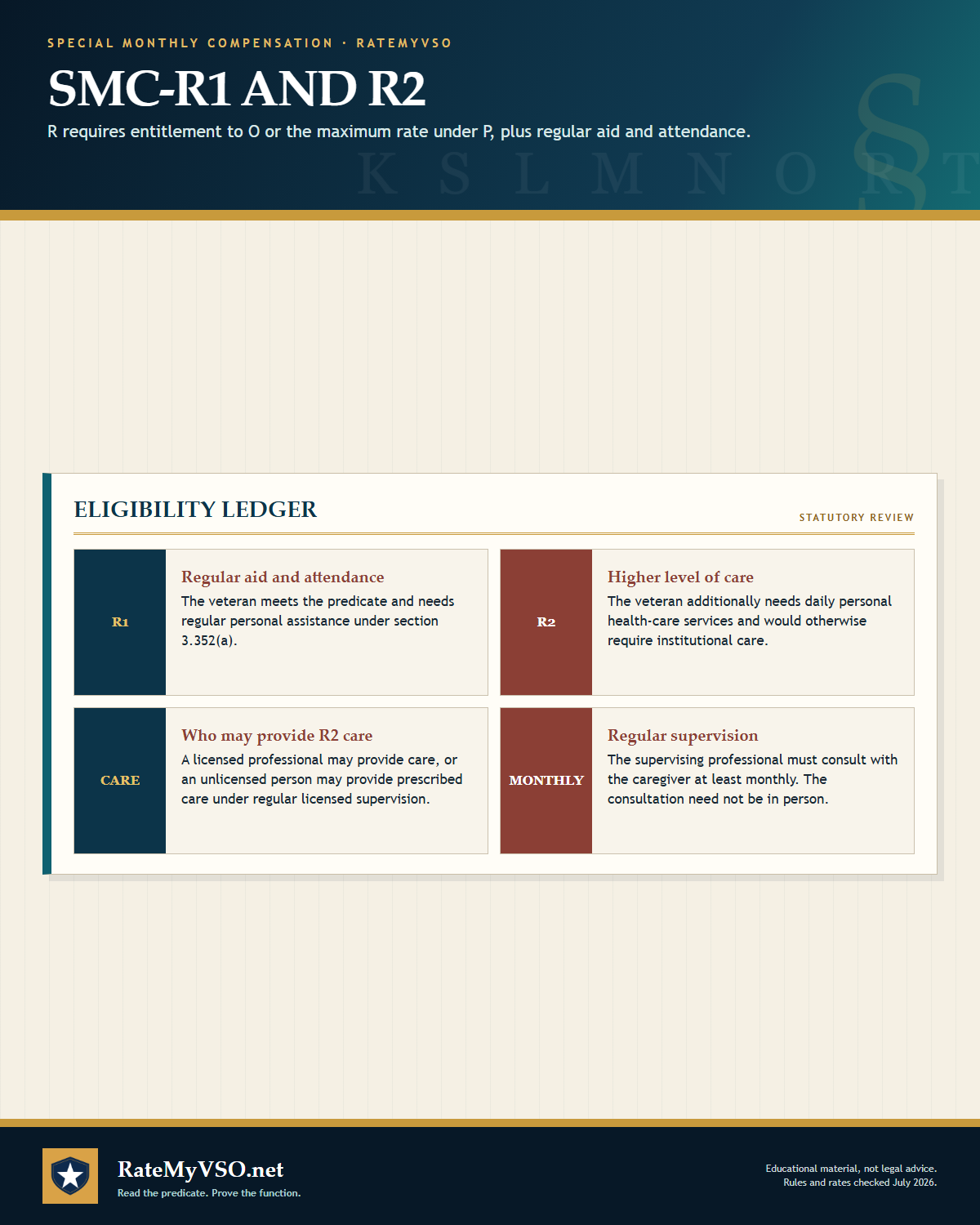
Visual guide: SMC-R1 and R2
The predicates, care needs, eligible caregivers and supervision for each tier.
View full size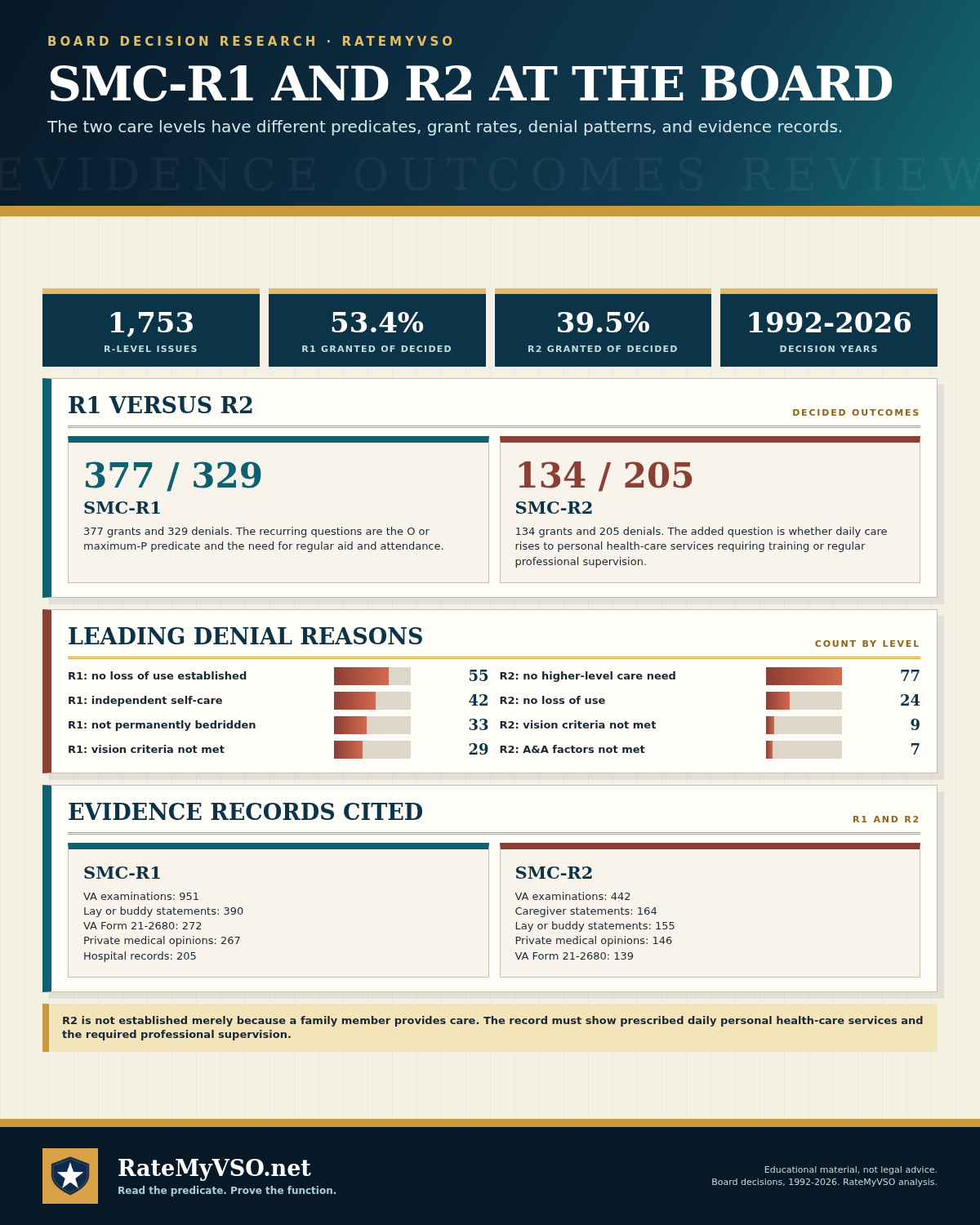
Visual guide: SMC-R1 and R2 Board Outcomes
Separate Board outcomes for each care level, with denial reasons and cited evidence.
View full sizeThe published Board record
What the appealed cases show.
Patterns to understand, not odds for your own claim.

The live Board outcome figures for SMC-R1 and SMC-R2 appear here when they are available. They are also published on SMC Appeals Data, linked in the related guides below.
This page is educational and is not legal advice. SMC-R claims are clinically and legally complex, work with a VA-accredited representative.