C&P Exam Prep Guide for Irritable bowel syndrome (DC 7319)
YOUR EXAM BLUEPRINT
Irritable bowel syndrome
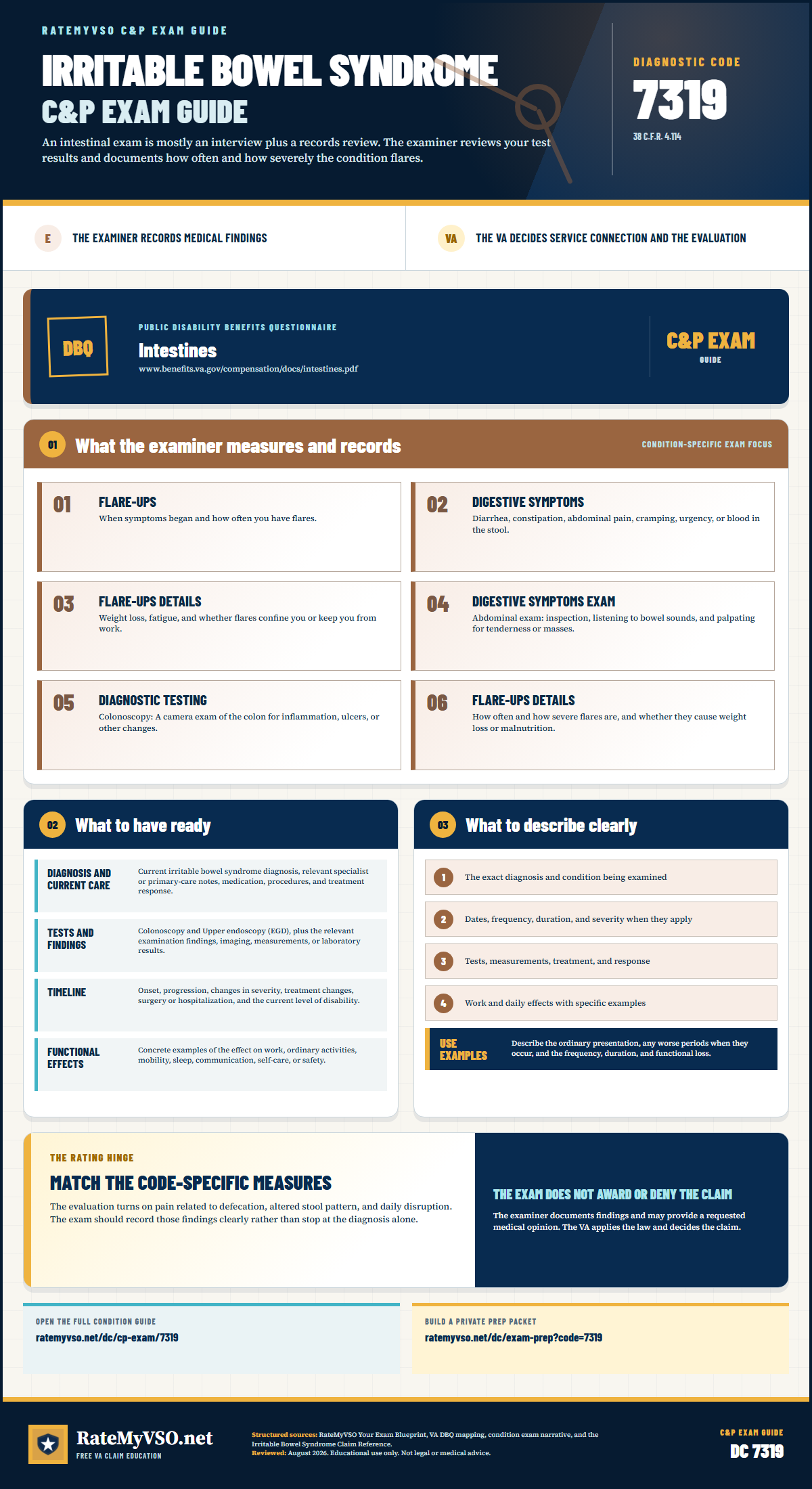
An intestinal exam is mostly an interview plus a records review. The examiner reviews your test results and documents how often and how severely the condition flares.
DBQ used for this condition
- PPublic formDBQ GI IntestinesOpen the public DBQ
What the examination is likely to focus on
Functional-impact topics to describe
- How often and how severe flares are, and whether they cause weight loss or malnutrition.
- Whether the condition keeps you from working during flares.
- Findings map to the tiers in 38 CFR 4.114 (IBS DC 7319; ulcerative colitis DC 7323; Crohn's DC 7326).
Which form the examiner uses
For irritable bowel syndrome (DC 7319), the C&P examiner completes the following Disability Benefits Questionnaire (DBQ):
- DBQ GI Intestines (public PDF on VA.gov)
DBQs are Department of Veterans Affairs Form 21-0960 series documents. Public DBQs are hosted on benefits.va.gov. A handful are examiner-only and are not posted publicly.
What to expect at your C&P exam
An intestinal exam is mostly an interview plus a records review. The examiner reviews your test results and documents how often and how severely the condition flares.
1Initial interview (history)
- When symptoms began and how often you have flares.
- Diarrhea, constipation, abdominal pain, cramping, urgency, or blood in the stool.
- Weight loss, fatigue, and whether flares confine you or keep you from work.
- Diet, medications, surgeries, and any ostomy.
- Hospitalizations or ER visits for the condition.
2Physical examination
- Abdominal exam: inspection, listening to bowel sounds, and palpating for tenderness or masses.
- Checking weight and signs of malnutrition or anemia.
3Diagnostic tests the examiner may rely on
Usually already in your records. The examiner reviews them to confirm the diagnosis and severity.
4Functional assessment
- How often and how severe flares are, and whether they cause weight loss or malnutrition.
- Whether the condition keeps you from working during flares.
- Findings map to the tiers in 38 CFR 4.114 (IBS DC 7319; ulcerative colitis DC 7323; Crohn's DC 7326).
Test explainers open MedlinePlus (NIH National Library of Medicine), or Wikipedia where MedlinePlus has no matching page. This describes what happens and what is measured, not how to influence a result.
What the examiner records (full DBQ form)
The fields below are reproduced from the DBQ form the examiner completes for this diagnostic code. This is the structural map of the form, showing what the examiner is asked to measure, observe, and record. It is a factual reproduction of the public DBQ, not advice on how to answer.
This DBQ evaluates intestinal conditions including irritable bowel syndrome, inflammatory bowel disease, diverticular disease, intestinal resections, and other intestinal disorders.
How DC 7319 maps to this DBQ: for this diagnostic code specifically, the examiner typically completes sections I-III and XV-XVIII of this form. Section III is the condition-specific section for this code. Sections IV-XIV cover unrelated conditions on this DBQ and are skipped.
DIAGNOSIS (Section I)
- 1A. List the claimed condition(s) that pertain to this questionnaire
- 1B. Select diagnoses associated with the claimed condition(s) (check all that apply): The Veteran does not have a current diagnosis associated with any claimed condition(s) listed above.
- Irritable bowel syndrome - ICD Code / Date of diagnosis
- Functional digestive disorder(s) (if checked, specify) - ICD Code / Date of diagnosis
- Inflammatory bowel disease: Ulcerative colitis - ICD Code / Date of diagnosis
- Inflammatory bowel disease: Crohn's disease - ICD Code / Date of diagnosis
- Inflammatory bowel disease: Undifferentiated form of inflammatory bowel disease - ICD Code / Date of diagnosis
- Chronic enteritis - ICD Code / Date of diagnosis
- Diverticular disease: Diverticulitis - ICD Code / Date of diagnosis
- Diverticular disease: Diverticulosis - ICD Code / Date of diagnosis
- Chronic complications of small intestine surgery (without resection) (including bariatric surgery) (if checked, specify) - ICD Code / Date of diagnosis
- Resection of small intestine (select one if known) - ICD Code / Date of diagnosis
- Short bowel syndrome - ICD Code / Date of diagnosis
- Mesenteric ischemic thrombosis - ICD Code / Date of diagnosis
- Post-bariatric surgery - ICD Code / Date of diagnosis
- Resection of large intestine - ICD Code / Date of diagnosis
- External intestinal fistulous disease - ICD Code / Date of diagnosis
- Celiac disease - ICD Code / Date of diagnosis
- Gastrointestinal dysmotility syndrome - ICD Code / Date of diagnosis
- Visceroptosis (downward displacement of the abdominal viscera) - ICD Code / Date of diagnosis
- Malignant intestinal neoplasm (if checked, specify) - ICD Code / Date of diagnosis
- Benign intestinal neoplasm (if checked, specify) - ICD Code / Date of diagnosis
- Peritoneal adhesions - ICD Code / Date of diagnosis
- Other intestine condition(s) (if checked, specify): Other diagnosis #1 - ICD Code / Date of diagnosis
- Other intestine condition(s) (if checked, specify): Other diagnosis #2 - ICD Code / Date of diagnosis
- 1C. If there are additional diagnoses that pertain to intestine conditions, list using above format and complete the section(s) that best approximates the disability picture
MEDICAL HISTORY (Section II)
- 2A. Describe the history, including onset and course, of the Veteran's intestine condition(s). Brief summary
- 2B. Does the Veteran's treatment plan include taking daily prescribed medication for the diagnosed condition(s)?
- If yes, list only those medications used for the diagnosed condition(s)
IRRITABLE BOWEL SYNDROME (Section III)
- 3A. Does the Veteran have irritable bowel syndrome, chronic enteritis, functional digestive disorder, or a similar condition?
- 3B. Frequency of abdominal pain related to defecation during the previous 3 months: None / At least once / At least 3 days per month / At least 1 day per week
- 3C. Signs or symptoms (check all that apply): Change in stool frequency
- Change in stool form
- Altered stool passage (straining and/or urgency)
- Mucorrhea
- Abdominal bloating
- Subjective distention
- Other, specify
INFLAMMATORY BOWEL DISEASE (Section IV)
- 4A. Does the Veteran have Crohn's disease, ulcerative colitis, undifferentiated form of inflammatory bowel disease, chronic enteritis, or a similar condition?
- Managed with oral or topical agents (other than immunosuppressants or other biologic agents (if checked, list medication(s))
- Managed on an outpatient basis with immunosuppressants or other biologic agents (if checked, list medication(s))
- Unresponsive to treatment
- Requires hospitalization at least once per year (if checked, give date and name of hospital for each recent hospitalization if known)
- Results in an inability to work (if checked, discuss how condition impacts ability to work)
- Recurrent abdominal pain
- Daily diarrhea (if checked, indicate frequency): 3 or less episodes / 4-5 episodes / 6 or more episodes
- No signs of systemic toxicity (such as fever, tachycardia, or anemia)
- Signs of toxicity such as fever, tachycardia, or anemia (Check all that apply): Minimal / Intermittent / Fever / Tachycardia / Anemia / Other, specify
- Recurrent abdominal distention
- Recurrent episodes of rectal incontinence
- Six or more episodes per day of rectal bleeding
- Resulting in colectomy or colostomy (also complete Section VI and Section IX)
- Peritoneal adhesions (also complete Peritoneal Adhesions questionnaire)
- Other, specify
DIVERTICULAR DISEASE (Section V)
- 5A. Does the Veteran have diverticular disease or a similar condition?
- Asymptomatic
- Managed by diet and medication
- Diverticular disease requiring hospitalization one or more times in the past 12 months (if checked, give date(s) and name of hospital(s) if known)
- Indicate reason(s) for hospitalization below, check all that apply: Abdominal distress / Fever / Leukocytosis (elevated white blood cells) / Other, specify
- Diverticular disease complications (check all that apply): Hemorrhage / Obstruction / Abscess / Peritonitis / Perforation / Other, specify
- Peritoneal adhesions (also complete Peritoneal Adhesions questionnaire)
- Resulting in colectomy or colostomy (also complete Section VI and Section IX)
SURGICAL PROCEDURE(S) (Section VI)
- 6A. Did the Veteran have surgery for an intestinal condition(s) (including bariatric surgery)? (If yes, give surgery type(s) and date(s))
- Surgery type
- Surgery date
CHRONIC COMPLICATIONS OF SMALL INTESTINE SURGERY (WITHOUT RESECTION) (Section VII)
- 7A. Does the Veteran have chronic complications of small intestine surgery (without resection) (including bariatric surgery)?
- Post-operative, asymptomatic
- Requiring continuous total parenteral nutrition (TPN) for a period longer than 30 consecutive days in the last six months - Start date of TPN / Completion date of TPN or anticipated date of completion
- Requiring continuous tube feeding for a period longer than 30 consecutive days in the last six months - Start date of tube feeding / Completion date of tube feeding or anticipated date of completion
- Vomiting (if checked, indicate frequency and if managed by medical treatment, oral dietary modification, or medication): Frequency: Less than 2 times a week / 2 or more times a week / Daily
- Treatment: No treatment / Managed by ongoing medical treatment / Vomiting despite medical treatment: Oral dietary modification / Medication / Other (specify)
- Watery bowel movements (if checked, indicate frequency): Less than 3 per day every day / 3-5 per day every day / 6 or more per day every day
- Explosive bowel movements that are difficult to predict or control
- Nausea (if checked, indicate if managed by medical treatment): Managed by ongoing medical treatment? Yes / No
- Post-prandial (meal-induced) light-headedness (syncope) with sweating
- Requirement for medications to specifically treat complications of upper GI surgery including dumping syndrome or delayed gastric emptying
- Peritoneal adhesions (Also complete Peritoneal Adhesions questionnaire)
- Discomfort or pain within an hour of eating and requiring ongoing oral dietary modification
- Other symptoms, specify
RESECTION OF SMALL INTESTINE (Section VIII)
- 8A. Did the Veteran have resection of the small intestine (including bariatric surgery, short bowel syndrome, or mesenteric ischemic thrombosis) or currently have celiac disease with malabsorption?
- Status post resection, asymptomatic
- Four or more episodes of diarrhea per day
- Undernutrition (see note above)
- Anemia
- Requiring continuous medication
- Requiring prescribed oral dietary supplementation
- Requiring total parenteral nutrition (TPN) (If checked, indicate frequency): Intermittent / Continuous
- Short bowel syndrome that results in high-output syndrome, to include a high-output stoma (also complete Section IX)
- Peritoneal adhesions (also complete appropriate Peritoneal Adhesions questionnaire)
- Other symptoms, specify
RESECTION OF LARGE INTESTINE (Section IX)
- 9A. Did the Veteran have resection of the large intestine and/or resection of the small intestine with short bowel syndrome that results in high-output syndrome, to include a high-output stoma?
- Colectomy (if checked, indicate if partial or total): Partial / Total
- Permanent colostomy
- Reanastomosis (reconnection of the intestinal tube)
- Loss of ileocecal valve
- Recurrent episodes of diarrhea (if checked, indicate frequency): Less than 4 times per day / 4 or more times per day
- Without high-output syndrome
- With high-output syndrome
- Formation of ileostomy
- More than 2 episodes of dehydration requiring intravenous hydration in the past 12 months (if checked, provide dates and location(s) if known)
- Peritoneal adhesions (also complete Peritoneal Adhesions questionnaire)
- Other symptoms, specify
EXTERNAL INTESTINAL FISTULOUS DISEASE (Section X)
- 10A. Does the Veteran have external intestinal fistulous disease?
- Intermittent fecal discharge
- Persistent drainage in the past 12 months (if checked, indicate frequency): more than 1 month / more than 2 months / more than 3 months
- Daily discharge (if checked, indicate volume): Equivalent to 3 or less ostomy bags (130 cc) / Equivalent to 4 or more ostomy bags (130 cc)
- Requiring pad changes (if checked, indicate frequency): Fewer than 10 pad changes per day / 10 or more pad changes per day
- Body Mass Index (BMI) of 16 to 18 inclusive
- BMI of less than 16
- Requiring enteral nutrition (tube feeding)
- Requiring total parenteral nutrition (TPN)
- Other symptoms, specify
CELIAC DISEASE (Section XI)
- 11A. Does the Veteran have celiac disease or a similar condition?
- Asymptomatic
- Malabsorption syndrome that causes chronic diarrhea managed by medically-prescribed dietary intervention such as prescribed gluten-free diet
- Malabsorption syndrome that causes weakness which interferes with activities of daily living (if checked, discuss how weakness interferes with activities of daily living)
- Without nutritional deficiencies
- With nutritional deficiencies due to lactase and pancreatic insufficiency
- Episodes of abdominal pain and diarrhea due to lactase or pancreatic insufficiency
- Systemic manifestations (check all that apply): Weakness and fatigue / Dermatitis / Lymph node enlargement / Hypocalcemia / Low vitamin levels / Other, specify
- Atrophy of the inner intestinal lining shown on biopsy (discuss biopsy in Section XVI)
- Weight loss resulting in wasting and nutritional deficiencies
- Anemia related to malabsorption
- Other symptoms, specify
GASTROINTESTINAL DYSMOTILITY SYNDROME (Section XII)
- 12A. Does the Veteran have gastrointestinal dysmotility syndrome, functional digestive disorder, or a similar condition?
- Without evidence of structural gastrointestinal disease
- Abdominal pain (if checked, indicate if intermittent below): Intermittent
- Feeling of epigastric fullness
- Bloating
- Dyspepsia
- Nausea (if checked, indicate if recurrent below): Recurrent
- Vomiting (if checked, indicate if recurrent below): Recurrent
- Regurgitation
- Constipation
- Diarrhea
- Other symptom(s) of intestinal dysmotility disorder (specify)
- Symptoms of chronic intestinal pseudo-obstruction (CIPO) (specify)
- Treatment: Symptoms managed by ambulatory care
- Requiring prescribed dietary management or manipulation
- Recurrent emergency treatment for episodes of intestinal obstruction or regurgitation due to poor gastric emptying, abdominal pain, recurrent nausea, or recurrent vomiting - If checked, provide date(s) and location(s) if known
- Requiring tube feeding for nutritional support (if checked, indicate if intermittent or continuous): Intermittent / Continuous
- Requiring complete dependence on total parenteral nutrition (TPN)
VISCEROPTOSIS (Section XIII)
- 13A. Does the Veteran have visceroptosis?
- If yes, indicate if asymptomatic or symptomatic: Asymptomatic / Symptomatic
- Identify symptoms below
- 13B. Is the visceroptosis marked?
TUMORS AND NEOPLASMS (Section XIV)
- 14A. Does the Veteran currently have, or has had, a benign or malignant neoplasm or metastases related to any condition in the diagnosis section?
- 14B. Is the neoplasm: Benign / Malignant
- If malignant: Active / In remission
- Primary / Secondary (metastatic) (if secondary, indicate the primary site, if known)
- 14C. Has the Veteran completed treatment or is the Veteran currently undergoing treatment for a benign or malignant neoplasm or metastases? Yes / No; watchful waiting
- Treatment completed
- Surgery - If checked, describe / Date(s) of surgery
- Radiation therapy - Date of most recent treatment / Date of completion of treatment or anticipated date of completion
- Antineoplastic chemotherapy - Date of most recent treatment / Date of completion of treatment or anticipated date of completion
- Other therapeutic procedure - If checked, describe procedure / Date of most recent procedure
- Other therapeutic treatment - If checked, describe treatment / Date of completion of treatment or anticipated date of completion
- 14D. Does the Veteran currently have any residuals or complications due to the neoplasm (including metastases) or its treatment, other than those already documented in the report above?
- If yes, list residuals or complications (brief summary), and also complete the appropriate questionnaire
- 14E. If there are additional benign or malignant neoplasms or metastases related to any of the diagnoses in the diagnosis section, describe using the above format
OTHER PERTINENT PHYSICAL FINDINGS, COMPLICATIONS, CONDITIONS, SIGNS, SYMPTOMS, AND SCARS (Section XV)
- 15A. Does the Veteran have any other pertinent physical findings, complications, conditions, signs or symptoms related to any conditions listed in the diagnosis section above?
- If yes, describe (brief summary)
- 15B. Does the Veteran have any scars or other disfigurement (of the skin) related to any conditions or to the treatment of any conditions listed in the diagnosis section?
DIAGNOSTIC TESTING (Section XVI)
- 16A. Have clinically relevant diagnostic imaging studies or other diagnostic procedures been performed or reviewed in conjunction with this examination?
- Endoscopy - Date / Results
- Radiographic study(ies): MRI - Date / Results
- Computed tomography (CT) scan - Date / Results
- Other radiographic study, specify - Date / Results
- Biopsy, specify site - Date / Results
- Other diagnostic test, specify - Date / Results
- 16B. Has clinically relevant laboratory testing been performed or reviewed in conjunction with this examination?
- CBC - Date of test / Hemoglobin / Hematocrit / White blood cell count / Platelets
- Serum antibody test, specify - Date of test / Results
- Other lab test, specify - Date of test / Results
- 16C. Are there any other clinically relevant diagnostic test findings or results related to the claimed condition(s) and/or diagnosis(es), that were reviewed in conjunction with this examination? - If yes, provide type of test or procedure, date and results (brief summary)
- 16D. If any test results are other than normal, indicate relationship of abnormal findings to diagnosed condition
FUNCTIONAL IMPACT (Section XVII)
- 17A. Regardless of the Veteran's current employment status, do the conditions listed in the diagnosis section impact his/her ability to perform any type of occupational task (such as standing, walking, lifting, sitting, etc.)?
- If yes, describe the functional impact of each condition, providing one or more examples
REMARKS (Section XVIII)
- 18A. Remarks (if any - please identify the section to which the remark pertains when appropriate)
Rating Levels for DC 7319
The following tiers are reproduced from 38 CFR Part 4, the VA Schedule for Rating Disabilities. Toggle between the official VA criteria and a Plain English explanation.
Plain-English summaries are AI-generated to explain the official criteria. The official 38 CFR language is the binding legal standard. When in doubt, ask a VSO.
Evidence cited in published BVA decisions for DC 7319
The counts below are aggregated from published Board of Veterans Appeals decisions for this diagnostic code, among issues the Board granted or denied (remanded issues are not included). Each row reports how often a given evidence type was discussed in the decision text, broken down by outcome. This is a factual aggregate of the public record, not a prediction or recommendation about any specific claim.
- Service treatment records: appeared in 1880 granted decisions (2801 denied; 4681 decided total)
- Buddy / lay statements: appeared in 1473 granted decisions (1775 denied; 3248 decided total)
- Medical literature: appeared in 203 granted decisions (206 denied; 409 decided total)
What the Board discussed in granted decisions for DC 7319
The themes below were extracted by clustering 500 grant-factor sentences from published Board of Veterans Appeals decisions for this diagnostic code. Frequencies indicate how often each theme appeared in the sample. This is a factual aggregate of the public record, not advice or strategy for any specific claim.
- 32% Benefit of the doubt doctrine stated or applied generallyThe Board cited the statutory benefit-of-the-doubt rule, noting that when positive and negative evidence is in approximate balance the claimant prevails, without tying the statement to a specific IBS finding.162 of 500 sample sentences
- 13% Preponderance of evidence against claim; benefit of the doubt inapplicableThe Board found that the persuasive weight of evidence was against the Veteran's IBS or related claim and therefore held that the benefit-of-the-doubt doctrine did not apply.67 of 500 sample sentences
- 10% Medical nexus opinion citing IBS or GI condition as service-relatedA VA or private examiner opined that it was at least as likely as not that the Veteran's IBS or gastrointestinal condition was incurred in, caused by, or related to active military service.52 of 500 sample sentences
- 9% Evidence found in equipoise supporting IBS or GI service connectionThe Board found the lay and medical evidence at least in relative equipoise on whether the Veteran's IBS or gastrointestinal disability was incurred in or related to service, triggering a grant.47 of 500 sample sentences
- 6% Benefit of the doubt applied to IBS rating level warrantedThe Board resolved benefit-of-the-doubt in the Veteran's favor to find that IBS symptoms more nearly approximated a higher rating level, such as moderate or severe under Diagnostic Code 7319.28 of 500 sample sentences
- 4% Secondary nexus opinion linking IBS to service-connected condition or medicationAn examiner opined that the Veteran's IBS or bowel condition was at least as likely as not caused or aggravated by a service-connected disability or its prescribed medications.22 of 500 sample sentences
- 4% Examiner request or remand order for at-least-as-likely-as-not IBS opinionThe Board or AOJ directed an examiner to opine whether an IBS or gastrointestinal condition was at least as likely as not incurred in, caused by, or related to service or a service-connected disability.22 of 500 sample sentences
- 4% Board applied benefit of the doubt to specific rating period or effective dateResolving reasonable doubt in the Veteran's favor, the Board assigned or extended a specific disability rating percentage for a defined period on appeal for an IBS or bowel disability.21 of 500 sample sentences
- 3% Persian Gulf War undiagnosed illness or MUCMI basis for IBS grantThe Board found IBS or chronic GI symptoms qualified as a medically unexplained chronic multisymptom illness or undiagnosed illness related to Gulf War or Southwest Asia service, supporting a grant.14 of 500 sample sentences
- 3% Credible lay evidence and symptom continuity noted in IBS or GI determinationThe Board noted the Veteran's credible lay statements regarding persistent IBS or gastrointestinal symptoms since service as a factor in finding the evidence in equipoise or supporting the claim.13 of 500 sample sentences
- 2% Benefit of the doubt applied to TDIU or unemployability findingThe Board applied the benefit-of-the-doubt doctrine to find that service-connected disabilities, including IBS, rendered the Veteran unable to secure or follow substantially gainful employment.8 of 500 sample sentences
- 1% Negative nexus opinion or inadequate opinion noted in IBS determinationThe Board noted an examiner's negative or inadequate nexus opinion regarding IBS or a gastrointestinal condition as part of the evidentiary weighing process.6 of 500 sample sentences
When the Board found the exam inadequate (DC 7319)
In 3,110 published Board of Veterans' Appeals decisions involving this condition, the Board found a C&P examination or medical opinion inadequate. Where the defect could be read from the decision, it was most often one of the following (counts are a floor from the decisions on file, not a total):
- 960 Failed to address a contention or part of the condition
- 769 Conclusion given without a supporting rationale
- 603 Veteran's lay statements not considered
- 225 Opinion relied on the absence of records instead of the evidence
- 142 Claims file or records not reviewed
- 113 Flare-ups or functional loss not addressed
- 92 Examiner said an opinion would require speculation
- 36 Exam too old to reflect current severity
- 25 Wrong legal standard or question applied
An inadequate exam is usually sent back for a new one rather than decided against the veteran. This is a factual report of published decisions, not advice about any exam or claim; whether an exam is adequate is decided case by case.
Disclaimer: This page reproduces public Department of Veterans Affairs forms (DBQs) and verbatim text from 38 CFR Part 4 (the VA Schedule for Rating Disabilities). It is informational only and is not legal or medical advice. For guidance on a specific claim, contact a VA-accredited representative.