Military Sexual Trauma (MST) Claims
This guide explains how the VA evaluates claims related to military sexual trauma, including sexual assault and sexual harassment during service. You will learn how MST claims work differently from other claims, including the relaxed evidence standard that lets "markers" (behavioral changes, medical visits, performance declines, counseling records) support a claim even when the event was never officially reported. It covers how MST links to PTSD, depression, anxiety, and other mental health conditions, and how the VA rates them under 38 CFR § 4.130. You will also find how to file, what evidence the VA accepts, how trauma-informed C&P exams work, and what to expect during the decision. Whether you are filing for the first time or appealing a denial, this guide shows you how MST claims are evaluated and what evidence supports a strong outcome.

If you or someone you know is in crisis:
Veterans Crisis Line · 24/7 · Confidential
Vet Center Counseling: 877-927-8387
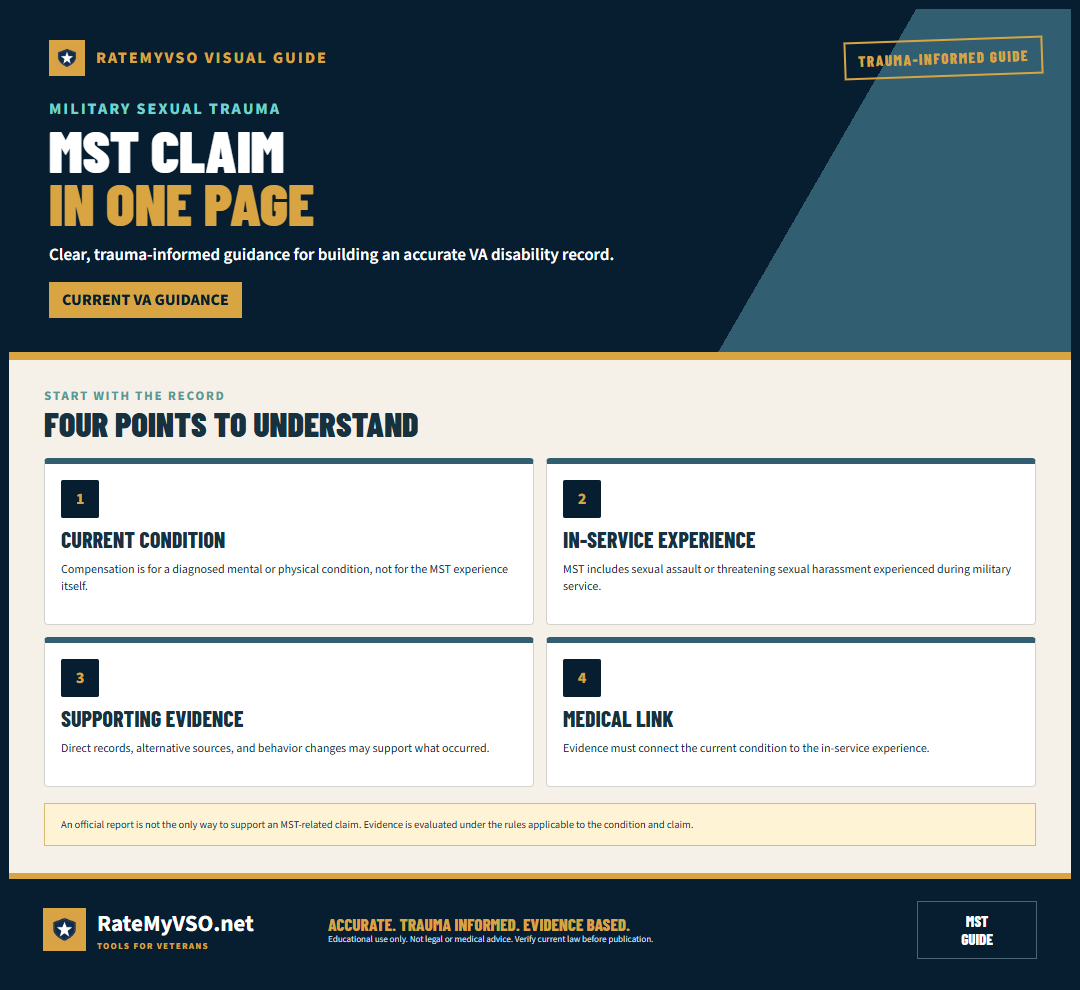 One-page guide: MST Claim in One Page
Five-part visual guide to an MST-related VA disability claim covering the current condition, in-service experience, direct and alternative evidence, behavioral markers, medical relationship, examination framework, and pre-filing checklist. Opens the full-size chart, free to save or print.
One-page guide: MST Claim in One Page
Five-part visual guide to an MST-related VA disability claim covering the current condition, in-service experience, direct and alternative evidence, behavioral markers, medical relationship, examination framework, and pre-filing checklist. Opens the full-size chart, free to save or print.
What Is MST?
Military Sexual Trauma (MST) is the VA's term for sexual assault or repeated, threatening sexual harassment that occurred during military service. MST is not a diagnosis, it is a stressor event. You do not file a claim for "MST." You file for the conditions MST caused - most commonly PTSD, depression, or anxiety.
The legal framework is 38 CFR § 3.304(f)(5), which establishes a relaxed evidentiary standard specifically for personal assault claims, including MST. This means the VA cannot require the same level of proof it requires for other types of PTSD claims.
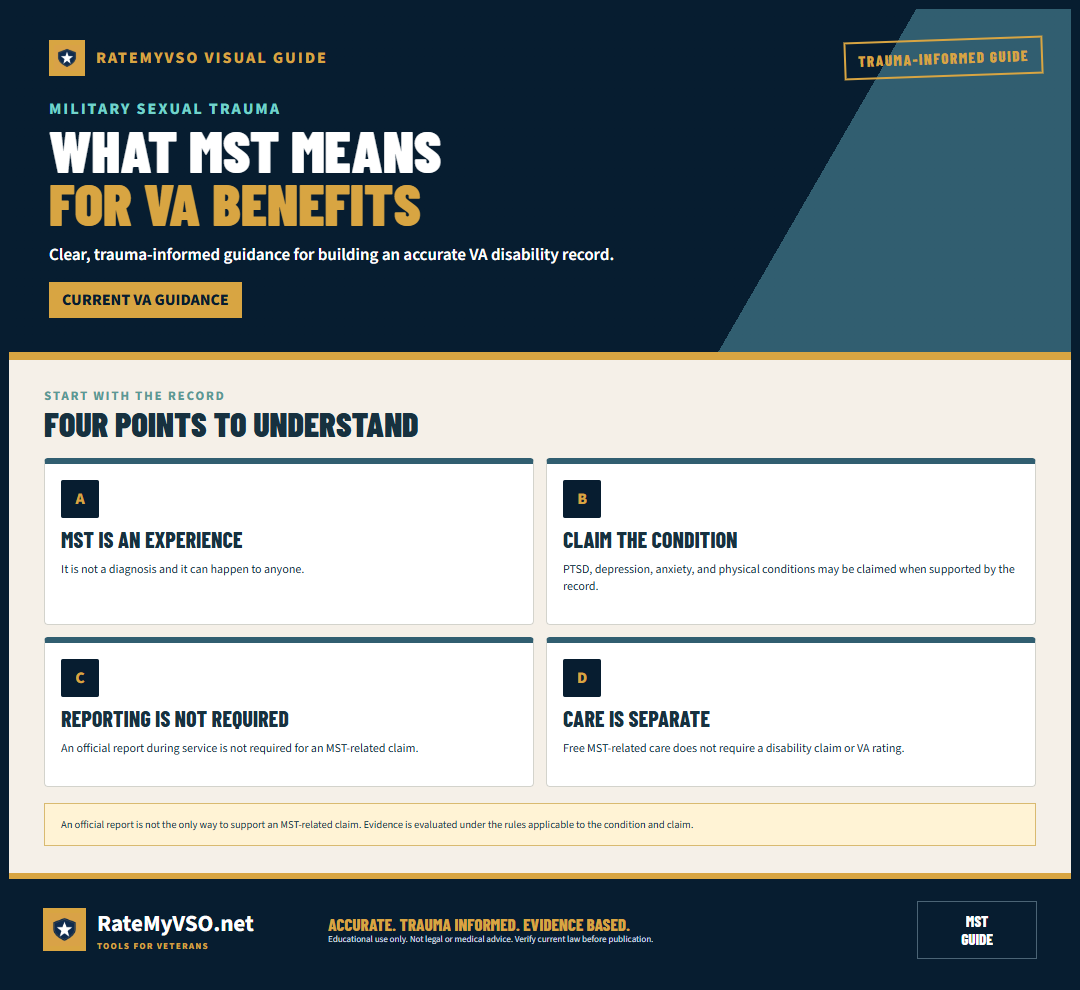 One-page guide: What MST Means for VA Benefits
Explanation that MST is an experience and compensation applies to resulting health conditions. Opens the full-size chart, free to save or print.
One-page guide: What MST Means for VA Benefits
Explanation that MST is an experience and compensation applies to resulting health conditions. Opens the full-size chart, free to save or print.
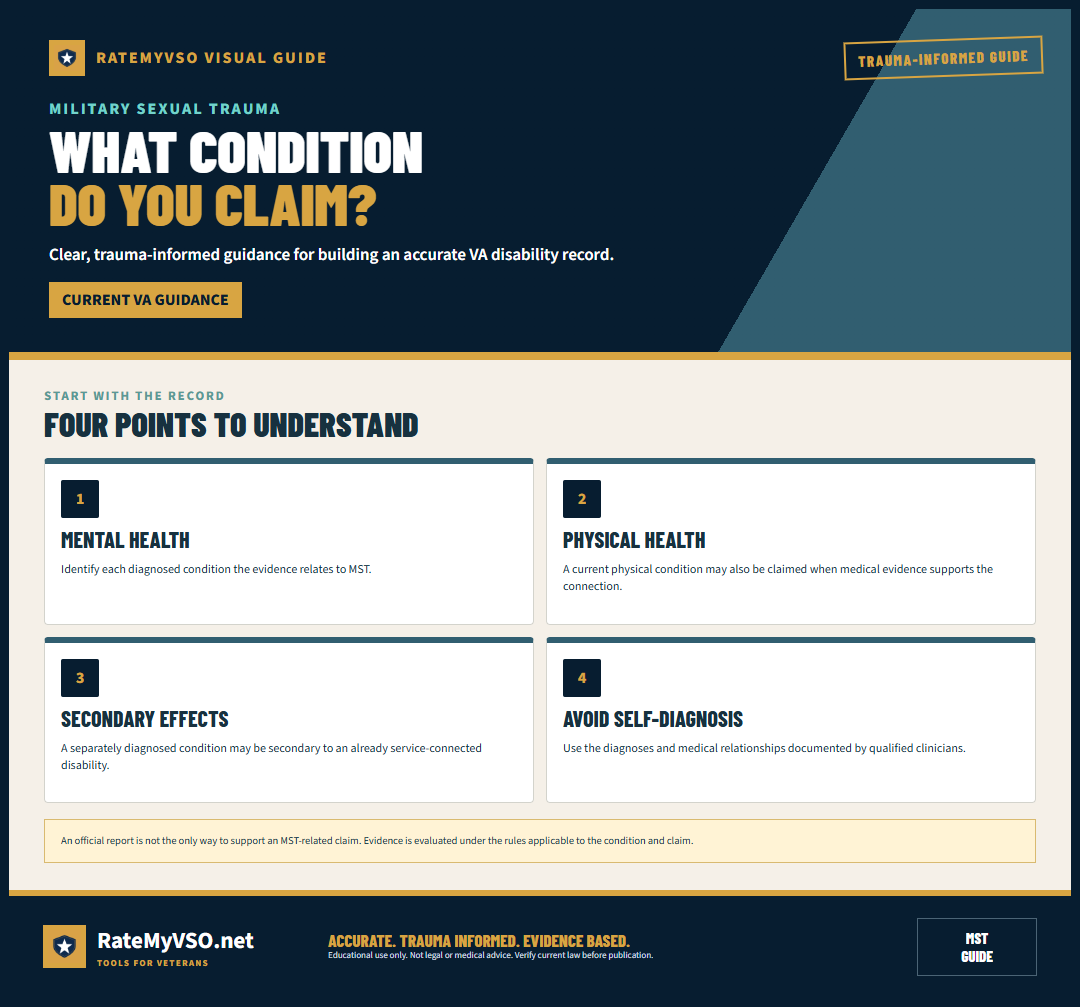 One-page guide: What Condition Do You Claim?
Guide to identifying mental, physical, and secondary conditions related to MST. Opens the full-size chart, free to save or print.
One-page guide: What Condition Do You Claim?
Guide to identifying mental, physical, and secondary conditions related to MST. Opens the full-size chart, free to save or print.
What to Claim on Your Application
This is the most important section. MST itself is not a ratable condition. You must claim a diagnosable condition that was caused by the MST. Here are the conditions to consider:
Primary Conditions (claim one or more)
- PTSD (DC 9411) - the most common MST-related claim. Rated 0-100% based on occupational and social impairment.
- Major Depressive Disorder (DC 9434) - if depression is your primary symptom rather than classic PTSD symptoms.
- Generalized Anxiety Disorder (DC 9400) - chronic anxiety, hypervigilance, difficulty concentrating.
- Other specified trauma disorder (DC 9440) - adjustment disorders related to the trauma.
Exactly What to Write on VA Form 21-526EZ
In Section 1 of the form, under "Disabilities," write:
Cause: Due to military sexual trauma (personal assault) during service
Date of onset: [Month/Year the symptoms began]
If you have multiple conditions (PTSD + depression + anxiety), list each separately with "due to military sexual trauma" as the cause for each. You can also write "PTSD (post-traumatic stress disorder) due to MST" in the VA.gov dropdown. It will accept this.
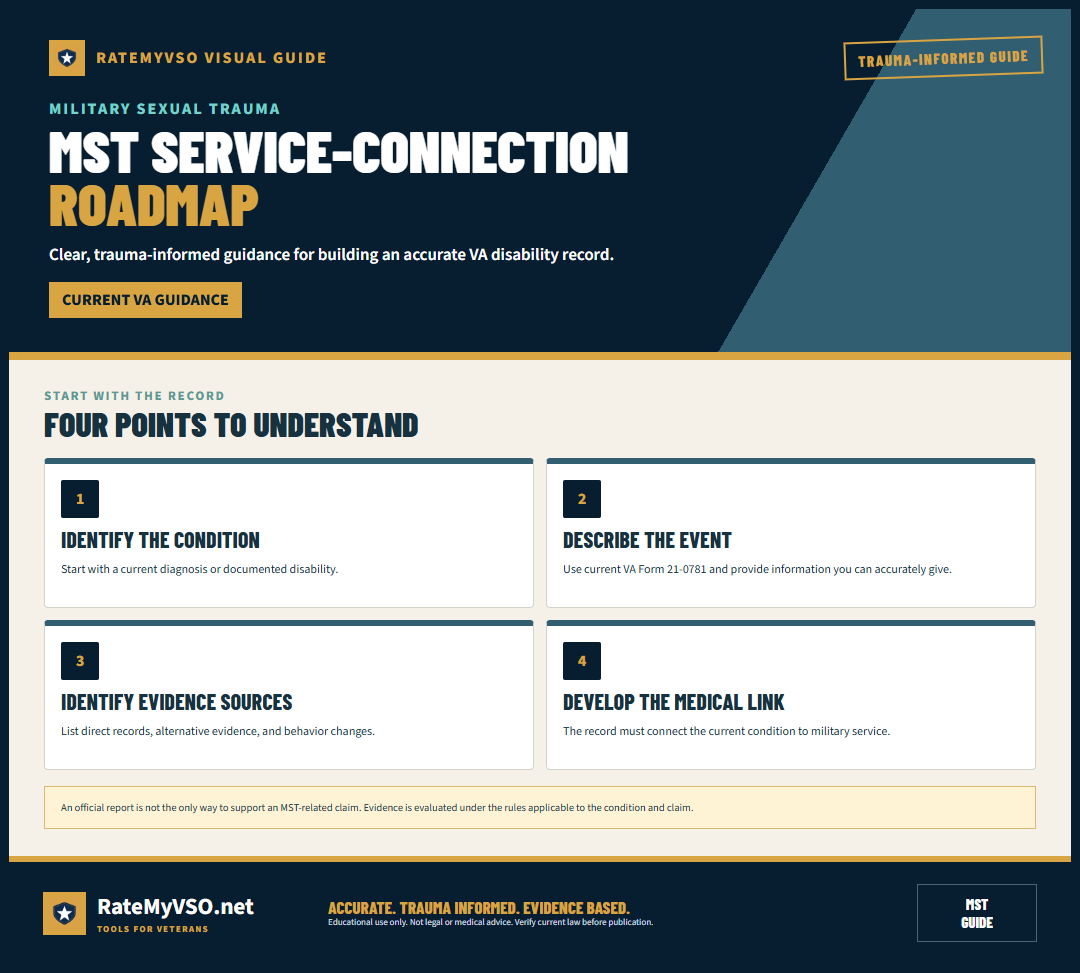
Filing the 21-526EZ: Step by Step
Step 1: File Your Intent to File
Call 1-800-827-1000 or file at VA.gov. This locks in your effective date. Every day you wait is a day of back pay you lose.
Step 2: Complete VA Form 21-526EZ
You can file online at VA.gov or with a VSO representative. On the form:
- List each condition separately (PTSD, depression, etc.)
- For each condition, state "due to military sexual trauma" or "due to personal assault"
- You will be asked to complete VA Form 21-0781, the Statement in Support of Claimed Mental Health Disorder(s) Due to an In-Service Traumatic Event(s). This is where you describe what happened and list your evidence markers.
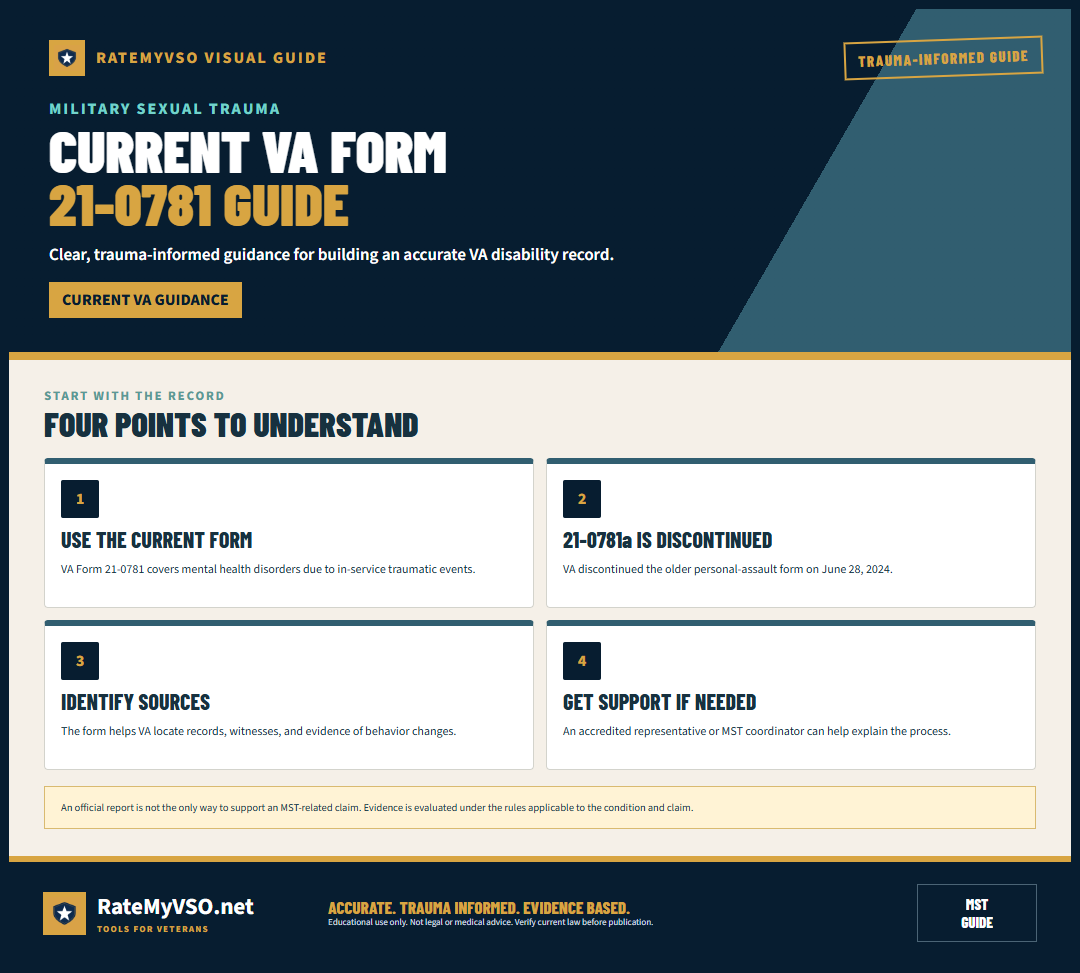 One-page guide: VA Form 21-0781 Guide
Guide to the current VA traumatic-event statement form and the discontinued 21-0781a. Opens the full-size chart, free to save or print.
One-page guide: VA Form 21-0781 Guide
Guide to the current VA traumatic-event statement form and the discontinued 21-0781a. Opens the full-size chart, free to save or print.
Step 3: Submit VA Form 21-0781
This is the critical form for MST claims. It asks you to describe:
- The traumatic event(s), in as much detail as you are comfortable providing
- Behavioral changes after the event (the "markers", see next section)
- Sources of evidence that may corroborate the event
Step 4: Gather Your Evidence
This is where MST claims differ from other claims. See the full list of accepted markers below.
Step 5: Get a Nexus Letter
A private medical opinion (nexus letter) from a psychologist or psychiatrist linking your current diagnosis to the in-service MST is the single strongest piece of evidence.
That reflects a pattern in already-decided appeals (cases with a nexus letter also tend to be stronger overall), not a prediction of your individual outcome.
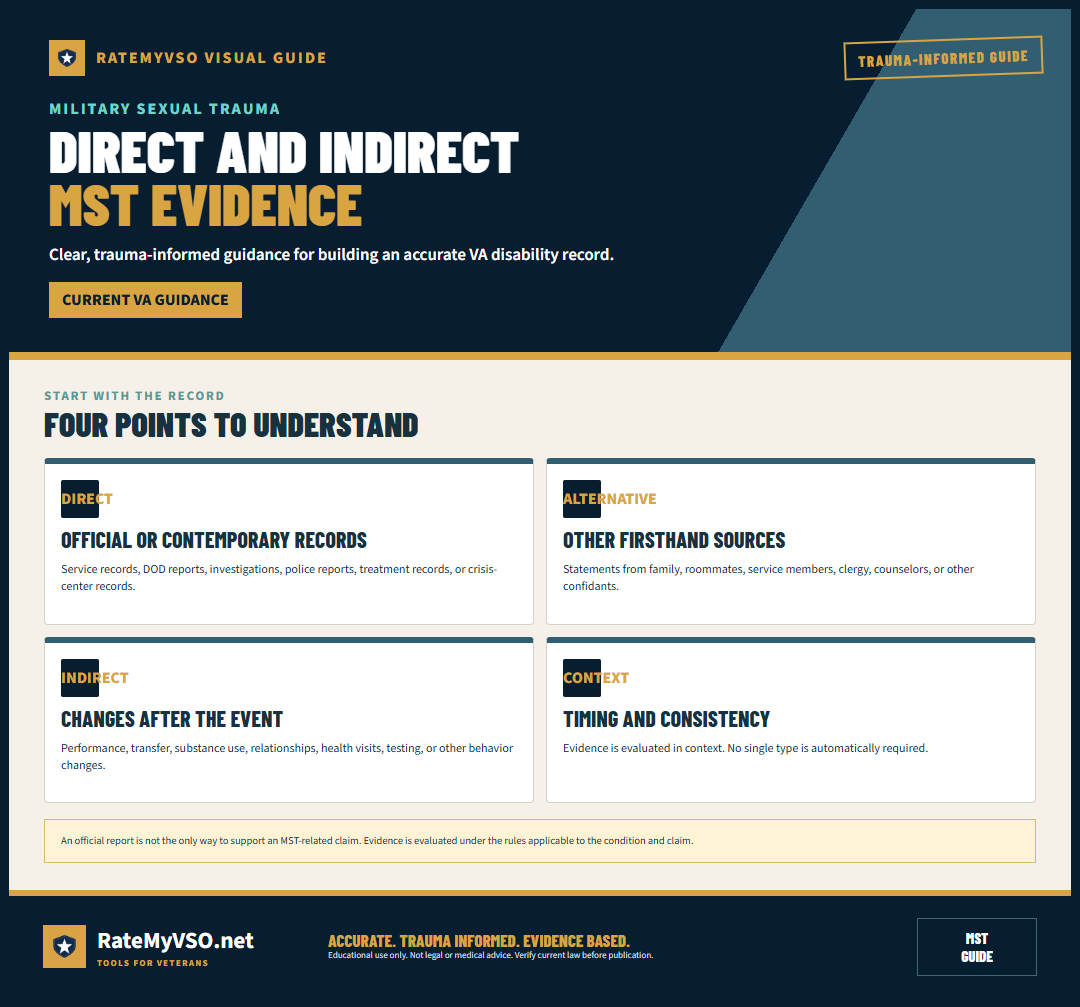 One-page guide: Direct and Indirect MST Evidence
Comparison of direct records, alternative evidence, behavior changes, and contextual evidence. Opens the full-size chart, free to save or print.
One-page guide: Direct and Indirect MST Evidence
Comparison of direct records, alternative evidence, behavior changes, and contextual evidence. Opens the full-size chart, free to save or print.
Accepted Evidence Markers
The VA must consider these behavioral and circumstantial markers as evidence that MST occurred, even without a service record of the event (see 38 CFR § 3.304(f)(5)):
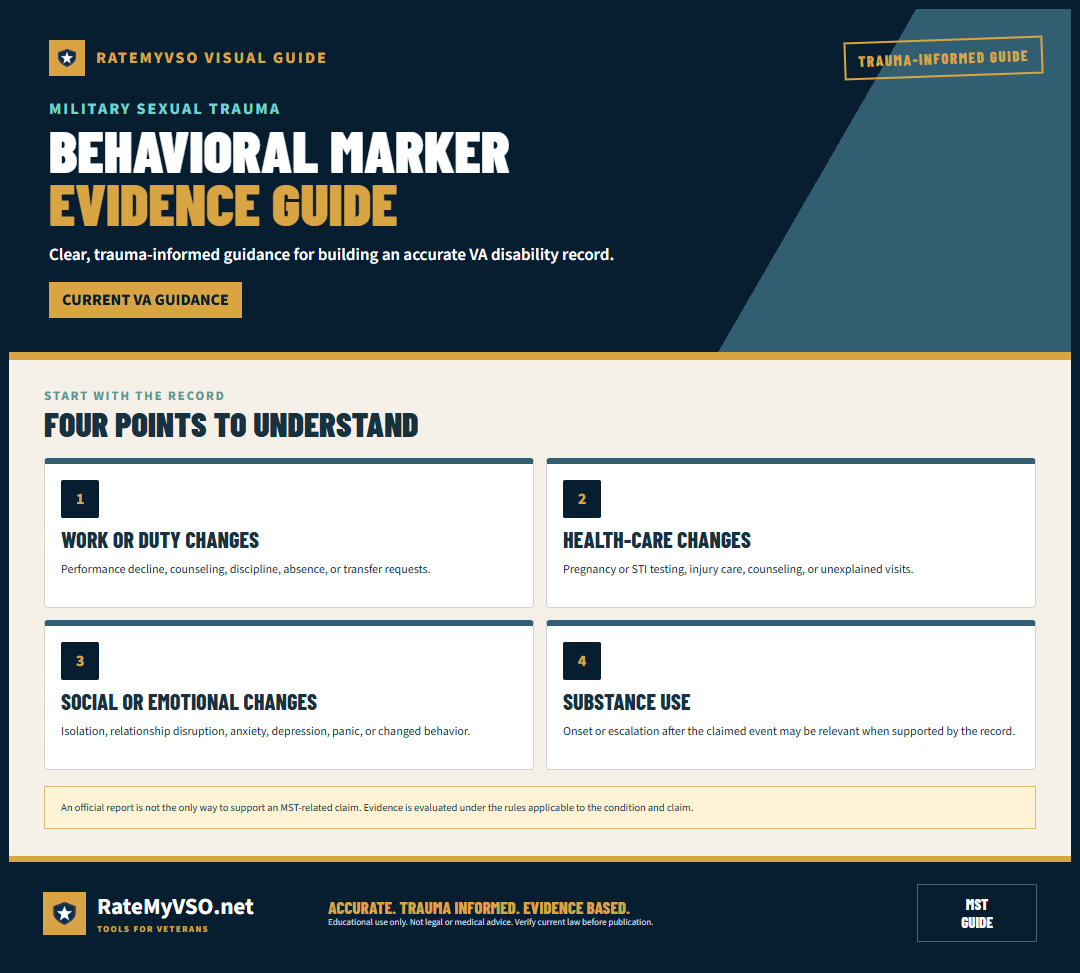
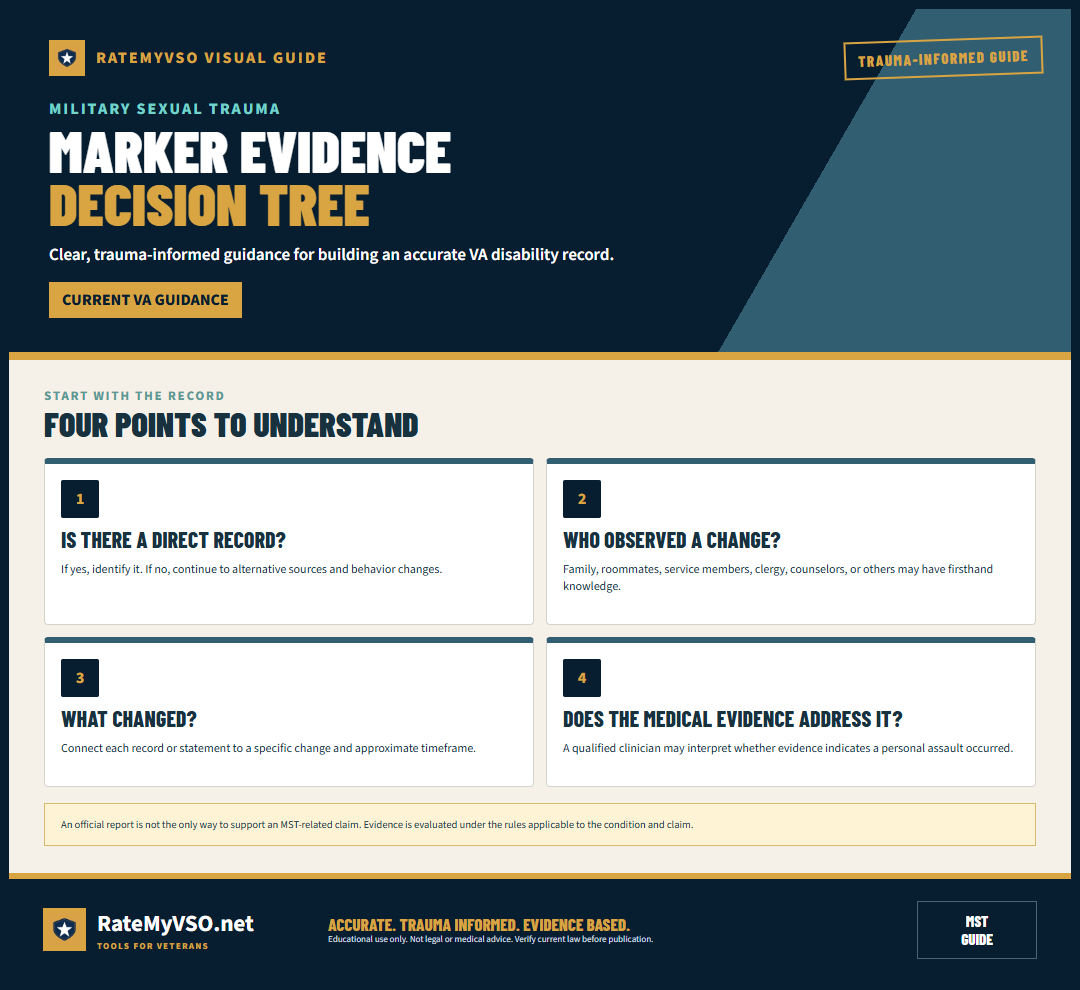
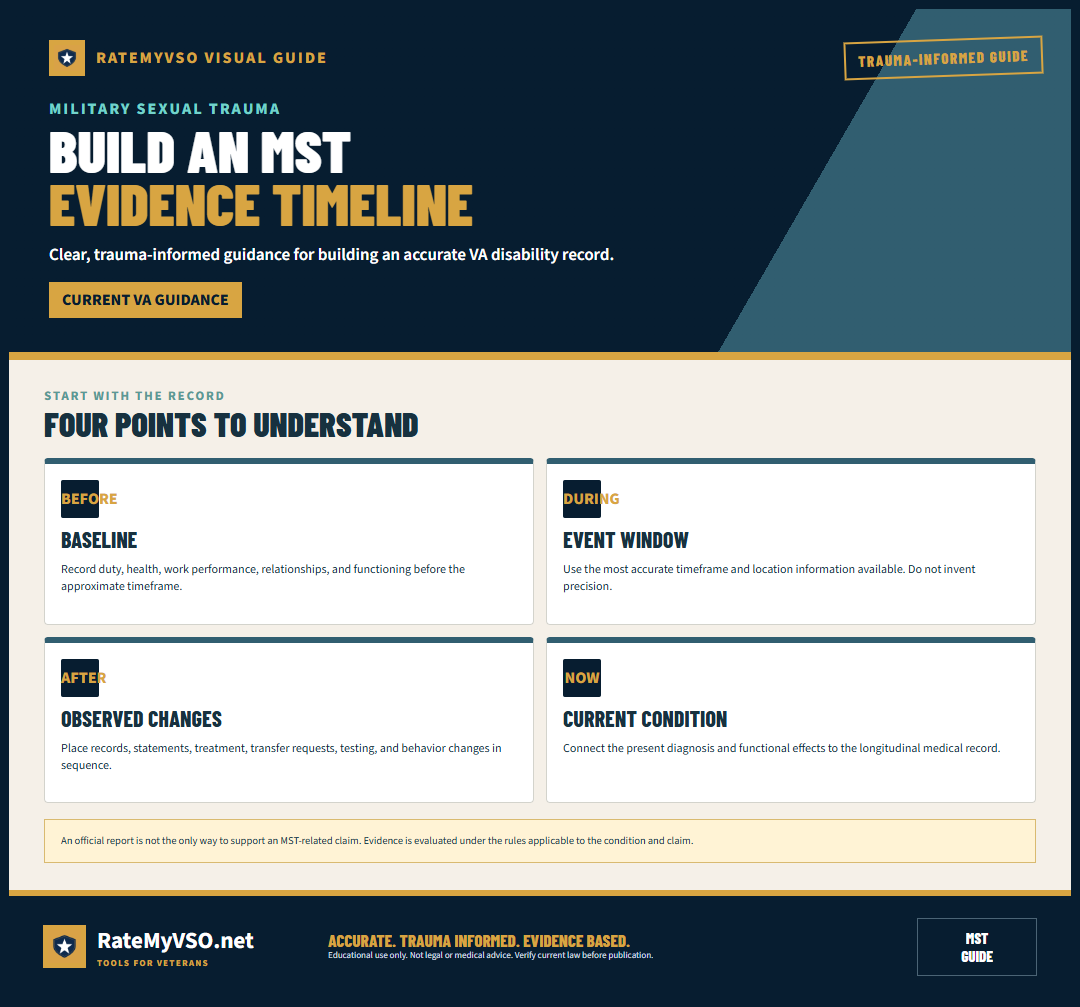
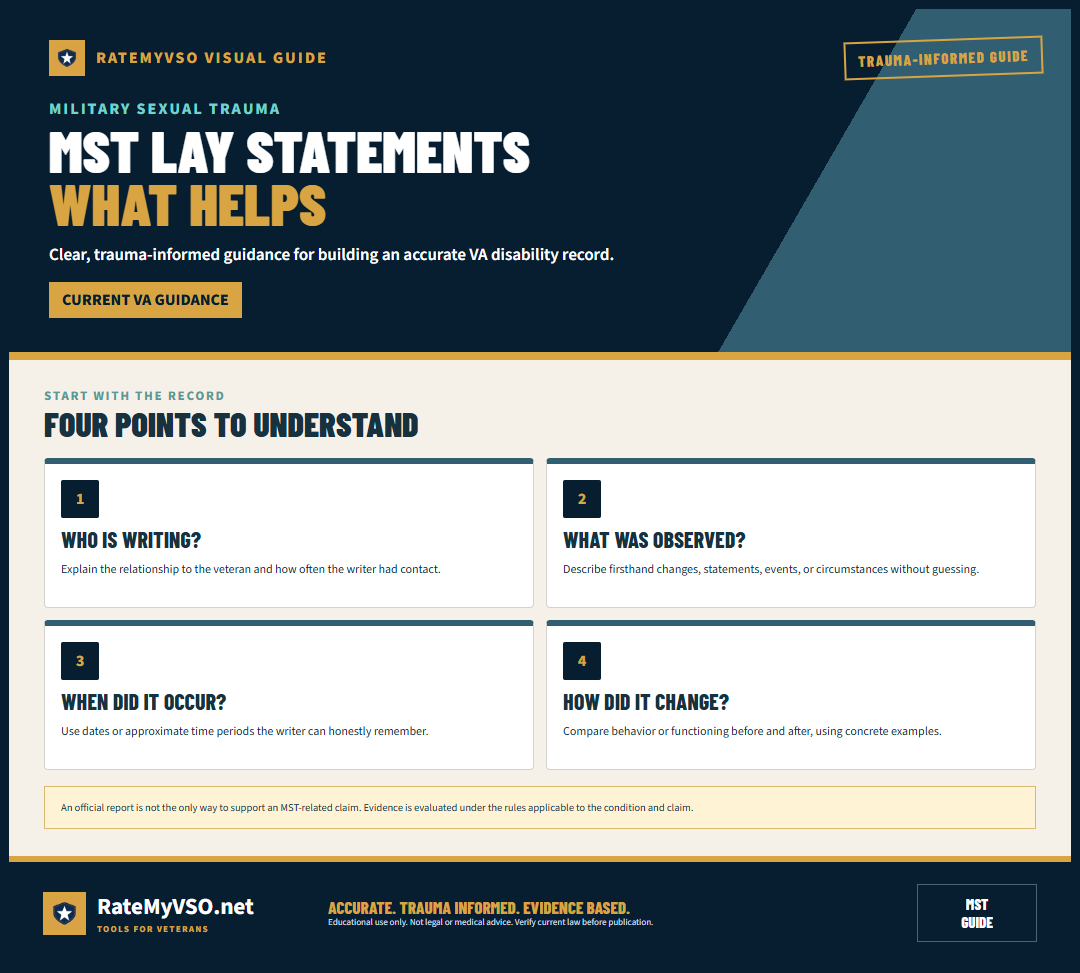 One-page guide: MST Lay Statement Guide
Guide for firsthand lay statements about observed changes and timing. Opens the full-size chart, free to save or print.
One-page guide: MST Lay Statement Guide
Guide for firsthand lay statements about observed changes and timing. Opens the full-size chart, free to save or print.
How to Get Your Records
- Service Personnel Records: Request your complete personnel file from the National Personnel Records Center (SF-180 form). Look for performance evaluations, counseling statements, and any changes around the time of the trauma.
- Service Treatment Records: Request from NPRC. Look for mental health visits, STI tests, pregnancy tests, or any medical visits around the timeframe.
- Buddy Statements: Ask anyone who observed behavioral changes (spouse, roommate, fellow service member, family member) to write a statement describing what they noticed and when.
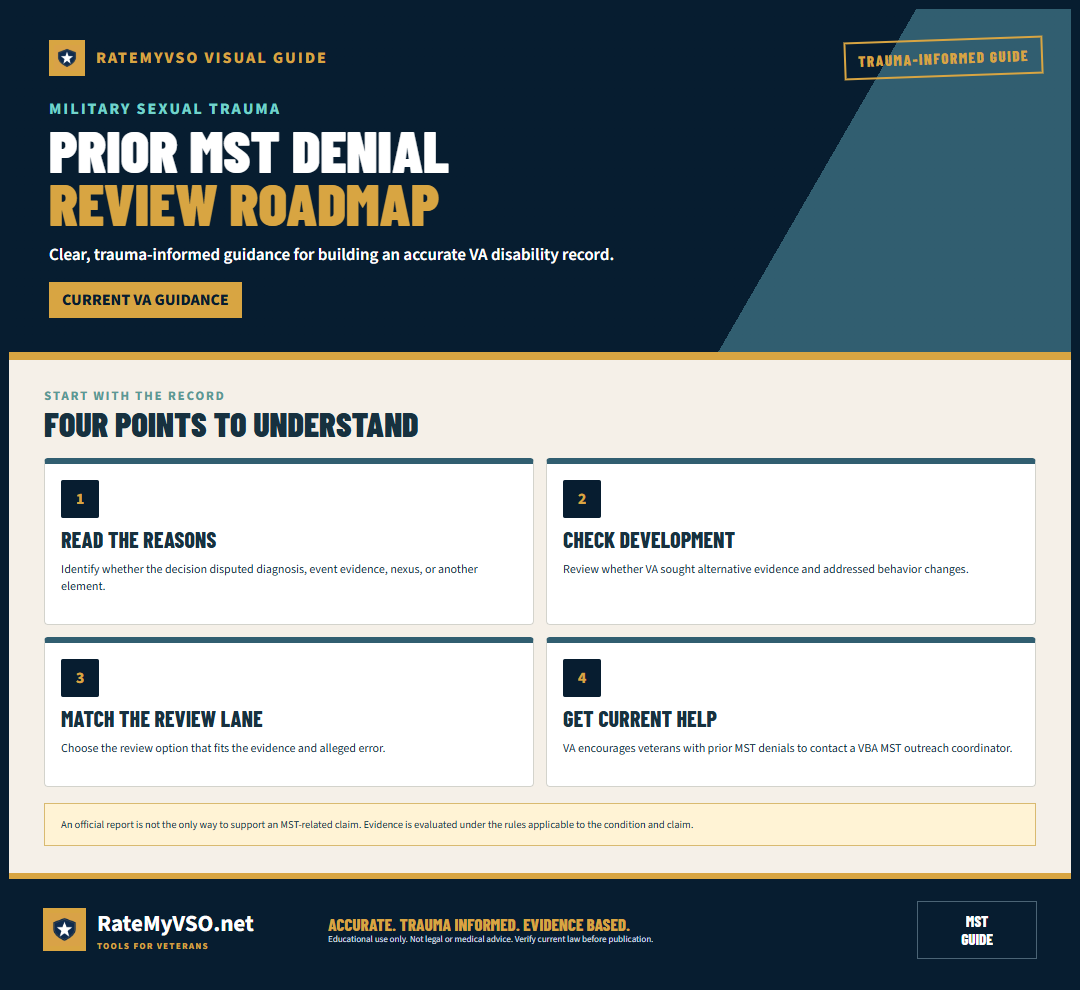 One-page guide: Prior MST Denial Review Roadmap
Four-step roadmap for reviewing a prior MST-related denial. Opens the full-size chart, free to save or print.
One-page guide: Prior MST Denial Review Roadmap
Four-step roadmap for reviewing a prior MST-related denial. Opens the full-size chart, free to save or print.
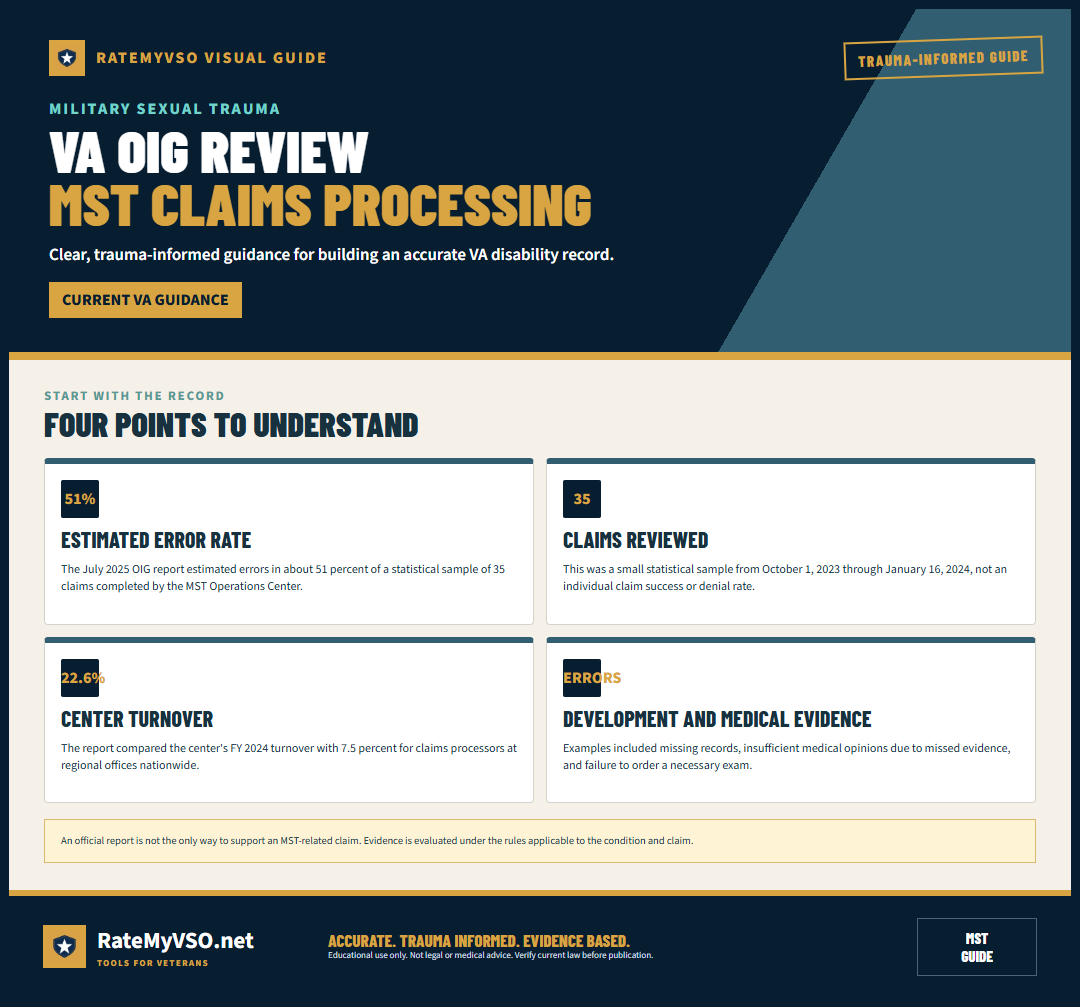 One-page guide: VA OIG MST Claims Processing Review
Summary of the July 2025 VA OIG review of MST Operations Center claims processing. Opens the full-size chart, free to save or print.
One-page guide: VA OIG MST Claims Processing Review
Summary of the July 2025 VA OIG review of MST Operations Center claims processing. Opens the full-size chart, free to save or print.
The 51% Error Rate
A VA Office of Inspector General audit (October 2023 - January 2024) found that 51% of MST claims were processed incorrectly.
Key findings:
- 46% of denied MST claims were denied without the VA ordering a required C&P exam
- The centralized MST Operations Center has 22.6% staff turnover (vs 7.5% VA-wide)
- Many claims processors lacked specialized MST training
The overall MST claim grant rate is 63%, up from 40% a decade ago. This means the system is improving, but errors remain common. Having strong evidence and a VSO representative significantly improves your chances.
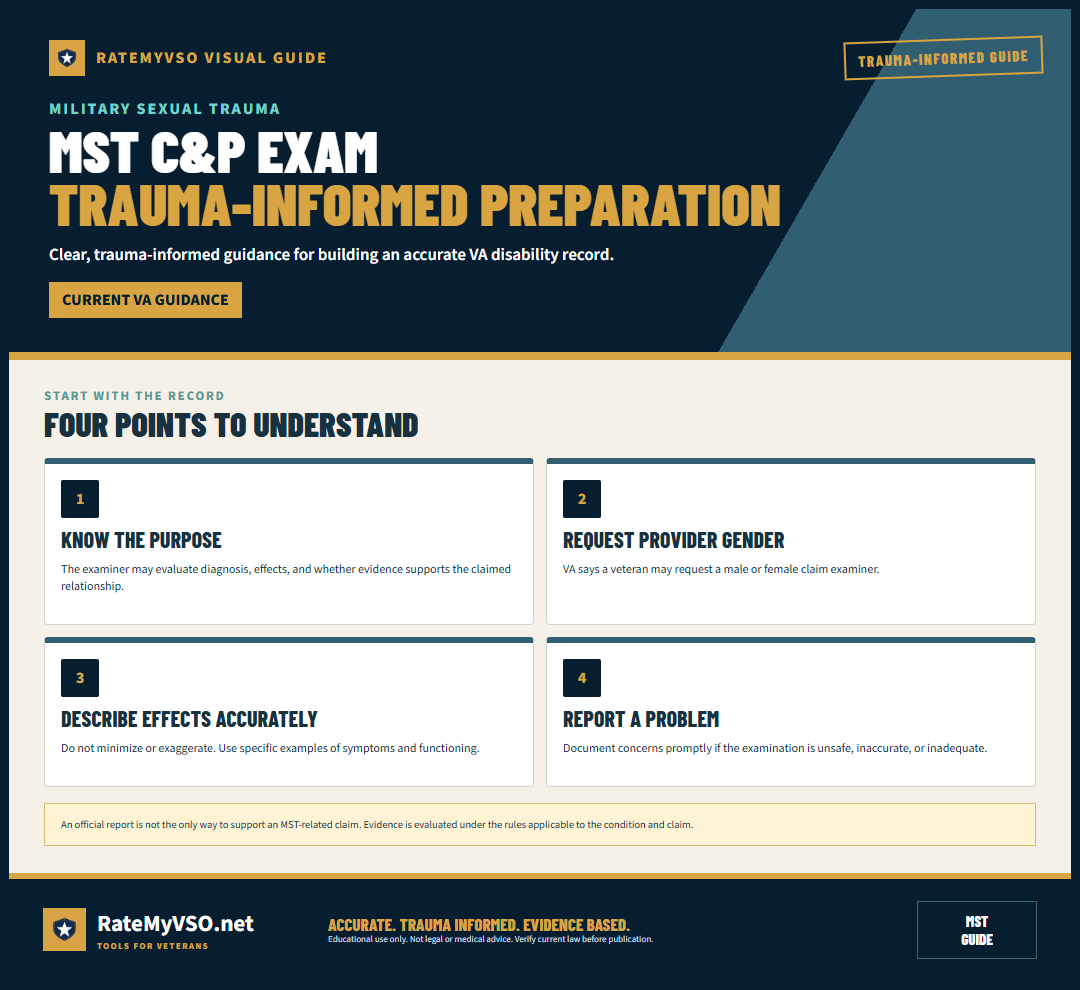 One-page guide: MST C&P Exam Guide
Trauma-informed preparation guide for an MST-related claim examination. Opens the full-size chart, free to save or print.
One-page guide: MST C&P Exam Guide
Trauma-informed preparation guide for an MST-related claim examination. Opens the full-size chart, free to save or print.
Your Rights at the C&P Exam
If the VA orders a Compensation & Pension exam for your MST claim, know these rights:
- You can request the gender of your examiner. If you are more comfortable with a female or male examiner, tell the VA when scheduling. This is your right.
- You can bring a support person - a friend, family member, VSO representative, or victim advocate can accompany you.
- You do not have to describe the assault in graphic detail to the examiner. A factual summary is sufficient. The examiner is assessing your current symptoms, not investigating the event.
- Describe your worst days. The examiner rates your current level of impairment. Be honest about how bad it gets: frequency of nightmares, panic attacks, difficulty working, relationship problems.
- If the examiner seems dismissive or uninformed about MST, document this and report it to your VSO representative. You can request a new exam.
Secondary Conditions to Consider
MST can cause or worsen conditions beyond PTSD. Consider filing for these as secondary to your MST-related primary diagnosis:
- Sleep disorders - insomnia, nightmares, sleep apnea (secondary to PTSD)
- Migraines - chronic headaches secondary to PTSD/anxiety
- Eating disorders - anorexia, bulimia (separately ratable)
- Substance use disorders - secondary to PTSD/depression
- Fibromyalgia - research links trauma to central sensitization
- Sexual dysfunction - directly related to MST
- Irritable Bowel Syndrome (IBS) - stress-related gastrointestinal conditions
- TMJ / teeth grinding - stress and anxiety-related
Each secondary condition requires a nexus letter from a medical provider linking it to your primary MST-related diagnosis. Use our Secondary Conditions tool →
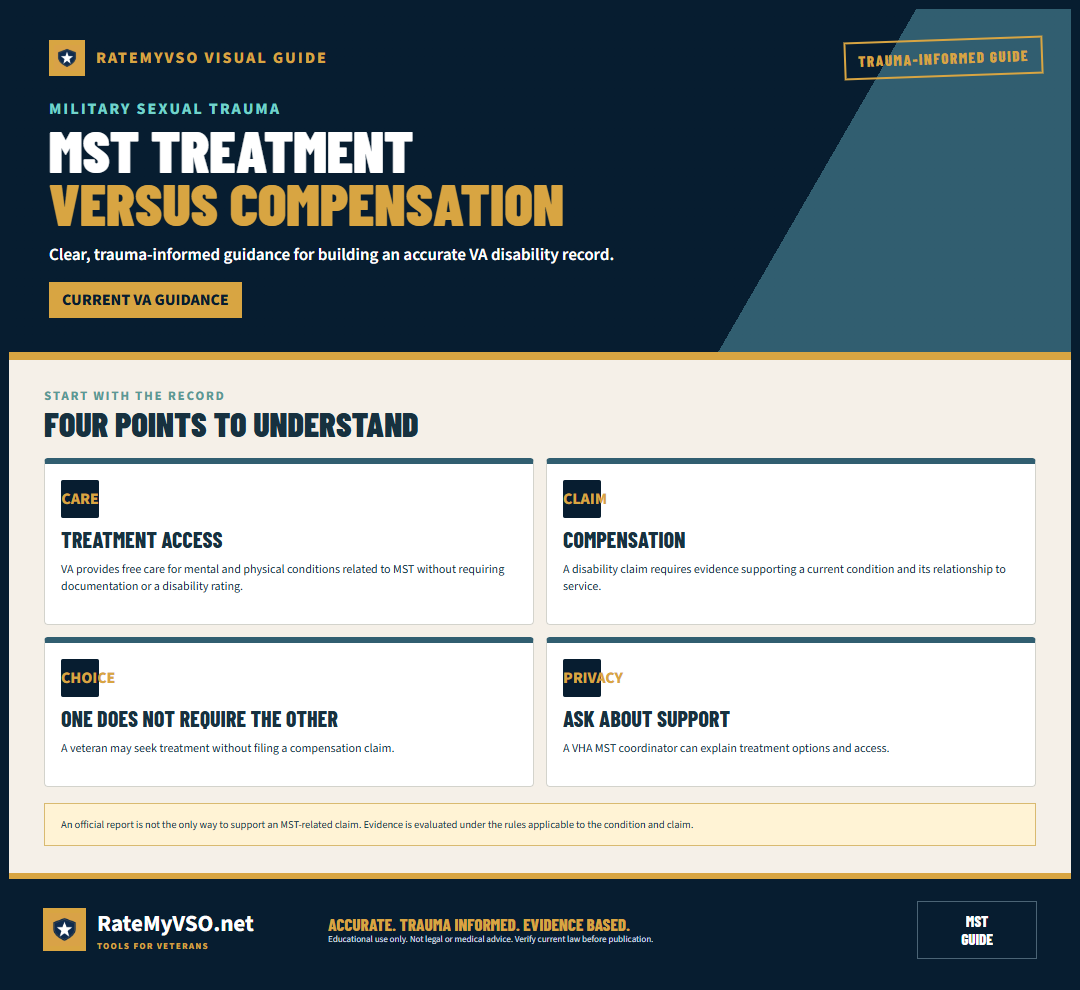 One-page guide: MST Treatment vs Compensation
Comparison of free MST-related treatment and disability compensation requirements. Opens the full-size chart, free to save or print.
One-page guide: MST Treatment vs Compensation
Comparison of free MST-related treatment and disability compensation requirements. Opens the full-size chart, free to save or print.
Free MST Treatment
MST-related treatment is free for veterans and for most former service members with an Other Than Honorable or uncharacterized (entry-level) discharge. It does not cover a dishonorable discharge. Former Guard and Reserve members need federal active duty service or a service-connected disability. It is available regardless of:
- Whether you have a service-connected disability rating
- Whether you are enrolled in VA healthcare
- Whether you reported the MST during service
- Your gender
You do not need to provide documentation that MST occurred to receive free treatment. Simply tell the VA you experienced MST and they must provide care.
If your discharge characterization was influenced by MST: the Kurta memo (2017) directs the Discharge Review Board and BCMR to apply liberal consideration to upgrade applications connected to MST. See the record-corrections guide for the DRB / BCMR / DARB paths.
Types of Treatment Available
- Individual therapy - including Cognitive Processing Therapy (CPT) and Prolonged Exposure (PE)
- Group therapy - MST-specific support groups
- Medication management - for depression, anxiety, sleep, nightmares
- Residential/inpatient programs - intensive treatment programs for MST survivors
- Vet Center counseling - confidential counseling in non-clinical community settings
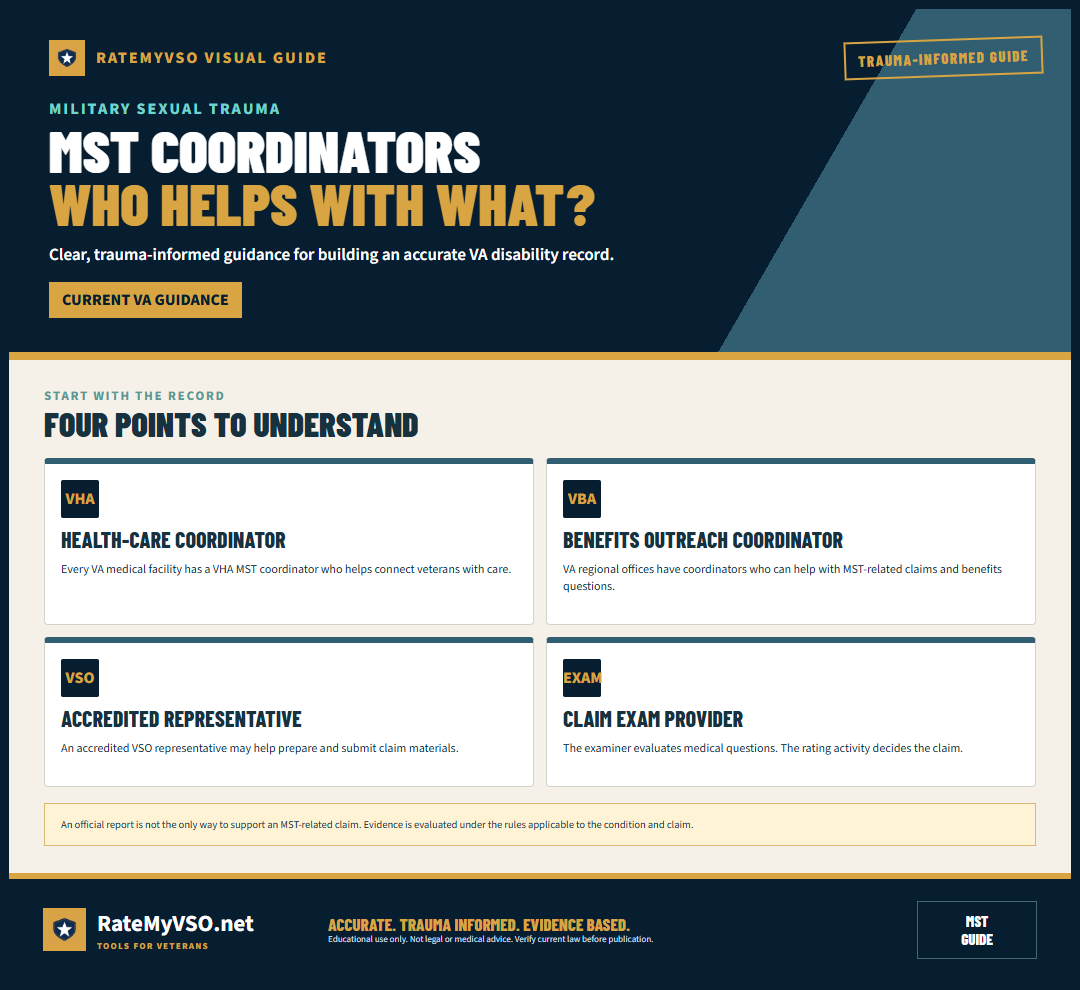 One-page guide: MST Coordinators and Support Roles
Roles of VHA and VBA MST coordinators, accredited representatives, and claim examiners. Opens the full-size chart, free to save or print.
One-page guide: MST Coordinators and Support Roles
Roles of VHA and VBA MST coordinators, accredited representatives, and claim examiners. Opens the full-size chart, free to save or print.
MST Coordinators
Every VA medical center has a designated MST Coordinator who can connect you with treatment, answer questions, and help you work through the system. Ask at the front desk or call your local VA medical center.
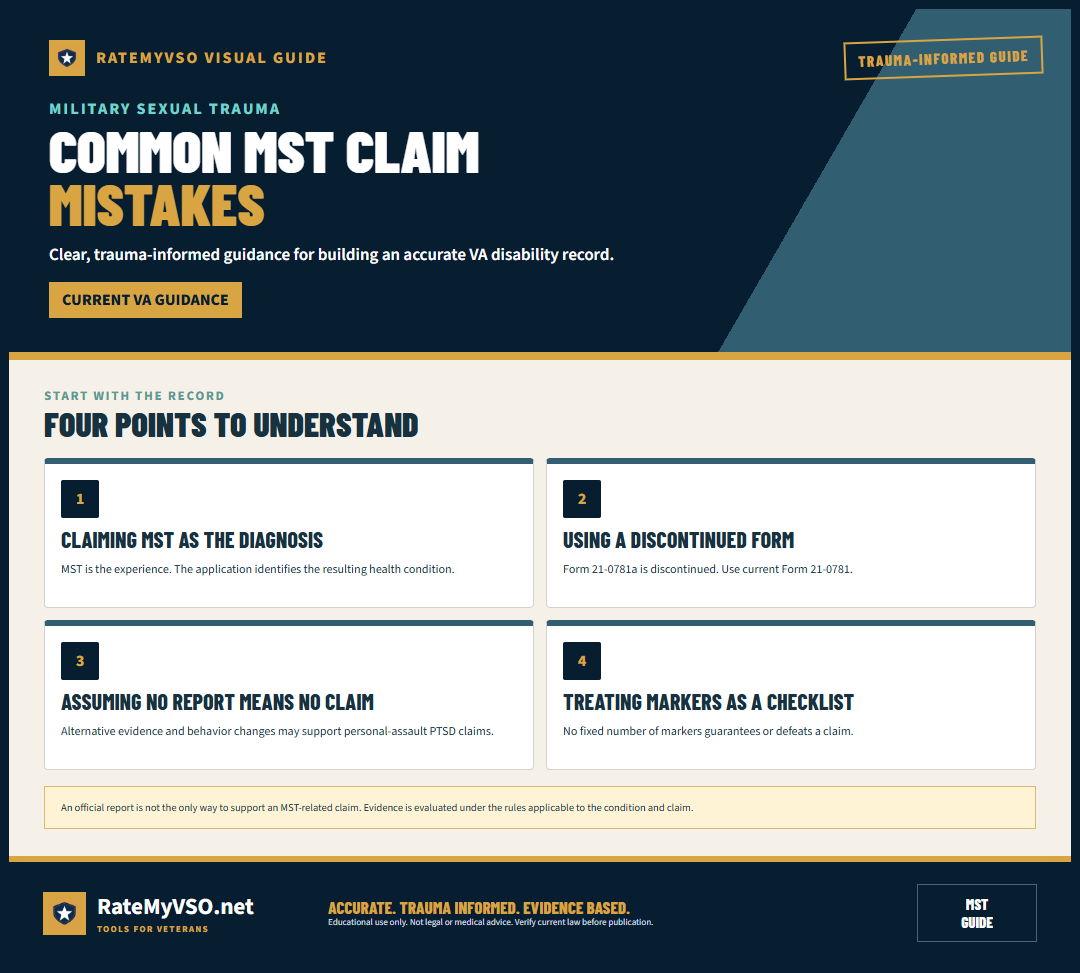 One-page guide: Common MST Claim Mistakes
Common mistakes involving diagnosis labels, obsolete forms, reporting, and marker evidence. Opens the full-size chart, free to save or print.
One-page guide: Common MST Claim Mistakes
Common mistakes involving diagnosis labels, obsolete forms, reporting, and marker evidence. Opens the full-size chart, free to save or print.
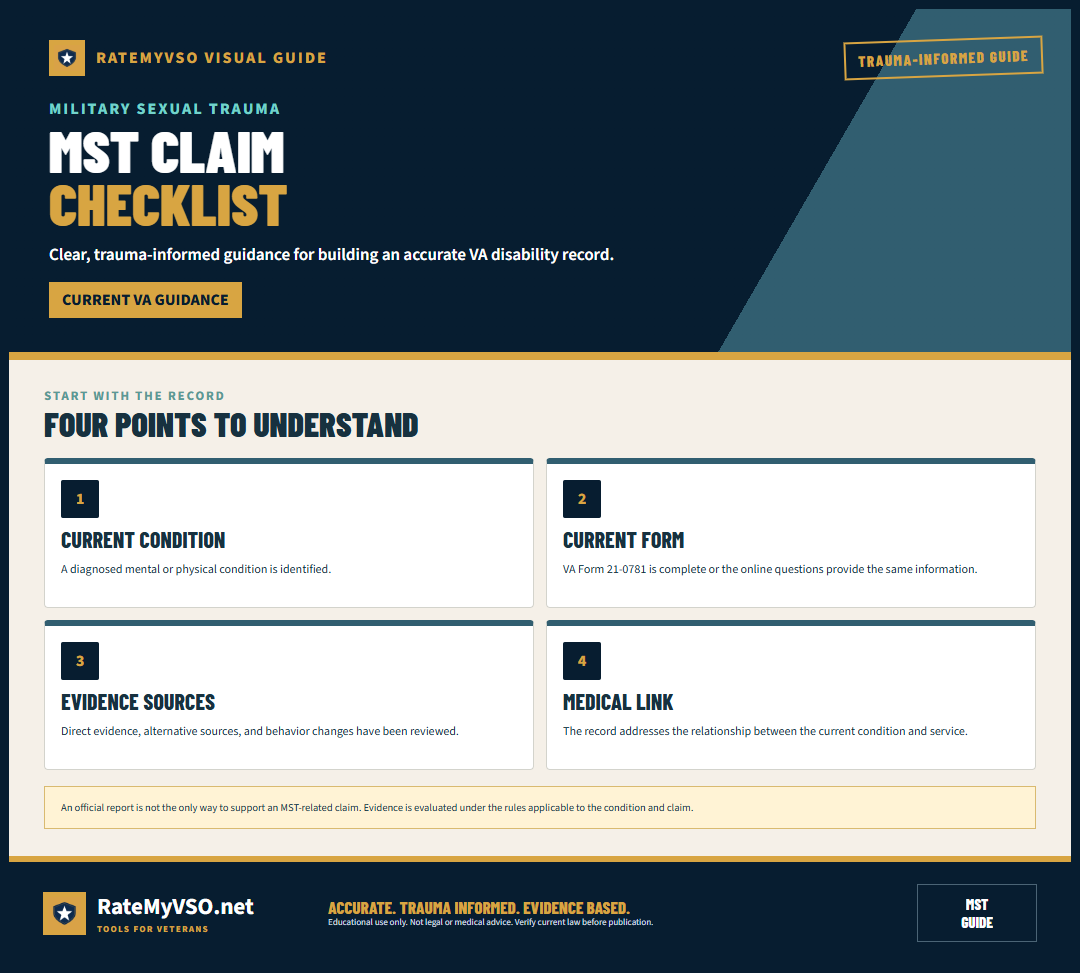 One-page guide: MST Claim Checklist
Four-part completeness check for an MST-related claim record. Opens the full-size chart, free to save or print.
One-page guide: MST Claim Checklist
Four-part completeness check for an MST-related claim record. Opens the full-size chart, free to save or print.
Resources
Veterans Crisis Line
Call, text, or chat 24/7 · Confidential
- Vet Center Confidential Call Center: 877-927-8387 - 24/7, MST counseling in non-clinical settings
- VA Health Benefits Hotline: 877-222-8387
- VA MST Information: va.gov/health-care/health-needs-conditions/military-sexual-trauma
- Vet Center Locator: vetcenter.va.gov
- Find a VSO Representative: Search 18,600+ accredited reps →
- RAINN National Sexual Assault Hotline: 800-656-4673
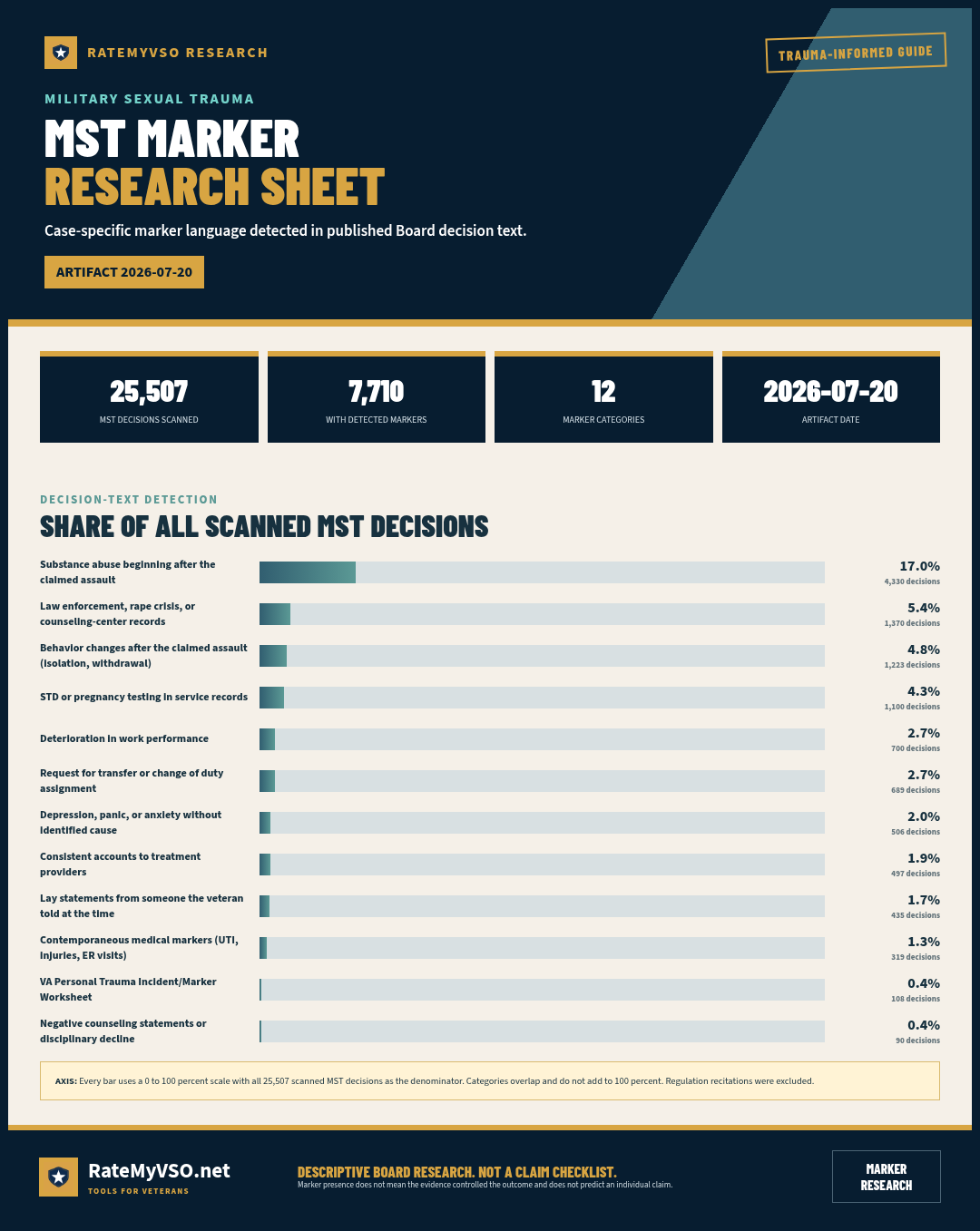 One-page guide: MST Marker Research Sheet
Frequency of twelve case-specific marker categories across 25,800 scanned MST Board decisions, 7,788 of which carried at least one marker. Opens the full-size chart, free to save or print.
One-page guide: MST Marker Research Sheet
Frequency of twelve case-specific marker categories across 25,800 scanned MST Board decisions, 7,788 of which carried at least one marker. Opens the full-size chart, free to save or print.
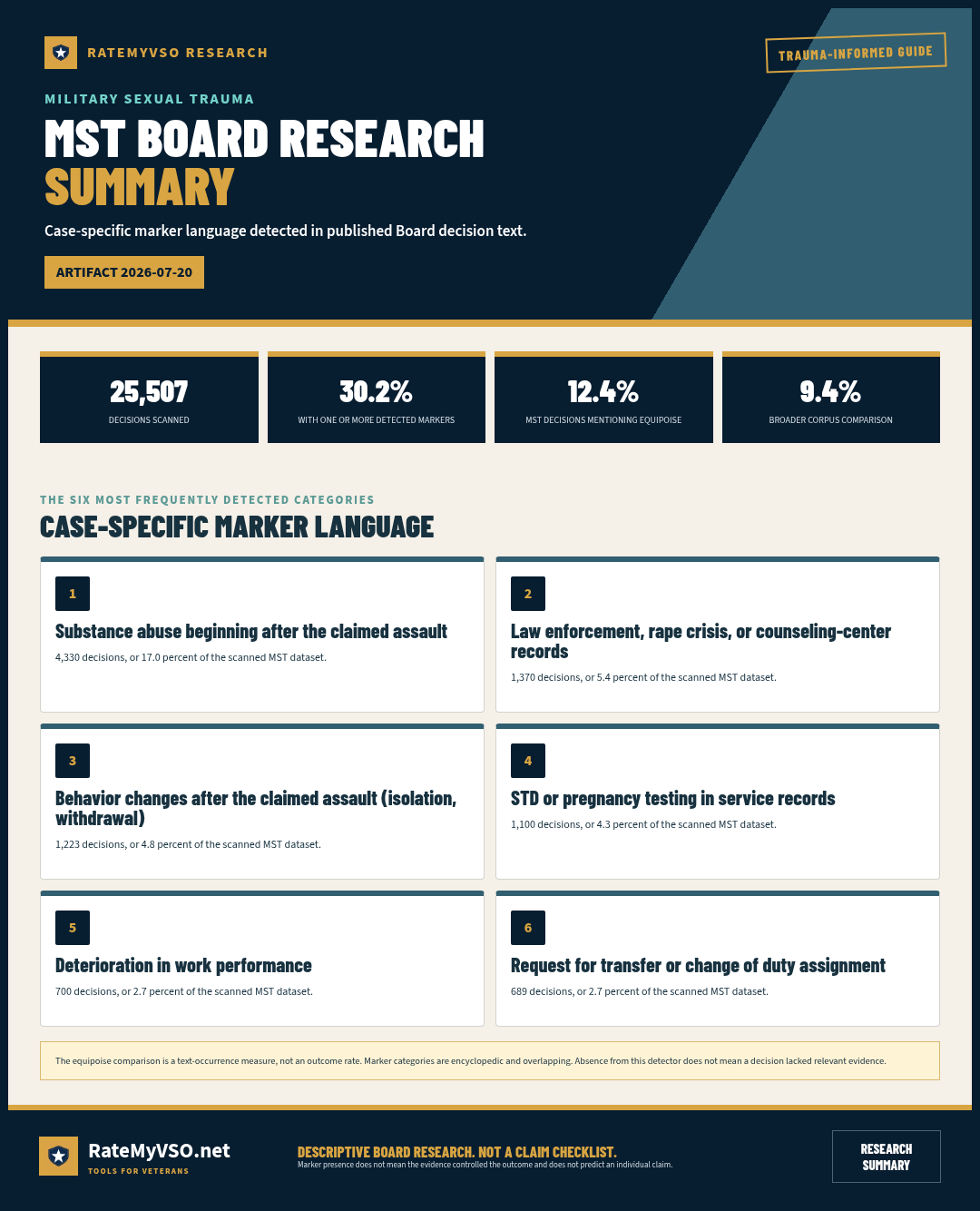 One-page guide: MST Board Research Summary
Summary of marker coverage and equipoise language across 25,800 scanned MST Board decisions. Opens the full-size chart, free to save or print.
One-page guide: MST Board Research Summary
Summary of marker coverage and equipoise language across 25,800 scanned MST Board decisions. Opens the full-size chart, free to save or print.
Related Tools and Guides
Sources: 38 CFR § 3.304(f)(5) · VA MST and Disability Compensation · VA OIG Denied MST Claims Report · VA News: MST Grant Rate Increase · RateMyVSO BVA analysis of 1,897,000+ appeal decisions. This guide is for educational purposes only and is not legal or medical advice. Find a VSO representative for personalized guidance.